Water Storage Tank & Reservoir Maintenance — AI Inspection Scheduling & Coating Management
By Grace on June 19, 2026
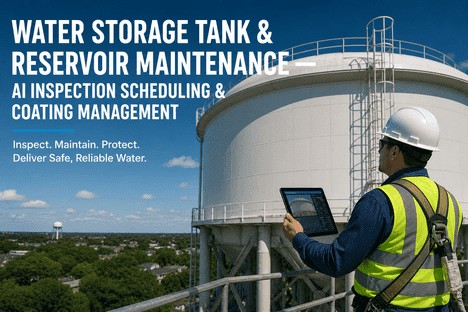
Every water utility operates a portfolio of storage assets it cannot afford to replace — elevated steel tanks built to AWWA D100, prestressed concrete reservoirs built to AWWA D110, and ground-level storage vessels of various ages, coating histories, and structural conditions. For the maintenance manager, each tank represents a recurring tension: the inspection schedule says it is due, but the budget says defer. The coating is visibly degrading, but a full recoat means weeks of outage. The last sanitary survey flagged a vulnerable hatch seal, but the repair crew is already stretched across three other sites. What makes water storage tank management structurally different from pipeline or pump station maintenance is that the consequences of deferral are invisible until they become critical — a coating failure that accelerates substrate corrosion, a sediment layer that harbours biofilm and drives chloramine decay, a cracked concrete wall that loses prestressing force slowly over years. The maintenance manager who shifts from a reactive inspection-and-repair model to an AI-driven condition-based programme does not just extend tank life. They eliminate the uncertainty that makes every budget request feel like a guess.
AI Condition Assessment · Coating Lifecycle Tracking · Drone & ROV Integration · AWWA Compliance Records
The Tanks You Defer Maintenance on Today Will Cost Three Times More to Rehabilitate Next Year. AI-Driven Condition Monitoring Eliminates the Deferral Cycle.
iFactory gives maintenance managers a single platform for storage tank condition tracking, inspection scheduling, coating lifecycle management, and AWWA-compliant documentation — with AI-powered anomaly detection that flags coating defects and structural changes before they become emergency repairs.
Saved per tank inspection when drone-based condition assessment replaces traditional confined-space entry methods — documented across municipal water utility programmes
80%
Reduction in long-term maintenance expenditure when protective coating systems are maintained proactively compared to uncoated or deferred-recoat steel tanks
3–5
Years between comprehensive interior-exterior inspections per AWWA guidance — yet coating condition can degrade 60% faster when inspection intervals are missed
30
Years of coating service life achievable for interior lining systems when specified and maintained per AWWA D102 — with AI condition tracking extending the reliable assessment interval
The Tank Lifecycle — From Inspection to Recoat, the Five Stages Every Maintenance Manager Must Control
Every water storage tank passes through five distinct stages that define its condition trajectory. The maintenance manager who understands where each tank sits on this lifecycle can allocate inspection resources, plan coating interventions, and budget capital expenditure with confidence. The manager who does not is perpetually responding to the most recent complaint, observation, or regulatory finding — always behind the condition curve.
01
Condition Assessment — Interior and Exterior
The foundation stage. Every tank needs a documented baseline — dry film thickness readings for coatings, substrate condition for steel and concrete, hatch and vent integrity, cathodic protection status where installed. AI-enhanced assessment using drone-mounted cameras and ultrasonic sensors captures 100% surface coverage instead of spot-check sampling, creating a condition baseline that the maintenance manager can reference across every subsequent inspection cycle.
02
Cleaning and Disinfection
Sediment accumulation, biofilm development, and inorganic deposits compromise water quality and accelerate coating degradation underneath the deposit layer. AWWA C652 governs disinfection procedures after every interior cleaning. AI scheduling systems track days since last cleaning against sediment accumulation rates modelled from raw water turbidity and tank turnover patterns — so the maintenance manager schedules cleaning based on condition, not an arbitrary calendar window.
03
Coating Condition Evaluation
The coating system is the primary barrier between the steel or concrete substrate and the stored water. AWWA D102 classifies seven exterior and six interior coating systems with widely varying service life projections — from 7 years for basic field-applied systems to 30 years for high-performance epoxy and fluoropolymer systems. AI-powered image analysis quantifies coating degradation by percentage, categorises failure modes (blistering, delamination, rust bleeding, pinhole corrosion), and projects the remaining service window before recoat is mandatory.
04
Spot Repair and Selective Recoat
Not every coating defect requires a full recoat. Localised failure in the roof soffit, at plate seams, or around hatch openings can be addressed through spot repair extending the overall coating system's service life by 3 to 7 years. The maintenance manager needs a triage framework that distinguishes between cosmetic degradation and structural coating failure. AI defect classification provides this triage automatically — ranking each defect by severity, location, and risk to water quality or substrate integrity.
05
Full Recoating or Rehabilitative Lining
When coating degradation exceeds 30% of the interior surface area, or when substrate corrosion has initiated, a full recoat is required. This is the highest-cost and longest-duration stage — a typical 1.5 MG elevated steel tank recoat costs between $150,000 and $350,000 and requires 4 to 8 weeks of outage depending on surface preparation requirements and coating cure time. AI-based lifecycle forecasting gives the maintenance manager 12 to 24 months of advance notice that a recoat is approaching, enabling budgeting, contractor bidding, and outage planning without crisis pressure.
Traditional vs AI-Driven Tank Maintenance — What Changes for the Maintenance Manager
The difference between a calendar-based and a condition-based tank programme is not incremental. It is a structural change in how the maintenance manager allocates time, budget, and crew resources across a portfolio that may span 20, 50, or 100 storage assets. The table below maps the practical difference at each stage of the tank lifecycle.
Lifecycle Stage
Traditional Approach
AI-Driven Approach
Inspection scheduling
Fixed 3-year or 5-year calendar cycle regardless of tank condition, coating type, or water quality impact
Risk-based schedule prioritising tanks with oldest coatings, highest sediment accumulation rates, or recent structural observations
Interior inspection method
Confined-space entry with scaffolding and full PPE — limited to spot-check samples of coating condition and sediment depth
Drone or ROV deployment with 4K visual, thermal, and ultrasonic sensors — 100% surface coverage with AI defect detection
Coating condition data
Qualitative inspector notes — visual estimate of degradation percentage with inspector-dependent variability
Quantified degradation map with AI-classified defect types, severity scoring, and year-over-year change detection
Recoat decision trigger
Visible coating failure, water quality complaint, or regulatory finding — reactive and often urgent
AI-projected end-of-service-life forecast with 12–24 month advance notice — enabling planned budget and outage cycles
Compliance documentation
Paper inspection reports filed by tank — difficult to aggregate across the portfolio for audit or capital planning
Digital condition records for every tank with AWWA-standard categorisation, searchable by date, coating type, and defect severity
Budget forecasting
Based on historical spend per tank with no condition data — reactive budget requests after inspection findings
Data-driven 10-year capital plan with projected recoat years and costs per tank, updated after each inspection cycle
AI Inspection Intelligence — Three Technologies Reshaping How Maintenance Managers Assess Tank Condition
The maintenance manager's inspection toolkit has expanded beyond the confined-space entry crew with a flashlight and a dry film thickness gauge. Three enabling technologies now provide inspection data at a resolution and coverage level that was previously unavailable outside of major capital rehabilitation projects. Each addresses a different dimension of tank condition assessment.
Technology 01
Indoor Drone Inspection
Collision-tolerant drones equipped with 4K cameras and LiDAR navigate the interior of steel and concrete tanks without requiring scaffolding, raft access, or confined-space entry permits. A complete interior scan of a typical 1 MG elevated tank is completed in 20 to 30 minutes — capturing every square metre of the roof soffit, sidewall, and floor plate. The drone footage is processed through AI defect recognition models that identify and classify coating failures, corrosion initiation, sediment accumulation, and structural anomalies at a resolution that the human eye cannot match in a confined-space environment. The Esri-documented case of the Onondaga County Water Authority demonstrated $6,500 savings per tank inspection by replacing traditional methods with drone-based assessment — savings that scale linearly across the tank portfolio.
For tanks that cannot be taken out of service for interior inspection — or where draining poses water supply continuity risk — remotely operated vehicles provide full interior condition assessment while the tank remains online and full. The ROV navigates the submerged interior, capturing visual footage of the submerged sidewall coating condition, floor sediment distribution, and inlet-outlet structure integrity. Ultrasonic thickness measurements can be collected at programmed grid points on the submerged floor plate, providing corrosion rate data for the most vulnerable zone of the tank — the floor-to-sidewall annular plate region where sediment accumulation and coating degradation concentrate. The ROV inspection output integrates directly into the iFactory platform as a condition record linked to that tank's lifecycle timeline.
Impact: No service interruption, full interior assessment while tank remains in operation, submerged floor corrosion measurement
Technology 03
AI Coating Degradation Modelling
The most significant intelligence leap is not in data capture but in data interpretation. Historical inspection records — often stored as PDF reports and inspector notes — contain valuable condition trajectory data that is almost never analysed across the portfolio. AI models trained on thousands of tank inspection records can predict coating degradation rate by coating system type, tank age, water quality parameters, and climatic exposure zone. When a new inspection documents 8% blistering on the roof soffit of a 15-year-old tank coated with ICS-5, the model compares that finding against similar assets to project whether full recoat will be needed in 3 years or 8. This projection is the single most valuable piece of information the maintenance manager can have for capital planning — and it is generated automatically from the inspection data the platform already holds.
Impact: 3–8 year recoat projection from single inspection cycle data point, portfolio-level capital planning
Every Tank in Your Portfolio Has a Condition Trajectory. AI-Driven Inspection Intelligence Turns That Trajectory Into a Capital Plan Your Budget Can Accommodate.
iFactory integrates drone, ROV, and manual inspection data into a single condition-tracking platform — with AI degradation models that forecast recoat timing, coating lifecycle cost projections, and AWWA-compliant audit documentation generated automatically from every inspection cycle.
The iFactory Tank Maintenance Dashboard — What the Maintenance Manager Sees
The maintenance manager's dashboard is not a process control interface. It is an asset portfolio management tool designed around the decisions that the maintenance manager makes every week: which tanks need inspection next, which coatings are approaching end of service life, which capital projects need to be budgeted for the next fiscal cycle, and whether the compliance documentation for the last inspection is complete and audit-ready.
View 01
Tank Condition Summary
Portfolio-level view showing every storage tank with its current condition rating, last inspection date, coating system type and age, and the projected remaining service life of the coating system. Colour-coded status indicators flag tanks requiring attention within the next 12 months.
Action: Filter by condition, coating age, or inspection overdue status
View 02
Inspection Schedule Optimiser
AI-generated inspection schedule that prioritises tanks based on coating age, last inspection findings, water quality risk, and regulatory requirement. The maintenance manager can accept the optimised schedule or adjust individual tank dates with drag-and-drop simplicity.
Action: Accept AI schedule or manually adjust by tank
View 03
Coating Lifecycle Forecast
Projected recoat year and estimated cost for every tank in the portfolio, calculated from AI degradation models and historical inspection data. The 10-year forecast is automatically updated after each new inspection cycle, providing the maintenance manager with a capital plan that evolves with the condition data.
Action: Export 10-year capital forecast for budget submission
View 04
AWWA Compliance Archive
Every inspection report, condition assessment, cleaning record, and coating evaluation is stored per AWWA documentation standards — searchable by tank, by date range, or by standard reference. Sanitary survey preparation time drops from days of file retrieval to a single export covering the survey period.
Action: Generate audit package for any date range in one click
"
Our tank portfolio had 42 elevated and ground-level storage assets, and we were operating on a fixed five-year inspection cycle. Every tank got inspected on schedule, but the ones with coating systems that were already 20-plus years old were not getting any additional attention between cycles. The drone inspection programme changed this completely. We inspected every tank in 14 weeks instead of spreading them across two years — and the AI coating analysis showed us that six of our tanks had roof soffit corrosion that was invisible from the ground but would require recoat within 18 months. We adjusted the capital plan, bundled those six tanks into a single contract, and saved approximately $180,000 in mobilisation costs compared to treating them as individual projects. The condition data changed the conversation with finance from a request to a documented forecast.
Water storage tanks are the most visible yet often the most deferred assets in the distribution system. They do not leak visibly like pipes, they do not fail abruptly like pumps, and they do not generate the same volume of customer complaints as main breaks. Their degradation is silent, gradual, and measured in years — which is precisely why it is so easy to defer. The maintenance manager who waits for a visible failure, a water quality complaint, or a regulatory finding to trigger action has already lost the advantage that condition-based management provides.
The evidence from utilities that have adopted AI-enhanced inspection and coating lifecycle management is consistent. Drone-based interior inspection eliminates confined-space entry risk while capturing 100% surface coverage at a cost saving of $6,500 per tank. AI coating degradation models convert qualitative inspector observations into quantitative remaining-service-life projections that enable 10-year capital planning. And digital compliance archives reduce sanitary survey preparation from weeks of paper file retrieval to a single export — with every condition record linked to the AWWA standard that governs it.
iFactory provides the integrated platform that makes this transition practical for maintenance managers operating across tank portfolios of any size — from a single elevated tank serving a small community to a regional network of 100-plus storage assets. Book a Demo to see the tank maintenance dashboard configured for your asset portfolio, or talk to an expert about a free condition-baseline assessment for your highest-priority storage tank.
Frequently Asked Questions
Yes. The iFactory platform ingests existing inspection reports — digital or scanned PDF — and extracts structured condition data using document AI. Coating condition descriptions, defect observations, and inspector notes are categorised and mapped to the same AWWA-standard fields that drone and ROV inspection data populate. This means the maintenance manager can build a digital condition history for every tank in the portfolio without waiting for the next inspection cycle. Tanks with older inspection records will have lower data resolution than tanks with AI-enhanced inspections, but they will have a documented condition baseline that can be compared across the portfolio and improved incrementally as each new inspection cycle is completed. The platform identifies data gaps and prioritises the tanks where additional inspection data would most significantly reduce forecast uncertainty. Talk to an expert about importing your existing inspection archive.
The platform registers each tank with its construction standard — D100, D110, D115, or other — and tailors the inspection checklist, condition assessment categories, and degradation model to the relevant standard. D100 steel tank inspections track coating system type per D102, dry film thickness, and corrosion initiation points. D110 concrete tank inspections track prestressing wire condition, concrete surface cracking, spalling, and joint integrity. The maintenance manager sees a unified portfolio view with condition ratings that are normalised across tank types — so a steel tank with coating degradation maps onto the same risk scale as a concrete tank with surface cracking, even though the underlying condition data is structurally different. Capital planning projections account for the different rehabilitation approaches and cost profiles of each tank type. Book a Demo to see mixed-asset portfolio configuration.
The initial forecast model requires the coating system type (per AWWA D102 classification), the year of last application, and at least one documented condition assessment. For tanks that have this minimum data, the model generates a projected end-of-service-life window with a confidence range. Forecast accuracy improves with each additional inspection cycle — the year-over-year change detection data provides the degradation rate that reduces projection uncertainty. After two inspection cycles with AI-enhanced condition data, forecast accuracy for recoat timing typically falls within a 12-month window. The platform communicates confidence levels clearly to the maintenance manager — projections based on single-point data are flagged as preliminary, and the system identifies which tanks need priority inspection to reduce forecast uncertainty. Book a Demo to see forecast accuracy data from comparable municipal deployments.
Tanks in pressure-sensitive zones are flagged in the platform with an operational criticality rating that influences both inspection method selection and recoat planning. For these tanks, the AI schedule prioritises ROV-based interior inspection — which requires no draining or service interruption — and schedules comprehensive interior-exterior inspections during the lowest-demand season. When recoat becomes necessary, the platform generates outage-planning documentation that includes bypass requirements, storage capacity impact assessment, and recommended seasonal timing windows. The lifecycle forecast for critical-pressure-zone tanks typically triggers capital planning discussion 18 to 24 months before projected recoat — giving the engineering and operations teams adequate lead time to design a bypass configuration, secure interim storage capacity, or coordinate with adjacent system maintenance activities. Talk to an expert about configuring operational criticality ratings for your tank portfolio.
Your Tanks Have a Condition Story That Inspection Data Already Tells. AI Reads It and Turns It into a Maintenance Plan Finance Will Fund. Get a Free Condition-Baseline Assessment.
iFactory's integrated tank maintenance platform — AI-enhanced inspection scheduling, coating lifecycle forecasting, drone and ROV integration, and AWWA-compliant compliance records generated automatically from the condition data your tanks already produce.