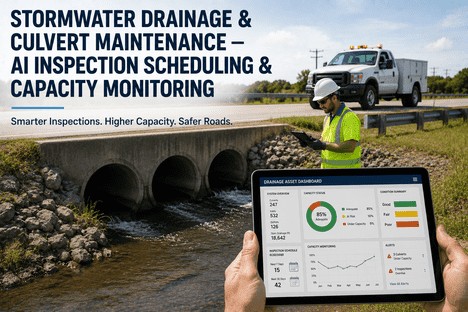
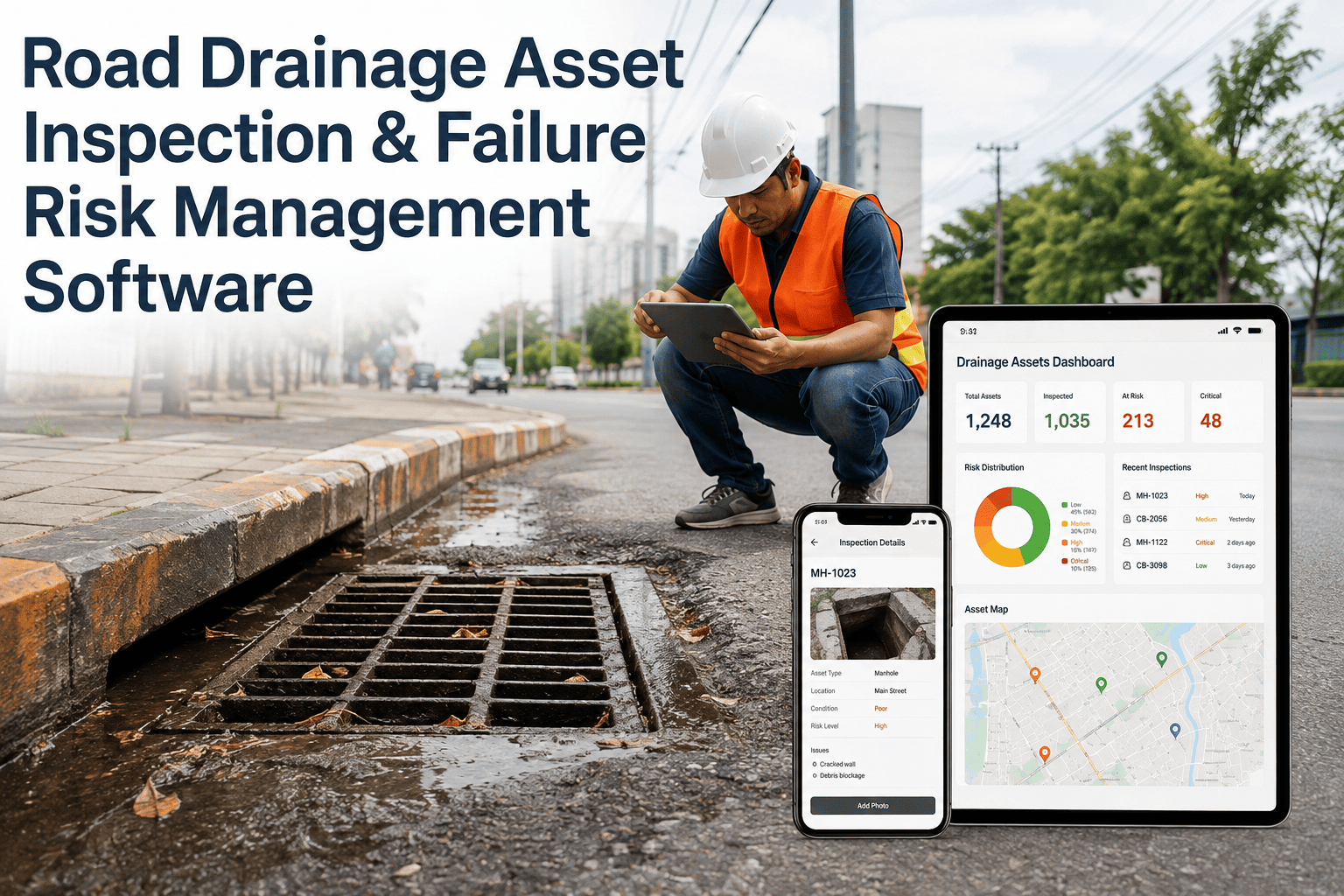
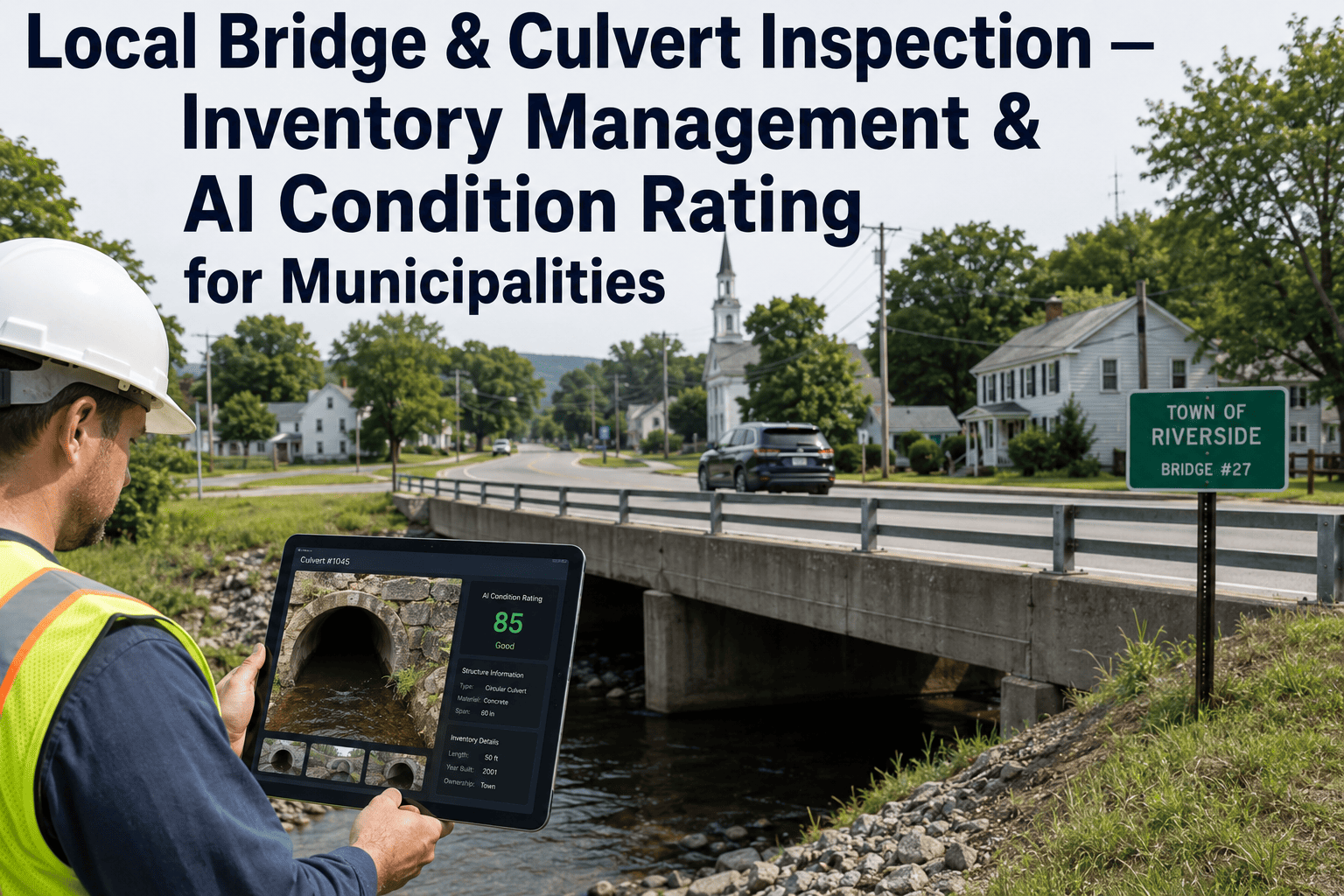
Stormwater drainage and culvert networks are the most invisible critical infrastructure on every road system — until they fail. A single blocked culvert during a heavy rain event backs water onto the roadway, saturates the pavement base, and initiates a failure sequence that can undermine an entire road section within hours. Maintenance managers responsible for drainage assets manage networks that average hundreds of culverts, thousands of catch basins, and miles of open channel per jurisdiction — most inventoried on paper or in spreadsheets that have not been updated since the last major inspection cycle. The inspection data that does exist is typically visual-only: an inspector standing at the inlet noting blockage or visible damage, while the barrel condition, invert deterioration, joint separation, and structural deformation remain unassessed because confined-space entry protocols make internal inspection slow, hazardous, and expensive. AI-powered drainage inspection fundamentally changes this equation by delivering internal condition assessment, blockage detection, capacity monitoring, and predictive failure forecasting across the entire network at a fraction of the cost and without confined-space risk. This is the maintenance manager's guide to deploying it.
The Drainage Network You Cannot See Is the One Most Likely to Fail Without Warning. AI Inspection Eliminates the Blind Spot.
iFactory's AI drainage inspection platform gives maintenance managers complete internal condition visibility across culverts, catch basins, outfalls, and storm drains — with automated defect detection, capacity trend analysis, and predictive failure alerts generated without a single confined-space entry.
Miles of storm sewers across the US, serving 270M+ storm drains and 2.5M treatment assets — the largest invisible infrastructure network on the road system
75%
Of urban flooding events are directly caused by inadequate drainage system capacity, blockage accumulation, and structural deterioration that went undetected during routine visual inspections
30-50%
Capacity reduction from sediment accumulation before any surface-level symptom appears — meaning the drainage system is already failing silently before the first flood event
5-10x
Cost multiplier when emergency culvert replacement replaces planned rehabilitation — $95K emergency on I-75 versus $15-20K for scheduled pipe replacement under normal conditions
The Hidden Failure Sequence: How One Blocked Culvert Becomes a Road Collapse
Drainage failures do not happen instantly. They follow a predictable sequence that begins with reduced hydraulic capacity and ends with structural collapse — but every intermediate stage is invisible from the road surface. Understanding this sequence is the foundation of every effective drainage maintenance programme, because each stage represents an intervention opportunity that closes once the next stage begins. AI inspection detects every stage from Stage 1, giving maintenance managers the lead time to intervene before emergency conditions develop.
01
Sediment & Debris Accumulation
Silt, gravel, trash, and vegetation build up inside the barrel and at the inlet. Hydraulic capacity drops 30-50% before any surface-level symptom is visible. AI detects the accumulation through sonar profiling and CCTV analysis during routine crawler inspection.
AI detects at Stage 1
02
Water Backup & Pavement Saturation
Reduced outflow causes water to pool upstream of the culvert and infiltrate the road embankment and pavement base layers. The subgrade loses structural support. Road surface may still look normal but the failure mechanism is now active beneath the pavement.
AI detects at Stage 2
03
Pipe Deterioration & Joint Separation
Sustained moisture exposure accelerates corrosion in metal culverts, spalling in concrete, and deformation in HDPE. Joints separate under soil pressure changes. Soil infiltration begins through gaps. Cracks widen. The structural integrity of the culvert barrel is now compromised.
AI detects at Stage 3
04
Sinkhole Formation & Road Collapse
Soil washed into the barrel through cracks and separated joints creates a void outside the pipe. The void expands, road surface sinks, and in a heavy rain event the culvert collapses underload — closing the road for weeks. Emergency replacement costs 5-10x planned rehabilitation.
The I-70 Culvert Collapse Cost $95,000 in Emergency Repairs and Required 49 Days of Road Work. AI Inspection Would Have Detected the Corrosion at Stage 1 — Five Years Before the Sinkhole Opened.
iFactory's AI drainage inspection platform detects every stage of the failure sequence — from sediment accumulation at Stage 1 through structural deformation at Stage 3 — giving maintenance managers the lead time to plan interventions before emergency conditions develop.
Drainage Inspection Evolution: From Visual Walk-Down to AI-Powered Network Intelligence
Drainage inspection methods have evolved through three distinct generations. Most maintenance organisations operate across two simultaneously — using CCTV for targeted investigations while still relying on visual walk-downs for routine network coverage. AI-powered inspection represents the third generation: continuous, quantitative, and predictive. Understanding where each method fits — and what it costs — is essential for building a drainage maintenance programme that allocates resources to the highest-risk assets first.
Generation 01
Visual Walk-Down
Inspector visits each culvert inlet and outlet, records visible blockage, erosion, and structural damage on a paper form or mobile device. No internal barrel assessment. No quantitative capacity data. Typical coverage: 200-500 linear feet per day. Confined-space entry required for internal inspection. Cost: $0.07/linear foot for end-of-pipe visual only.
$0.07/ft
External visual only
Generation 02
CCTV Crawler Inspection
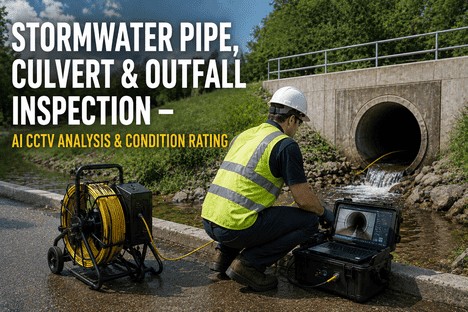
Remote-controlled crawler with pan-tilt-zoom camera traverses the barrel, transmitting live video to an operator at surface level. Provides internal visual assessment of joints, cracks, corrosion, deformation, and blockage. Typical coverage: 2,000+ linear feet per day. No confined-space entry. Manual defect coding required. Data is video-based and operator-dependent for quality.
$0.23-2.50/ft
Visual internal only
Generation 03
AI-Powered Inspection
Crawler with HD camera, sonar profiler, and LIDAR feeds AI defect detection engine that classifies and measures cracks, corrosion, joint gaps, sediment depth, deformation, and root intrusion in real time. Output: quantitative condition report with GPS-located defects, capacity score, and priority rating. Typical coverage: 3,000+ linear feet per day. No confined-space entry. Defect data is objective and repeatable.
$0.50-1.50/ft
Quantitative + predictive
The Critical Drainage Assets Every Maintenance Manager Must Monitor
A drainage network is composed of four primary asset categories, each with distinct failure modes, inspection requirements, and maintenance interventions. Most maintenance programmes prioritise one or two categories based on visible failure history — but the assets that fail catastrophically are often the ones that were never inspected because they looked fine from the surface. AI inspection covers all four categories in a single integrated survey, producing a complete drainage health map that reveals which assets need intervention and which are genuinely sound.
C
Culverts — Roadway Cross-Drainage
Culverts carry water under roadways and are the most structurally critical drainage asset. Failure modes include invert corrosion in metal pipes, joint separation allowing soil infiltration, crown cracking in concrete pipes, and cross-section deformation in flexible pipes. AI inspection detects all failure modes through CCTV analysis, sonar profiling of submerged sections, and LIDAR cross-section measurement. Condition is rated against DOT inspection standards and mapped to GPS coordinates for targeted repair planning.
Typical network: 100-500 culverts per jurisdiction. Most have no internal inspection record.
CB
Catch Basins & Inlets — Surface Collection Points
Catch basins collect surface runoff and direct it into the underground pipe network. Failure modes include sediment accumulation reducing storage capacity, grate blockage from debris, structural cracking in basin walls, and outlet pipe blockage. AI inspection uses crawler-mounted cameras and sonar to measure sediment depth, assess structural condition, and verify outlet pipe connectivity. Catch basin cleaning schedules are optimised based on measured sediment accumulation rates rather than fixed calendar intervals.
ASCE estimates 270M+ catch basins and storm drains across the US network.
O
Outfalls & Headwalls — Discharge Points
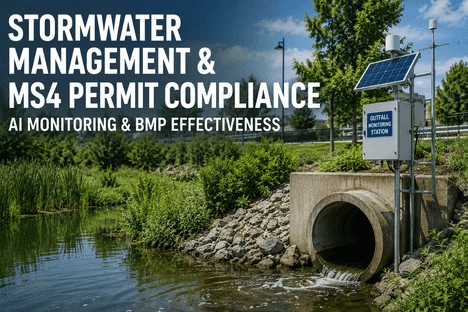
Outfall structures discharge drainage water into receiving water bodies. Failure modes include scour undermining the outlet structure, headwall cracking or tilting, erosion of the discharge channel, and blockage at the outlet. Outfall inspection is often neglected because these structures are located off the road corridor and require separate access. AI-enabled drone or crawler inspection captures outfall condition with GPS location data, structural assessment, and scour measurement — integrating outfall condition into the same database as the rest of the drainage network.
Outfall failure can trigger EPA NPDES consent decree violations with fines exceeding $50K per day.
CH
Open Channels & Ditches — Conveyance Corridors
Open channels and roadside ditches convey stormwater between collection points and outfalls. Failure modes include erosion and scour of channel banks, vegetation overgrowth reducing hydraulic capacity, sediment deposition raising the channel bed, and debris accumulation at constriction points. Channel assessment is typically visual but AI drone surveys with photogrammetry and vegetation analysis provide quantitative channel capacity measurement and erosion tracking over time — converting an informally managed asset class into a documented, condition-rated component of the drainage inventory.
Channel capacity degradation is the leading cause of unexpected localised flooding in suburban road networks.
The iFactory AI Drainage Inspection Platform: Three Capabilities That Change How Maintenance Managers Maintain Drainage Networks
The iFactory platform integrates crawler inspection hardware, AI defect detection, and network-level asset management into a single drainage intelligence system. Maintenance managers deploy the system across their entire network — culverts, catch basins, outfalls, and channels — and receive quantitative condition data with predictive priority rankings without managing separate inspection, analysis, and reporting tools. Three capabilities define the platform's value for drainage maintenance programmes.
Capability 01
AI Defect Detection & Classification in Real Time
As the crawler traverses the culvert or drain, the AI engine processes the video feed and classifies every detectable defect — cracks by width and orientation, corrosion by surface area, joint separation by gap measurement, sediment depth by percentage of cross-section, deformation by deviation from nominal shape, and root intrusion by severity. Each defect is tagged with the GPS location, pipe station, and a severity rating based on DOT condition assessment standards. The maintenance manager receives a complete defect inventory for the inspected asset, not a subjective operator narrative.
95%+ defect detection accuracy in controlled validation studies against certified inspector panels.
The platform tracks sediment accumulation rates, crack propagation, and corrosion progression across successive inspection cycles — converting point-in-time condition snapshots into trend lines that forecast when an asset will reach critical condition. A culvert with 25% sediment fill today that accumulated 8% in the last 12 months is forecast to reach 50% blockage within 36 months. The maintenance manager schedules cleaning before capacity loss triggers upstream flooding. Corrosion progression rates identify which metal culverts need lining or replacement within the current budget cycle — not after they fail during a storm event.
Capacity forecasting enables scheduled cleaning vs emergency response — reducing cost by 60-80%.
Every inspection generates condition data that feeds directly into the drainage asset register — updating each asset's condition score, defect list, inspection history, and priority ranking. Maintenance managers generate work orders for cleaning, repair, or replacement directly from the inspection dashboard, with the defect data automatically included in the work order scope. Budget planning uses the condition distribution histogram across the network to justify resource requests with quantitative evidence: 15% of culverts rated poor, 30% fair, 55% good — with a 5-year replacement cost projection based on measured deterioration rates.
Drainage asset register automatically updated with condition scores from every inspection cycle.
What the AI Drainage Inspection Dashboard Shows the Maintenance Manager
The maintenance manager's dashboard is designed around the questions that matter most for drainage network management: Which assets are in critical condition right now? What is the current capacity status of the network? Where should the next maintenance crew be deployed? And what is the budget requirement for the next cycle? Six dashboard views provide the answers at a glance.
View 01
Network Condition Map — Asset Health by Location
A GIS-based map of the entire drainage network colour-coded by condition rating: good condition in green, fair in amber, poor in red, and critical in purple. Each asset marker is clickable to display the latest inspection date, condition score, defect list, and inspection video clips. Maintenance managers see the spatial distribution of drainage health across the network — identifying corridors where multiple poor-rated assets cluster and require programme-level intervention rather than individual repairs.
Maintenance manager action: Route crews to cluster zones first — highest impact per deployment hour.
View 02
Capacity Status — Blockage Risk by Asset
A quantitative blockage risk view displays the current sediment fill percentage, debris accumulation level, and hydraulic capacity score for every culvert, catch basin, and channel section. Assets approaching the 50% blockage threshold are flagged for cleaning within the next inspection cycle. Trend indicators show whether each asset's blockage is stable, accumulating, or accelerating — enabling the maintenance manager to differentiate between assets that need immediate cleaning and those that can be deferred to the next scheduled cycle.
Maintenance manager action: Schedule cleaning for accumulating assets — defer stable assets to next cycle.
View 03
Defect Pareto — Most Common Failure Modes by Asset Category
The defect Pareto view ranks defect occurrences by category across the network — corrosion, cracking, joint separation, deformation, sediment accumulation, root intrusion — segmented by asset type. A maintenance manager who sees that 65% of culvert defects are metal pipe corrosion in pipes installed before 1990 has a structural finding that drives a replacement programme, not a repair-by-repair approach. The Pareto is generated automatically from AI-inspected defect data and is filterable by date range, asset category, and geographic corridor.
Maintenance manager action: Dominant defect patterns escalate to capital programme planning vs individual repair.
View 04
Inspection Cycle Tracker — Coverage by Asset Type and Route
A coverage tracker displays the percentage of drainage assets inspected within each cycle — segmented by culvert, catch basin, outfall, and channel — with the inspection date, method used, and condition score recorded for each asset. Maintenance managers see at a glance which routes are fully inspected, which have assets approaching their re-inspection due date, and which corridors have not been inspected within the target cycle. The tracker eliminates coverage gaps by surfacing uninspected assets rather than waiting for an asset failure to reveal the inspection gap.
Maintenance manager action: Route next inspection crew to corridors with highest percentage of uninspected assets.
View 05
Maintenance Work Order Queue — Prioritised by Risk Score
The work order queue ranks every pending drainage maintenance action by a composite risk score that combines the asset condition rating, capacity status, traffic loading above the asset, and asset criticality. High-risk assets — poor-rated culverts under high-volume roads with measurable capacity loss — appear at the top of the queue with the specific defect data and recommended intervention scope attached. Low-risk assets — good-rated catch basins with stable sediment levels — are deferred to the next scheduled cycle automatically without requiring manual triage by the maintenance manager.
Maintenance manager action: Deploy crew to top-ranked work orders — no manual prioritisation required.
A budget planning view projects the cost of replacing or rehabilitating drainage assets over a configurable planning horizon — typically 5, 10, or 20 years — based on the current condition distribution, measured deterioration rates, and unit cost benchmarks for cleaning, lining, and replacement. The projection is updated automatically as new inspection data becomes available, so the budget forecast reflects the current network condition rather than a static depreciation model. Maintenance managers use this view to justify budget requests with quantitative evidence: the asset-by-asset condition data that drives the forecast, the deterioration trend that supports each projection, and the cost comparison between planned and emergency replacement.
Maintenance manager action: Present condition-based replacement forecast to justify next budget cycle request.
"
We had 340 culverts in our maintenance inventory. The inspection records showed general condition ratings for maybe 60 of them from the last five years — most of those were visual walk-downs that only assessed the inlet and outlet. The rest had never been inspected internally because confined-space protocols made it too expensive and too slow. We deployed AI-powered crawler inspection across the entire network in one season. We found 18 culverts with active joint separation and soil infiltration that had zero surface symptoms, 42 with sediment accumulation exceeding 40% of barrel diameter, and 7 with active crown cracks that would have failed within two years. None of those were detectable from the road surface. The programme paid for itself in avoided emergency repairs before the first maintenance season was over.
— Maintenance Manager, County Public Works Department — 340 Culverts, 4,200 Lane-Miles of Roadway
Conclusion
Drainage network management has been the most underserved function in road maintenance because the assets are invisible, the failure sequence is hidden until the final stage, and the inspection methods available to most maintenance organisations are limited to surface-level visual assessment that detects only the most advanced deterioration. AI-powered drainage inspection closes this visibility gap by delivering quantitative internal condition assessment across the entire network at a cost and speed that makes comprehensive inspection feasible for every maintenance budget.
The economics are definitive. Emergency culvert replacement costs 5 to 10 times planned rehabilitation. A single blocked culvert that goes undetected through three inspection cycles can generate flood damage, pavement undermining, and road closure costs that exceed the entire annual drainage inspection budget for a mid-sized jurisdiction. The ASCE estimates that the US stormwater infrastructure funding gap exceeds $115 billion, and the maintenance manager's primary tool for closing the gap between available funding and required work is accurate condition data that ensures every dollar is spent on the highest-risk asset — not on the asset that happens to be easiest to inspect.
iFactory's AI drainage inspection platform is designed for maintenance managers who need to move from reactive emergency response to proactive network management without increasing inspection headcount or confined-space risk. Book a Demo to see the AI inspection system configured for your drainage network and culvert inventory, or talk to an expert about a free drainage network condition assessment pilot covering up to 50 culverts in your jurisdiction.
Frequently Asked Questions
iFactory's crawler inspection system uses a combination of above-water HD visual inspection and below-water sonar profiling in a single pass. The sonar profiler measures sediment depth, invert condition, and cross-section geometry in submerged sections where the camera cannot provide visual data. The two data streams are merged into a single condition report — the AI engine classifies visual defects from the camera feed and sonar defects from the profiler feed simultaneously. For culverts that are fully submerged or have consistently high water levels, the sonar profiler becomes the primary inspection sensor and provides quantitative condition data comparable to visual inspection in dry conditions. The platform also records water level and flow data during inspection, which informs capacity modelling and identifies hydraulic restrictions not apparent from structural condition alone. Talk to an expert about configuring sonar profiling for your permanently submerged culvert inventory.
AI crawler inspection eliminates the need for confined-space entry for routine internal assessments. The crawler is deployed and retrieved entirely from the surface — at the inlet or outlet — and the operator never enters the culvert barrel. This addresses the primary safety risk in drainage inspection: according to OSHA confined-space fatality data, drainage structures are among the deadliest confined-space environments due to toxic gas accumulation, oxygen deficiency, entrapment, and structural collapse hazards. For culverts large enough to permit walk-in inspection (typically 72-inch diameter and above), the AI crawler still provides faster, more consistent data than a human inspector walking through the barrel, and eliminates the atmospheric monitoring, ventilation, retrieval system, and standby personnel requirements of confined-space entry. The crawler also inspects culverts that are too small for human entry — which represent the majority of the network — delivering internal condition data for culverts that previously had no feasible inspection method. Book a Demo to see the crawler deployment process for standard culvert configurations.
iFactory's inspection outputs are generated in formats compatible with standard asset management systems — including GIS shapefiles, CSV condition tables, and API push to enterprise asset management platforms. Defect classifications follow DOT culvert inspection coding standards (NBI-compatible condition ratings for culverts under roadways, FHWA hydraulic deficiency codes, and state-specific inspection protocols where required). The platform can be configured to match the condition rating scale used by your jurisdiction — 0-9 NBI scale, 1-5 condition index, or custom DOT rating frameworks. Inspection data generated by the AI platform can be pushed directly into existing asset registers without manual data entry, updating asset condition scores and defect lists automatically after each inspection cycle. For organisations using CMMS platforms for maintenance workflow, work orders for cleaning or repair can be generated from the inspection dashboard and pushed to the CMMS with the defect data, GPS location, and recommended intervention scope pre-populated. Talk to an expert about integration with your current asset management system.
A single AI crawler system operated by a two-person crew achieves 3,000 to 4,000 linear feet of inspection per day under normal conditions — including setup, inspection, data upload, and teardown — compared to 200 to 500 linear feet per day for manual confined-space inspection or 2,000 linear feet per day for traditional CCTV without AI defect detection. For a typical county or municipal maintenance district with 300 to 500 culverts averaging 40 to 60 feet in length, a single crawler system completes first-time full internal inspection of the entire network within a single 12 to 16 week inspection season. The limiting factor is typically mobilisation between sites rather than inspection speed — the platform is designed for rapid deployment with vehicle-mounted crawler storage, on-board data processing, and wireless upload to the cloud dashboard within minutes of completing each inspection. For larger networks — state DOT districts with 1,000+ culverts — deployment of two crawler systems operating from separate maintenance yards achieves full network coverage within a single inspection season. The platform also supports concurrent catch basin and channel inspection by the same crew, integrating all three asset types into a single condition database. Book a Demo to calculate the coverage rate and crew requirement for your specific network size.
The Drainage Network You Cannot See Is the One Failing Right Now. Get a Free AI Inspection Pilot for Up to 50 Culverts in Your Jurisdiction.
iFactory's AI drainage inspection platform delivers quantitative internal condition data for culverts, catch basins, outfalls, and channels — without confined-space entry, without manual defect coding, and without coverage gaps. Complete internal assessment. Automated defect detection. Predictive capacity monitoring. Integrated with your asset register from the first inspection cycle.