Wastewater Collection System Maintenance — AI Sewer CCTV Inspection & Defect Coding
By Grace on June 20, 2026
Every wastewater collection system tells a story through its inspection data — the cracks that propagate between cycles, the root intrusions that slowly displace joints, the service laterals that fail at three times the rate of mainlines, and the infiltration points that quietly add millions of gallons to the treatment plant's daily load. Utility managers responsible for these networks operate under a fundamental tension: the network is mostly invisible, mostly underground, and mostly inspected less than once per generation. The ASCE 2025 Infrastructure Report Card gave U.S. wastewater systems a D+ and documented a funding gap approaching $700 billion by 2033 — yet the inspection data that should drive rehabilitation decisions covers less than 4% of the network per year. This gap between what is buried and what is known is the utility manager's defining operational risk. AI-powered CCTV analysis and automated NASSCO-PACP defect coding close this gap by extracting every defect from every frame of every inspection — not just the ones the operator caught during the 30 feet per minute manual review. This is the utility manager's guide to deploying AI at the intersection of collection system maintenance and capital planning.
800,000
miles of mainline sewers
Total U.S. publicly owned sewer mains — 90% are 6 to 15 inches in diameter, with replacement value exceeding $3 trillion
40%
defects missed per inspection
Industry studies confirm that human CCTV operators miss approximately 40% of defects during field inspection due to fatigue, equipment navigation, and simultaneous traffic management
13.7%
sewer robot market CAGR
The sewer inspection robotics market is projected to grow from $1.29 billion in 2025 to $2.44 billion by 2030 — driven by AI integration and autonomous deployment
55%
fewer contractor failures
The City of Houston achieved a 55% reduction in contractor data submittal failures and over $1 million in cumulative savings using AI-powered QA/QC on 28,000 CCTV inspections
Your Collection System Runs on Data You Collect but Rarely Fully Use. AI Extracts Every Defect From Every Frame — Closing the Gap Between What Is Buried and What Is Known.
iFactory's AI-powered sewer inspection platform gives utility managers automated NASSCO-PACP defect coding from existing CCTV footage, risk-based rehabilitation prioritization, and consent decree compliance tracking — without new hardware or workflow disruption.
The Four Structural Gaps That Keep Collection System Maintenance Reactive — and How AI Closes Each One
Most collection system maintenance programmes operate within a cycle that is fundamentally reactive: inspect a segment when a blockage is reported, discover additional deterioration that was not the reason for the inspection, add the segment to the rehabilitation queue, and move to the next emergency. The pattern repeats because the structural gaps in the inspection-to-planning workflow are embedded in the process itself rather than in any single decision. AI-assisted inspection eliminates each gap at the point where it occurs.
01
Manual Coding Inconsistency Across Operators and Contractors
Industry research shows that even experienced CCTV operators miss at least 20% of defects during field inspections, and studies across multiple utility programmes document a 15% underestimation and 20% overestimation of defect severity — meaning two different operators inspecting the same pipe segment on consecutive days can produce materially different condition scores. For utility managers consolidating data from multiple inspection contractors, this inconsistency makes network-wide condition assessment unreliable. AI defect coding applies NASSCO PACP standards identically to every frame of every inspection — eliminating the operator-to-operator variation that makes longitudinal condition trend analysis meaningless.
The industry average is less than 4% of network inspected annually — a 25-year cycle between assessments for any given pipe segment. In that interval, a pipe with a slowly propagating crack, an incrementally worsening root intrusion, or a joint that is gradually losing seal can transition from condition grade 3 to grade 5 without ever being observed. AI-assisted coding accelerates inspection throughput by 4x to 6x — turning 16 hours of manual coding per mile into roughly 4 hours — enabling utilities to double or triple their annual inspection coverage without increasing crew size. For utility managers under consent decree, this throughput gain is often the difference between meeting compliance deadlines and falling behind schedule.
03
Defect Data Trapped in Unprocessed Video Archives
Most utilities have years — sometimes decades — of historical CCTV video stored on hard drives, network folders, or shelf media that was never fully coded to NASSCO standards. This unprocessed video represents the single largest repository of underutilised asset condition data in the collection system. AI can reprocess legacy footage at machine speed, applying current PACP coding standards retroactively and generating condition baselines that allow the utility manager to compare current inspection data against historical deterioration rates. The ability to detect which segments have accelerated deterioration between the legacy inspection and the current one is a capability that manual reprocessing at 30 feet per minute cannot economically deliver at network scale.
04
Disconnected Data Flows Between Inspection and Capital Planning
Even when inspection data is captured and coded, it typically resides in a CCTV management platform that does not communicate directly with the GIS, the CMMS, or the capital planning model. The utility manager responsible for the $33 million rehabilitation programme (the scale of Phoenix's annual programme) must manually extract inspection findings, translate condition codes into risk scores, and import the results into the planning system. AI platforms that integrate inspection outputs directly with GIS and asset management systems eliminate this manual data translation step — and ensure that every rehabilitation decision is based on current condition data rather than exported spreadsheets that are already weeks or months old by the time they reach the planning team.
Four Gaps Make Reactive Maintenance Inevitable. AI Closes All of Them — From Field Capture Through Capital Planning.
iFactory integrates AI defect coding, NASSCO-compliance, and risk-based prioritization into a single workflow that starts at the manhole and ends at the capital improvement plan — without requiring new inspection hardware or additional field crew training.
The AI-Powered Sewer Inspection Architecture: From Raw Footage to Rehabilitation Priority
The iFactory platform for wastewater collection system inspection operates across three integrated layers that convert raw CCTV footage into defensible capital planning data without manual coding at any intermediate step. Each layer performs a distinct function, and all three operate in sequence on every inspection the utility processes.
Layer 01
Intelligent Field Capture
Works with existing CCTV equipment — crawlers, push cameras, and 360-degree manhole cameras — and adds real-time video quality validation to ensure every inspection meets NASSCO clarity and coverage standards before the crew leaves the site.
Field crews record footage using their existing CCTV hardware — no new equipment purchases, no retraining, no truck roll changes. The platform validates video quality in real time: lighting adequacy, crawler speed compliance, distance counter accuracy, and pipe coverage completeness. If the footage does not meet PACP quality standards, the crew is notified before they leave the manhole. This eliminates the most common cause of inspection rework — footage that fails QA/QC weeks after collection when the crew is already deployed elsewhere.
Real-time QA validation
Multi-format video support
Automated header validation
LTE/5G cloud upload
Layer 02
AI Defect Recognition and NASSCO Coding
Computer vision models trained on millions of feet of PACP-coded inspection data detect, classify, and grade every defect in the video — with 97%+ accuracy and full NASSCO PACP 8.0 compliance.
The AI processing layer analyzes every frame of every inspection video, detecting structural defects (cracks, fractures, holes, collapses), operational defects (roots, deposits, debris, grease), and service connection observations. Each detection is classified against NASSCO PACP observation codes, assigned a severity grade, and logged with the frame location and pipe distance. The model achieves 97% accuracy in defect detection and classification — validated against 425,000+ completed NASSCO surveys and 40 million linear feet of inspection data. Items where the model has lower confidence are automatically flagged for human review by PACP-certified technicians, ensuring that every report is both AI-efficient and professionally defensible.
Structural defect detection
Operational defect coding
PAC P 8.0 compliant output
Human review of low-confidence items
Layer 03
Risk-Based Asset Prioritization
Condition grades from AI coding are scored against consequence-of-failure factors — pipe material, diameter, depth, proximity to critical infrastructure — and ranked into a single rehabilitation priority queue.
Condition grades alone do not determine rehabilitation priority — a grade 4 pipe in a low-consequence location may be less urgent than a grade 3 pipe under a major arterial road with a history of collapse events. The prioritization layer combines AI-derived condition scores with utility-defined consequence factors: pipe diameter and depth, soil type, traffic loading, proximity to water bodies, critical customer impact, and regulatory consent decree requirements. The output is a single, sortable rehabilitation priority score for every inspected segment — the direct input to the capital improvement plan. The City of Phoenix uses this exact approach across its $33 million annual small-diameter rehabilitation programme, with AI-assisted assessment delivering consistent prioritization across three separate inspection contractors and multiple CCTV system types.
Consequence-of-failure scoring
GIS-based risk heatmapping
Multi-contractor data consolidation
CIP-ready priority queue output
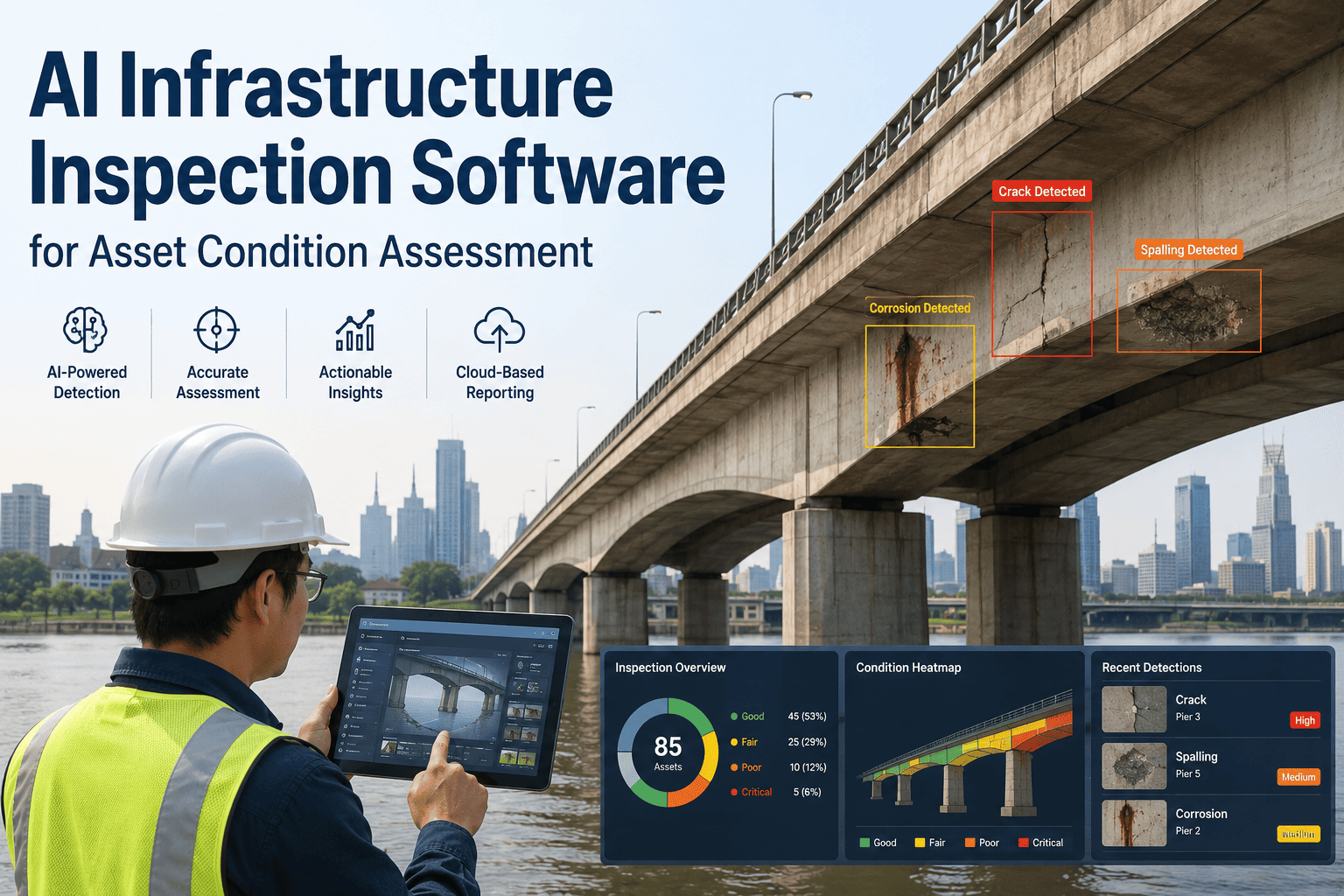
What the AI-Powered Collection System Dashboard Shows the Utility Manager
The utility manager's dashboard is designed around the questions that collection system operators need to answer continuously: Which segments are in the worst condition right now? Is the inspection programme on track to meet consent decree milestones? Where should the next rehabilitation dollar be spent for maximum risk reduction? Every view is generated automatically from the AI-coded inspection data.
Dashboard View 01
Network-Wide Condition Heatmap
A GIS-integrated map view of the entire collection system with color-coded pipe segments by PACP condition grade — green for grade 1 and 2, yellow for grade 3, orange for grade 4, and red for grade 5. Utility managers see the spatial distribution of structural condition at a glance: which basins are deteriorating fastest, which pipe cohorts are overrepresented in the worst grades, and which segments require immediate engineering review. Clicking any segment displays the full defect log, AI confidence scores, and the most recent inspection video frames for verification without leaving the map view.
Dashboard View 02
Defect Pareto by Pipe Cohort, Material, and Diameter
The Pareto view ranks defect categories across user-selectable dimensions — pipe material, installation decade, diameter range, or basin. A utility manager who sees that 65% of all grade 4 and 5 structural defects occur in VCP pipes installed between 1960 and 1975 has a cohort-based rehabilitation finding that drives programme-level planning — not segment-by-segment decisions. The Pareto is generated automatically from the AI-coded inspection database without manual data compilation, and it updates with every new inspection processed through the platform.
Dashboard View 03
Inspection Programme Tracker and Consent Decree Milestones
A programme management view that tracks inspected linear feet against annual targets, month-over-month inspection throughput, contractor performance metrics, and consent decree milestone dates. Utility managers see exactly how many miles have been inspected, coded, and imported into the asset register to date — and what pace is required to meet the next compliance deadline. For utilities like Houston operating under federal EPA consent decrees with 129,000 manholes and thousands of miles of pipe to assess, this view is the single source of truth for reporting to regulatory authorities and the city council.
Dashboard View 04
Rehabilitation Priority Matrix With Cost Estimates
Every inspected segment with a condition grade of 3 or higher is displayed in a matrix view sorted by rehabilitation priority score — combining condition grade, consequence of failure, and estimated rehabilitation cost (CIPP lining versus point repair versus open-cut replacement). Utility managers reviewing a $33 million annual programme can sort, filter, and batch segments by priority tier, pipe diameter range, or geographic basin — and export the resulting priority queue directly into the capital improvement plan budgeting process. The Phoenix programme's pilot found that 38% of assessed pipe required CIPP lining and 2% required point repairs — commercial-grade data for programme-level budget forecasting.
Dashboard View 05
Condition Grade Trend Analysis by Segment Cohort
For segments with multiple inspection events in the platform's history — a first inspection from a legacy CCTV archive retroactively coded by AI, and a current inspection from the ongoing programme — this view displays condition grade trajectory. Segments that have accelerated from grade 3 to grade 5 in two inspection cycles are flagged for immediate engineering attention. Segments that have remained stable at grade 2 across multiple cycles can be confidently deferred, freeing rehabilitation budget for the deteriorating cohort. This trend analysis is the core of predictive maintenance for collection systems and is only feasible at network scale with AI-coded data.
Dashboard View 06
Contractor QA/QC Performance Scorecard
Every contractor-submitted inspection is automatically scored on PACP compliance, video quality, coding accuracy, and submittal completeness. The platform detects missing headers, invalid observation codes, non-standard clock positions, and speed violations that would trigger a submittal rejection. Houston's programme documented a 55% reduction in contractor data submittal failures — from nearly 50 failed surveys per month to an average of 22 — after deploying AI-powered QA/QC across its contractor network. The scorecard view gives utility managers the data they need for contractor performance reviews, pay-item verification, and accounts payable validation.
"
We were questioning some of the recommendations we received from a traditional condition assessment — a significant list of repairs flagged as immediate priorities that would carry a substantial cost. Rather than accept the findings, we turned to SewerAI's AutoCode to reassess the same data. Within 24 hours of analysis, the AI had corrected the record — saving us over a million dollars in repairs that were not, in fact, urgently needed. At the same time, it uncovered critical defects that had been missed entirely in the original manual assessment. The experience changed how we validate inspection data and how we budget for rehabilitation.
— Operations Team, Macomb County, Michigan — Wastewater Collection System, 1,400+ Miles of Sanitary Sewer
Conclusion
Wastewater collection system maintenance is not constrained by a lack of inspection data. It is constrained by the gap between the data collected and the data actually used for decisions. Manual CCTV coding at 30 feet per minute produces inspection reports that capture approximately 60% of defects, and the 4% annual inspection coverage rate means that 96% of the network enters each year without a current condition assessment. The utility manager responsible for asset management, consent decree compliance, and rehabilitation budget allocation cannot make defensible capital planning decisions on this basis — because the condition data driving those decisions is incomplete at the point of collection and stale by the time it reaches the planning team.
AI-powered CCTV analysis closes this gap at every stage. Field capture with real-time QA ensures that every inspection meets NASSCO standards before the crew leaves the site. AI defect recognition codes every defect in every frame — recovering the 40% of observations that manual processes miss and applying consistent PACP classification across every inspection, every contractor, and every pipe material. Risk-based prioritization converts condition grades into rehabilitation priority scores that feed directly into the capital improvement plan — eliminating the manual translation step that introduces delay and error between the inspection programme and the construction programme.
The industry evidence from 2025 and 2026 is unequivocal: utilities deploying AI-assisted inspection at scale — including Houston, Phoenix, Macomb County, and Costa Mesa — are documenting 4x to 6x coding throughput improvements, 55% reductions in contractor submittal failures, and rehabilitation savings measured in millions of dollars per programme. The sewer inspection robotics market growing at 13.7% CAGR and the wastewater pipeline inspection software market approaching $1.2 billion by 2034 are market signals that reflect what utility managers already know: the transition from manual to AI-powered collection system management is not a technology pilot question — it is an operational necessity for utilities that need to do more inspection with the same crews and prioritize more rehabilitation projects with constrained budgets. iFactory's AI sewer inspection platform is designed for utility managers who need to close the gap between what is buried and what is known. Book a Demo to see the platform configured for your collection system network size and consent decree requirements, or talk to an expert about a free NASSCO-PACP compliance and inspection throughput assessment for your utility.
Frequently Asked Questions
No. AI defect coding platforms are designed to process video from standard CCTV inspection equipment — the same crawlers, push cameras, and pan-tilt-zoom cameras that field crews already use. The AI model analyzes existing footage regardless of the camera make or model, as long as the video meets basic resolution and clarity thresholds. The key operational change is not new hardware — it is the shift from having the operator code defects in the field while simultaneously navigating the crawler and managing traffic, to having the operator focus entirely on video quality and coverage while the AI processes the footage post-collection. Several major programmes, including Houston's consent decree programme covering 129,000 manholes and Phoenix's $33 million rehabilitation programme, operate with multiple contractors using different CCTV systems, all feeding a single AI processing platform. Talk to an expert about integrating the platform with your existing inspection equipment and contractor workflows.
The AI model is trained on a dataset spanning 425,000+ completed NASSCO surveys and 40 million linear feet of inspection data — covering VCP, concrete, PVC, HDPE, ductile iron, and brick pipe materials across diameters from 6 inches to 120 inches. The model recognizes all 80+ PACP observation codes across structural defects (cracks, fractures, holes, collapses, deformation), operational defects (roots, grease, deposits, debris, infiltration), and service connection observations. Detection accuracy varies by defect category — structural defects such as cracks and fractures achieve the highest accuracy, while certain deformation classifications require human verification at current model capability levels. The platform handles this transparently by flagging low-confidence detections for human review rather than silently misclassifying them. For utilities with unique pipe materials or uncommon defect types, the model can be fine-tuned on a representative sample of local inspection footage. Book a Demo to review accuracy data by pipe material and defect category for programmes comparable to yours.
Yes, and this is one of the highest-value use cases for AI in collection system management. Most utilities have years or decades of CCTV video that was either coded to a previous NASSCO standard version, coded partially with only the most severe defects documented, or never formally coded at all. The AI processing engine applies current PACP 8.0 standards to legacy footage at machine speed — generating a complete condition baseline for every segment that has a historical inspection record. This baseline then enables condition grade trend analysis when current inspection data is added: the utility manager can see which segments are deteriorating at an accelerated rate, which have remained stable, and which require re-inspection because the legacy footage quality does not meet current standards. NASSCO's own AI workgroup has identified legacy footage reprocessing as one of the primary approved uses for AI-collected inspection data. Talk to an expert about pricing for bulk legacy footage processing and condition baseline generation.
The platform is designed around data portability and existing system compatibility. All AI-coded inspection data is exportable as standard NASSCO PACP exchange files that integrate with Esri ArcGIS, Trimble, OpenGov, and the majority of CMMS platforms used by municipal wastewater utilities. Condition grades, defect logs, and rehabilitation priority scores are accessible via API for direct consumption by capital planning models and financial systems — eliminating the CSV export and manual import step that introduces data lag and transcription errors. The platform also integrates with CCTV management software from the major camera manufacturers, enabling inspection task assignment, video upload, and coded data return to occur within the workflow that field crews and contractors already use. For utilities operating under consent decrees with mandatory reporting requirements to regulatory authorities, the platform generates compliance reports in the format specified by the consent decree — including inspection progress against milestones, condition grade distributions, and rehabilitation completion tracking. Book a Demo to see the platform integrated with your existing GIS and asset management environment.
Your Collection System Runs on Data That Is Only 60% Complete. AI Finds the Other 40% in Every Inspection Frame. Get a Free NASSCO Compliance and Inspection Throughput Assessment.
iFactory's AI-powered sewer inspection platform — automated NASSCO-PACP defect coding from existing CCTV footage, risk-based rehabilitation prioritization, consent decree compliance tracking, and GIS integration — built for utility managers who need to close the gap between inspection data and capital planning decisions.