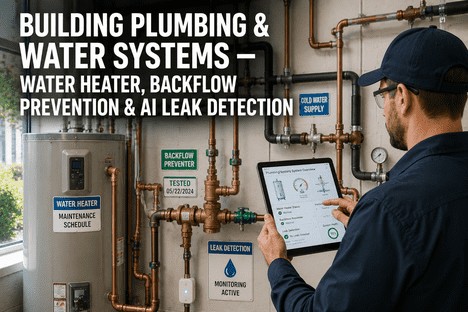
Building Plumbing & Water Systems — Water Heater, Backflow Prevention & AI Leak Detection
By Grace on June 20, 2026
A water heater at a twelve-storey office tower fails at 3:47 AM on a Sunday. By the time the facility manager arrives at 7:30 AM, the mechanical room has three inches of standing water, the ceiling on the floor below is sagging under the weight of trapped moisture, and the main electrical panel for the east wing has tripped on ground fault. The water damage restoration contractor estimates $240,000 in structural repairs. The insurance deductible is $175,000. The business interruption cost — two floors of tenants relocated for six weeks while the ceilings and electrical infrastructure are replaced — is not covered at all. This is not a rare event. It is the pattern that repeats across thousands of commercial buildings every year, and it happens not because building water systems are inherently unreliable — but because the maintenance programmes responsible for monitoring water heater performance, tracking backflow preventer test schedules, detecting concealed leaks before they become floods, and documenting Legionella prevention protocols have not kept pace with the complexity of the systems they are meant to protect.
AI Plumbing Maintenance · Water Heater Monitoring · Backflow Compliance · Leak Detection · Legionella Prevention
$240,000 in Water Damage Starts with a $0.50 Maintenance Oversight. iFactory AI Prevents the Oversight Before the Water Starts Flowing.
iFactory centralises water heater performance monitoring, backflow preventer testing schedules, AI-powered leak detection, and Legionella risk management into one platform — giving facility managers real-time visibility and automated compliance across every building water system in their portfolio.
US plumbing industry revenue in 2025 — driven by aging commercial building infrastructure and the rising cost of water damage claims across the sector
#1
Internal water leaks are the leading cause of commercial property damage — surpassing fire, theft, and weather-related events combined
$2.5B
Annual water damage insurance claims in the United States — with commercial deductibles now routinely reaching $100,000 to $200,000 per incident
8-20%
Insurance premium reduction available for buildings with AI-powered water leak detection and proactive water management systems installed
The Hidden Cost of Unmanaged Building Water Systems — and Why the Damage Is Invisible Until It Is Too Late
Building water system failures are different from other infrastructure failures in one critical way: the damage is not instantaneous. A fire alarm panel either works or it does not. A sprinkler system either flows or it does not. But a water heater develops a slow leak over weeks. A backflow preventer check valve fails incrementally as the rubber seal degrades. A concealed pipe in a ceiling cavity weeps for months before the first water stain appears. The failure curve is gradual, cumulative, and hidden — which means the maintenance response must be predictive rather than reactive. Most facility management programmes are still structured for reactive response, which is why water damage is the single largest source of commercial property claims and why the trend is accelerating.
Week 1
Week 3
Week 6
Week 10
Week 14
T&P valve weeps intermittently
Floor drain handles small discharge
Corrosion accelerates on tank bottom
Catastrophic tank failure occurs
$240K damage, 6-week disruption
Without AI Monitoring
First sign of problem is catastrophic failure at week 10. Damage is $240K. No actionable data before failure.
With iFactory AI Monitoring
AI detects abnormal flow pattern at week 2. Alert generated. Technician replaces T&P valve at week 3. Total cost: $320.
The Backflow Compliance Gap
Annual test mandated. Most buildings cannot produce this year's report in under 48 hours.
IPC Section 312 requires annual backflow preventer testing by certified testers. In practice, test records are scattered across contractor invoices, email chains, and filing cabinets. When an AHJ or insurance auditor requests the documentation, most facility managers spend hours searching before producing an incomplete record set — leaving the building exposed to compliance findings, fines, and potential water service termination by the municipal utility.
The Legionella Risk Exposure
ASHRAE 188 requires a documented Water Management Plan. Most facilities do not have one.
286 people died from Legionnaires' disease in the US in 2022. Cooling towers account for 98% of CDC-identified outbreak risk, followed by hot water systems at 84%. ASHRAE Standard 188 has established the Water Management Plan as the professional standard of care, and states including New York, California, and Maryland have codified it into law. Facility managers without a documented, auditable WMP are carrying a liability exposure that most insurance policies now specifically exclude from coverage.
The Concealed Leak Blind Spot
80% of water damage comes from leaks that are invisible until structural damage is done.
Modern AI-powered water leak detection systems analyse flow patterns and temperature data to identify anomalies hours or weeks before visible damage occurs. Studies show that properties with AI leak detection prevent an average of $10,000 per incident by catching failures early. Insurance carriers are increasingly offering 8-20% premium reductions for buildings with proactive water monitoring — making the ROI calculation on AI leak detection favourable within the first year for buildings above 50,000 square feet.
AI Water Monitoring · Backflow Compliance · Legionella Risk Management · Leak Prevention
The Building Water System Has Three Critical Failure Points. iFactory Monitors All of Them — and Alerts You Before the Water Reaches the Floor.
From water heater performance degradation to backflow test compliance to concealed leak detection, iFactory connects every water system data point into a single platform — with AI that flags anomalies, automated scheduling that aligns with code requirements, and documentation that satisfies auditors, insurers, and regulators without manual effort.
What iFactory's Water Systems Module Actually Does
iFactory is not a plumbing work order system with a water tab attached. It is a purpose-built water systems management platform where every water heater, every backflow preventer, every cooling tower, and every water distribution line is registered, monitored, and maintained in a single data environment — with AI-powered anomaly detection, code-compliant scheduling, and portfolio-wide compliance visibility that gives facility managers the tools they need to prevent failures before they happen and document every action for the auditors who arrive after they do.
Capability 01
AI-Powered Water Heater Performance Monitoring — Detect Degradation Before Failure
Predictive Asset Management
iFactory connects to water heater controllers, temperature sensors, and flow monitoring devices to track the key performance indicators that precede failure: temperature fluctuation range, recovery time trends, T&P valve discharge frequency, anode rod depletion timeline, and sediment buildup indicators. The AI models are trained on degradation patterns from thousands of commercial water heater installations and can identify the signature of an impending tank failure, a failing heating element, or a compromised relief valve an average of six to ten weeks before a catastrophic event occurs. When the system detects an anomaly, it generates a predictive work order with the specific component diagnosis, the estimated remaining useful life, and the recommended corrective action — transforming the maintenance response from reactive replacement after flood damage to planned intervention during normal business hours.
Real-time temperature and flow monitoring
AI failure prediction algorithm
Auto-generated predictive work orders
Capability 02
Backflow Preventer Testing Management — Annual Compliance Without Manual Tracking
Code Compliance Automation
iFactory maintains a complete inventory of every backflow prevention assembly in your portfolio — RPZ, double check, double check detector, and pressure vacuum breaker types — each tagged with its location, hazard classification, certified tester contact, and test due date. The platform auto-generates annual test work orders sixty days before each device's compliance deadline, tracks the test result submission, and stores every certified test report in a searchable, audit-ready archive linked to the specific device. When a test identifies a failing check valve or relief valve, iFactory creates a corrective work order, tracks the repair, and schedules the required re-test — closing the compliance loop without the facility manager touching a spreadsheet. The system also tracks which local water utility requires test report submission, the submission format, and the deadline — eliminating the compliance gap between device testing and municipal reporting that causes most backflow violations.
Device-level inventory with hazard classification
Auto-scheduled annual test work orders
Audit-ready test report archive
Capability 03
AI Leak Detection and Auto-Shutoff Integration — Stop the Leak Before It Becomes a Claim
Real-Time Damage Prevention
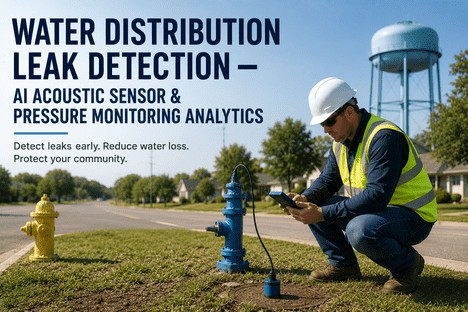
iFactory integrates with flow monitoring sensors, pressure transducers, and acoustic leak detection devices to create a continuous water surveillance system across every building in your portfolio. The AI engine learns each building's normal water consumption pattern — accounting for occupancy schedules, seasonal HVAC makeup water demand, irrigation cycles, and cooling tower bleed rates — and generates an alert when consumption deviates from the expected profile by a configurable threshold. For critical applications, the platform can be integrated with automatic shutoff valves that isolate the water supply to a specific zone or the entire building when a catastrophic flow event is detected. The combination of AI pattern recognition and automated shutoff reduces average water damage claim severity by over 60% in buildings where it is deployed — a reduction that insurers are increasingly recognising with premium reductions of 8 to 20% for equipped properties.
Continuous flow pattern monitoring
AI anomaly detection and alerting
Auto-shutoff integration for catastrophic events
Capability 04
Legionella Risk Management and Water Management Plan Documentation — ASHRAE 188 Compliance Built In
Health Safety Compliance
iFactory's Legionella risk management module provides a structured framework for developing, implementing, and documenting the ASHRAE 188-required Water Management Plan for every building in your portfolio. The platform guides facility managers through the seven required elements: team assembly, system description, hazard analysis, control limit determination, monitoring procedures, corrective action protocols, and documentation management. Temperature monitoring schedules for hot water return lines, cooling tower biocide dosing records, culture test results, and distal site flushing logs are all captured, timestamped, and stored in the compliance record for each building. When a control limit is breached — hot water temperature at a return line drops below 124F, or a cooling tower disinfectant residual falls below the target range — the system generates an immediate alert and creates a corrective action work order with the specific remediation protocol attached. The complete Water Management Plan documentation package can be exported for regulatory review, insurance audit, or Joint Commission survey within minutes.
ASHRAE 188 structured WMP framework
Temperature and biocide monitoring with alerts
Audit-ready compliance documentation
Water System Component
Failure Mode
Consequence Without AI
iFactory AI Prevention
Water Heater
Tank corrosion, T&P valve failure, sediment buildup, element burnout
Catastrophic tank rupture, flooding, $150K-$300K damage, building evacuation
AI detects temperature fluctuation and recovery time trends 6-10 weeks before failure, generates predictive replacement work order
Backflow Preventer
Check valve seal degradation, relief valve failure, internal corrosion
IPC compliance violation, water service termination, $5K-$25K fines, contamination liability
Auto-scheduled annual test with certified tester tracking, digital report archive, re-test workflow on failure
Continuous temperature and biocide monitoring, control limit breach alerts, WMP documentation auto-generated
"
I manage a portfolio of eighteen commercial buildings across three states. Before iFactory, our water heater replacement decisions were driven entirely by failure events — and in the previous eighteen months, we had three catastrophic tank failures that each caused over $200,000 in water damage and tenant disruption. The insurance broker told us at renewal that we were one more claim away from being non-renewed. After deploying iFactory's water monitoring across the portfolio, the platform flagged a water heater in Building 7 with a degrading temperature recovery trend that the AI scored at critical. We replaced it during a scheduled weekend shutdown for $4,200. Two weeks later, the removed unit's tank failed during a pressure test in the shop. That was the moment the team stopped trusting calendar-based replacement schedules and started trusting the data.
— Director of Facility Operations, Commercial Real Estate Investment Trust — 18 Buildings, 1.4M Square Feet
Conclusion
Water damage is the leading cause of commercial property loss in the United States — surpassing fire, theft, and weather events combined. The annual cost runs into billions of dollars in insurance claims, deductible payments, business interruption losses, and regulatory penalties. And the underlying pattern is consistent across every incident: a gradual, detectable failure process that no one detected because the monitoring systems, compliance tracking, and maintenance workflows were disconnected. The water heater's temperature trend was degrading for weeks before the tank ruptured. The backflow preventer's check valve was seating imperfectly for months before the annual test caught it. The concealed pipe was weeping for days before the ceiling collapsed. The cooling tower's disinfectant level was dropping for hours before Legionella reached the aerosolization stage.
These are not unpredictable events. They are predictable events whose warning signals were being generated but not received. iFactory's Water Systems module closes that gap — with AI that monitors every water system component, automated scheduling that aligns with every code requirement, integrated leak detection that alerts before damage occurs, and a compliance documentation framework that eliminates the gap between maintenance action and audit-ready record. Book a Demo to see how the platform maps to your specific building portfolio and water system configuration, or Talk to an Expert to begin your water systems risk assessment and compliance platform deployment.
Frequently Asked Questions
No. iFactory supports integration with any water heater controller or sensor system that provides temperature, flow, or pressure data via standard communication protocols including BACnet, Modbus, and API-based connectivity. For water heaters without digital controllers, iFactory's mobile app allows technicians to log temperature readings, visual inspection observations, and T&P valve test results during routine rounds — providing performance trending data without requiring smart sensors on every unit. The AI analysis engine works with whatever data is available, and its prediction accuracy improves as more data points are collected over time. The platform can start delivering value with manual temperature logging on day one and scale to full sensor-based monitoring as infrastructure is upgraded. Talk to an Expert to discuss the sensor integration approach for your specific building infrastructure.
iFactory maintains a jurisdiction-specific configuration for each building's water authority — storing the submission format (online portal, email, paper form), the submission deadline relative to test date, the specific test report template required, and the contact information for the authority's backflow coordinator. When a certified tester completes a backflow preventer test and uploads the results through iFactory's mobile app, the platform generates the jurisdiction-specific report, submits it through the required channel, and logs the submission confirmation in the device compliance record. For authorities that require the building owner to maintain the test record on site, iFactory generates the property-specific backflow test log with all device test histories, repair records, and certification dates in a single document that can be printed or shared digitally within seconds. Book a Demo to see a live walkthrough of the multi-jurisdiction backflow compliance workflow.
iFactory's leak detection integration is designed for retrofit deployment without structural modification. The primary installation involves fitting flow monitoring sensors on the main water supply line — a process that typically takes a licensed plumber less than two hours per building — and placing wireless spot sensors in high-risk areas including mechanical rooms, below sink cabinets, near water heaters, and in concealed plumbing chase access panels. The sensors communicate via cellular or LoRaWAN, eliminating the dependency on building WiFi networks that cause connectivity failures in earlier-generation monitoring systems. AI analysis begins generating a consumption baseline within 72 hours of installation, and the system starts producing actionable alerts within the first week of operation. For buildings where pipe access is limited, iFactory also supports acoustic leak detection sensors that can be strapped to pipe exteriors without cutting into the water distribution system. Book a Demo to review the retrofit installation requirements for your specific building types.
Yes. iFactory includes a structured ASHRAE 188 compliance framework that generates the complete Water Management Plan documentation package for each building. This includes the water management team roster, building water system inventory and schematic, hazard analysis matrix with identified risk points, control limit parameters for temperature, disinfectant residual, and flow, monitoring and measurement procedures with assigned responsibility, corrective action protocols with escalation pathways, and a documentation and record-keeping log that captures every monitoring event, test result, and corrective action with timestamps and technician signatures. The WMP is generated as a living document that updates automatically as new monitoring data, test results, and system modifications are recorded. For Joint Commission-accredited healthcare facilities, the documentation framework also addresses the specific EC.02.05.01 water management requirements. Talk to an Expert to review the ASHRAE 188 documentation output samples for your facility types.
Every Building Water System Failure Is Preceded by Warning Signs. iFactory Makes Sure Someone Reads Them Before the Water Reaches the Floor.
iFactory's Water Systems module — AI-powered water heater monitoring, backflow preventer compliance automation, intelligent leak detection, Legionella risk management, and ASHRAE 188 documentation. The platform that transforms your building water systems from the portfolio's biggest liability into its most predictable asset.