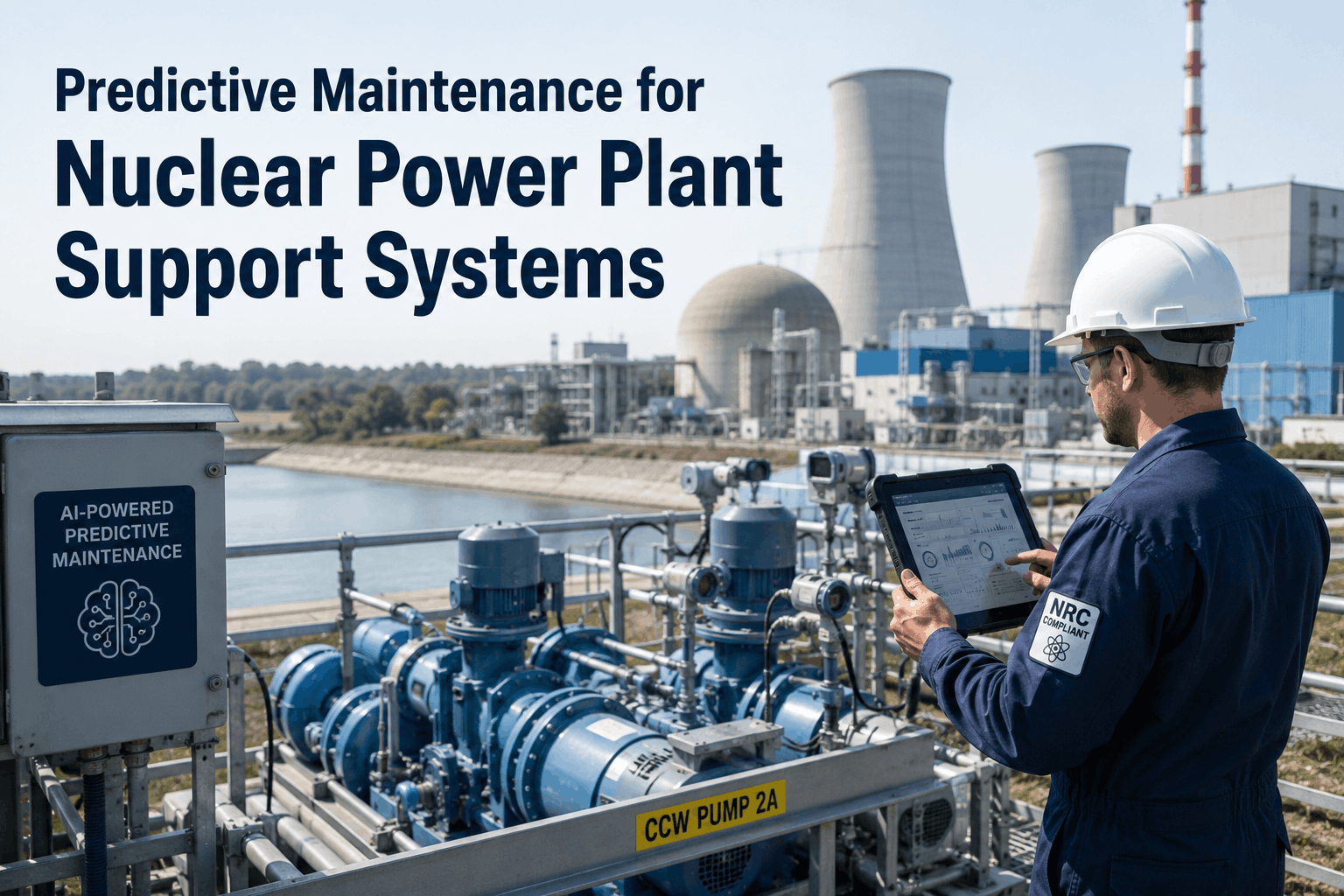
Nuclear plants require the highest reliability standards in industrial operations — AI monitors cooling water pumps, emergency diesel generators, HVAC systems, and instrumentation air compressors with the continuous health tracking and NRC-grade documentation that nuclear maintenance programs demand. Start Trial Free to see how iFactory gives nuclear plant maintenance organizations the equipment health monitoring, trend documentation, and audit-ready records needed to support maintenance rule compliance and operability assurance across safety-related support systems.
Maintain Nuclear Plant Support System Reliability with Documented AI Health Monitoring
iFactory provides continuous health monitoring of cooling water pumps, diesel generators, HVAC, and instrument air systems — with the trend documentation and audit-ready records that NRC maintenance rule compliance requires.
Why Nuclear Support System Maintenance Requires Continuous Condition Monitoring
Nuclear plant safety-related support systems — service water pumps, essential chilled water systems, diesel generators, and instrument air compressors — are required to start and operate on demand under conditions that may occur infrequently. This infrequent-operation profile means that equipment can degrade significantly between surveillance tests without generating any operational alert, and the degradation only becomes evident during the next monthly or quarterly surveillance run. Continuous condition monitoring between surveillance events provides the trending data that identifies degradation trajectories before they reach functional failure — enabling corrective maintenance to be scheduled during planned outages rather than generating a technical specification action level that requires immediate shutdown entry. Engineering teams that Book a Demo with iFactory see how continuous trending between surveillance tests changes the operability assurance picture for safety-related support system equipment.
-
Service Water Pump Health Monitoring
iFactory continuously monitors service water pump vibration, differential pressure, flow rate, and motor current — trending these parameters between surveillance tests to detect bearing degradation, impeller wear, and motor winding changes before they affect operability.
-
Emergency Diesel Generator Condition Tracking
iFactory tracks EDG vibration signatures, lube oil pressure trends, coolant temperature patterns, and fuel system parameters — identifying mechanical degradation trends between monthly surveillance runs that surveillance testing alone cannot reveal.
-
Essential HVAC System Monitoring
iFactory monitors essential HVAC fan bearing condition, coil differential pressure trends, and damper actuator performance — ensuring that the heating, ventilation, and cooling systems that maintain control room and safety equipment room habitability remain in verified operable condition.
-
Instrument Air Compressor Health Tracking
iFactory analyzes instrument air compressor vibration signatures, discharge pressure and temperature trends, and valve condition indicators — detecting compressor valve wear and bearing degradation before they affect instrument air system pressure and the pneumatic systems that depend on it.
-
NRC-Grade Trend Documentation
iFactory maintains a complete, timestamped equipment condition trend record for each monitored system — generating the audit-ready documentation that NRC inspection and maintenance rule implementation reports require without additional manual data compilation effort.
-
Maintenance Rule Performance Criterion Tracking
iFactory tracks equipment-specific performance and condition monitoring criteria established under 10 CFR 50.65 — flagging parameter trends that approach maintenance rule action level thresholds before they are exceeded, enabling proactive corrective maintenance entry before surveillance test confirmation.
Nuclear Support System Monitoring: Critical Asset Priorities
-
Service Water and Component Cooling Water Pump Monitoring
Highest Safety SignificanceService water and component cooling water pumps provide the ultimate heat sink connection that removes decay heat from the reactor core during and after shutdown — making their operability among the most safety-significant equipment dependencies in the plant. iFactory continuously monitors SW and CCW pump vibration against ASME OM Code alarm and action levels, tracks differential pressure and flow rate trends against pump curve reference data, and monitors motor current as a winding and bearing condition indicator between quarterly surveillance tests. Vibration trending between surveillance events identifies bearing degradation trajectories weeks before they would reach action level — enabling bearing replacement to be scheduled during the next planned outage entry rather than requiring an unplanned outage to restore operability. Teams that Start Trial can configure iFactory vibration monitoring for SW and CCW pumps against ASME OM Code Table ISTB-5100-1 alert and action levels.
Vibration Standard
ASME OM Code ISTB-5100-1 alert and action level reference
Trend Parameters
Vibration, differential pressure, flow rate, motor current
iFactory Record
Continuous trend record between surveillance tests per pump train
-
Emergency Diesel Generator Predictive Condition Monitoring
Standby Power AssetEmergency diesel generators must start within ten seconds of receiving a load shedding signal and carry full safety bus load for the duration of a design basis event — a demanding performance requirement on equipment that spends most of its life in standby. iFactory monitors EDG vibration signatures during monthly surveillance runs and any planned run intervals, tracking trend directions in bearing vibration, crankshaft vibration, and auxiliary equipment condition between surveillance periods using any available continuous sensor data. Lube oil pressure and temperature trends during surveillance runs are analyzed against expected run curves — identifying developing oil system problems, valve wear, and cooling system issues that monthly surveillance pass-fail results do not reveal. For plants with online EDG monitoring, iFactory processes continuous data streams to maintain a between-surveillance trend picture that supplements the formal surveillance record. Teams that Book a Demo can review EDG monitoring configuration options for both continuous and surveillance-interval data availability.
Surveillance Integration
Trend data from monthly surveillance runs plus continuous monitoring where available
Trend Parameters
Engine vibration, lube oil pressure and temperature, cooling system trends
iFactory Record
Trend history from each surveillance run with between-run interpolation
-
Instrument Air Compressor and Dryer System Monitoring
Pneumatic System AssetInstrument air system pressure underpins the operability of pneumatically actuated safety-related valves, dampers, and control systems throughout the plant — and compressor valve degradation in reciprocating instrument air compressors produces a gradual pressure drop capacity reduction that surveillance tests may not detect until the reduction is significant. iFactory monitors instrument air compressor vibration signatures with particular attention to valve frequency content — reciprocating compressor valve failures produce characteristic frequency changes in the vibration spectrum that iFactory's analysis identifies weeks before discharge pressure capacity degrades to a detectable level. Dryer regeneration cycle timing and dew point trends are also tracked — identifying molecular sieve degradation or pre-filter fouling that increases air moisture content and the corrosion risk it poses to pneumatic actuators and positioners in safety-related applications.
Key Fault Target
Reciprocating compressor valve failure via vibration spectral analysis
System Parameters
Discharge pressure trend, dryer dew point, regeneration cycle timing
iFactory Record
Compressor vibration and system performance trend per air station
-
Essential Chilled Water and HVAC Fan Bearing Monitoring
Habitability SystemEssential chilled water systems and control room HVAC maintain the environmental conditions required for control room personnel habitability and for electronic equipment operability in safety system cabinets — and their failure in a design basis event would compromise the operator environment at the time when it is most critical. iFactory monitors chilled water pump and HVAC fan bearing vibration continuously — applying bearing defect frequency analysis and overall vibration trending against ASME OM Code or plant-specific vibration acceptance criteria. Chilled water system performance trends — approach temperature, differential pressure, and compressor load — are tracked as indicators of heat exchanger fouling and refrigerant system condition that affect cooling capacity without necessarily producing mechanical alarms in the rotating equipment. Early detection of chilled water system performance degradation enables heat exchanger cleaning and refrigerant system maintenance to be scheduled before capacity reduction affects control room temperature under summer design conditions.
Vibration Standard
ASME OM Code or plant-specific bearing vibration acceptance criteria
System Performance
Approach temperature, differential pressure, compressor load trends
iFactory Record
Bearing vibration and system performance trend per HVAC train
-
Maintenance Rule 10 CFR 50.65 Performance Criterion Monitoring
Regulatory ComplianceThe NRC Maintenance Rule requires nuclear plants to monitor the performance or condition of structures, systems, and components against established goals — and to take appropriate corrective action when goals are not met. iFactory maintains the equipment-specific performance and condition monitoring criterion database for 10 CFR 50.65 compliance — tracking measured parameters against established criteria and alerting the maintenance rule coordinator when parameter trends indicate approach to an action level threshold. Comprehensive trend documentation in iFactory supports the semi-annual maintenance rule program assessment reporting required by the regulation without requiring manual trend data compilation from multiple sources. When an iFactory trend alert indicates a SW pump bearing vibration is approaching the plant-established maintenance rule action level threshold, the maintenance coordinator has the trend data needed to evaluate whether the condition warrants (a)1 category reclassification and corrective action planning before the next surveillance confirms the action level exceedance. Teams that Start Trial can configure maintenance rule criterion tracking for safety-related system equipment in iFactory's nuclear monitoring template.
Regulation
10 CFR 50.65 performance and condition monitoring criterion
Alert Function
Parameter trend approach to maintenance rule action level
iFactory Record
Criterion compliance trend for semi-annual maintenance rule assessment
-
Motor-Operated and Air-Operated Valve Actuator Health Tracking
Active Component MonitoringMotor-operated valves and air-operated valves in safety-related systems must stroke to the required position and develop the required thrust or torque on demand — and actuator degradation through stem packing wear, gearbox deterioration, and spring degradation reduces the available output margin against design basis loads. iFactory processes MOV diagnostic data from smart positioners and valve control units — tracking actuator current signatures, stroke time trends, and thrust margin indicators between periodic valve operability tests. For AOVs with positioner feedback, iFactory monitors actuator response curves and spring rate indicators — identifying packing wear, diaphragm degradation, and positioner calibration drift that reduce valve operability margins before they are identified during formal valve testing. Connecting valve actuator health trends to the valve maintenance history in iFactory enables maintenance to sequence actuator maintenance within the corrective maintenance program before operability margins become unacceptable. Teams that Book a Demo can review MOV and AOV diagnostic monitoring configuration in iFactory's nuclear valve module.
MOV Diagnostics
Actuator current signature, stroke time, thrust margin tracking
AOV Diagnostics
Response curve, spring rate indicator, positioner calibration trend
iFactory Record
Valve actuator health trend between formal operability test intervals
Nuclear Support System Monitoring Performance Indicators
Degradation Detection Lead Time vs Surveillance
Continuous AI trending between surveillance events provides up to 60 days of degradation detection lead time — versus zero lead time for surveillance-only programs that confirm failure at the next test interval.
Maintenance Rule Action Level Approach Rate
Relative frequency of iFactory maintenance rule approach alerts by system type
Service water pumps generate the highest frequency of maintenance rule action level approach alerts — the system class with the most continuous degradation exposure due to normal operating service versus standby equipment.
Unplanned Outage Entry Reduction
Nuclear plants deploying iFactory between-surveillance trending reduce support system-driven unplanned outage entries from 6 to 1 per year — converting reactive forced outages into planned corrective maintenance windows.
Audit Documentation Preparation Time
iFactory's automated trend documentation reduces NRC inspection and maintenance rule assessment report preparation time from 40 hours of manual data compilation to 4 hours of report review and export.
Nuclear Support System Monitoring: Reference Specifications
Scroll for more
| System | Regulatory Reference | Monitored Parameters | iFactory Detection Method | Alert Lead Time |
|---|---|---|---|---|
| Service Water Pumps | ASME OM Code ISTB-5100-1 | Vibration, dP, flow, motor current | Continuous trend vs OM alert/action levels | 28–60 days |
| Emergency Diesel Generators | 10 CFR 50 App B, Tech Spec | Engine vibration, lube oil pressure/temp | Surveillance run trend analysis | Between surveillance events |
| Instrument Air Compressors | Plant maintenance rule criteria | Vibration, discharge pressure, dew point | Valve frequency vibration analysis | 14–45 days |
| Essential HVAC and Chilled Water | Plant-specific acceptance criteria | Bearing vibration, approach temp, dP | Bearing defect trend + system performance | 21–60 days |
| MOV and AOV Actuators | NRC GL 89-10, GL 96-05 | Current signature, stroke time, thrust margin | Actuator diagnostic signature analysis | Between formal test intervals |
How iFactory Supports Nuclear Plant Support System Reliability
Nuclear plant support system reliability is not just a maintenance objective — it is a regulatory requirement backed by technical specifications, maintenance rule program requirements, and NRC inspection attention. iFactory supports the nuclear maintenance organization's compliance obligations by providing the continuous parameter trending that identifies degradation between surveillance events, the maintenance rule criterion monitoring that alerts before action levels are exceeded, and the audit-ready trend documentation that reduces the preparation burden for NRC inspections and maintenance rule assessments. When iFactory identifies a developing bearing degradation trend on a train A service water pump that is projected to reach the plant's maintenance rule performance criterion action level in thirty-five days, the maintenance rule coordinator and system engineer have the trending data to evaluate the condition, initiate a corrective action program document, and schedule bearing replacement in the upcoming refueling outage window — all before the next quarterly surveillance test would have confirmed the action level exceedance. Facilities can Start Trial and configure iFactory for nuclear support system monitoring with maintenance rule criterion integration within the first deployment session.
Between-Surveillance Trend Monitoring
iFactory maintains continuous parameter trends between surveillance test intervals — providing the degradation trajectory data that surveillance-only programs cannot produce for equipment that operates infrequently or only during periodic tests.
Maintenance Rule Criterion Tracking
iFactory monitors safety-related system equipment parameters against 10 CFR 50.65 performance and condition monitoring criteria — alerting maintenance rule coordinators when trends approach action level thresholds before formal surveillance confirmation.
ASME OM Code Vibration Standards
iFactory applies ASME OM Code alert and action level references to service water pump vibration monitoring — providing code-referenced severity classifications that support operability determination and maintenance prioritization decisions.
NRC-Grade Audit Documentation
iFactory generates timestamped, complete equipment trend records for each monitored system — producing the audit-ready documentation that NRC inspections and maintenance rule semi-annual assessments require without additional manual data compilation.
Deploying Predictive Maintenance in Nuclear Plant Support Systems: Implementation Steps
01
Identify Safety-Related Systems for Monitoring Priority
Prioritize support systems by safety significance and historical maintenance rule performance history — focusing initial deployment on systems that have experienced maintenance rule action level entries or that have high degradation rates based on corrective maintenance work order frequency.
02
Establish Maintenance Rule Criterion Database in iFactory
Load the plant-specific performance and condition monitoring criteria for each safety-related system component into iFactory — establishing the regulatory reference baseline against which parameter trends and alert thresholds are defined for maintenance rule compliance tracking.
03
Connect Continuous Monitoring Data Sources
Configure iFactory integration with plant process computers, vibration monitoring systems, and SCADA data historians — establishing the continuous parameter data feeds that between-surveillance trend monitoring requires for service water pumps, HVAC systems, and instrument air compressors.
04
Configure Surveillance Run Data Integration
Set up iFactory to receive and archive surveillance test results for equipment without continuous monitoring — capturing EDG performance data, pump surveillance differential pressure and flow results, and valve stroke time records as the basis for surveillance-interval trend analysis.
05
Validate Against Plant Corrective Action Program
Cross-reference iFactory trend alerts with the plant corrective action program during the initial deployment period — confirming that alert thresholds generate timely notifications for conditions that have historically resulted in CAP documents, and adjusting sensitivity for the specific equipment population.
06
Integrate with Semi-Annual Maintenance Rule Assessment
Configure iFactory's reporting module to export the parameter trend data, criterion compliance history, and alert records required for the 10 CFR 50.65 semi-annual maintenance rule program assessment — reducing the manual data compilation burden for the system engineering and maintenance rule coordinator staff. Book a Demo to see the full nuclear support system monitoring workflow.
Frequently Asked Questions
How does iFactory support NRC Maintenance Rule compliance for nuclear plants?
iFactory maintains the performance and condition monitoring criterion database required by 10 CFR 50.65, tracks safety-related system equipment parameters against plant-established criteria, alerts maintenance rule coordinators when trends approach action levels, and generates the audit-ready trend documentation needed for NRC inspections and semi-annual program assessments.
What standards does iFactory apply to service water pump vibration monitoring?
iFactory applies ASME Operations and Maintenance Code Section ISTB-5100-1 alert and action level references to in-service pump vibration monitoring — providing code-referenced vibration severity classifications that support operability evaluations and maintenance rule criterion compliance assessments.
How does iFactory monitor emergency diesel generators given their infrequent operation?
iFactory processes performance data from monthly surveillance runs and any planned run intervals — building surveillance-to-surveillance trend analysis for engine vibration, lube oil system performance, and cooling system parameters. For plants with online EDG monitoring, iFactory supplements surveillance analysis with continuous parameter trending between test events.
Can iFactory integrate with the plant's corrective action program?
iFactory generates trend alerts with the parameter data, trend direction, and criterion reference information needed to initiate a corrective action program document — and can be configured to export alert records in formats compatible with plant document control and CAP initiation workflows.
How does nuclear plant monitoring differ from standard industrial predictive maintenance in iFactory?
Nuclear plant monitoring in iFactory incorporates regulatory criterion references, ASME OM Code standards, and maintenance rule compliance tracking that standard industrial configurations do not require. The audit documentation requirements, formal surveillance record integration, and action level alert functions are configured specifically for the 10 CFR 50.65 regulatory framework that nuclear plants operate under.
Meet Nuclear Reliability Standards with AI Monitoring and NRC-Grade Trend Documentation
iFactory gives nuclear plant maintenance organizations the between-surveillance condition trending, maintenance rule criterion monitoring, and audit-ready documentation needed to protect support system operability — converting surveillance-confirmed failures into proactively managed degradation corrections before they reach action levels.