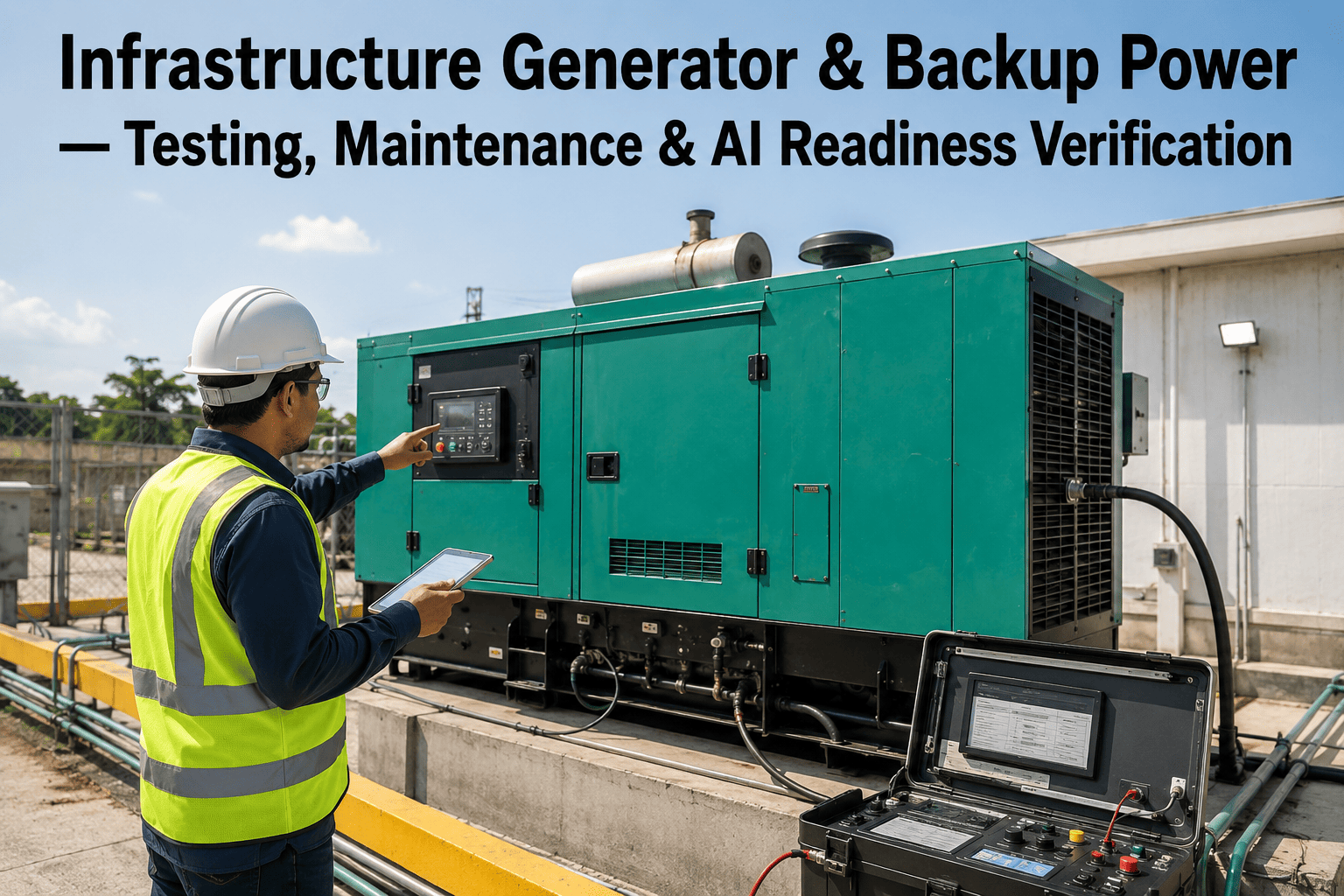
A grid outage during an ice storm is not the moment to discover that a backup generator's fuel has gone bad. It happens more often than maintenance managers like to admit: the weekly exercise cycle ran fine because it only demands a few minutes under light load, but nobody caught the microbial contamination quietly building in the diesel tank because the last full load bank test was over a year ago. Eight hours into the outage, the filters clog, the generator shuts down, and a water pump station or a signalized intersection goes dark at the exact moment the community needed it most. Municipal and infrastructure fleets running generators across water pump stations, traffic signal cabinets, lift stations and emergency facilities face this same exposure every outage season, because a generator that starts on Tuesday's test is not the same as a generator that can hold full rated load for two hours during a real event. Book a demo to see how AI-verified readiness catches the gap between "it started" and "it's actually ready."
Infrastructure Generator & Backup Power Readiness
Know Every Generator Is Actually Ready — Not Just That It Started
iFactory tracks exercise cycles, load bank test results and fuel condition across every generator protecting your water pump stations, traffic signals and critical facilities, and flags degradation weeks before a no-start event during the next outage.
99%+
Start reliability achievable with a tracked, automated testing program
30-50%
Reduction in unplanned standby failures with AI anomaly detection
35%
Typical drop in emergency maintenance cost versus reactive service calls
The NFPA 110 Testing Cadence Most Fleets Quietly Fall Behind On
Emergency and standby power systems under NFPA 110 carry a layered testing schedule, and it is the layer furthest out — the annual load bank test — that most municipal and infrastructure fleets let slip once a weekly exercise routine feels like enough. A generator can pass twelve straight weekly exercises under light load and still fail within the first hour of a genuine full-load event, because light-load running never reveals a fouled radiator, a weak alternator or fuel that has degraded past usability.
Weekly
Exercise Run
Level 1 systems run under light load to confirm the engine starts, charges batteries and maintains mechanical readiness.
Monthly
Load Verification
Transfer switch operation, voltage, frequency and run-time documentation confirm the system performs, not just starts.
Quarterly
Full Inspection
Fuel quality, coolant level, oil condition, belts and battery health are inspected beyond what a routine exercise reveals.
Annual
Full Load Bank Test
A resistive load bank confirms the generator can hold 100% of nameplate capacity for a sustained period, the single test most likely to be delayed.
What AI Readiness Verification Actually Tracks
Readiness verification is not a single dashboard light — it is a continuous read on every subsystem that determines whether a generator holds up under a real outage instead of just a scheduled exercise. See how the tracking model maps to your specific generator fleet and facility types.
Testing Calendar Automation
Every Weekly, Monthly, Quarterly And Annual Test Tracked Against Its Deadline
Each generator's full NFPA 110 testing cadence is scheduled automatically, and any missed exercise, skipped load verification or overdue annual load bank test generates an alert before it becomes a compliance gap discovered during an audit or, worse, during an outage.
Fuel System Monitoring
Tank levels, delivery schedules and polishing cycles are tracked continuously, catching contamination and water intrusion risk long before a filter clog shuts a generator down mid-outage.
Load Bank Test Records
Voltage, frequency and temperature readings from every load bank test are logged against the generator's history, showing performance drift year over year instead of a single pass or fail.
Anomaly Detection
AI flags patterns like a gradual drop in alternator output or a slow rise in coolant temperature during exercise cycles, weeks before those trends turn into a no-start event.
Critical Spares & Transfer Switch Health
Parts On Hand And Transfer Switches Verified Before They're Needed
Minimum stock levels for filters, batteries and alternator brushes trigger automatic reorder before a part-related delay stalls a repair, while automatic transfer switch operation is verified on every exercise cycle rather than assumed to work.
What's Actually At Stake When A Generator Doesn't Perform
The facilities backup generators protect are rarely optional infrastructure, and each one carries a different consequence profile when standby power fails to hold.
| Facility Type |
What Fails When The Generator Doesn't Hold |
Typical NFPA 110 Level |
| Water Pump Station |
Pumping capacity drops, risking low pressure, backflow risk and service interruption to residents. |
Level 1 or 2 depending on system criticality |
| Traffic Signal Cabinet |
Intersections revert to flashing or dark signals, sharply raising collision risk during outage-driven congestion. |
Level 2, distributed across many intersections |
| 911 Dispatch / EOC |
Emergency call handling and coordinated response capability is lost at the exact moment demand spikes. |
Level 1, mandatory weekly exercise |
| Water Treatment Plant |
Treatment processes halt, risking regulatory violations and public health exposure if outage extends. |
Level 1, continuous critical operation |
| Emergency Shelter |
Climate control, lighting and medical equipment support are lost for vulnerable residents relying on the shelter. |
Level 1 or 2 depending on shelter designation |
Why "It Started" Isn't The Same As "It's Ready"
Ask any maintenance manager how their generator fleet is doing and the honest answer is usually built on weekly exercise logs — a green checkmark that the engine turned over and ran for a few minutes. That checkmark answers one question: does the starter, the battery and the fuel line work well enough to crank the engine today. It does not answer the question that actually matters during a real outage: can this generator absorb full facility load and hold it for hours without the cooling system overheating, the alternator sagging, or the fuel supply degrading mid-run. Those two questions look similar on a maintenance log and are entirely different in practice, which is exactly why a fleet can show a clean testing record right up until the week it fails when it's needed most. Readiness verification exists to close that gap — turning a pass/fail exercise checkmark into a continuous read on whether each generator would actually perform under the load conditions a real emergency demands.
Stop Discovering Generator Problems During The Outage
iFactory tracks every test interval, fuel reading and load bank result across your fleet, and flags the ones drifting toward failure before the grid goes down.
Manual Testing Logs vs. AI-Verified Readiness
Most infrastructure generator programs already test — the gap is almost never a missing test, it's a missing feedback loop between what the test revealed and what happens next.
| Capability |
Paper Logs & Manual Tracking |
AI-Verified Readiness |
| Test Scheduling |
Spreadsheet reminders across dozens of generators, easy to miss during staffing gaps. |
Automated calendar per generator with escalating alerts as deadlines approach. |
| Load Bank Trend Visibility |
Pass/fail recorded on paper, with no easy way to see performance drift year over year. |
Voltage, frequency and temperature trended automatically across every annual test. |
| Fuel Condition |
Checked only during scheduled inspections, with contamination often found too late. |
Continuously monitored, with polishing cycles triggered before degradation reaches a critical threshold. |
| Failure Prediction |
None — the first sign of trouble is usually a failed start. |
Anomaly detection flags degrading alternator output or coolant trends weeks in advance. |
| Audit Readiness |
Compliance records assembled manually from paper logs ahead of every inspection. |
Digital test records export instantly, timestamped and complete by generator. |
Six Early Warning Signatures AI Catches Before A No-Start Event
Every generator failure has a build-up period, and most of that period is invisible to a technician glancing at a weekly exercise log. These are the signatures the system watches for continuously.
Alternator Output Drift
A gradual decline of even a few percentage points in output during exercise cycles signals winding or brush wear well before a failed load test.
Coolant Temperature Rise
Temperature trending upward across successive exercise runs points to radiator fouling or thermostat failure that will limit sustained full-load operation.
Fuel Contamination Risk
Water intrusion and microbial growth indicators in stored diesel are flagged before they reach the concentration that clogs filters mid-run.
Battery Voltage Decay
Slow-fading starting battery voltage between exercises is the single most common cause of a no-start event, and the easiest to catch early.
Transfer Switch Delay
Automatic transfer switch response time creeping past its rated window is tracked on every exercise, not assumed to still be within spec.
Oil Pressure Instability
Irregular oil pressure readings during start and run cycles surface lubrication issues before they cause engine damage under sustained load.
None of these six signatures are visible from a single weekly exercise log entry on their own. It is the trend across dozens of exercise cycles, load tests and fuel readings that turns a routine data point into an early warning, which is precisely the kind of pattern recognition that is impractical to sustain manually across a fleet spread over dozens of sites and multiple generator makes.
Getting A Generator Fleet Onto AI-Verified Readiness
Rollout is designed to fit around an existing testing program rather than replace it — the goal is visibility and prediction layered onto the compliance work your team is already doing. Most infrastructure and municipal fleets carry a mix of generator ages, manufacturers and controller types across water, traffic and emergency facilities, so onboarding is built to work with whatever is already installed rather than requiring a fleet-wide hardware swap before the first alert can fire. A pilot group proves the model against real testing cycles before the rest of the fleet follows, which keeps the rollout low-risk for teams that cannot afford a gap in emergency power coverage during the transition.
1
Asset Registry & Testing Calendar
Every generator, its NFPA 110 level and its current testing cadence is catalogued into a single fleet-wide registry.
2
Sensor & Telemetry Connection
Existing generator controllers, remote monitoring units and fuel sensors are connected, or added where a facility has none.
3
Baseline & Threshold Calibration
Normal ranges for alternator output, coolant temperature and fuel condition are established per generator model and age.
4
Pilot Fleet Monitoring
A subset of critical-facility generators runs live for a full testing cycle, validating alerts against real exercise and load bank results.
5
Fleet-Wide Rollout
Remaining generators onboard using the validated thresholds, with paper testing logs retired site by site.
A Water And Traffic Signal Fleet, Before And After
Municipal Public Works — 40+ Generators
From Ad-Hoc Service Calls To Predictable, Verified Readiness
A public works department covering water pump stations, traffic signal cabinets and an emergency operations center ran generator maintenance through a mix of paper logs and reactive service calls, with the annual load bank test frequently pushed back when staff were pulled onto storm response. Fuel condition was checked only during scheduled quarterly inspections, leaving months of blind exposure to contamination risk between visits. After every generator was brought onto a tracked testing calendar with fuel and performance monitoring, missed test intervals dropped close to zero within the first quarter, and two alternators showing early output drift were repaired during scheduled maintenance instead of failing during a subsequent outage.
0
Missed annual load bank tests after rollout
2
Alternator failures caught before a no-start event
35%
Reduction in emergency service call spend
What Maintenance Managers Say About AI Readiness Verification
We used to find out a generator had a problem the same week we needed it. Now the fuel and alternator trends tell us months ahead, during a normal Tuesday, not during a storm.
Public Works Maintenance Manager
Regional Municipal Utility
Tracking forty generators across water and traffic sites on spreadsheets meant something always slipped. The automated calendar alone paid for itself the first time it caught an overdue load bank test.
Facilities Operations Supervisor
County Infrastructure Department
Our auditors used to get a stack of paper logs. Now they get a timestamped export in minutes, and it's actually made our compliance conversations shorter, not longer.
Compliance & Emergency Preparedness Lead
City Emergency Management Office
Fuel contamination used to be something we only found out about mid-outage. Continuous tank monitoring changed that completely for our critical facilities.
Water Utility Maintenance Lead
Water Treatment Authority
Frequently Asked Questions
These are the questions maintenance managers ask most often when evaluating AI-verified readiness for a generator fleet spanning multiple critical facility types.
Does this replace our NFPA 110 testing program or run alongside it?
It runs alongside your existing program rather than replacing it. Weekly exercises, monthly load verification, quarterly inspections and the annual load bank test still happen exactly as required — the system automates the scheduling, captures the results digitally, and layers anomaly detection on top so you catch degradation between tests rather than only at them. Your testing cadence and compliance obligations under NFPA 110 stay the same; what changes is how much visibility you have into trends across that cadence.
Can it track generators across multiple facility types with different NFPA 110 levels?
Yes. Water pump stations, traffic signal cabinets, 911 dispatch centers and treatment plants are typically classified at different NFPA 110 levels with different testing intervals, and the platform tracks each generator against its own specific requirement rather than applying a single uniform schedule across a mixed fleet.
Talk to support about mapping your facility types to the correct testing tier.
How does fuel monitoring actually prevent a mid-outage shutdown?
Diesel fuel degrades over time through water intrusion and microbial growth, and that degradation is invisible during a short weekly exercise but becomes catastrophic during a sustained outage when filters clog under continuous demand. Continuous tank-level and condition tracking flags contamination risk early enough to schedule fuel polishing during routine maintenance, rather than discovering the problem eight hours into an emergency run when the generator is needed most.
What does the system flag if it isn't confident a reading indicates a real problem?
Anomaly detection is built around trends rather than single readings, so a one-time fluctuation in coolant temperature or alternator output does not automatically trigger a work order. The system looks for sustained drift across multiple exercise cycles before flagging a generator for inspection, which keeps alerts meaningful instead of adding noise your team learns to ignore.
How long does it take to get a full generator fleet onto the platform?
A pilot group of critical-facility generators typically runs live within the first few weeks, validated against a full exercise and inspection cycle before the rest of the fleet onboards.
Book a demo to see a rollout timeline sized to your generator count and facility mix.
Make Sure Every Generator Is Ready Before The Grid Goes Down
iFactory automates NFPA 110 testing schedules, tracks fuel and load bank performance, and flags degradation weeks before a no-start event across your water, traffic and critical facility generator fleet.
Every test interval tracked and alerted automatically
Fuel condition and load bank trends monitored continuously
Failure signatures flagged weeks before a no-start event
Digital, audit-ready compliance records by generator