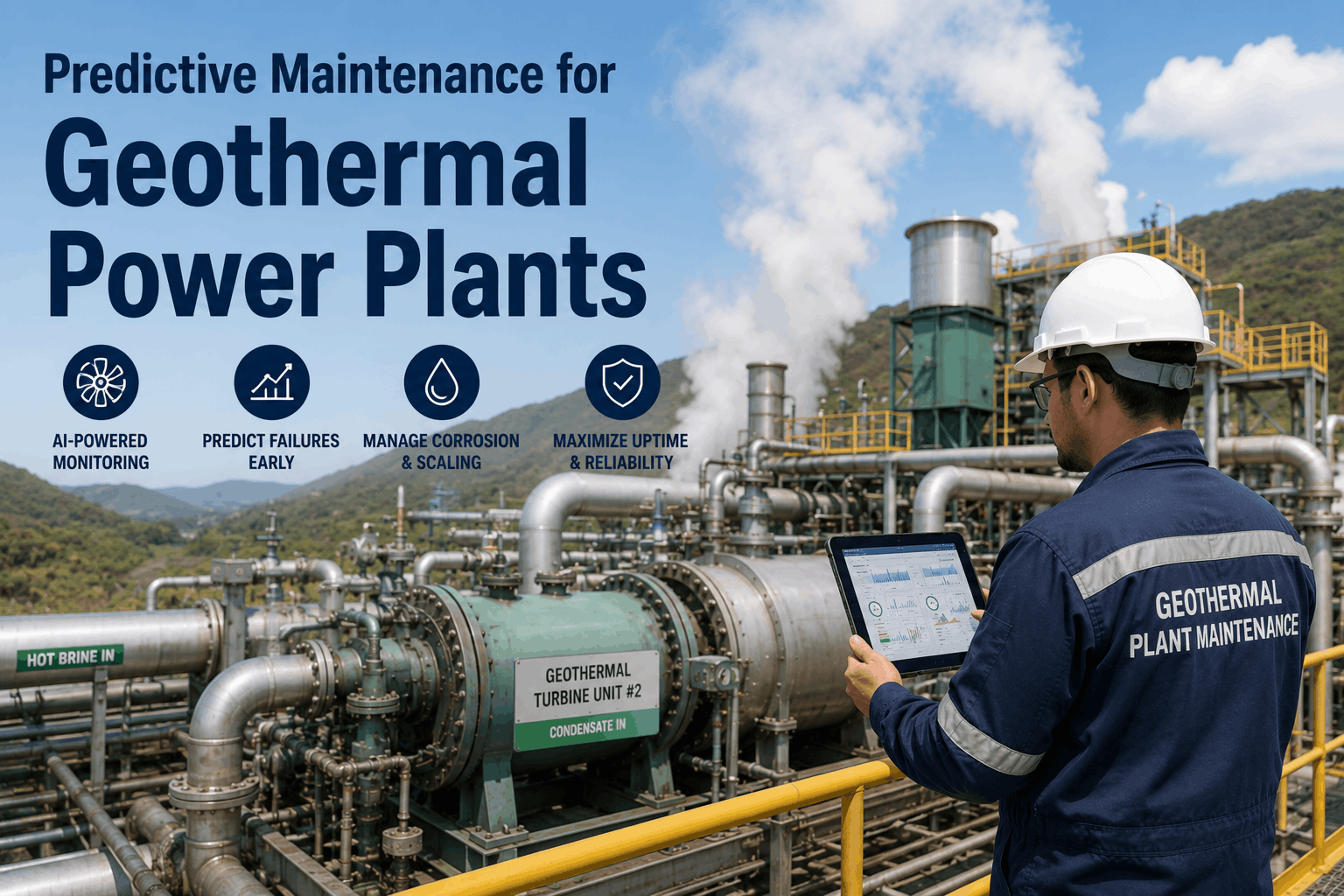
Geothermal power plants operate in environments that would degrade conventional industrial equipment in months — corrosive brine saturated with hydrogen sulfide, silica, and dissolved minerals flows through turbines, heat exchangers, and wellhead systems continuously, depositing scale and driving corrosion at rates that make annual inspection intervals far too infrequent. A turbine trip at a geothermal plant in a remote location is not a maintenance event that resolves quickly — spare part lead times, access constraints, and the chemical complexity of returning equipment to service can extend forced outages to weeks. AI monitoring changes the equation by detecting corrosion, scaling, and mechanical degradation months before they produce failures. Get iFactory Support to deploy AI predictive maintenance across your geothermal plant systems today.
Protect Geothermal Plant Revenue from Corrosion, Scaling, and Premature Equipment Failure
iFactory AI monitors turbines, brine pumps, heat exchangers, and wellhead equipment continuously — detecting corrosive degradation and scaling impact weeks before they cause forced outages in remote, high-consequence geothermal environments.
The Six Critical Geothermal Plant Systems AI Monitors
Geothermal plant reliability challenges are unlike those in any other power generation environment. The working fluid is not a controlled feedstock — it is naturally occurring brine whose chemistry varies with reservoir conditions, production rate, and seasonal factors. Equipment must be designed and maintained to handle this variability, and AI monitoring provides the continuous chemical-mechanical health picture that static inspection schedules cannot. Contact iFactory to configure monitoring appropriate for your specific brine chemistry, plant design, and generation capacity.
System 1
Steam and Binary Turbines
Geothermal steam turbines exposed to wet steam carrying brine droplets and non-condensable gases face blade erosion from silica and calcite particles, corrosion from hydrogen sulfide, and deposit accumulation on blade surfaces that alters the aerodynamic profile. Binary cycle turbines in ORC systems face refrigerant contamination from brine ingress. AI monitors turbine vibration, bearing temperatures, efficiency performance, and differential pressure across blade stages — detecting degradation 6–16 weeks before it forces a scheduled outage for inspection or cleaning.
System 2
Brine and Steam Injection Pumps
High-pressure brine injection pumps returning spent brine to the geothermal reservoir operate continuously in one of the most aggressive pump environments in the power industry — high-temperature brine saturated with minerals, dissolved gases, and scaling compounds. Impeller erosion-corrosion, mechanical seal failure in high-H₂S environments, and casing scaling each reduce pump efficiency and reliability. AI monitors pump efficiency, vibration, seal system performance, and discharge pressure — providing 4–10 weeks of detection lead time before pump failure interrupts reinjection operations.
System 3
Heat Exchangers and Brine-Steam Separators
Flash separators separating steam from brine at wellhead pressure and heat exchangers in binary plants are subject to silica and calcite scale deposition on internal surfaces. Scale buildup progressively reduces heat transfer efficiency and can cause flow restriction leading to pressure differential problems. AI monitors heat exchanger thermal performance ratios, separator pressure differential trends, and brine outlet temperature — detecting scale buildup 4–8 weeks before it requires chemical treatment or mechanical cleaning shutdown.
System 4
Wellhead and Production Equipment
Wellhead valves, flow control equipment, and production tubing exposed to geothermal brine face corrosion from hydrogen sulfide, scaling from silica and calcite, and erosion from sand and mineral particles in high-flow wells. AI correlates wellhead pressure and flow data with chemical treatment injection rates — detecting scale accumulation in production tubing and casing that reduces well productivity before it requires costly workovers or acid treatment programs.
System 5
Cooling Tower and Condenser Systems
Geothermal plant cooling towers handling brine-contaminated cooling water face accelerated scaling and biological fouling from the mineral-rich water chemistry. Condenser tube fouling progressively raises condensing pressure, reducing turbine output and efficiency. AI monitors condenser approach temperature, cooling tower fan performance, and circulating pump efficiency — detecting fouling onset 3–6 weeks before it causes measurable turbine output reduction or forced condenser cleaning outage.
System 6
H₂S Abatement and Emissions Systems
Hydrogen sulfide abatement systems — chemical scrubbers, thermal oxidizers, or H₂S conversion systems — must operate continuously to meet emissions compliance requirements. Equipment failures in H₂S abatement systems create both regulatory violations and safety hazards. AI monitors scrubber chemical dosing rates, reaction efficiency, exhaust H₂S concentration, and blower performance — detecting abatement system degradation before it creates compliance or safety incidents.
Geothermal Scaling and Corrosion: Detection Lead Times by Mechanism
Scaling and corrosion in geothermal equipment do not produce sudden failures — they produce progressive degradation that accelerates as deposits build and corrosion progresses. The table below maps each degradation mechanism to its AI detection method and the lead time available between first detection and operational impact. Book a demo to see how iFactory applies these detection methods to your specific plant chemistry and design.
Scroll for more →
| Degradation Mechanism | Affected Equipment | AI Detection Method | Detection Lead Time |
|---|---|---|---|
| Silica Scale Deposition | Heat exchangers, separators, pipework | Thermal performance ratio trending + pressure differential | 4–10 weeks before flow restriction |
| Calcite Scale (CaCO₃) | Production tubing, wellhead, brine circuits | Wellhead pressure vs flow correlation model | 6–14 weeks before well productivity impact |
| H₂S Corrosion | Turbine blades, pump casings, piping | Corrosion probe data + efficiency decline correlation | 8–20 weeks via wall thickness trend |
| Erosion-Corrosion (pumps) | Brine injection pumps, production pumps | Pump efficiency trend + vibration envelope | 4–8 weeks before efficiency failure |
| Turbine Blade Deposition | Steam turbine blade passages | Turbine stage differential pressure + output efficiency | 6–12 weeks before output reduction |
| Condenser Tube Fouling | Main condenser, pre-heaters | Condenser approach temperature trend | 3–6 weeks before output impact |
Geothermal AI Monitoring Performance Metrics
Turbine Availability Improvement
+6–11 Availability Points
Geothermal turbine forced outages from blade deposition, bearing failure, and seal degradation are the primary source of revenue loss in flash and binary cycle plants. AI monitoring converting emergency shutdowns to planned maintenance events — which can be timed to coincide with low-wind or low-hydro periods on the grid for minimum revenue impact — consistently achieves 6–11 percentage point improvements in turbine availability.
Turbine Output Recovery
3–7% Net Output Increase
Turbine blade deposition from brine carryover reduces turbine output progressively — a 10MW geothermal turbine may be producing only 9.3MW after six months of operation without cleaning. AI detection of efficiency decline enabling timely offline water washing or chemical cleaning recovers 3–7% of rated output that would otherwise be lost to deposition degradation over a 12-month operating period.
Well Productivity Preservation
4–9% Productivity Retention
Calcite scale in production tubing reduces well deliverability progressively — a geothermal well producing 250 tonnes/hour may drop to 220 tonnes/hour over 18 months without scale management. AI monitoring wellhead pressure-flow relationships detects early-stage tubular scaling and triggers inhibitor injection or mechanical descaling before productivity loss becomes severe enough to require expensive workover operations.
Chemical Treatment Cost Optimization
22% Chemical Cost Reduction
Geothermal chemical treatment programs for scale inhibition and corrosion control are often dosed at conservative rates regardless of actual scaling and corrosion activity. AI correlating brine chemistry data with actual equipment degradation rates optimizes inhibitor dosing — increasing dosing when conditions indicate high activity and reducing dosing during low-activity periods, achieving 22% average chemical treatment cost reduction while maintaining equivalent equipment protection.
Turbine and Wellhead Monitoring: The Revenue-Critical Applications
Turbine Aerodynamic Performance Trending Highest Revenue Impact
Geothermal turbine performance is characterized by the heat rate — the thermal energy input required per unit of electrical output. Blade deposition increases effective blade roughness, reduces blade passage flow area, and alters the inlet and outlet angles of flow — all increasing the heat rate and reducing electrical output at constant steam flow. AI tracks the turbine heat rate normalized against steam conditions (pressure, temperature, non-condensable gas content) and detects the performance slope consistent with blade deposition typically 6–12 weeks before output reduction becomes commercially significant.
Turbine Vibration and Bearing Health
Geothermal steam turbine bearings are exposed to brine droplets and non-condensable gas species that accelerate lubricant contamination and corrosion. AI monitors shaft vibration using proximity probes at journal bearing planes — tracking 1× synchronous vibration for unbalance from blade deposition (which creates a characteristic step-change when deposition sloughs), sub-synchronous instability from bearing oil film, and bearing temperature for direct thermal degradation indication.
Wellhead Pressure-Flow Productivity Model
Each geothermal well has a characteristic productivity index — the relationship between wellhead flowing pressure and production flow rate. Scale accumulation in the production tubing or wellbore reduces this productivity index over time. AI builds a wellhead productivity model for each well from historical pressure-flow data and detects deviations from the expected model — identifying wells developing tubular scaling or wellbore damage that warrant inhibitor treatment or mechanical intervention before deliverability loss requires a workover.
Brine Chemistry — Equipment Corrosion Correlation
iFactory correlates continuous online brine chemistry analyzer data (H₂S concentration, pH, chloride, silica, dissolved oxygen) with actual corrosion probe measurements and equipment condition indicators — building site-specific models that predict corrosion rates for different equipment materials under the actual brine chemistry conditions encountered. This closes the loop between chemistry monitoring and equipment maintenance planning, replacing generic corrosion allowances with data-driven predictions.
Non-Condensable Gas Monitoring
Non-condensable gases (NCG) — primarily CO₂, H₂S, and N₂ — accumulate in the turbine condenser and reduce the effective vacuum, increasing turbine backpressure and reducing output. AI monitors NCG extraction system performance — ejector or mechanical vacuum pump efficiency, condenser vacuum trend, and NCG flow rate — detecting extraction system degradation that allows NCG accumulation before condenser pressure rises to the level that forces turbine load reduction.
Brine Injection Pump Fleet Monitoring
Brine injection pump failures that interrupt reinjection operations create both regulatory compliance issues (in jurisdictions requiring full brine reinjection) and reservoir pressure management problems. AI monitors the full injection pump fleet using vibration analysis, motor current signature monitoring, and efficiency tracking — providing a prioritized maintenance queue based on actual pump condition rather than run-hours, optimizing the limited maintenance resources available at remote geothermal sites. Contact iFactory Support to configure injection pump fleet monitoring.
Geothermal Plant Monitoring Infrastructure
H₂S-Rated Enclosures
All iFactory hardware deployed at geothermal sites uses enclosures and cabling rated for H₂S-atmosphere exposure — preventing corrosion of electronics in high-H₂S machine room environments
PI Historian Integration
Direct connection to OSIsoft PI or equivalent process historians — consuming existing turbine, wellhead, and brine chemistry data without new instrumentation at most modern geothermal plants
Remote Site Connectivity
iFactory edge processing operates on satellite or LTE connectivity for remote geothermal sites — local AI processing ensures continuous monitoring even during communication outages
Multi-Well Dashboard
Unified wellfield monitoring dashboard showing productivity index, wellhead condition, and chemical treatment status for every production and injection well simultaneously
Geothermal Plant AI Deployment: 6-Phase Roadmap
01
Plant Data Availability Assessment
Audit available data in your plant PI historian or SCADA system against iFactory monitoring requirements. Most modern geothermal plants have turbine performance, wellhead pressure-flow, and brine chemistry data already available — the deployment task is connecting iFactory to these existing data streams and configuring the AI performance models rather than deploying new instrumentation.
02
Turbine Performance Model Configuration
Deploy turbine heat rate and vibration monitoring as the first application — turbines represent the highest revenue-per-unit-degradation equipment in the plant. Configure the thermodynamic performance model using turbine design data and establish the clean baseline during the first 30 days of monitoring. Blade deposition detection activates once the baseline is confirmed.
03
Wellfield Productivity Monitoring
Configure wellhead productivity models for each production well using 6–12 months of historical pressure-flow data from the PI historian. iFactory builds well-specific productivity index models automatically and begins detecting deviations from expected decline curves — distinguishing scale-induced productivity loss from normal reservoir depletion through the characteristic rate and pattern of productivity index change.
04
Brine Chemistry — Corrosion Integration
Connect online brine chemistry analyzer data (if available) and corrosion probe measurements to iFactory. Build the site-specific corrosion model correlating chemistry variables with measured corrosion rates for each equipment material class in your plant. This phase typically requires 60–90 days of concurrent chemistry and corrosion probe data to establish statistically valid correlation models.
05
Injection Pump Fleet Monitoring
Deploy vibration and motor current monitoring on the brine injection pump fleet. Inject pump sensors install without pump shutdown using clamp-on CT for current analysis and adhesive-mounted accelerometers for vibration. iFactory ranks injection pumps by condition — giving site maintenance teams a clear priority order for limited inspection and maintenance time in remote locations.
06
Overhaul Planning and Chemical Treatment Optimization
Use iFactory condition data to drive turbine overhaul timing, well treatment scheduling, and heat exchanger cleaning decisions — replacing fixed calendar schedules with evidence-based condition-driven planning. For geothermal plants on long-term power purchase agreements, AI-optimized maintenance scheduling maximizes energy generation during high-value periods and minimizes revenue loss from planned maintenance outages. Get iFactory Support to build your condition-based overhaul planning framework.
Frequently Asked Questions
How does AI monitoring handle the variability in geothermal brine chemistry between different wells and seasons?
iFactory builds individual models for each well and equipment item — not generic geothermal models applied uniformly. The AI performance models normalize against brine chemistry inputs (temperature, dissolved solids, H₂S concentration, pH) for each well, so changes in production conditions are accounted for before anomaly detection algorithms identify true equipment degradation versus chemistry-driven operating changes. This per-well, chemistry-aware approach is essential for accurate detection in variable geothermal environments.
Can AI predict when geothermal turbine blades need washing or cleaning?
Yes — this is one of the highest-value applications of AI at geothermal plants. The turbine heat rate performance model detects the efficiency slope characteristic of blade deposition and projects the time to a user-defined output loss threshold. Offline water washing scheduled based on this projection recovers full turbine output with minimal production loss — versus the traditional approach of washing on a fixed calendar that either washes too early (unnecessary production loss) or too late (greater cumulative output degradation).
How does iFactory operate reliably at remote geothermal sites with limited internet connectivity?
iFactory deploys edge processing hardware at each plant site that performs all AI analysis locally — the edge server does not require continuous internet connectivity to generate alerts and maintain monitoring. Alert notifications are queued and delivered when connectivity is available. The plant dashboard operates from the local edge server for on-site teams. Remote iFactory engineering teams access full data through scheduled synchronization rather than real-time streaming, which is appropriate for satellite-connected sites.
What is the typical forced outage duration at a geothermal plant and how does AI monitoring change this?
Geothermal turbine forced outages average 7–21 days due to the combination of remote location, complex chemical cleanup required before internal inspection in H₂S environments, and long spare parts lead times for geothermal-specific components. AI monitoring converting forced outages to planned outages reduces this to 3–7 days by allowing advance parts procurement, contractor scheduling, and outage preparation — the same repair takes a fraction of the time when planned versus reactive.
Protect Geothermal Plant Revenue from Corrosion, Scaling, and Forced Outages
iFactory AI detects turbine blade deposition, wellbore scaling, and pump degradation weeks before they force outages in your geothermal plant — converting emergency repairs into planned maintenance and recovering output lost to progressive equipment degradation.