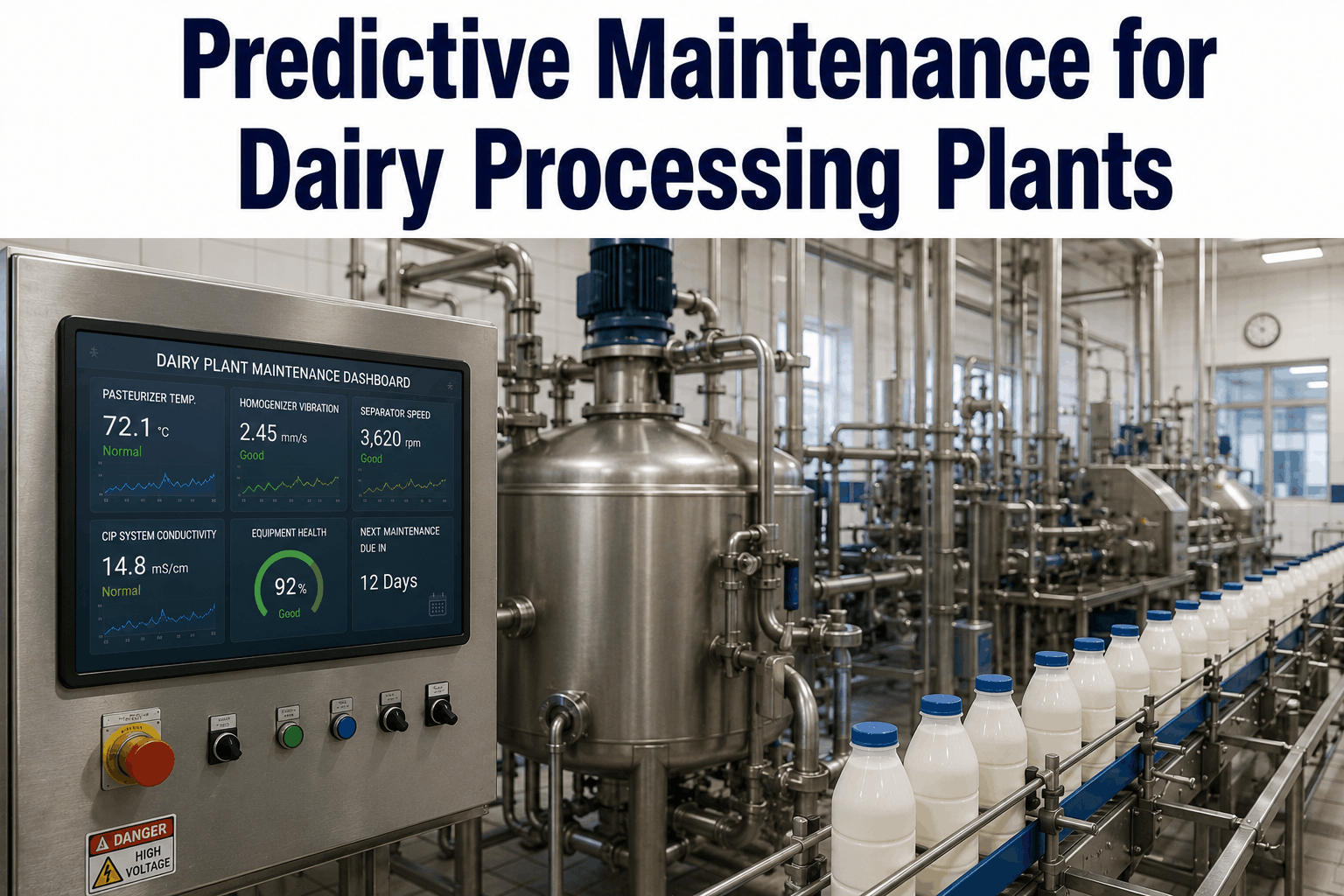
Dairy processing plants operate at the intersection of food safety regulation, temperature-sensitive product biology, and 24-hour production schedules that leave no room for unplanned stops. A pasteurizer temperature excursion does not just require a repair — it requires product hold, regulatory notification, and potential recall depending on the nature and duration of the deviation. A separator bearing failure during the early morning raw milk intake processing backs up farm collection and creates raw material spoilage. AI monitoring in dairy operations protects not just uptime but the entire chain of product safety compliance that governs every shift. Get iFactory Support to deploy AI predictive maintenance across your dairy processing equipment today.
Protect Dairy Product Safety and Prevent Compliance Violations with AI
iFactory AI monitors pasteurizers, separators, homogenizers, and CIP systems under dairy hygiene requirements — detecting equipment degradation before it creates product loss, temperature deviations, or FSMA compliance failures.
The Six Critical Dairy Processing Systems AI Monitors
Dairy processing equipment failure carries a double consequence — production downtime plus food safety compliance risk. Equipment that can be repaired and restarted in a conventional manufacturing plant may require product hold, laboratory testing, and regulatory notification before dairy production can resume. AI monitoring that detects degradation early enough to allow planned maintenance eliminates both the downtime cost and the compliance exposure that reactive repair creates. Contact iFactory to configure monitoring that meets your specific HACCP and FSMA compliance framework.
System 1
Pasteurization Systems
HTST and UHT pasteurizers must deliver validated temperature-time profiles for every unit of product processed. Plate heat exchanger fouling, flow diversion valve degradation, and temperature sensor drift each create risks of pasteurization deviation — a regulatory notifiable event requiring product hold and laboratory testing. AI monitors heat exchanger thermal performance, valve response times, and temperature sensor agreement continuously, detecting pre-deviation conditions before they cross the pasteurization failure threshold.
System 2
Cream Separators
High-speed centrifugal separators processing raw milk at 5,000–10,000 RPM are among the most mechanically demanding dairy processing assets. Disc stack wear affects separation efficiency. Bearing degradation at operating speeds creates both product quality and safety risks. AI monitors separator vibration signatures, bearing temperature, and milk fat separation efficiency — detecting mechanical degradation and separation performance loss before either creates a product quality failure or catastrophic mechanical event.
System 3
Homogenizers
High-pressure homogenizers processing milk at 100–300 bar rely on piston pump mechanisms, homogenizing valves, and pressure management systems that wear progressively under high-cycle operation. Valve seat wear reduces homogenization efficiency and produces particle size distribution shift in finished products. AI monitors homogenizer pump pressure profiles, valve impact signatures, and pressure uniformity across stages — detecting wear-related performance drift 3–6 weeks before it affects product specification.
System 4
CIP Systems
Clean-in-place systems delivering precisely controlled caustic, acid, and sanitizer cycles to all product-contact surfaces are both regulatory requirements and the primary defense against microbial contamination in dairy operations. Pump wear, spray ball blockage, heat exchanger fouling, and chemical dosing system failure each compromise CIP effectiveness. AI monitors every CIP cycle against validated parameters — flagging deviations that require investigation before product contact surfaces are returned to service.
System 5
Evaporators and Dryers
Spray dryers and falling-film evaporators producing milk powder, whey powder, and concentrated products operate with thermal systems that are subject to fouling, scaling, and mechanical wear. Atomizer wear in spray dryers affects powder particle size distribution. Evaporator heat exchanger fouling reduces concentration efficiency. AI monitors thermal performance ratios, atomizer speed stability, and product outlet temperature — detecting efficiency losses and atomizer degradation before they affect product specification compliance.
System 6
Refrigeration and Cold Store Systems
Dairy product refrigeration — raw milk reception tanks, pasteurized product storage, and cold store rooms — requires temperature maintenance within strict regulatory limits at all times. Compressor degradation, evaporator coil ice accumulation, and expansion valve wear each reduce refrigeration capacity. AI monitors compressor efficiency, cold store temperature trends during demand peaks, and refrigeration system capacity reserve — detecting capacity loss before it creates temperature exceedances in product storage areas.
Dairy Compliance and Product Safety: The Regulatory Stakes
Dairy processing operates under FSMA Preventive Controls for Human Food, PMO (Pasteurized Milk Ordinance) requirements, and HACCP plans that mandate specific monitoring, corrective action, and documentation at every critical control point. Equipment failures at CCPs — pasteurizers, separation systems, and cold storage — trigger specific regulatory obligations that AI monitoring is designed to prevent. Book a demo to see how iFactory supports your HACCP documentation and FSMA compliance program.
Scroll for more →
| Equipment / CCP | Failure Consequence | Regulatory Obligation | iFactory Prevention |
|---|---|---|---|
| HTST Pasteurizer | Temperature deviation below minimum pasteurization threshold | PMO product hold, FDA notification, laboratory testing before release | Heat exchanger fouling detection 3–6 weeks early |
| Flow Diversion Valve | Failure to divert under-processed product | Critical CCP failure — mandatory product hold and investigation | Valve response time trending, actuator wear detection |
| Cold Store Refrigeration | Storage temperature above regulatory maximum | Product hold, shelf-life reassessment, potential recall | Compressor capacity trending, pre-exceedance alert |
| CIP System | Out-of-spec cleaning cycle — inadequate time, temperature, or concentration | FSMA Preventive Controls — corrective action and investigation required | Per-cycle parameter compliance monitoring |
| Raw Milk Reception Tank | Temperature exceedance — received milk quality compromise | PMO raw milk temperature limits — acceptance/rejection decision | Tank cooling system performance trending |
| Separator | Disc wear — bacteria and somatic cell separation failure | Clarification efficiency affects downstream product specification | Vibration envelope + separation efficiency monitoring |
AI Monitoring Performance: Dairy Processing Outcomes
Pasteurization Deviation Events
91% Reduction in Deviations
AI pasteurizer monitoring that detects heat exchanger fouling onset 3–6 weeks before it causes pasteurization temperature deviation eliminates the majority of PMO-reportable pasteurization events. The 9% residual events represent sudden equipment failures (valve actuator seizure, sensor failure) that even continuous monitoring provides insufficient lead time to prevent — but which are still detected faster than alarm-based systems.
Separator Mechanical Downtime
68% Reduction
Cream separator bearing failures are the dominant source of mechanical downtime in raw milk processing. AI vibration monitoring on high-speed separator bearings converts emergency bearing replacements — which require complete separator disassembly and sterilization before restart — into planned maintenance events during scheduled CIP windows, achieving 68% reduction in separator-related production losses.
CIP Cycle Compliance Rate
99.7% Parameter Compliance
AI monitoring every CIP cycle parameter — temperature, chemical concentration, flow rate, and contact time — against validated procedure requirements catches out-of-spec cycles immediately for corrective action before product contact surfaces are returned to service. Manual review of CIP cycle records catches deviations only during post-shift record review — after the affected surfaces may already be in product contact.
Homogenizer Uptime
+16 OEE Points
Homogenizer piston pump and valve wear causing unplanned stops is the leading source of OEE loss in dairy homogenization. AI detecting pressure profile deviations indicating valve seat wear and piston seal degradation 3–6 weeks before production impact converts 80% of homogenizer unplanned stops into planned maintenance events — delivering a consistent 16-point OEE improvement across dairy plants with iFactory deployed on homogenizer systems.
Pasteurizer and CIP Monitoring: The Compliance-Critical Applications
HTST Pasteurizer Thermal Performance Highest Compliance Risk
HTST pasteurizer plate heat exchanger fouling is the primary mechanism causing pasteurization temperature deviation events. Dairy protein and mineral fouling deposits progressively reduce the heat transfer coefficient — requiring the system to compensate by reducing throughput or increasing heating media temperature until thermal capacity is exhausted and the outlet temperature falls below the minimum pasteurization requirement. AI tracks the LMTD efficiency ratio continuously, detecting fouling onset at the 5% efficiency decline threshold — typically 3–6 weeks before it would cause a temperature deviation event at normal throughput.
Flow Diversion Valve Response Monitoring
The flow diversion valve — the critical safety device that redirects under-processed product away from the final product line — must respond within milliseconds to a temperature deviation signal. Actuator wear, seal degradation, and positioner calibration drift each increase valve response time or cause partial stroke failure. AI monitors valve stroke time on every transition event against the validated response time specification — detecting actuator degradation before it affects the valve's ability to perform its critical safety function.
CIP Cycle Parameter Real-Time Validation
iFactory validates each CIP cycle phase against the validated procedure parameters — caustic concentration, temperature, flow rate, and contact time for the pre-rinse, caustic wash, intermediate rinse, acid wash, and final rinse phases. Any phase that does not meet the validated parameters generates an immediate alert and creates an exception record in the CIP compliance log. This real-time validation replaces post-shift manual review with in-cycle detection that allows corrective action — such as extending a short contact time — before the cycle completes.
Separator Disc Stack and Bearing Health
High-speed separator bearings operating at 5,000–10,000 RPM require vibration monitoring with high-frequency resolution — defect frequencies at these speeds fall in the ultrasonic range for many bearing sizes. AI uses high-frequency vibration envelope analysis and temperature monitoring to detect bearing defects at the earliest possible stage, combined with throughput-normalized separation efficiency tracking that detects disc stack wear before it affects clarification or standardization specifications.
Homogenizer Pressure Profile Analysis
Homogenizer valve seat wear and piston seal degradation both manifest as changes in the pressure profile during each piston stroke cycle — pressure build-up rate, peak pressure consistency, and pressure release profile all deviate from the baseline signature as wear progresses. AI decomposes the high-frequency pressure signal from the homogenizer head instrumentation to extract these profile features per cycle — detecting wear-induced changes that predict valve or seal failure 3–6 weeks before a production-stopping failure event occurs.
Cold Store and Refrigeration Capacity Monitoring
Dairy product cold store refrigeration requires temperature maintenance within regulatory limits (typically <4°C for pasteurized milk) at all times — including during ambient temperature peaks in summer and during high product throughput periods. AI tracks compressor efficiency, cold store pull-down time after loading, and temperature recovery rate after door opening events — detecting capacity loss before it creates temperature exceedances during demand peaks. Contact iFactory Support to configure cold store monitoring for your regulatory temperature limits.
Dairy Plant Monitoring Infrastructure
Food-Grade Sensor Materials
All iFactory sensors in product-zone proximity use food-grade material housings compliant with FDA 21 CFR requirements — no sensor material contact risk with dairy product contact surfaces
FSMA Documentation
iFactory generates FSMA Preventive Controls-compliant monitoring records for pasteurizer performance, CIP cycle compliance, and cold store temperature — ready for regulatory inspection
SCADA and DCS Integration
Direct integration with dairy plant SCADA and DCS historians — connecting to existing pasteurizer, CIP, and separator instrumentation without duplicating sensor infrastructure
CIP Cycle Library
Pre-configured CIP validation models for common dairy CIP programs — caustic-acid-sanitizer, acid-caustic, and allergen cleaning protocols — reducing compliance configuration time
Dairy Plant AI Deployment: 6-Phase Implementation
01
HACCP CCP Equipment Prioritization
Begin by identifying every piece of equipment associated with a Critical Control Point in your HACCP plan. Pasteurizers, flow diversion valves, and cold store refrigeration systems at CCPs receive first-priority monitoring deployment — equipment failure at a CCP has the highest consequence profile in the facility and the most stringent regulatory documentation requirements.
02
Pasteurizer Integration Pilot
Connect iFactory to your HTST pasteurizer control system to begin heat exchanger thermal performance monitoring. Most dairy pasteurizer systems have all required data — flow rate, inlet and outlet temperatures, and heating media temperature — available in the pasteurizer PLC or SCADA historian. iFactory's pasteurizer fouling model begins trending from the first full operating shift, establishing the baseline clean efficiency ratio.
03
CIP System Validation Monitoring
Configure CIP cycle monitoring using existing conductivity, temperature, and flow transmitters in your CIP circuit. iFactory maps your validated CIP procedures into the monitoring model — specifying the acceptance criteria for each parameter in each cycle phase. Real-time cycle validation begins immediately, generating compliance records automatically without additional operator data entry.
04
Separator and Homogenizer Monitoring
Install vibration sensors on cream separator bearing housings and connect homogenizer head pressure transducer data to iFactory. These two systems represent the highest-frequency mechanical failure sources after pasteurizers in most dairy plants. Separator sensors install in 2–4 hours without machine shutdown using magnetic or adhesive mounting on bearing housing access points.
05
Cold Store and Refrigeration Monitoring
Deploy cold store temperature arrays and connect refrigeration compressor performance monitoring. iFactory integrates with existing cold store temperature loggers where installed — adding AI trend analytics on top of existing regulatory temperature logging rather than replacing it. New temperature sensors use wireless transmission to avoid running cables through cold store insulation panels.
06
FSMA Documentation and Audit Readiness
Configure iFactory to generate FSMA Preventive Controls monitoring records in the format required for your facility's food safety plan. AI monitoring records for pasteurizer performance, CIP compliance, and cold store temperature form a continuous, automatically timestamped documentation package that is available for regulatory inspections and third-party food safety audits without manual report assembly. Get iFactory Support to configure your FSMA documentation package.
Frequently Asked Questions
What is a pasteurization deviation event and what are the regulatory consequences?
A pasteurization deviation occurs when the pasteurizer fails to deliver the minimum required temperature-time combination to all product — in HTST pasteurization, typically 72°C for 15 seconds. PMO requirements mandate that a properly functioning flow diversion valve must redirect the under-processed product, that the deviation be documented, and that the cause be investigated before full production resumes. Product that may have been incompletely pasteurized must be held pending laboratory testing or destroyed. iFactory's pasteurizer monitoring prevents the conditions that cause deviations rather than documenting them after they occur.
Can AI monitoring be used as evidence in a FSMA Preventive Controls corrective action record?
Yes. iFactory generates time-stamped monitoring records that document equipment operating status, parameter values, and any alert conditions for every production shift. These records constitute monitoring evidence under FSMA Preventive Controls requirements — demonstrating that the preventive control was monitored at the required frequency and that any deviations were detected and addressed through documented corrective actions. The records are retained in iFactory's secure audit trail for the FDA-required minimum retention period.
How does iFactory handle the hygienic design requirements for dairy processing environments?
iFactory sensors deployed in dairy processing areas use stainless steel or food-grade polymer housings with IP69K washdown ratings — resisting the high-pressure, high-temperature washdown procedures used in dairy plant cleaning. Sensors are not installed in product contact zones; they mount on equipment housings, bearing housings, and pipework exteriors. All electrical connections in wet processing areas use rated watertight connectors appropriate for food processing environments.
Can iFactory monitor spray dryers and evaporators in dairy powder production?
Yes. Spray dryer atomizer speed and power draw monitoring detects atomizer wear and bearing degradation. Evaporator thermal performance monitoring tracks heat exchanger fouling rate. Both are standard iFactory monitoring applications for dairy powder facilities — spray dryer atomizer monitoring typically provides 2–5 weeks of wear detection lead time before atomizer failure causes particle size distribution failure in the finished powder product.
How does iFactory integrate with existing dairy plant process control systems?
iFactory connects to dairy plant SCADA and DCS historians via OPC-UA, Modbus, or direct PI server connection — consuming existing process instrumentation data without duplicating sensor infrastructure. For pasteurizers, separators, and CIP systems that have their own dedicated control systems, iFactory uses the available communication interface of each system. Most modern dairy processing equipment suppliers provide OPC-UA server interfaces that iFactory connects to directly.
Protect Product Safety and Production Continuity in Your Dairy Plant
iFactory AI gives dairy processing teams weeks of early warning on pasteurizer fouling, separator bearing wear, and CIP system failures — before equipment degradation creates a compliance event or stops your production line.