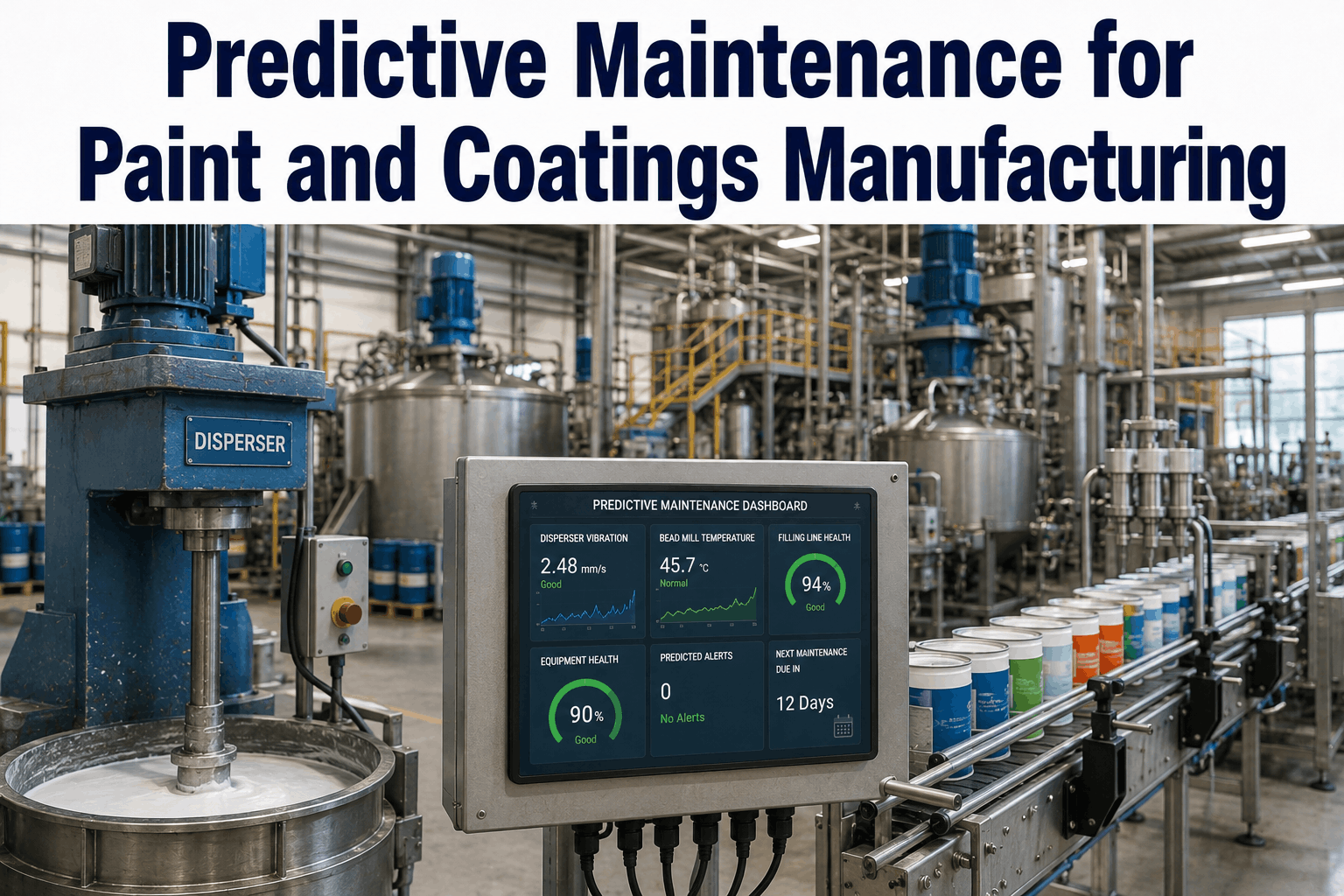
Paint and coatings manufacturing runs on tight batch tolerances — a disperser running with worn bearings transmits contamination into a white architectural finish, a bead mill with degraded media produces particle size distributions outside specification, and a filling line with worn valve seats creates fill weight variation that triggers customer complaints and costly rework. Equipment degradation in paint plants does not just cause downtime — it causes batch failures that cannot be recovered once the product has been processed. Get iFactory Support to deploy AI predictive maintenance across your paint and coatings production lines today.
Prevent Batch Contamination and Maintain Product Consistency with AI
iFactory AI monitors dispersers, bead mills, filling lines, and solvent recovery systems continuously — detecting equipment degradation before it compromises batch quality or stops your production lines.
The Six Critical Paint Plant Equipment Systems AI Monitors
Paint and coatings manufacturing involves a sequence of size reduction, dispersion, and filling operations where each stage's output quality depends directly on equipment precision. Mechanical wear that changes dispersion energy, particle size, or filling accuracy translates immediately into product quality deviation — making condition monitoring at each stage essential for batch consistency. Contact iFactory to configure monitoring for your specific production process and product range.
System 1
High-Speed Dispersers
Cowles disperser blades rotating at 500–2,000 RPM are the workhorse of paint manufacturing — processing hundreds of batches annually. Blade wear changes dispersion efficiency and energy input per batch. Bearing degradation introduces metal contamination into pigment dispersions. AI monitors motor current signatures, vibration spectra, and power draw per batch — detecting blade wear and bearing degradation before they affect dispersion quality or create contamination risk.
System 2
Horizontal Bead Mills
Bead mills grinding pigment dispersions to target particle size distributions rely on media loading, agitator disc condition, and rotor speed for consistent fineness of grind output. Media degradation from bead fracture changes the energy transfer characteristics. Disc wear alters the flow pattern inside the mill chamber. AI monitors mill motor power consumption normalized against batch throughput — detecting performance drift that precedes fineness of grind specification failure.
System 3
Let-Down Tanks and Agitators
Let-down agitators incorporating pigment paste into base paint must maintain consistent mixing energy throughout the let-down process. Agitator seal failures introduce air into product causing foam and gloss defects. Gearbox wear changes agitator speed under load. AI monitors agitator motor current draw profiles against batch-specific baselines — flagging seal degradation symptoms and gearbox efficiency loss that affect batch-to-batch consistency.
System 4
Filling and Canning Lines
High-speed volumetric and gravimetric filling systems filling 1L to 20L containers must maintain fill weight accuracy within ±0.5% across thousands of containers per shift. Valve seat wear, pump diaphragm fatigue, and nozzle clogging each cause fill weight drift that creates underweight complaints or overfill waste. AI monitors individual fill station cycle times and weight signal statistics — detecting wear-related fill drift before it reaches the specification limit.
System 5
Solvent Recovery Systems
Solvent recovery stills and condensers processing solvent from cleaning operations and product changeovers represent both an environmental compliance obligation and a significant cost recovery asset. Still heater degradation, condenser fouling, and vacuum pump wear each reduce recovery efficiency. AI monitors still temperature profiles, condenser outlet temperature, and vacuum pump performance — detecting efficiency losses that increase solvent purchase costs and waste disposal volumes.
System 6
Raw Material Handling Pumps
Positive displacement and centrifugal pumps transferring resins, solvents, pigment slurries, and additives are critical to batch accuracy and production flow. Pump wear affects transfer rate accuracy and creates pressure variation that affects batch uniformity in metered addition sequences. AI monitors pump motor current and flow rate consistency — detecting diaphragm fatigue, impeller wear, and seal degradation across the full raw material transfer pump fleet.
Paint Plant Failure Modes: Equipment Condition to Product Quality Impact
In paint manufacturing, the path from equipment degradation to product quality failure is often short and non-recoverable. The table below maps each critical failure mode to its product quality consequence and the AI detection method that intercepts it before batch impact occurs. Book a demo to see how iFactory maps these failure modes against your specific production process.
Scroll for more →
| Equipment | Failure Mode | Product Quality Impact | AI Detection Method |
|---|---|---|---|
| Cowles Disperser | Blade wear / bearing contamination | Coarse grind, metal specks in white or light-tint products | Motor current profile + vibration envelope |
| Bead Mill | Media fracture / disc wear | Fineness of grind failure, particle size distribution widening | Specific energy consumption trend per batch |
| Let-Down Agitator | Mechanical seal failure | Air entrainment, foam defects, gloss reduction | Motor current variation + seal flush flow monitoring |
| Filling Valve | Valve seat wear / nozzle clogging | Fill weight deviation, underweight compliance failure | Per-station cycle time statistics + weight trend |
| Solvent Recovery Still | Heater element fouling / vacuum pump wear | Reduced recovery efficiency, off-spec recovered solvent | Temperature profile + vacuum level trending |
| Resin Transfer Pump | Diaphragm fatigue / strainer blockage | Metered addition inaccuracy, batch viscosity variation | Flow rate consistency + motor current trend |
AI Monitoring Performance: Paint Plant Production Outcomes
Batch Contamination Events
80% Reduction Achieved
Bearing-related contamination events in dispersers and bead mills — the primary source of metal particle contamination in light-tint and white coatings — decrease by 80% when AI bearing condition monitoring replaces fixed-interval bearing replacement. Early detection prevents bearings reaching the spalling stage where debris enters the product stream.
Bead Mill Fineness Failure Rate
65% Fewer Specification Failures
Bead mill specific energy consumption trending detects media degradation and disc wear 3–6 weeks before fineness of grind output crosses specification limits. Catching mill performance drift at the advisory stage — before product testing fails — allows media replenishment and disc inspection to be scheduled in the next available maintenance window rather than during an emergency batch hold.
Filling Line Uptime
+14 OEE Points Average
Filling line unplanned stoppages from valve seat wear, nozzle clogging, and conveyor drive failures account for 60–70% of filling line availability losses in paint plants without condition monitoring. AI detecting these failure modes 1–3 weeks before production impact converts emergency repairs into planned maintenance events — driving filling line OEE from an industry average of 71% to 85% in plants with iFactory deployed.
Solvent Recovery Rate
92% Recovery vs 74% Unmanaged
Solvent recovery system efficiency monitoring catches heater fouling and vacuum pump degradation before they reduce recovery rate below economic break-even thresholds. Maintaining still efficiency above 90% recovery rate represents significant annual solvent purchase cost avoidance and reduces hazardous waste disposal volumes — both operating cost and environmental compliance improvements in a single monitoring application.
Disperser and Bead Mill Monitoring: The Quality-Critical Applications
Disperser Motor Current Signature Analysis Primary Detection
High-speed disperser motor current carries the signature of blade loading, bearing condition, and mechanical imbalance simultaneously. AI decomposes the current spectrum to extract: running speed harmonics that reveal blade or shaft imbalance, bearing defect frequencies at the cage, inner race, and outer race, and low-frequency power variation that indicates blade wear affecting dispersion efficiency. All three indicators are extractable from a single current transformer without additional sensors on most installations.
Bead Mill Specific Energy Trending
A bead mill's grinding efficiency — the energy required to produce a unit reduction in particle size — is determined by media loading, media size distribution, disc condition, and product flow rate. AI normalizes measured power consumption against throughput and product type to calculate specific energy per batch. Progressive increase in specific energy at constant product specification indicates media or disc degradation requiring intervention before fineness of grind output degrades.
Filling Station Per-Valve Cycle Analysis
Rotary filling machines have individual valve assemblies per filling head — and each valve wears at a different rate depending on product abrasivity, cleaning cycle frequency, and mechanical loading. AI tracks the open-to-close cycle time for each filling valve independently, identifying individual stations with timing drift that indicates seat wear or actuator degradation. Replacing worn individual valves during planned cleaning windows eliminates the fill weight variation that drives underweight complaints.
Agitator Mechanical Seal Health
Mechanical seals on let-down and tinting tank agitators are exposed to abrasive pigment slurries and aggressive solvent-borne formulations that accelerate seal face wear. Seal failure introduces air into the product and, in solvent-borne products, creates volatile organic compound emission pathways. AI monitoring seal flush liquid flow rate and pressure differential — combined with agitator motor current — detects seal degradation 2–4 weeks before breakthrough failure requiring emergency shutdown.
Solvent Recovery Still Efficiency Model
The thermal efficiency of a solvent recovery still is described by its evaporation rate per unit of heating energy input. Fouling of heat transfer surfaces from tar and resin deposition reduces this ratio progressively. AI tracks the efficiency ratio trend and projects the time to reach the cleaning threshold — allowing still cleaning to be scheduled between production campaigns rather than reacting to efficiency collapse that reduces recovery rate below viable thresholds during peak solvent generation periods.
Raw Material Pump Fleet Monitoring
Paint plants operate large fleets of transfer pumps handling materials ranging from water and light solvents to high-viscosity resins and abrasive pigment slurries. iFactory deploys motor current signature analysis across the full pump fleet — providing bearing and wear detection for every pump without the cost of individual vibration sensor sets. Contact iFactory Support to configure fleet-wide pump monitoring for your plant.
Paint Plant Monitoring Infrastructure
MCS Current Analysis
Motor current signature analysis covers dispersers, mills, agitators, and pumps from a single clamp-on CT — no motor shutdown, no mechanical disassembly required for installation
Batch-Level Analytics
AI compares equipment performance per batch — not just per shift — identifying which specific batches were processed under degraded equipment conditions for quality traceability
ERP and LIMS Integration
iFactory integrates with production ERP and laboratory LIMS systems — correlating equipment condition events with batch quality test results to build the predictive quality model
ATEX-Rated Sensors
All iFactory sensors deployed in solvent-handling areas of paint plants are ATEX Zone 1 or Zone 2 certified — meeting the explosion protection requirements of paint manufacturing environments
Paint Plant AI Deployment: 6-Phase Implementation
01
Product Quality Risk Mapping
Begin by mapping equipment failure modes to product quality consequences rather than just downtime costs. In paint manufacturing, bearing contamination in white dispersers and fineness failures in premium coatings carry higher cost consequences than equivalent failures in industrial primer lines. This risk-weighted view drives deployment priority to equipment where failure has the highest quality and commercial impact.
02
Disperser and Mill Pilot Deployment
Deploy iFactory motor current analysis on your highest-throughput dispersers and bead mills first. These assets process the most batches annually, accumulate wear fastest, and have the highest contamination consequence per failure event. Run the pilot for 60 days to establish per-asset baselines and validate that AI alert thresholds match your quality testing cadence.
03
Filling Line Integration
Connect iFactory to your filling line PLC to extract per-valve fill cycle data. Most modern paint filling lines have this data available in the line controller — iFactory reads it via OPC-UA or Modbus without additional instrumentation. Per-valve cycle time trending begins immediately upon connection, providing the fill weight deviation early warning that prevents compliance failures and overfill waste simultaneously.
04
Solvent Recovery Monitoring
Install temperature transmitters on still inlet, outlet, and condenser if not already present, and connect to the existing vacuum pump motor supply. iFactory's solvent recovery efficiency model begins trending from the first full operating cycle — establishing the clean baseline efficiency ratio against which subsequent fouling-related decline is detected and quantified in cost terms.
05
Pump Fleet Coverage Expansion
Expand motor current analysis to the full raw material transfer pump fleet — resin, solvent, and additive pumps. MCSA deployment is fast at this stage because the infrastructure is already established from the disperser pilot. iFactory prioritizes monitoring resources by pump criticality: pumps in the critical path of scheduled batch production receive higher monitoring priority than utility transfer pumps.
06
Quality Correlation Analysis
After 3–6 months of concurrent equipment monitoring and batch quality data, iFactory builds statistical correlation models between equipment condition indicators and laboratory quality test results. These models enable predictive quality alerts — flagging batches processed under borderline equipment conditions for priority quality testing before they reach packaging. Contact iFactory Support to configure quality correlation analytics for your plant.
Frequently Asked Questions
How does AI detect metal contamination risk in dispersers before it affects product?
Bearing spalling — the failure mode that releases metal particles into product — is preceded by weeks of bearing defect frequency development in the vibration and current signature. iFactory detects outer race, inner race, and cage defect frequencies at the stage when bearing damage is localized and contained within the bearing housing — before debris migrates into the product contact zone of the disperser. The detection window is typically 3–8 weeks before contamination risk develops.
Can iFactory detect when a bead mill needs media replenishment before product quality is affected?
Yes. Bead media wear and fracture progressively reduce the active grinding surface area and change the energy transfer characteristics of the mill. The specific energy consumption required to achieve a given fineness of grind increases measurably as media degrades — typically by 5–15% before product testing detects the fineness failure. iFactory's specific energy trend model triggers a media inspection recommendation at the 8% increase threshold — before quality impact occurs.
Are iFactory sensors suitable for use in solvent-handling areas of paint plants?
Yes. iFactory sensors and gateway hardware deployed in solvent-handling areas are ATEX Zone 1 or Zone 2 certified depending on location classification. Current transformers on motor supply cables outside the hazardous area boundary use standard industrial ratings. Temperature sensors and IoT wireless nodes within hazardous areas use intrinsically safe or flameproof certified variants appropriate for the site area classification.
How does batch-level monitoring work differently from continuous equipment monitoring?
Continuous monitoring tracks equipment condition over time regardless of what is being processed. Batch-level monitoring normalizes equipment performance against the specific product being processed in each batch — because disperser power draw is different for a high-pigment-volume architectural paint versus a low-viscosity industrial coating. iFactory maintains product-specific baselines for each piece of equipment, enabling fault detection that accounts for product variation and identifies true equipment degradation rather than product-change-driven apparent anomalies.
Keep Every Batch In-Spec — AI Predictive Maintenance for Paint Plants
iFactory AI gives paint and coatings manufacturers 2–8 weeks of early warning on disperser, bead mill, and filling line failures — before equipment degradation contaminates a batch or stops a production line.