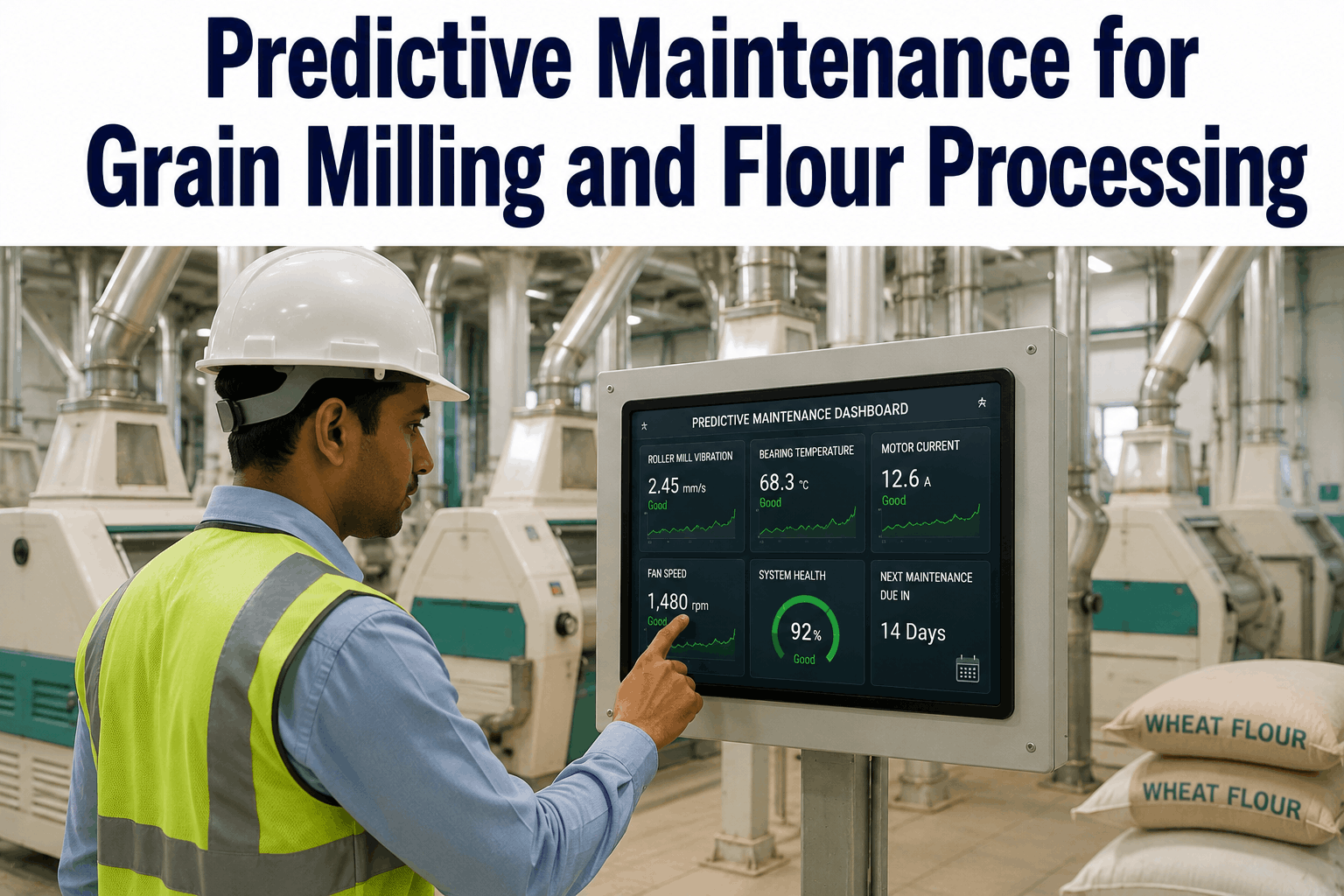
Grain milling operates on a relentless seasonal calendar — when wheat arrives at harvest, the mills run continuously, and a roller mill bearing failure at peak intake is not just a maintenance event, it is a throughput loss that cannot be recovered because the grain does not wait. Flour mill machinery presents a specific reliability challenge: high dust loads, continuous vibration from roller contact, and the abrasive nature of grain and bran particles create accelerated wear patterns that standard inspection intervals fail to track between scheduled shutdowns. AI predictive maintenance monitors roller mills, plansifters, purifiers, and pneumatic conveyance systems continuously — detecting the bearing deterioration, belt tension loss, sifter imbalance, and conveying system pressure anomalies that precede failures weeks before they interrupt production. Talk to an Expert to see how iFactory deploys AI predictive maintenance across your grain milling and flour processing operation.
Of flour mill unplanned downtime is caused by roller mill bearing failures — the single largest maintenance cost driver in grain milling, driven by abrasive dust ingress and continuous high-load operation
Average lead time between AI-detected roller mill bearing deterioration and functional failure — sufficient for planned replacement during a scheduled cleaning shutdown rather than emergency stoppage
Reduction in unplanned stoppages reported by flour mills deploying AI condition monitoring across their full roller mill and plansifter population during a 12-month operation period
Cost ratio between emergency roller mill bearing replacement — including production loss at peak intake — versus planned bearing replacement during a scheduled maintenance window
Keep Every Roller Mill Running Through Harvest. Predict Failures Before They Stop Production.
iFactory's AI predictive maintenance platform monitors roller mill bearings, plansifter balance, purifier shoe wear, and pneumatic conveying pressure continuously — detecting deterioration weeks before it interrupts grain intake or flour production throughput.
Why Flour Mill Equipment Needs AI Monitoring, Not Just Periodic Inspection
Flour mill machinery operates under conditions that accelerate wear between inspection visits in ways that visual checks and periodic vibration routes cannot track. Roller mill bearings run under continuous load with wheat bran and flour dust penetrating even well-maintained seals — a bearing that inspects perfectly at the start of a milling week can develop a detectable defect frequency and progress to failure within the same week if dust ingress has reached the rolling elements. Plansifter balance degrades gradually as sieve cloth wears unevenly and frame connections loosen under cyclic loading, shifting the sifter's gyratory motion in ways that reduce extraction efficiency weeks before any operator notices a quality change in the flour stream. AI continuous monitoring detects these developing conditions from vibration signatures, pressure trends, and current patterns that are present and measurable long before they become visible or audible to an operator or inspector. Teams that Book a Demo with iFactory see how continuous monitoring across a full mill flow converts seasonal maintenance risk into a managed predictive programme with weeks of intervention lead time on the failures that previously caused emergency stoppages.
Roller Mill Bearing Condition Monitoring
AI vibration analysis detects the developing defect frequency signatures of roller mill bearing deterioration from dust ingress, contamination, and overload — providing 3 to 6 weeks of intervention lead time.
Plansifter Balance and Frame Condition
Gyratory motion analysis detects sifter imbalance from uneven sieve loading, frame looseness, and drive eccentricity that reduce extraction efficiency before product quality is affected.
Purifier Shoe and Deck Wear Monitoring
Vibration and airflow pressure tracking identifies purifier shoe wear and deck blockage conditions that shift purification efficiency and contaminate the semolina stream.
Pneumatic Conveying System Health
Conveying system pressure, flow rate, and rotary valve current trending identifies developing blockages, rotor wear, and filter loading that reduce conveying capacity or cause product accumulation.
Roller Differential and Gap Monitoring
Roller gap stability and differential speed trending detects roll wear, bearing play, and adjustment drift that shift granulation and extraction without triggering any alarm in the milling control system.
Dust Collection and Filter Loading Tracking
Filter differential pressure trending and pulse jet timing analysis identify filter cloth loading and pulse valve failures before dust emissions or suction loss affects conveying performance.
Six AI Monitoring Capabilities That Protect Flour Mill Production
01
Roller Mill Bearing Defect Frequency Trending
Primary Protection Capability
Roller mill bearings operate under continuous radial and axial loads with grain dust as a constant contamination threat despite sealing and lubrication programmes. AI bearing defect frequency analysis extracts the outer race, inner race, rolling element, and cage defect frequency components from the roller mill vibration spectrum and tracks their amplitude over time per individual bearing location. A bearing developing an outer race defect from dust ingress shows a progressively rising BPFO amplitude that is detectable 3 to 6 weeks before the defect severity reaches failure. This lead time — combined with a milling flow that allows individual rolls to be isolated for bearing replacement — converts what would otherwise be an emergency stoppage into a planned maintenance event scheduled for the next cleaning shift.
Bearing failures caught (periodic route): 38%
Bearing failures caught (AI continuous): 91%
02
Plansifter Gyratory Motion and Imbalance Detection
Extraction Quality Protection
A plansifter whose gyratory motion has shifted from its designed circular path — due to imbalance, frame looseness, or worn suspension components — produces altered product separation that reduces flour extraction efficiency and increases contamination in fine streams without triggering any process alarm. AI analysis of the sifter's vibration signature across three measurement axes detects the deviation from designed gyratory motion pattern, classifies the deviation as imbalance, structural looseness, or drive eccentricity, and trends the severity over successive measurement cycles. Flour millers who detect plansifter motion degradation early consistently report 2 to 3 percent extraction efficiency recovery after corrective action — a significant financial impact on high-volume milling operations.
Extraction loss before detection (manual): 4–6 weeks
AI motion deviation detection: 2–3 weeks earlier
03
Pneumatic Conveying System Pressure and Flow Trending
Throughput Continuity
Pneumatic conveying systems in flour mills transport flour, semolina, bran, and offal streams continuously between processing stages, and a blockage or conveying capacity degradation in any line backs up the entire mill flow above it. AI pressure and flow trending detects the gradual pressure rise pattern of a developing filter loading condition, the flow reduction signature of a worn rotary valve, and the pressure instability pattern of a developing partial blockage — each with 1 to 3 weeks of lead time before the condition requires a controlled stoppage for clearing. The difference between clearing a partially blocked line during a planned stoppage and clearing a fully blocked line that has already forced a mill shutdown is measured in hours of production loss and significant material waste.
Blockage clearance time (forced): 4–8 hours
Blockage clearance time (planned): 30–60 min
04
Roller Gap Stability and Differential Speed Monitoring
Milling Process Quality
Roller gap and differential speed are the two primary process variables that determine granulation in each milling passage, and their stability directly determines the consistency of extraction and the quality distribution of the flour streams. Bearing play that allows gap variation under load, adjustment mechanism wear that allows gap drift between resets, and differential drive issues that allow speed ratio instability all produce granulation inconsistency that affects downstream sifting and extraction without triggering any alarm in the control system. AI monitoring of the vibration and current signatures associated with gap stability and speed consistency detects these mechanical degradation conditions 2 to 4 weeks before they reach a level where product quality is measurably affected.
Gap instability detected (manual): at quality complaint
AI gap degradation detection: 2–4 weeks prior
05
Drive Belt Tension and Wear Monitoring on Milling Drives
Drive System Reliability
Roller mill drives typically use multi-groove V-belt systems that transmit high torque at controlled speed ratios, and belt tension loss from stretch, wear, or sheave groove deterioration reduces differential speed ratio and allows slip that changes the milling action without any alarm in the drive system. AI vibration monitoring of the belt pass frequency and its harmonics detects tension loss from rising belt frequency instability, identifies sheave groove wear from altered harmonic ratios, and flags developing belt wear from the high-frequency noise signature that worn belt surfaces generate. Planned belt replacement on a detected tension loss condition takes one hour. Emergency belt replacement after a snap failure on a running mill takes significantly longer, with full flow stoppage and restart time included.
Belt failures reaching snap point: 48% (no monitoring)
Belt failures reaching snap point: 9% (AI monitored)
06
Dust Collection Filter Loading and Pulse Jet Effectiveness
Environmental and Safety Compliance
Dust collection system filter loading reduces conveying suction across the entire mill flow and, if allowed to reach bypass conditions, creates dust concentration levels that represent an explosion risk in addition to an environmental compliance issue. AI filter differential pressure trending detects progressive filter cloth loading, identifies pulse jet cleaning failures from the pressure recovery signature after each cleaning cycle, and projects when filter change-out is required based on the actual loading rate rather than a fixed calendar interval. Mills managing filter change-out on actual condition rather than calendar schedules consistently extend filter service life by 30 to 50 percent while maintaining safe differential pressure operating ranges throughout the filter's service life.
Filter life on calendar schedule: 6 months avg
Filter life on AI condition basis: 8–9 months avg
Grain Milling Equipment Monitoring Reference
Scroll for more
| Equipment | Primary Failure Mode | AI Monitoring Signal | Detection Lead Time | Production Impact Prevented |
|---|---|---|---|---|
| Roller Mill | Bearing failure from dust ingress | Bearing defect frequency trending | 3–6 weeks | Unplanned flow stoppage |
| Plansifter | Gyratory motion degradation | 3-axis motion pattern analysis | 2–4 weeks | Extraction efficiency loss |
| Pneumatic Conveying | Blockage or rotary valve wear | Pressure and flow trending | 1–3 weeks | Product stream backup |
| Purifier | Shoe wear, deck blockage | Vibration and airflow pressure | 2–4 weeks | Semolina contamination |
| Dust Collector | Filter loading, pulse jet failure | Differential pressure trending | 1–3 weeks | Suction loss, safety event |
How iFactory Supports Grain Milling Predictive Maintenance
Flour mill maintenance operates on compressed windows — cleaning shifts, weekly shutdowns, and the annual overhaul between seasons — and planned maintenance interventions must align with these windows to avoid disrupting continuous production flow. iFactory connects AI monitoring alerts to the milling maintenance schedule, generating work orders that are planned into the next available maintenance window within the estimated intervention lead time. When a roller mill bearing is detected with 4 weeks of estimated remaining life, iFactory schedules the replacement for the next weekly shutdown, confirms bearing stock availability, and assigns the work to the appropriate maintenance team — converting a potential emergency stoppage into a routine planned replacement that the production team never notices. Teams can Talk to an Expert about connecting iFactory's flour mill monitoring to your maintenance scheduling and parts management workflows.
Roller Mill Bearing AI Trending
Continuous bearing defect frequency monitoring on all roller mill positions, with severity trending and maintenance window scheduling integrated into the mill cleaning calendar.
Plansifter Motion Analysis
Three-axis gyratory motion monitoring detects imbalance and frame conditions that reduce extraction efficiency before product quality is measurably affected.
Conveying System Health Tracking
Pneumatic conveying pressure and flow trends detect developing blockages and rotary valve wear in the 1 to 3 week window where planned intervention is still possible.
Harvest Season Risk Reporting
Pre-harvest fleet condition assessment identifies all roller mill bearings and drive components approaching intervention threshold before seasonal peak demand begins.
Implementing AI Predictive Maintenance in Your Flour Mill: Six Steps
01
Audit Current Roller Mill Bearing Population and Failure History
Identify which roller mill positions have the highest historical bearing failure frequency and the shortest average bearing life — these are the priority monitoring targets for initial AI deployment.
02
Install Vibration Sensors on Critical Roller Mill Positions
Deploy accelerometers on the bearing housings of the highest-criticality roller mill positions — break rolls, reduction rolls, and smooth rolls in high-throughput passages — as the first monitoring layer.
03
Establish Baseline During Stable Production Period
Allow iFactory to collect 30 days of baseline vibration and process data during stable full-production milling before activating deterioration alerts, capturing normal operational variation in the baseline model.
04
Align Alert Response With Maintenance Window Calendar
Configure iFactory alert severity levels to match the milling maintenance calendar — moderate severity scheduled into weekly shutdowns, high severity escalated to a planned urgent intervention within days.
05
Run Pre-Harvest Fleet Condition Assessment
Six weeks before peak seasonal intake, run a fleet-wide condition assessment in iFactory to identify all bearings and drive components approaching intervention threshold and schedule pre-harvest replacements.
06
Extend Monitoring to Plansifters, Purifiers, and Conveying
After roller mill monitoring is established, extend the programme to plansifter balance, purifier deck conditions, and pneumatic conveying systems to achieve full mill flow predictive coverage.
Frequently Asked Questions
Why are roller mill bearings the highest failure risk in a flour mill?
Roller mill bearings operate under continuous high radial and axial loads in an environment with constant fine particle dust that penetrates seals despite best lubrication practices, producing accelerated abrasive wear that shortens bearing life significantly compared to equivalent bearings in cleaner industrial environments.
How does AI detect plansifter performance degradation before product quality is affected?
AI analysis of the sifter's three-axis vibration signature detects deviations from the designed gyratory motion pattern — caused by imbalance, frame looseness, or suspension wear — in the 2 to 4 week window before the motion deviation is large enough to produce a measurable change in flour stream extraction efficiency.
Can iFactory monitor pneumatic conveying systems without additional sensors beyond existing instrumentation?
In most flour mills, existing pressure transmitters and flow indicators on the conveying system provide sufficient data for AI trending and blockage detection. iFactory ingests existing SCADA and PLC data without requiring additional instrumentation on established conveying lines.
How does harvest season timing affect the predictive maintenance programme?
iFactory supports a pre-harvest condition assessment that identifies all monitored equipment approaching intervention thresholds in the 6-week window before seasonal peak intake begins, enabling planned replacements during pre-harvest maintenance rather than emergency corrections during peak production.
What is the typical reduction in unplanned stoppages in the first year of AI monitoring?
Flour mills deploying AI condition monitoring across their full roller mill and plansifter population typically report 50 to 65 percent reduction in unplanned stoppages within the first 12 months, with the greatest improvement during the harvest season intake period when continuous operation is most critical.
Harvest Season Stoppages Are the Failures That Cost the Most and Are the Most Preventable. AI Monitoring Finds the Bearings That Will Fail Before They Do.
iFactory connects AI roller mill bearing trending, plansifter motion analysis, and conveying system health monitoring to your maintenance calendar — ensuring every developing fault is planned into a maintenance window before it stops the mill at the worst possible moment.