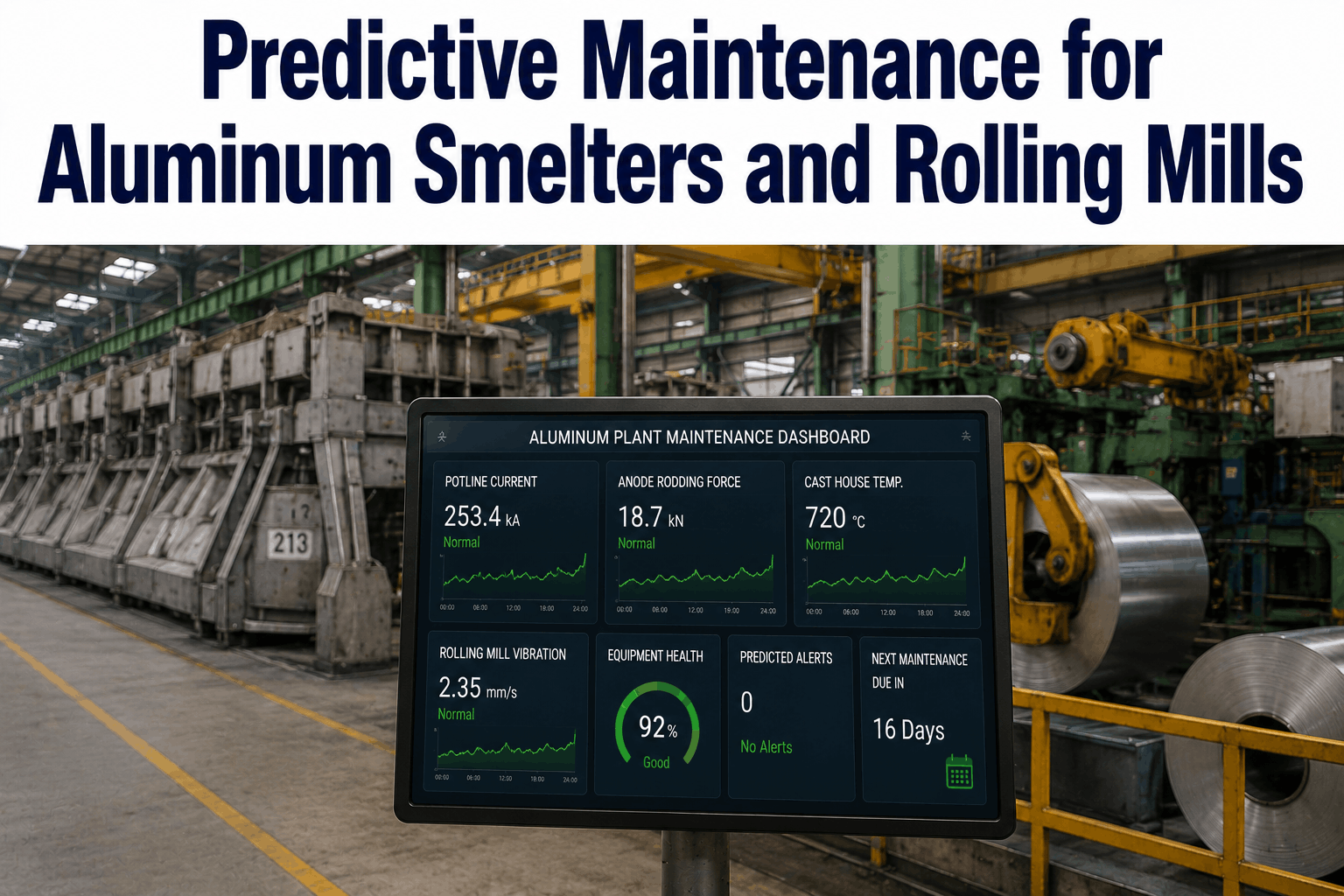
AI monitors potlines, anode rodding, cast houses, and cold rolling mills in aluminum production — detecting developing pot failures, anode problems, and rolling mill vibration exceedances before they interrupt continuous production or damage high-value process equipment. Start Trial Free to see how iFactory gives aluminum producers the equipment-specific predictive maintenance intelligence needed to protect potlines and rolling mill assets across the full production chain.
Protect Aluminum Potlines and Rolling Mills with AI-Driven Predictive Maintenance
iFactory integrates potline electrical signals, anode rodding sensor data, cast house equipment health, and rolling mill vibration spectra into a unified predictive maintenance platform — giving reliability teams early warning across every critical asset in aluminum production.
Why Aluminum Production Reliability Demands Asset-Specific AI Monitoring
Aluminum smelting and rolling present reliability challenges that general-purpose maintenance platforms were not designed to address. A Hall-Héroult reduction cell that develops an anode problem generates a recoverable electrical signature days before it progresses to a pot failure — but only if someone is monitoring the individual cell voltage pattern and anode current distribution with sufficient resolution to detect the early deviation. A cold rolling mill that develops a work roll bearing defect at the entry stand transmits characteristic chatter frequencies into the strip surface — detectable in the mill vibration spectrum before strip quality is affected. These failure modes require monitoring strategies tuned to the specific physics of aluminum production processes. Engineering teams that Book a Demo with iFactory see how equipment-class-specific monitoring configurations produce earlier and more actionable alerts across aluminum production assets than generic vibration threshold systems.
-
Potline Cell Voltage Pattern Monitoring
iFactory monitors individual reduction cell voltage patterns and anode current distribution across the potline — identifying early anode problems, ledge instability, and bath chemistry deviations before they progress to pot failures or anode effects requiring emergency intervention.
-
Anode Rodding Shop Equipment Health
iFactory monitors rodding press hydraulic systems, anode baking furnace temperature uniformity, and thimble crimping equipment vibration — preventing anode defects that propagate as quality problems into the reduction cell.
-
Cast House Equipment Predictive Monitoring
iFactory tracks casting machine hydraulics, metal transfer pump condition, degassing unit rotor wear, and metal filtration differential pressure — protecting the cast house equipment that converts liquid aluminum into rolling stock.
-
Hot Rolling Mill Bearing and Drive Monitoring
iFactory analyzes work roll and backup roll bearing vibration spectra, roll drive motor current signatures, and roll gap hydraulic system pressure trends — detecting mill stand defects before they cause strip surface defects or forced roll change shutdowns.
-
Cold Rolling Mill Chatter Detection
iFactory identifies chatter frequencies in cold rolling mill vibration spectra — distinguishing third-octave chatter, fifth-octave chatter, and random chatter from normal rolling dynamics to prevent strip surface quality exceedances and roll mark incidents.
-
Fume Treatment and Pot Gas System Monitoring
iFactory monitors dry scrubber fan condition, alumina distribution conveying system health, and duct pressure trends — maintaining the environmental compliance systems that operate continuously alongside the potline.
Critical Aluminum Production Assets: Monitoring Priorities
-
Reduction Cell Anode Monitoring: Early Problem Detection from Electrical Signatures
Highest Production ImpactA Hall-Héroult reduction cell operates with a set of anodes in various stages of consumption — and an anode that develops a crack, spall, or poor electrical contact with the rod produces a detectable deviation in its individual current distribution and the overall cell voltage pattern days before the problem is visible during anode change inspection. iFactory monitors individual anode current distribution through the beam current measurement system and tracks cell voltage noise characteristics — identifying anodes with elevated resistance, uneven current sharing, or voltage instability patterns associated with carbon cracking or bath infiltration. Early anode detection enables targeted anode change scheduling that prevents the problem anode from progressing to an anode effect — a condition that disrupts cell operation, generates greenhouse gas emissions, and requires process recovery time that reduces potline productivity. Teams that Start Trial can connect iFactory to potline process data systems and begin anode current distribution monitoring from existing measurement infrastructure.
Data Source
Beam current distribution and individual cell voltage measurement
Detection Target
Anode resistance deviation and voltage noise pattern anomalies
iFactory Record
Cell voltage and anode current history archived per reduction cell
-
Cold Rolling Mill Chatter Identification and Severity Staging
Strip Quality ProtectionRolling mill chatter — the self-excited vibration that produces periodic thickness variations and surface marks on rolled strip — originates from the coupling between roll stand structural dynamics and the rolling process instability at specific reduction-speed combinations. Third-octave chatter (typically 100–200 Hz) and fifth-octave chatter (typically 500–700 Hz) produce characteristic frequency content in mill stand vibration spectra that iFactory identifies and tracks as rolling conditions change. iFactory monitors the amplitude of chatter-associated vibration frequencies relative to the speed and reduction combination in use — alerting when chatter severity approaches the threshold where strip surface quality exceedance becomes probable. This allows rolling schedule optimization to avoid speed-reduction combinations that excite chatter rather than waiting for strip quality rejection to confirm the problem. Teams that Book a Demo can see how iFactory's chatter frequency tracking is configured for specific mill stand configurations and roll dimensions.
Chatter Types
Third-octave (100–200 Hz) and fifth-octave (500–700 Hz) chatter
Context Variables
Chatter amplitude tracked against rolling speed and reduction
iFactory Record
Chatter frequency amplitude history per mill stand and roll pass
-
Work Roll and Backup Roll Bearing Condition Monitoring
Mechanical Asset HealthRolling mill bearings — particularly the four-row tapered roller or cylindrical roller bearings used in work roll and backup roll chocks — operate under extreme radial loading at rolling speed, making them among the most heavily loaded bearings in any industrial application. Bearing defect frequency tracking in rolling mill vibration spectra is complicated by the high dynamic loading environment and the multiple overlapping frequencies from different roll sets running simultaneously. iFactory applies rolling-element-specific defect frequency models for each bearing position — separating BPFO, BPFI, and BSF signatures from background rolling noise using envelope analysis tuned to the specific bearing geometries and rolling speeds. Work roll bearing defect detection is particularly valuable because work roll bearing failures force unplanned roll change shutdowns that disrupt the rolling schedule and can cause strip surface marking from the degraded bearing before it is detected.
Bearing Types
Four-row tapered roller, cylindrical roller in work and backup roll chocks
Analysis Method
Envelope demodulation tuned to rolling mill loading environment
iFactory Record
Defect frequency trend per bearing position and roll change interval
-
Cast House Degassing Rotor and Metal Transfer Pump Monitoring
Cast House AssetThe cast house represents the transition from liquid metal to solid rolling stock — and equipment failures here interrupt production across the entire upstream potline, not just the cast house itself. Degassing unit rotors that process molten aluminum through hydrogen removal experience erosion and corrosion in the liquid metal environment, producing changes in rotational balance and vibration signature as rotor condition degrades. iFactory monitors degassing rotor vibration — tracking 1X imbalance growth as an erosion indicator and detecting the impulsive contact signatures that indicate rotor damage from metal inclusions or refractory debris. Metal transfer pumps and launders with circulation pumps are also monitored for bearing condition and impeller wear through vibration and flow performance trend analysis.
Monitored Assets
Degassing rotors, metal transfer pumps, launder circulation pumps
Failure Indicators
1X imbalance growth (erosion), impulsive contact signatures
iFactory Record
Vibration trend and performance history per cast house equipment unit
-
Anode Baking Furnace Temperature Uniformity Monitoring
Upstream Quality AssetAnode quality is established in the baking furnace — and non-uniform temperature distribution across the furnace section produces anodes with variable density, conductivity, and mechanical strength that translate directly into elevated anode problem rates in the reduction cells. iFactory monitors anode baking furnace temperature profiles across multiple thermocouple positions — tracking temperature uniformity indices that identify developing burner problems, flue passage blockages, or insulation degradation before they produce a batch of out-of-specification anodes. Connecting baked anode quality outcomes back to furnace temperature uniformity data in iFactory enables root cause identification when elevated anode problem rates appear in potline monitoring — closing the loop between upstream quality and downstream reliability. Teams that Start Trial can configure furnace temperature uniformity tracking using existing thermocouple historian data.
Monitored Parameter
Temperature uniformity index across furnace section thermocouple array
Fault Indicators
Temperature deviation from uniformity, gradient pattern anomalies
iFactory Record
Furnace uniformity trend correlated to downstream anode problem rate
-
Potline Fume Treatment Plant Fan and Scrubber Monitoring
Environmental Compliance AssetFume treatment plant fans serving aluminum reduction cells are large-volume, continuous-duty assets whose failure causes environmental compliance exceedances in addition to the operational disruption of losing cell suction. Potline FTP fans typically handle corrosive fluoride-laden gas streams that accelerate impeller erosion and bearing seal degradation relative to clean-air applications — making standard vibration monitoring interval assumptions inappropriate. iFactory monitors FTP fan bearing condition, impeller balance, and flow performance continuously — tracking 1X imbalance growth from impeller erosion and bearing defect development from seal failures at intervals appropriate for the corrosive service environment. Integration of fan vibration monitoring with suction pressure and flow data provides performance-context-normalized health assessment that distinguishes process-driven flow changes from mechanical deterioration. Teams that Book a Demo can see how FTP fan monitoring is configured for fluoride service operating conditions.
Service Condition
Fluoride-laden gas at potline operating temperature and flow
Fault Indicators
1X imbalance growth (erosion), bearing defect from seal degradation
iFactory Record
Fan vibration and performance trend per FTP fan unit
Aluminum Production Predictive Maintenance Performance Indicators
Anode Problem Detection Lead Time
AI current pattern and voltage noise analysis detects developing anode problems 9 days before anode effect — compared to 1 day lead time for manual inspection programs relying on visual anode change assessment.
Mill Stand Chatter Detection by Octave Type
iFactory achieves 95% detection accuracy for third-octave chatter and 91% for fifth-octave — enabling rolling schedule intervention before strip surface quality exceedance occurs on monitored mill stands.
Potline Anode Effect Frequency Reduction
AI-assisted anode monitoring reduces anode effect frequency from 3.8 to 0.8 per cell per month over 12 months — a 79% reduction that directly improves current efficiency and reduces greenhouse gas generation.
Unplanned Mill Shutdown Reduction
Aluminum rolling mills deploying iFactory report 50% reduction in unplanned mill shutdown events within 12 months — primarily from work roll bearing and chatter-related incidents caught before strip quality impact occurs.
Aluminum Production Asset Monitoring: Reference Specifications
Scroll for more
| Production Asset | Primary Failure Mode | Detection Method | iFactory Data Source | Alert Lead Time |
|---|---|---|---|---|
| Reduction Cell Anode | Anode crack, spall, poor contact | Current distribution + voltage noise | Beam current system, cell voltage | 6–9 days |
| Cold Rolling Mill Stand | Chatter, roll bearing defect | Chatter frequency + envelope analysis | Mill stand vibration accelerometers | 14–30 days |
| Degassing Rotor | Erosion, rotor damage | 1X imbalance growth, impulsive content | Rotor shaft vibration | 7–21 days |
| Anode Baking Furnace | Temperature non-uniformity | Uniformity index from thermocouple array | Furnace temperature historian | Per batch (preventive) |
| FTP Fan | Impeller erosion, bearing failure | 1X imbalance trend, defect frequency | Fan bearing vibration, flow data | 14–45 days |
How iFactory Supports Aluminum Production Predictive Maintenance
Aluminum production reliability spans two fundamentally different asset classes — electrochemical process equipment in the potroom and high-speed rotating mechanical equipment in the rolling mill — each with failure modes, monitoring data types, and intervention economics that differ enough to require separate monitoring strategies within a unified platform. iFactory provides the flexibility to address both: potline cell voltage and anode current data processed through deviation detection algorithms tuned to the electrochemical environment, and rolling mill vibration spectra analyzed through chatter frequency tracking and bearing defect models calibrated for the extreme loading conditions of roll stands. When iFactory identifies a developing anode problem in Cell 47 nine days before the scheduled anode change, and simultaneously detects a work roll bearing defect progression at Entry Stand 2 that is likely to require roll change within the next rolling campaign, the reliability team has the advance planning data to schedule both interventions without a forced outage. Facilities can Start Trial and configure iFactory monitoring for both potroom and rolling mill asset classes within the first deployment session.
Potline Electrochemical Monitoring
iFactory processes cell voltage noise, anode current distribution, and potline process data through deviation detection models tuned to Hall-Héroult electrochemical dynamics — identifying anode problems and bath instability signatures invisible to conventional threshold alarms.
Rolling Mill Vibration Analysis
iFactory analyzes mill stand vibration spectra for chatter frequencies and roll bearing defects — applying envelope analysis and frequency tracking calibrated for the high dynamic loading and multi-roll frequency environment specific to aluminum rolling mills.
Cast House Asset Health Tracking
iFactory monitors degassing rotors, metal transfer pumps, and casting machine hydraulics — tracking the cast house equipment that connects potroom liquid metal production to the rolling mill feed stock supply.
Upstream Quality to Downstream Reliability
iFactory correlates anode baking furnace uniformity data with potroom anode problem rates — closing the loop between upstream quality process monitoring and downstream reliability outcomes across the full aluminum production chain.
Implementing Predictive Maintenance in Aluminum Production: Deployment Steps
01
Prioritize Asset Classes by Production Impact
Rank potline cells, rolling mill stands, and cast house equipment by historical failure cost and production impact — establishing the deployment sequence that delivers the greatest reliability improvement per monitoring investment dollar.
02
Connect Potline Process Data Systems
Configure iFactory integration with the potline process control system — establishing the cell voltage, anode current distribution, and bath temperature data feeds that anode problem detection requires from existing potroom instrumentation infrastructure.
03
Install Rolling Mill Vibration Instrumentation
Confirm accelerometer coverage on work roll and backup roll chock positions at each mill stand — supplementing existing instrumentation where bearing housing access is available to provide the measurement points needed for defect frequency and chatter analysis.
04
Establish Asset-Specific Baseline References
Run iFactory's baseline acquisition on priority reduction cells and mill stands under known good operating conditions — building the reference signatures that anode current deviation detection and chatter frequency monitoring compare against during ongoing production.
05
Integrate Maintenance Records and Anode Change History
Load historical anode change records, roll change intervals, and equipment failure events into iFactory — enabling the correlation between monitoring indicators and actual outcomes that calibrates alert thresholds to the specific operating conditions of each smelter and mill.
06
Expand Coverage Based on Validated Performance
Review iFactory's alert accuracy against actual anode problems and mill failures at the 90-day mark — using validated performance data to expand monitoring coverage from the initial priority assets to the full potline and rolling mill fleet. Book a Demo to see the full aluminum production deployment workflow.
Frequently Asked Questions
What makes aluminum smelter predictive maintenance different from general industrial PdM?
Aluminum smelter monitoring requires combining electrochemical process data from reduction cells with rotating equipment vibration analysis from the rolling mill — two fundamentally different data types that require separate monitoring strategies within a unified platform. iFactory handles both through configurable monitoring templates tailored to Hall-Héroult cell physics and rolling mill mechanical dynamics.
How does iFactory detect anode problems in reduction cells?
iFactory monitors individual anode current distribution through the beam current measurement system and analyzes cell voltage noise characteristics — identifying anodes with elevated resistance, uneven current sharing, or voltage instability patterns associated with carbon cracking or bath infiltration up to nine days before the problem would trigger a conventional threshold alarm.
What is rolling mill chatter and why is it a maintenance concern?
Rolling mill chatter is self-excited vibration that produces periodic thickness variations and surface marks on rolled aluminum strip — originating from the coupling between mill stand structural dynamics and rolling process instability at specific speed-reduction combinations. iFactory detects chatter frequency content in mill stand vibration before strip surface quality exceedance occurs, enabling rolling schedule adjustment that avoids the chatter-prone speed-reduction zone.
Can iFactory monitor the full aluminum production chain from potroom to rolling mill?
Yes. iFactory connects potline process data, anode rodding equipment sensors, cast house vibration instrumentation, and rolling mill accelerometers into a unified monitoring platform — giving reliability teams a single view across all production assets from reduction cell to finished coil.
How does iFactory handle the corrosive environment of potroom and FTP fan monitoring?
iFactory's monitoring algorithms account for the accelerated degradation rates of equipment in fluoride and high-temperature service environments — applying tighter monitoring intervals, adjusted baseline expectations, and corrosion-specific failure mode signatures for assets in potroom and fume treatment plant service.
Protect Potlines and Rolling Mills with Aluminum-Specific Predictive Maintenance
iFactory gives aluminum producers the anode current monitoring, rolling mill chatter detection, and cast house equipment health tracking needed to reduce anode effects, prevent mill shutdowns, and maintain production targets across the full aluminum production chain.