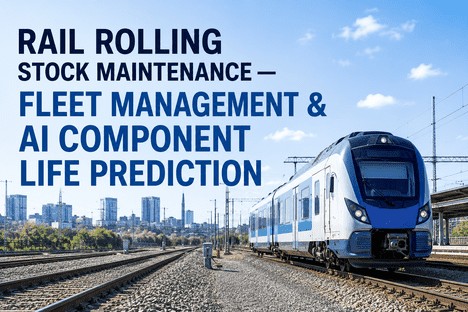
A Class 77 locomotive suffers an oil pump failure 300 miles from the depot. The replacement part has a 500-day lead time. The locomotive sits idle for six weeks while emergency sourcing triples the procurement cost. That locomotive is not an outlier. Across the global rail fleet, rolling stock unplanned downtime costs operators an estimated 15 to 30 percent of total maintenance expenditure. Every unscheduled shop visit compounds: lost revenue per train-day, cascading delays across the network, premium pricing for emergency parts, and crew utilisation that collapses when a consist goes dark mid-route. The root cause is not a lack of maintenance. It is a lack of maintenance intelligence. Without AI-powered component life prediction and fleet-wide health monitoring, maintenance managers are sequencing work by calendar interval rather than by actual condition, by fixed schedule rather than by remaining useful life. That is the difference between a fleet that runs at 92 percent availability and one that consistently delivers 99 percent.
30-50%
Unplanned downtime reduction achieved by operators using AI-driven predictive maintenance across rolling stock fleets
15%
Improvement in locomotive availability documented by national rail operators deploying AI-based condition monitoring across their fleets
20%
Reduction in total maintenance costs enabled by transitioning from fixed-interval to condition-based, AI-optimised maintenance regimes
44%
Of total rolling stock lifecycle cost is spent on maintenance after purchase, making predictive strategy the single highest-ROI investment in fleet operations
Four Critical Systems That Define Rolling Stock Reliability
Rolling stock reliability is not a single metric. It is the sum of the health states of four interdependent systems, each with distinct failure modes, escalation curves, and maintenance strategies. When any one of them fails in service, the entire consist is affected. When all four are monitored continuously and scored by remaining useful life, the maintenance manager moves from scheduling by calendar to sequencing by data.
System 01
Traction Motors & Power Systems
Traction motor bearings operate under continuous thermal cycling, vibration load from wheel-rail interaction, and contamination from brake dust and moisture. Bearing degradation is the leading cause of traction motor failure, and it is almost never detected early by visual inspection. AI models trained on motor current signature analysis and vibration spectrum data can detect the onset of bearing wear, winding insulation degradation, and demagnetisation in permanent magnet motors eight to twelve weeks before failure. The cost delta between a planned traction motor replacement at the depot and an emergency mid-route failure that requires road call recovery and line-side replacement is five to eight times the planned cost.
Bearing wear detection
Current signature analysis
Remaining useful life
System 02
Brake Systems & Pneumatics
Brake system degradation is insidious. Brake disc thermal fatigue, pad wear beyond threshold, and pneumatic leakage in actuation circuits develop over thousands of operating cycles. Intake filter clogging alone reduces braking efficiency measurably before any threshold is tripped. AI-driven performance degradation models using LSTM networks on pressure, temperature, and actuator response data have demonstrated over 99 percent accuracy in predicting intake filter degradation progression. The same modelling approach applied to brake disc thermal fatigue and pad wear enables the maintenance manager to predict exactly when a brake component will reach end of life, allowing replacement during a scheduled shop visit rather than after a violation event that grounds the vehicle.
Thermal fatigue prediction
Pneumatic leak detection
Pad wear forecasting
System 03
Wheel & Axle Assemblies
Wheel flats, tread defects, and axle bearing degradation represent the highest safety-critical category in rolling stock maintenance. A wheel flat of 30 millimetres or longer creates periodic impact forces that accelerate bearing fatigue in the traction motor and gearbox, reducing their service life by a measurable margin. AI systems that integrate wayside monitoring data with onboard vibration analysis can detect wheel flat formation at 10 millimetres and assign a remaining useful life to the wheel set with statistical confidence. The maintenance-of-way optimisation achieved by scheduling wheel truing based on actual wear profiles rather than fixed mileage intervals extends wheel life by 15 to 25 percent and eliminates unnecessary removal of healthy material.
Wheel flat detection
Bearing fatigue prediction
Wear-optimised truing
System 04
HVAC & Auxiliary Systems
Auxiliary systems including HVAC, compressed air supply, and door actuation account for a disproportionate share of in-service failures because they operate across more duty cycles than primary propulsion components. An HVAC failure in a passenger car during summer months triggers passenger complaints, service score penalties, and in some jurisdictions, regulatory service credits. Compressor degradation in pneumatic systems follows a predictable pattern that AI models detect through analysis of pressure decay rates, cycle frequency changes, and current draw drift. The lead time between AI detection of auxiliary compressor degradation and functional failure is typically six to eight weeks at normal duty cycles long enough to schedule replacement at the next planned depot visit rather than triggering an unscheduled intervention.
Compressor degradation
HVAC failure prediction
Door actuation monitoring
Your Rolling Stock Fleet Generates Failure Data Every Mile. iFactory Turns It Into a Predictive Maintenance Schedule.
Continuous component health monitoring, remaining useful life prediction, and shop visit scheduling optimised by AI to maximise fleet availability and eliminate unscheduled downtime.
How the AI Component Life Prediction Engine Works Across Your Fleet
The transition from fixed-interval preventive maintenance to AI-driven condition-based maintenance is not a theoretical upgrade. It is a structural change in how maintenance data is collected, processed, and translated into shop visit decisions. iFactory's component life prediction engine operates across four continuous layers that together produce the actionable intelligence that drives fleet availability above 98 percent.
01
Sensor Fusion and Telemetry Ingestion
Onboard sensors across the fleet stream vibration, temperature, current, pressure, and acoustic emission data at one-hertz frequency or higher. The engine ingests this telemetry alongside maintenance history, repair records, and component age data to build a continuous digital representation of every critical asset in the fleet. Modern rolling stock generates up to five gigabytes of data per trainset per day enough signal depth to detect micro-degradation patterns that are invisible to threshold-based alarm systems.
02
Anomaly Detection and Degradation Signature Matching
Trained models compare incoming telemetry against known failure signatures for each component type. A bearing wear pattern in a traction motor is identified by its specific vibration frequency shift and amplitude growth rate across the run cycle. A pneumatic leak in a brake actuation circuit is identified by pressure decay rate deviation from the component's own historical baseline. The engine distinguishes between operational variation and genuine degradation onset, issuing an alert only when the deviation matches a failure-progression signature with statistical confidence exceeding the configured threshold.
03
Remaining Useful Life Calculation with Confidence Intervals
For every degradation signature detected, the engine calculates remaining useful life in calendar days, operating hours, or mileage depending on the component's duty cycle pattern. This is not a single-point estimate. The model outputs a confidence interval that widens over the prediction horizon, giving the maintenance manager a probabilistic window rather than a fixed date. The practical effect is that the shop visit can be scheduled with weeks of lead time rather than responding to an alert that requires immediate action.
04
Optimised Shop Visit Scheduling and Workscope Generation
The engine does not merely report component health. It aggregates all remaining-useful-life data across the fleet and generates recommended shop visit schedules that cluster interventions to minimise total downtime. When multiple components on the same vehicle are approaching their maintenance window, the system groups them into a single workscope, reducing the number of shop visits and ensuring the maximum work is completed per maintenance event. The output is a rolling 90-day maintenance forecast that the fleet manager can review, adjust, and export as the operational schedule for depot operations.
The Measurable Shift: From Fixed-Interval to AI-Driven Fleet Maintenance
Quantified results from rail operators who have deployed AI-driven predictive maintenance across their rolling stock fleets demonstrate that the shift from calendar-based to condition-based maintenance produces consistent, repeatable improvements across four metrics that define fleet financial performance.
Rolling Stock Fleet Performance Before and After AI-Driven Predictive Maintenance
Metric
Fixed-Interval Maintenance
AI-Driven Maintenance
Improvement
Fleet Availability
88-92%
97-99%
+5 to 15%
Unplanned Downtime
Baseline
30-50% reduction
Up to 50% lower
Spare Parts Inventory Cost
Baseline
18% reduction documented
-18% average
Network Punctuality
Baseline
8% improvement documented
+8%
Fleet Maintenance Manager's Priority Configuration by Rolling Stock Type
The priority logic for rolling stock maintenance differs by fleet profile. A metro fleet running 200 cars on a single urban loop has a different component criticality hierarchy than a national freight operator managing 60 diesel locomotives with 500-day spare parts lead times. iFactory's priority scoring engine accounts for fleet type, duty cycle, and supply chain constraints so that the maintenance sequence it produces reflects the actual risk and cost profile of each fleet class.
Fleet Type
Highest Priority Components
iFactory Priority Configuration
High-Speed Passenger
Traction motor bearings, brake disc thermal fatigue, wheel set profiling, pantograph wear, door actuation systems
Safety-critical weighting elevated; vibration analysis prioritised at higher operational speeds; passenger comfort systems scored alongside safety items due to service level agreement exposure
Metro / Suburban
Door systems, brake pneumatics, HVAC, auxiliary compressors, traction inverter cooling, platform interface systems
High-cycle component scoring weighted by duty cycle intensity; door and brake reliability elevated due to station dwell impact on schedule adherence; HVAC prioritised in climate-extreme regions
Freight Locomotive
Traction motors, axle bearings, diesel engine ancillary systems, oil pump, alternator, turbocharger, wheel-rail interface
Lead-time aware scoring for long-lead components; engine health monitoring with oil analysis integration; wheel-rail optimisation for mixed freight profiles; remote monitoring for distributed fleet
Light Rail / Tram
Brake actuation, wheel profile, HVAC, traction inverter, overhead current collection, onboard energy storage
Mixed-traffic environment scoring; street-running impact on brake and wheel wear weighted higher; energy storage system health monitoring for battery-electric fleets
We were running 60 locomotives on a fixed-interval maintenance schedule inherited from the OEM. Every 90 days, each locomotive came into the shop whether it needed work or not. We were replacing healthy bearings, overhauling clean filters, and taking locomotives out of service that could have run another six weeks. The AI deployment changed the conversation. Within four months, the system flagged a traction motor bearing anomaly on unit 47 at 80 percent confidence. We inspected and found micro-spalling on the raceway that no visual inspection would have caught for another eight weeks. That single detection paid for the first year of the platform. Our interval-based maintenance cost us time and material. Condition-based maintenance is saving us both.
Fleet Maintenance Manager, Class I Freight Railroad Operator
Conclusion
The gap between a fleet operating at 92 percent availability and one operating at 99 percent is not a gap in maintenance effort. It is a gap in maintenance intelligence. Every locomotive, railcar, and trainset in the fleet generates degradation data in every mile of operation. The difference between a reactive maintenance organisation and a predictive one is whether that data is collected, analysed, and acted upon before the failure occurs rather than after.
AI-powered component life prediction shifts the maintenance paradigm from fixed-interval replacement based on mean time between failure statistics to condition-based intervention based on the actual health state of each individual component in each individual vehicle. The result is fewer unscheduled shop visits, lower spare parts inventory costs, higher fleet availability, and a defensible maintenance schedule that the fleet manager can present to operations leadership as a data-driven forecast rather than a calendar-based assumption.
iFactory's rolling stock predictive maintenance module gives fleet maintenance managers the AI-powered component monitoring, remaining useful life prediction, and shop visit optimisation that turns a fixed-interval maintenance programme into a condition-based, data-driven fleet management strategy. Book a demo to see how iFactory maps to your fleet's component profile and generates your first predictive maintenance forecast, or talk to an expert about your current rolling stock maintenance programme and how to structure the sensor and maintenance data you already possess into a predictive fleet management plan.
Frequently Asked Questions
Your Fleet Is Generating the Data. iFactory Generates the Predictive Maintenance Intelligence That Maximises Availability.
Continuous component health monitoring, remaining useful life prediction, anomaly detection, and optimised shop visit scheduling built from your fleet's own operating data starting from week one.