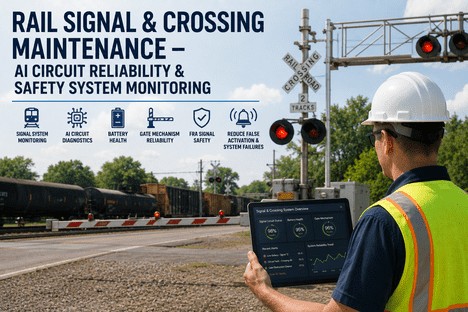
Rail signal and grade crossing systems are among the most safety-critical assets any maintenance manager will ever oversee. A missed inspection interval, a degraded battery, a relay that drifts out of tolerance — none of these announce themselves until the system fails. And when they fail, the consequences are not an inconvenience: they are an FRA activation failure report, an emergency response, and a public safety event that ends careers and generates headlines. The traditional model of calendar-based inspection rounds and paper-based fault logging was designed for a simpler network. It does not scale to the modern reality of maintenance managers responsible for hundreds of crossings, dozens of signal interlockings, and the continuous compliance burden of 49 CFR Part 234. AI-powered circuit diagnostics and condition monitoring are changing the equation — and this article explains exactly how.
Why Signal and Crossing Maintenance Is Different From Every Other Rail Asset Category
Most rail maintenance challenges are about managing asset degradation before it causes service disruption. Signal and crossing maintenance has an additional dimension: regulatory and public safety consequence that is immediate and non-negotiable. A worn wheel tread causes a rough ride. A failed grade crossing warning system at the wrong moment causes a fatality. That asymmetry shapes everything about how maintenance managers should think about these systems — and it is why the gap between reactive and predictive maintenance matters so much more here than in almost any other maintenance context.
Reactive signal maintenance — waiting for a fault report, a maintainer's inspection round, or a complaint from operations — means the degradation has already reached a threshold where normal function is compromised. Battery voltage drop, relay contact erosion, gate motor wear: all of these follow gradual deterioration curves that are entirely visible to diagnostic systems if the data is being collected and monitored. They are invisible to a calendar-based inspection programme that checks the crossing once every 30 days.
Condition-based monitoring for signal circuits tracks voltage readings, current draw, relay response times, and gate mechanism force profiles against established baselines for each asset type. Deviation from baseline — even small, gradual deviation — triggers a maintenance recommendation before any threshold is breached. The circuit is serviced during the next planned maintenance window. The FRA activation failure report never gets written, because the activation failure never happens.
The Four Signal and Crossing Failure Modes That AI Diagnostics Are Built to Catch
Not all signal failures are the same, and not all of them follow the same degradation signature. Understanding the specific failure modes — and the data signatures they produce before failure — is the foundation of an effective AI diagnostic programme for signal and crossing systems.
FRA Compliance Is Not Just About Inspections — It Is About Documentation, Response Times, and Audit Trails
The Federal Railroad Administration's signal and crossing safety framework under 49 CFR Parts 234 and 236 is among the most demanding compliance environments in the maintenance world. Inspection intervals are mandatory, not advisory. Reporting deadlines are fixed. And the audit trail that demonstrates compliance must be complete, legible, and available on demand. Most signal maintenance teams are managing this compliance burden through a combination of paper inspection forms, spreadsheet logs, and manual report compilation — a process that is not only slow but structurally vulnerable to the kind of gaps that become findings during FRA inspections.
Every inspection task completed through iFactory generates a timestamped, technician-attributed record with the specific test results recorded at the asset level. There is no gap between the inspection happening and the record existing — and no possibility of a backdated entry that a paper system allows. When an FRA inspector requests inspection records for a specific crossing, the complete history is retrieved in seconds, not assembled over days from filing cabinets.
Under 49 CFR Part 234, a railroad's response to an activation failure report must follow a defined sequence — notifying train crews, contacting law enforcement, and providing alternative warning. iFactory's failure response workflow walks the signal maintainer through each required step, captures the time of each action taken, and generates the failure report documentation that must be submitted to FRA within 15 days. The compliance record is built automatically as the response happens.
The most common FRA inspection finding against signal maintenance programmes is not a failure — it is a missed inspection that was never flagged before the inspector arrived. iFactory tracks every scheduled inspection against its required interval, escalates overdue tasks to supervisors before the deadline passes, and maintains a compliance dashboard that shows the inspection status of every crossing in the network at a glance. Overdue tasks do not get lost in a planner's spreadsheet — they surface automatically.
What AI Circuit Diagnostics Actually Looks Like in a Signal Maintenance Operation
The phrase "AI diagnostics" is used broadly enough that it can mean almost anything. In the context of rail signal and crossing maintenance, it has a specific and practical meaning: continuous or periodic monitoring of electrical and mechanical performance parameters at the asset level, with automated analysis that identifies deviations from established performance baselines and generates prioritised maintenance recommendations before any threshold is breached.
Before we implemented condition monitoring on our crossing batteries, we were replacing them on a fixed three-year cycle regardless of state of health — and we still had two backup power failures in four years because some batteries degraded ahead of schedule. After we started tracking voltage under load continuously, we replaced exactly the batteries the data told us to replace, exactly when it told us to replace them. We have not had a backup power failure since. The cost saving on the battery programme alone covered the platform cost in the first year. But the thing that actually changed for my team was not the cost — it was that we stopped dreading the next storm because we knew our crossings were covered.
— Signal Maintenance Manager, Class II Regional Railroad — 19 Years in Rail Signal and Crossing SystemsHow iFactory Connects Signal Diagnostics to Maintenance Workflow — Without Adding a New System to Manage
The gap between a diagnostic alert and a resolved maintenance issue is where most predictive maintenance programmes fail in practice. A system that generates alerts nobody acts on — because the workflow to convert an alert into a work order, assign it to a technician, and confirm its completion is too friction-heavy — produces data that sits unused until the failure it was meant to prevent happens anyway. iFactory is built to close that gap.
When iFactory's diagnostic engine identifies a parameter trending toward a threshold — battery voltage, gate cycle time, track circuit sensitivity — it does not send an email to a shared inbox. It generates a prioritised work order, pre-populated with the asset details, the specific parameter reading, the recommended intervention, and the required skills and tooling for the task. The work order is ready to assign the moment the alert fires.
Signal maintainers have specific qualifications — not every technician is authorised to work on every crossing type or signal system configuration. iFactory's work order assignment engine matches open tasks to available technicians with the required certifications and the nearest available schedule slot, factoring in proximity to the asset and current workload. The right person goes to the right crossing with the right parts the first time.
Technicians complete work orders in the field through iFactory's mobile interface — recording the specific test readings taken, the parts replaced, the final asset state, and any follow-up requirements. The completion record is timestamped and linked to the originating diagnostic alert, creating a closed-loop evidence chain from alert to resolution that satisfies both internal quality requirements and FRA inspection readiness requirements without any manual report assembly.
For maintenance managers responsible for a network of crossings and signal interlockings, iFactory's network dashboard shows the inspection compliance status, open diagnostic alerts, and work order completion rates for every asset in the programme. No crossing falls through the gap because it was not on the right spreadsheet tab. The dashboard is the single source of truth for the programme's compliance posture — and it is the view a maintenance manager can walk into an FRA inspection with confidence.
Conclusion
Rail signal and grade crossing maintenance sits at the intersection of operational reliability, regulatory compliance, and public safety — a combination that makes the cost of a reactive maintenance posture uniquely high. The failure modes that produce FRA activation failure reports and crossing incidents are not sudden; they are gradual, measurable, and entirely preventable with the right monitoring infrastructure. Battery voltage trends, relay response degradation, gate mechanism wear, and track circuit sensitivity decline all leave data signatures that AI diagnostics can detect weeks before a threshold is breached.
iFactory brings those diagnostic capabilities together with the maintenance workflow, inspection documentation, and compliance tracking that signal maintenance managers need to run a programme that is both safer and more efficient. The result is fewer activation failures, fewer emergency call-outs, a cleaner FRA audit trail, and a maintenance team that spends its time solving problems the data identified in advance — not reacting to failures nobody saw coming. Book a Demo to see how iFactory maps to your signal and crossing programme, or talk to an expert to discuss your specific compliance and diagnostic requirements.