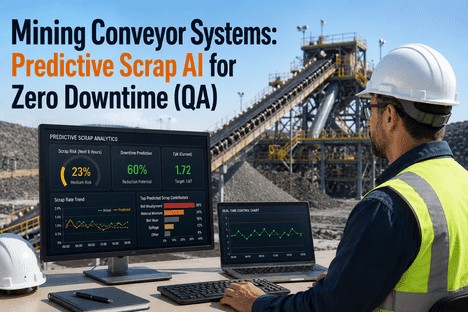
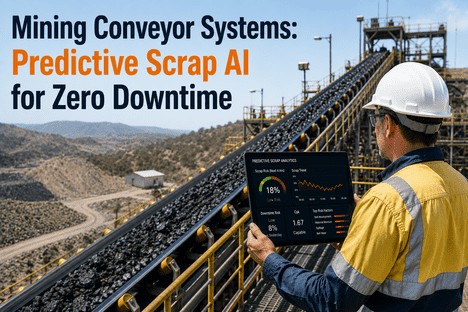
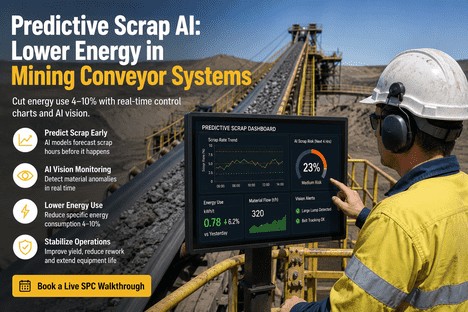
Every ton of material moving across a mining conveyor carries hidden scrap risk — belt damage accumulating unseen, material segregation building toward a quality failure, or a process parameter drifting past the threshold that will trigger a batch rejection hours later. Plant executives who rely on scheduled inspections and static control charts to catch these events are working with a detection system that is structurally too slow. Predictive Scrap AI changes the timeline: from hours of lag to minutes of warning, from reactive investigation to proactive correction, from defect management to defect elimination. This is what the technology delivers in 2026 — and why it is reshaping quality economics in mining conveyor operations.
Machine Vision · Self-Tuning Limits · 24-Hour Scrap Forecasts · Audit-Ready Records
Plant Executives Cutting Defects 30–70% in Mining Conveyor Operations Are Running Predictive Scrap AI — Not Static Control Charts.
iFactory's Predictive Scrap Analytics platform gives plant executives AI-powered scrap forecasts up to 24 hours ahead, self-tuning control limits that adapt to every material shift, and 100% machine vision coverage across conveyor belt systems — all in one quality intelligence layer built for mining.
30–70%
Documented defect reduction in mining operations that move from static quality control to AI-driven predictive scrap analytics
98%+
Defect detection accuracy achieved by neural-network vision systems on mining conveyor belts — catching what human inspectors miss at production speed
24 hrs
Scrap forecast lead time that AI-SPC systems provide — giving plant executives an intervention window before defects are physically produced
20%
Of total revenue the ASQ estimates is consumed by Cost of Poor Quality in manufacturing — the recoverable margin Predictive Scrap AI targets directly
Why Conveyor Systems Are Where Mining Scrap Risk Concentrates
Conveyor systems in mining operations are not passive transport infrastructure. They are the point where ore segregation, particle size variation, moisture deviation, and material contamination translate into downstream quality failures — and where early-stage defect signals are most visible to a detection system that is designed to read them. The problem is that most plants are not equipped to read those signals in real time. Belt damage accumulates incrementally. Splice degradation does not produce a visible failure event until it produces a catastrophic one. Material quality variation crossing the conveyor feeds a processing circuit that will surface the defect hours later, after significant value has been committed to a batch the plant cannot recover.
Plant executives managing this risk with periodic visual inspections and control charts calibrated months ago are operating with a structural detection gap. The gap is not a resource problem — it is an architecture problem. Predictive Scrap AI addresses it at the architecture level: continuous belt monitoring via machine vision, real-time process variable analytics with self-tuning control limits, and ML models that correlate today's conveyor performance data with tomorrow's quality test outcomes. The result is scrap risk that is quantified and acted on before it becomes scrap produced.
The Four Conveyor Scrap Failure Modes — and What Predictive AI Detects Before Each One Occurs
Belt Surface Damage and Longitudinal Tears
Surface cracks, puncture damage, and longitudinal tears evolve over multiple shifts before they reach a failure threshold. By the time a scheduled inspection identifies the damage, the belt has been running degraded — affecting material containment, spillage rates, and in severe cases, the quality of material reaching the processing circuit. Machine vision systems detect these defect patterns in real time, logging damage progression and triggering maintenance alerts before production is affected.
AI detection: Surface crack progression tracked frame-by-frame. Alert fires on threshold approach, not on failure.
Splice Degradation and Steel-Cord Damage
Steel-cord belt damage and splice changes are invisible to visual inspection without magnetic sensing — and in operations running high-value ore over long conveyor routes, a splice failure that triggers an emergency stop carries costs measured in hours of lost production. Magnetic sensors detecting cord damage changes integrated with the predictive platform provide the early warning that converts an unplanned failure into a planned maintenance intervention scheduled for the next available window.
AI detection: Magnetic cord monitoring flags splice degradation weeks before failure threshold is reached.
Idler and Pulley Thermal Anomalies
Idler bearing failures rarely announce themselves before they become a production event. Thermal sensors monitoring idler and pulley temperatures continuously detect the heat signature of a bearing in early-stage degradation — a rise of 15–25°C above baseline is consistently present hours to days before a seized bearing stops the belt. Integrating thermal alert data into the predictive analytics platform builds a maintenance forecast that converts reactive fire-fighting into a scheduled maintenance programme with measurable uptime impact.
AI detection: Thermal anomaly baseline deviation triggers alert hours to days before bearing failure event.
Material Quality Drift and Contamination Events
Foreign object contamination — stone, metal, wood — changes the material quality profile of what the processing circuit receives. So does ore segregation caused by conveyor speed and load variations. Vision systems detecting foreign objects in real time and process variable monitoring tracking conveyor feed rate, material weight, and particle size proxy measurements together create a continuous material quality record. When the combination of signals matches a historical pattern associated with downstream quality failure, the predictive model generates a scrap risk alert before the processing circuit confirms it.
AI detection: Vision plus process variable fusion identifies contamination and segregation risk in real time.
Vision Detection · Thermal Monitoring · Material Quality Forecasting
The Belt Has Been Telling You Where Scrap Risk Lives. Predictive Scrap AI Reads That Signal in Real Time and Acts Before the Defect Reaches the Process Circuit.
iFactory fuses machine vision, thermal sensing, and process variable analytics into a single predictive quality layer — so plant executives see scrap risk ranked, quantified, and actionable before the next scheduled inspection would have found it.
How Self-Tuning Control Limits Eliminate the Static SPC Gap in Mining Conveyor Operations
The most common failure mode in mining quality management is not the absence of an SPC system — it is the presence of an SPC system whose control limits stopped reflecting the real process the moment conditions changed. Ore blend transitions, seasonal moisture variation, feed rate changes across production runs, and material grade changes all shift what normal looks like on a mining conveyor. A static control limit calibrated for last quarter's ore blend will generate false alarms on this quarter's legitimate operating range — and may miss genuine scrap risk because the process has shifted into a new regime where the old limits no longer mark the actual boundary between in-control and out-of-control.
Self-tuning control limits eliminate this gap by treating the limit as a continuously updated statistical model of the current process rather than a fixed threshold set at the last capability study. When ore blend changes, the model detects the regime shift and transitions the limits to the new baseline within a configurable window — generating alerts that reflect the new normal, not the old one. The practical consequence is documented clearly in comparable mineral processing deployments: false alarm rates drop 50–70%, operator alert credibility is restored, and the genuine scrap-risk events that require intervention are reliably detected because they are no longer buried in noise.
Static vs. Adaptive SPC — What Changes for Plant Executives
Static Control Limits
Control limits calibrated once per capability study — typically quarterly or annually. Every process change between studies operates against limits that no longer reflect current conditions.
Ore blend transitions generate high false-alarm rates as the new operating range conflicts with old limits — eroding operator trust in alerts over weeks and months.
No mechanism to distinguish legitimate process regime shifts from genuine scrap-risk deviations — the system treats both the same way.
Limit change documentation is manual, often incomplete, and creates audit risk when auditors ask for rationale behind the current control thresholds.
Self-Tuning Adaptive Limits (iFactory)
Limits recalibrate continuously against a rolling model of the current process baseline — every ore blend change, feed rate shift, and moisture variation is absorbed into the current norm automatically.
Regime transitions are detected and managed — the system holds alert generation during the transition window to eliminate false alarms, then resets to the new baseline before resuming full sensitivity.
Genuine scrap-risk deviations produce alerts that stand out against a current, accurate baseline — not against a threshold calibrated for conditions that no longer apply.
Every limit recalculation is automatically logged with timestamp, triggering condition, prior and new limit values, and statistical basis — producing the audit documentation trail with zero manual effort.
The Predictive Scrap Analytics Platform: What Plant Executives See and Act On
The iFactory platform delivers predictive scrap analytics across three operational layers — real-time belt monitoring, predictive scrap risk forecasting, and executive-level quality visibility — each designed for a different decision type and a different time horizon. All three run simultaneously and feed into a single quality record that is audit-ready from the first day of deployment.
Real Time
Belt and Material Monitoring
100% visual coverage — what every inspection misses between shifts
Machine vision cameras positioned along the conveyor route capture continuous image streams that the AI model analyses for belt surface damage, foreign object contamination, spillage events, edge wear, and material segregation indicators. Every detection is logged with a timestamp, a belt position reference, a defect classification, and a severity score — creating a 100% inspection record for every shift, every run, and every ore blend transition. Neural network classification achieves above 98% accuracy on surface defect types in real-time mining conditions, including the dust and variable lighting environments that defeat standard camera setups. Infrared imaging supplements visible-light cameras in high-dust zones, maintaining detection reliability across the full conveyor route regardless of environmental conditions.
100% belt coverage
Foreign object detection
Infrared thermal overlay
Predictive
Scrap Risk Forecasting
Scrap alerts up to 24 hours before the quality test confirms them
The predictive ML model is trained on historical pairings of conveyor process variable patterns — belt speed, material load, vibration signature, thermal readings, and vision-detected surface conditions — with downstream quality test outcomes. When the current combination of signals matches a historical pattern associated with an off-spec result, the system generates a scrap risk forecast before the quality result is available. For plant executives, this creates a decision window measured in hours, not minutes: enough time to isolate the at-risk batch for additional sampling, adjust the processing circuit parameters for the next run, hold material for re-testing, or authorise a production change before additional product is committed. The forecast accuracy documented in comparable mineral processing AI deployments reaches 92% — a performance level that converts predictive output into a primary production decision input rather than an advisory signal.
Up to 24-hour forecast
92% forecast accuracy
Batch isolation workflow
Executive
Quality Programme Visibility
COPQ trending, Cpk by conveyor zone, and audit export on demand
The executive dashboard aggregates scrap risk, defect frequency, Cpk trends, and COPQ impact across all active conveyor zones into a single management view — designed for plant executives who need programme-level visibility rather than machine-level process control data. Scrap rate trends are displayed against baseline and target, segmented by material grade, ore blend, and time period, so the pattern behind recurring defect categories is visible without manual data compilation. CAPA effectiveness tracking links every corrective action to the alert that generated it and monitors the subsequent defect rate to confirm whether the intervention prevented recurrence. ISO 9001 audit documentation — control limit histories, defect event logs, CAPA records, and Cpk trend exports — is generated automatically and available for any date range at a single export click.
COPQ impact trending
CAPA closed-loop tracking
One-click ISO 9001 export
The COPQ Equation: What Scrap Is Actually Costing Your Conveyor Operation
Plant executives who focus defect reduction conversations on scrap rate percentage are working with a partial view of the cost. The American Society for Quality's 2024 Cost of Poor Quality framework documents that COPQ reaches 15–20% of total revenue when internal failure costs, external failure costs, appraisal costs, and prevention costs are fully accounted for. In a mining conveyor operation generating $100M annually, that represents $15–20M in recoverable margin — the portion of the operation's financial performance that is directly attributable to quality failures and the systems built to detect them after the fact.
Internal Failure
Scrap material, rework, batch re-processing, conveyor re-inspection, and production hold costs incurred before product leaves the plant. The most visible COPQ category — and the one Predictive Scrap AI most directly reduces.
External Failure
Customer rejections, quality claims, product recalls, and penalty clauses activated when defects escape the operation. External failure costs typically run 5–10× higher than the equivalent internal failure cost — making escape prevention the highest-value application for the predictive model.
Appraisal Costs
Manual inspection labour, scheduled belt shutdowns for inspection, sample testing, and quality audit preparation costs. Vision-based continuous monitoring converts a significant portion of appraisal cost from manual labour to automated coverage — with higher detection reliability and a complete inspection record.
Prevention Costs
Quality system maintenance, training, SPC administration, and process improvement programme costs. Adaptive SPC with automated documentation reduces the administrative cost of running the prevention programme — making the total prevention investment more efficient as well as more effective.
"
We were treating our COPQ figure as a fixed operating cost — something to manage rather than eliminate. What changed our perspective was seeing the predictive model surface the same material quality pattern on three separate runs over six weeks, each of which ended in a downstream quality rejection. The pattern was there in the conveyor data every time. We just weren't reading it. After deploying AI-based monitoring and connecting the vision output to the scrap forecast model, we identified that a specific combination of belt speed reduction and material load increase was reliably preceding the rejections. We changed the operating protocol for that combination. The rejection category disappeared from our COPQ tracking in the following quarter.
— Plant Operations Executive, Hard Rock Mining Operation, Overland Conveyor System, 8 Mtpa Throughput
What Implementation Looks Like — From First Sensor to Production-Grade Forecast
Plant executives evaluating Predictive Scrap AI for conveyor operations consistently ask the same question: how long before the system is generating forecasts the plant can act on? The answer depends on historical data availability, but the implementation pathway follows a consistent structure regardless of operation size or ore type.
PHASE 1 — WEEKS 1-3
Data Integration and Vision Commissioning
Process historian connection, LIMS quality record pairing, vision camera commissioning with dust-adaptive image enhancement, and thermal sensor integration. Minimum 6 months of paired process-to-quality history is sufficient for initial model training. Twelve to eighteen months produces better forecast accuracy during ore blend transitions.
Deliverable: Full sensor stack live with baseline quality record established.
PHASE 2 — WEEKS 4-6
Shadow Mode Forecast Validation
The predictive model runs in parallel with the existing quality programme — generating scrap risk forecasts without using them to drive production decisions. The quality team validates forecast accuracy against actual test outcomes over 2–4 weeks. This period generates the documented accuracy data the plant needs to authorise transition to primary decision input status.
Deliverable: Forecast accuracy report with site-specific performance data.
PHASE 3 — WEEK 7+
Live Deployment and COPQ Tracking
Forecasts become primary decision inputs for batch isolation, production parameter adjustments, and maintenance scheduling. COPQ tracking activates — scrap rate, defect frequency, and financial impact are tracked against pre-deployment baselines continuously. The executive dashboard is live from the first day of this phase, and ISO 9001 documentation is generated automatically from all platform activity.
Deliverable: Live COPQ reduction dashboard with audit documentation active.
Conclusion
Mining conveyor operations produce the industry's most tractable scrap signals — continuous sensor streams, 24/7 belt motion, and a direct material connection between conveyor performance and downstream quality outcomes. The obstacle has never been the absence of signal. It has been the absence of a detection architecture fast enough to convert that signal into a production decision before the defect is produced. Predictive Scrap AI closes that gap at every level simultaneously: machine vision that provides 100% belt inspection coverage, self-tuning control limits that eliminate the false alarm noise drowning genuine risk signals, and ML models that generate actionable scrap forecasts 24 hours before a quality test could confirm the risk.
The documented outcomes across mineral processing operations making this transition are consistent: 30–70% defect reduction, 50–70% false alarm reduction, 85% improvement in unplanned downtime from belt failures, and 60-month ROI timelines that routinely compress to under 12 months when the first avoided external failure event is counted. Plant executives who have deployed AI-driven quality intelligence in their conveyor operations consistently report the same finding: the scrap signals were present in the data the entire time. The platform made them readable, rankable, and actionable at a speed the production cycle can use.
iFactory's Predictive Scrap Analytics platform is built for mining conveyor operations where defect elimination — not defect management — is the operating standard. Book a Demo to see the platform configured for your conveyor system and ore profile, or talk to an expert about a free COPQ reduction assessment for your operation.
Frequently Asked Questions
Your Conveyor Data Already Contains Tomorrow's Scrap Signal. Calculate What Finding It 24 Hours Earlier Is Worth to Your Operation.
iFactory's Predictive Scrap Analytics for mining conveyor systems — machine vision belt monitoring, self-tuning control limits, 24-hour scrap forecasting, and ISO 9001 audit documentation, all running from a single quality intelligence platform that deploys without replacing your existing infrastructure.