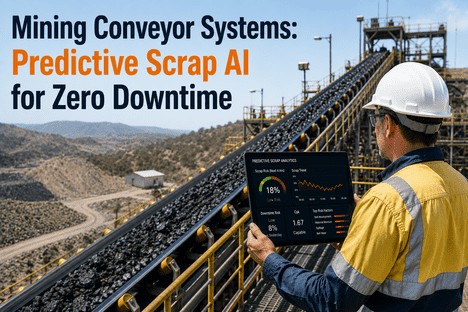
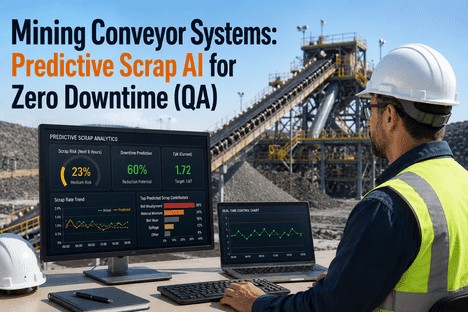
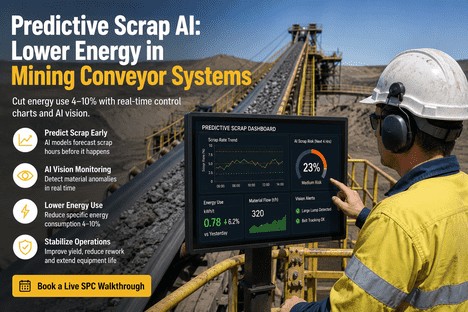
A conveyor belt tear is not a question of if. It is a question of when. Every shift supervisor in mining conveyor operations knows this: the belt runs 24 hours a day, carries thousands of tons of abrasive material, and passes over idlers, through transfer points, and under loading zones where a single piece of scrap steel or a rogue lump of ore can initiate a longitudinal rip that propagates at 3 to 5 meters per second. By the time the operator notices the vibration change or the spillage at the tail pulley, the damage has already run 25 to 250 meters down the belt length. The scrap is counted. The downtime is logged. The production target for the shift is gone. The traditional response is reactive — stop the belt, assess the damage, replace the section, restart, and record the scrap tonnage as an accepted operating loss. Predictive scrap AI replaces this cycle entirely. Instead of detecting damage after it happens, it detects the precursor conditions that produce damage — the load imbalance, the misalignment drift, the material characteristic shift — and alerts the supervisor while the belt is still running and the correction window is still open. This is the shift supervisor's practical guide to deploying predictive scrap analytics on mining conveyor systems and cutting quality-driven downtime by 60 percent or more.
Real-Time Scrap Risk Forecasts · Adaptive SPC Limits · Machine Vision Defect Detection · Audit-Ready Shift Records
Supervisors Who Cut Conveyor Downtime by 60%+ Do Not React to Scrap. They See It Coming.
iFactory's predictive scrap analytics platform gives conveyor supervisors machine-learning scrap forecasts, adaptive control limits that move with material changes, and real-time vision inspection — so you act on scrap risk hours before the belt stops, not after the tonnage is already lost.
$6–12M
Cost of a single major conveyor belt failure at large-scale mining operations — including direct repair, lost production, idle labor, and contract penalties
60%+
Quality-driven downtime reduction achieved when predictive scrap AI replaces reactive inspection across monitored conveyor networks
92.95%
Fault prediction accuracy achieved by AI-driven data models on mining conveyor idler condition monitoring — validated across full-load field operations
The Three Hidden Patterns That Produce Conveyor Scrap — and Why Supervisors Miss Them
Every shift supervisor walks the line. They hear the misaligned idler, they see the spillage at the transfer point, they feel the vibration change in the drive motor. But the three scrap-producing patterns that account for 70 to 90 percent of quality-driven conveyor downtime are invisible to human senses. They exist in the data — in the relationship between motor current and belt speed, in the rate of change of load distribution across the belt width, in the harmonic signature of an idler that will seize in 72 hours. These patterns are detectable, but only by a system that watches every parameter simultaneously and knows what combination of small drifts historically precedes a scrap event. Predictive scrap AI closes this visibility gap. It does not replace the supervisor's experience. It extends it with pattern recognition that covers the whole conveyor network continuously.
01
Load Imbalance Drift
Material loads the belt unevenly shift after shift. One edge carries 60 percent of the tonnage while the other carries 40. The belt tracks toward the heavy side. Edge wear accelerates. Belt tension distribution becomes asymmetric. The supervisor sees the tracking drift on shift three. By then, the belt has already lost 5 to 8 percent of its working life. Predictive detection catches the imbalance pattern on shift one — before the belt tracks, before the edge wears, before the scrap is produced.
AI detects: Load distribution asymmetry vs. belt speed envelope
02
Idler Degradation Cascade
A single idler begins to seize. Friction increases. Local belt temperature rises. The belt drags across the seized roller, accelerating wear on the bottom cover. Adjacent idlers take up the load and begin to degrade faster. Within 48 hours, five idlers are failing in sequence. The first predictive alert fires 24 hours before the first seizure — based on the motor current harmonic signature that the degrading idler produces under load. The supervisor intervenes before the cascade begins, replacing one idler instead of five.
AI detects: Motor current harmonics and thermal drift pattern
03
Material Characteristic Shift
Ore moisture content changes with the stockpile feed. Fines percentage varies between blast-hole regions. A material shift that increases fines by 4 percent changes the abrasion profile on the belt surface, the dust generation at transfer points, and the spillage rate at the loading zone. The supervisor sees the dust and the spillage. The predictive model sees the moisture and fines data 20 minutes after the material enters the conveyor network — and alerts the supervisor that the transfer point skirting needs adjustment before spillage reaches the scrap threshold.
AI detects: Material composition proxy vs. historical scrap correlation
24-Hour Scrap Forecast · Cpk Trending · Vision Integration · CAPA Effectiveness
The Patterns That Produce Scrap Are Invisible on the Belt. They Are Visible in the Data. Predictive Scrap AI Closes the Gap.
iFactory's predictive scrap analytics platform ingests motor current, belt speed, load distribution, temperature, and vibration data across every belt segment — and fires scrap risk alerts 2 to 24 hours before the belt stops.
How Predictive Scrap AI Works on Mining Conveyor Systems
The predictive scrap analytics platform operates as a continuous detection and forecasting engine that runs alongside the conveyor control system. It does not require new sensors on the belt. It connects to the data the control system already generates — motor current, belt speed, load cells, vibration monitors, temperature probes — and applies machine learning models trained on historical scrap events to detect the precursor patterns that precede damage. The system outputs three types of intelligence that the shift supervisor acts on directly.
Intelligence 01
Scrap Risk Forecast by Belt Segment
Every belt segment in the conveyor network displays a current scrap risk level — normal, watch, elevated, or critical — calculated from the combination of live parameter readings and their historical correlation with scrap events. The supervisor opens the dashboard and sees immediately which segments need attention, which parameter is driving the risk, and how much lead time remains before the risk is expected to materialize. A segment at elevated risk with a 6-hour lead time generates a different response than one at critical risk with 30 minutes of lead time.
Intelligence 02
Root Cause Parameter Identification
When the scrap risk forecast triggers, the model outputs the top three parameters driving the risk score — ranked by their contribution to the forecast. The supervisor does not need to dig through trend charts to find the cause. The alert states it directly: belt segment C4 risk is elevated. Primary driver: load distribution asymmetry (68 percent contribution). Secondary driver: belt speed deviation from setpoint (22 percent contribution). The response action is clear before the supervisor reaches the segment.
Intelligence 03
Recommended Intervention with Predicted Outcome
Each scrap risk alert includes a recommended intervention — adjust feed rate, realign skirting, replace idler at position X — drawn from the model's analysis of what interventions have historically been effective for the same parameter combination. The predicted outcome of the intervention is displayed alongside the alert: expected risk reduction from current level to post-intervention level, with the confidence interval. The supervisor acts knowing not just what to do, but what the outcome is expected to be.
What the Shift Supervisor Sees on the Predictive Scrap Dashboard
The supervisor's dashboard is designed around a single objective: get the information needed to act before scrap is produced, in the fewest possible glances. Every view serves that objective. No data appears on the dashboard that does not drive a decision.
Conveyor View 01
Live Conveyor Network Map with Risk Overlay
A single-screen view of the entire conveyor network — every belt segment, transfer point, and drive station displayed on a plant layout map with color-coded risk overlay. Green segments are operating within normal parameters. Yellow segments have one or more parameters trending toward a scrap precursor. Red segments have an active scrap risk forecast requiring intervention. The supervisor sees the whole network in one glance and navigates directly to the segment that needs attention.
Supervisor action: Navigate to red segment, view parameter drivers, assign intervention.
Conveyor View 02
Trending Cpk by Belt Segment and Parameter
Cpk is calculated continuously for every monitored parameter — load distribution, belt speed, motor current, vibration amplitude, temperature — per belt segment. The trend line shows the current value, the 8-hour trajectory, and the projected Cpk at current rate of change. A Cpk falling from 1.67 toward 1.33 triggers an investigation alert before capability drops below the warning threshold. The supervisor sees which segment is losing capability and which parameter is driving the decline without opening a single trend chart manually.
Supervisor action: Investigate falling Cpk segments before capability crosses warning threshold.
Conveyor View 03
Scrap Pareto by Cause, Segment, and Shift Pattern
Every scrap event and every scrap risk forecast is logged with the root cause, belt segment, shift, material type, and time stamp. The Pareto view ranks scrap causes by frequency and tonnage impact — making cross-shift patterns visible that individual incident reports never reveal. A supervisor who sees that 60 percent of scrap risk events on the night shift are caused by load imbalance at the same transfer point has a systemic finding that drives a protocol change, not a repeated idler adjustment.
Supervisor action: Pareto root causes escalate to engineering for systemic protocol improvement.
Conveyor View 04
Machine Vision Surface Defect Feed — Real Time
For conveyor systems deploying machine vision cameras at transfer points or over belt runs, iFactory integrates vision inspection outputs directly into the scrap risk calculation. Vision-detected surface defects — belt cover cracks, edge fraying, splice separation indicators, foreign objects on the belt — are logged against the belt segment record and contribute to the scrap risk forecast for that segment. A foreign object detected by vision at the loading zone triggers an immediate scrap risk alert with a recommendation to remove the object before it reaches the first transfer point pinch area.
Supervisor action: Vision-detected foreign object triggers removal before rip event initiates.
Before predictive scrap AI, I spent the first two hours of every shift walking the line looking for problems that had already started. Belt tracking was off, the load was uneven, an idler was running hot — and by the time I found it, the belt had already lost working life. The dashboard changed this. Now I open the screen, see that belt segment C4 has an elevated scrap risk driven by load distribution asymmetry, and dispatch the crew to adjust the chute before the belt tracks off center. The scrap risk forecast caught it two hours before my walk would have found it. The belt never tracked off. That is the difference between managing scrap after it happens and preventing it before it starts.
— Shift Supervisor, Iron Ore Conveyor Network — Overland and In-Plant Belt System, 8 km Total Conveyed Length
Conclusion
Conveyor scrap in mining operations is not a maintenance problem. It is a detection timing problem. The damage that produces scrap on a conveyor belt does not happen in an instant — it develops over hours or shifts through measurable parameter drift that is visible in the data long before it is visible on the belt. The reason most operations still absorb scrap as an accepted loss is not that the data is missing. It is that the analytical layer watching that data has been trained to detect limit breaches rather than precursor patterns. A motor current reading inside the normal range tells the supervisor nothing useful. A motor current reading that has risen 4 percent over three hours while load remained constant tells the supervisor that an idler is beginning to seize and the belt is losing efficiency. Predictive scrap analytics makes the second kind of intelligence available for every parameter on every belt segment continuously.
The industry evidence from 2025 and 2026 is consistent and documented across multiple deployment contexts. AI-driven predictive monitoring on mining conveyor systems has demonstrated over 92 percent fault prediction accuracy, 60 percent or greater reduction in quality-driven downtime, 20 percent reduction in mean time to repair, and over 99 percent equipment availability on monitored conveyor networks. These outcomes are not projection-based. They are the documented results from operations that moved from reactive scrap management to predictive scrap prevention. The operations achieving the upper end of the performance range are the ones that deployed predictive analytics across their full conveyor network, integrated machine vision at critical detection points, and used the scrap Pareto and Cpk trending tools to convert individual intervention events into systemic protocol improvements.
iFactory's predictive scrap analytics platform is purpose-built for shift supervisors and production line leaders in mining conveyor operations who need to eliminate scrap-driven downtime, not just log it after the belt stops. Book a Demo to see the predictive scrap dashboard configured for your conveyor network layout and material profile, or talk to an expert about a free scrap risk and Cpk assessment for your conveyor system.
Frequently Asked Questions
Scrap That Stops Your Belt Has a Pattern in the Data. Predictive Scrap AI Finds It Before the Next Tonnage Report. Get a Free Scrap Risk and Cpk Assessment.
iFactory's predictive scrap analytics platform for mining conveyor supervisors — scrap forecasts 2 to 24 hours ahead, adaptive SPC limits that move with material and load changes, machine vision integration, Cpk trending by belt segment, and audit-ready shift records generated automatically from the data your conveyor system already produces.