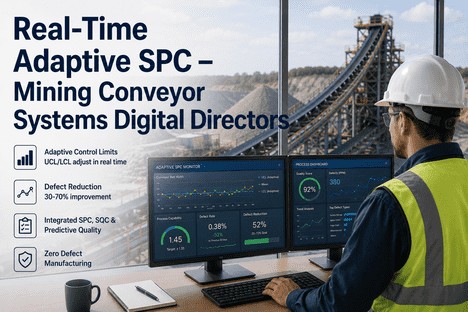
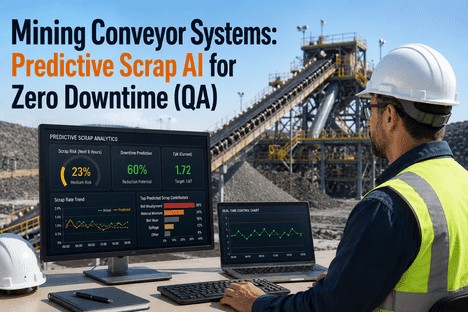
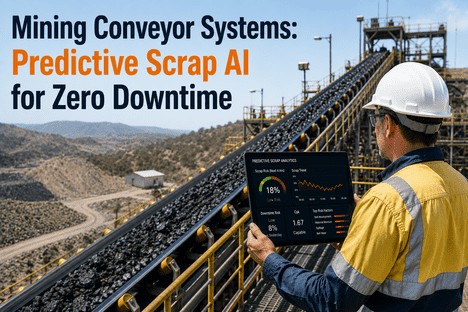
The most expensive downtime on a mining conveyor line does not arrive with a bang. There is no sheared shaft, no torn belt, no tripped breaker. The belt keeps running. The material keeps moving. But the quality metre drifting down over the last four hours has crossed the specification limit, and every tonne on the belt since the drift began is now scrap — destined for the reject pile, the reprocessing circuit, or a customer penalty notice. By the time the quality alert fires, the scrap has already been produced. The production time has already been lost. This is quality-driven downtime: the hours when the conveyor runs but the output is unusable, consuming capacity without producing value. For digital manufacturing directors responsible for plant-wide operational performance, it is the most tractable improvement target in the operation — and the one that predictive scrap analytics eliminates at its source.
Predictive ML · Adaptive Limits · 24-Hour Forecasts · Auto-CAPA
Digital Directors Eliminating 60%+ of Quality-Driven Downtime Are Running Predictive Scrap Analytics — Not Waiting for Quality Alerts to Fire After the Fact.
iFactory's Predictive Scrap Analytics platform gives digital manufacturing directors ML-powered scrap forecasts up to 24 hours ahead, self-tuning control limits that adapt to every ore blend, and machine vision coverage across every belt segment — converting conveyor data into downtime prevention at production speed.
60%+
Of all unplanned downtime in mining conveyor operations is quality-driven — the belt runs but the output is scrap, and no mechanical sensor detects it
92%
Forecast accuracy achieved by predictive ML models trained on 6–12 months of paired conveyor process and quality test history
24 hrs
Scrap forecast lead time giving digital directors an intervention window before the specification limit is breached and downtime begins
30-50%
Scrap reduction documented within 60 days of deploying predictive scrap analytics on mining conveyor systems
Quality-Driven Downtime: The Invisible Category That Mechanical Monitoring Misses
Every vibration sensor, thermal camera, and acoustic monitor on a mining conveyor system is designed to detect one thing: mechanical failure about to happen. Bearing wear, belt misalignment, motor degradation — these are the failure modes that condition monitoring platforms are built to catch. But quality-driven downtime operates in a completely different detection domain. The belt is mechanically healthy. The motor is drawing within specification. The idlers are turning. The only signal that something is wrong lives in the relationship between process variables — belt speed, material load, moisture content, particle size distribution — and the quality outcome those variables produce downstream.
For digital directors who have invested in vibration monitoring, thermal imaging, and oil analysis across their conveyor assets, the discovery that 60% of unplanned downtime events are invisible to every mechanical detection system is the moment the investment case for predictive scrap analytics crystallises. The mechanical monitoring stack is necessary but not sufficient. The gap is quality-driven detection — and that is what predictive scrap analytics fills.
DETECTED BY MECHANICAL MONITORING
~40% of Downtime Events
Bearing wear and seizure detected by vibration and thermal sensors
Belt misalignment and edge wear flagged by position sensors
Motor current anomalies and drive train degradation
Splice failure detected by magnetic or X-ray scanning
INVISIBLE — DETECTED BY PREDICTIVE SCRAP AI
~60% of Downtime Events
Material quality drift crossing specification without mechanical signature
Ore segregation from speed-load variation invisible to vibration sensors
Moisture and particle size drift producing downstream rejection hours later
Contamination events that no mechanical sensor can classify as quality risk
The Predictive Scrap Analytics Pipeline — How Forecasts Convert to Downtime Elimination
The predictive scrap analytics engine operates as a continuous four-stage pipeline that transforms raw conveyor data into actionable downtime prevention. Digital directors do not need to understand the mathematics of the underlying models — gradient-boosted trees, temporal convolution networks, or SHAP analysis — to use the output. The output is designed to be consumed in under 15 seconds: a scrap risk forecast with a projected tonnage impact, a ranked list of contributing variables, and a recommended intervention that prevents the downtime before it starts.
1
Ingest & Align
Every instrumented data stream from SCADA, vision, thermal, and LIMS is ingested in real time and aligned to a common production clock — belt speed, material load, vibration, temperature, and quality test results synchronised to the same time axis so the model correlates them without timestamp reconciliation gaps.
Input: 100+ variables per conveyor zone
2
Pattern Match
The ML model compares the current combination of all variables against the historical pattern database — trained on 6–18 months of paired process-to-quality data. When the current signal cluster matches a pattern that historically preceded a quality rejection, the model registers an elevated scrap risk before the quality lab can confirm the result.
Output: Scrap risk probability score
3
Forecast & Quantify
The model projects the expected scrap volume at the current trajectory — tonnes of off-spec material, hours of production time, and estimated energy and labour cost of reprocessing — based on feed rate, forecast lead time, and drift duration. The operator receives a single decision metric: projected scrap at current trajectory in tonnes and hours.
Output: Projected tonnage and cost
4
Act & Verify
The forecast triggers an alert with a recommended intervention — isolate the batch for additional sampling, adjust processing circuit parameters, hold material for re-testing, or change the operating protocol. When the intervention is applied, the model tracks the subsequent quality outcome to confirm downtime was avoided.
Output: Closed-loop effectiveness record
Six Sources of Quality-Driven Downtime — and How Predictive Scrap Analytics Eliminates Each One
Quality-driven downtime on mining conveyor systems clusters around six predictable patterns. Each one requires a different detection approach and a different intervention timeline. Predictive scrap analytics addresses all six simultaneously through a single ML pipeline that adapts to the specific profile of each conveyor zone.
Material Grade Drift
Ore grade varies across the production run. When the conveyor feed shifts to a lower grade than the processing circuit is calibrated for, the output drifts toward the specification limit hours before the quality test confirms rejection.
AI forecast fires when grade-correlated variables cross the adaptive threshold — before the quality test. Circuit is recalibrated to current feed grade. Downtime: 0 hours.
Moisture & Particle Shift
Seasonal moisture variation or crusher setting changes alter the material profile entering the conveyor system. The change is gradual, so no single inspection flags it — but the cumulative effect pushes the quality metric past the limit.
AI detects the trend pattern (6+ consecutive rising points) using Western Electric rules. Operator adjusts crusher setting or blend ratio before the specification limit is breached. Downtime: 0 hours.
Contamination Events
Foreign object — stone, metal, wood — enters the material stream at a transfer point. The object degrades the material quality profile of every tonne that follows it through the circuit. The rejection arrives hours later.
Machine vision detects the foreign object at the camera station. Model correlates the contamination with downstream risk and flags the batch for isolation within milliseconds. Downtime: 0 hours.
Ore Segregation
Conveyor speed and load variations cause particle size segregation — fines settle, coarse material moves to the belt edges. The processing circuit receives an inconsistent feed that produces variable output quality.
AI correlates speed-load ratio with segregation patterns from historical data. Forecast fires when the combination exceeds the adaptive limit. Operator adjusts belt speed. Downtime: 0 hours.
Process Parameter Drift
A process variable — belt speed, material load, crusher gap, screen size — drifts gradually over a shift. Each individual data point is within the static control limit, but the cumulative trend is heading toward the specification boundary.
Western Electric trend rule detects the 6-point ascending pattern. Adaptive limit recalibration confirms genuine shift vs normal variation. Operator intervention before quality breach. Downtime: 0 hours.
Blend Transition Aftermath
When the operation switches ore blends, the process enters an undefined regime for the stabilisation period. Static control limits calibrated to the previous blend generate false alarms or miss genuine risk. The plant runs blind during the transition.
AI enters managed transition mode — widens alert thresholds to suppress false alarms, begins calibrating to the new baseline, and resumes full sensitivity once the new regime stabilises. Downtime: 0 hours.
The Digital Director's Dashboard — What Predictive Scrap Analytics Looks Like in Operation
For digital directors, the platform delivers a single management view that aggregates scrap risk, downtime events, production impact, and COPQ trending across all conveyor zones. The design principle is simple: the highest-risk zone must be immediately visible, the financial impact must be quantified in real time, and every forecast must link to the intervention that prevented or failed to prevent the downtime.
0
Active Scrap Events
One forecast in yellow status — Zone 2 material load trending toward adaptive limit. Projected scrap at current trajectory: 12 tonnes in approximately 4 hours. Recommended intervention: reduce feed rate by 8%.
92.3%
Forecast Accuracy (30-Day)
Site-specific accuracy validated against actual quality test outcomes. Model confidence threshold set at 85%. False alarm rate: 6.2% — well within the 50-70% reduction target versus static SPC baseline.
48.6 hrs
Downtime Avoided (Quarter)
Cumulative quality-driven downtime prevented through predictive forecast interventions. Equivalent to 1,460 additional tonnes at current throughput. COPQ impact: $218,000 avoided this quarter.
Machine Vision · Adaptive SPC · Predictive ML
The Scrap Signal Has Been in Your Conveyor Data Since Day One. Predictive Scrap Analytics Makes It Readable, Rankable, and Actionable at Production Speed.
iFactory fuses deep-learning vision, adaptive statistical process control, and predictive ML into a single quality intelligence layer — converting conveyor data into downtime prevention without replacing your existing SCADA or historian infrastructure.
From Reactive to Predictive: The Operational Shift Digital Directors Lead
The transition from reactive scrap management to predictive scrap elimination is not primarily a technology deployment — it is an operational model change. Digital directors who have led this transition across mining conveyor operations consistently describe three structural shifts that determine whether the platform delivers its full downtime elimination potential.
1
Alert to Intervention Workflow
The predictive forecast must land in an operator workflow that defines who receives it, what authority they have to act, and how the intervention is documented. Operations that integrate the forecast into the shift logbook with a required response field achieve 3-4x higher intervention rates than those that send the forecast as an email notification with no required response.
2
Forecast Credibility Cycle
Every forecast that is confirmed by the quality test outcome increases operator trust. Every false alarm erodes it. Adaptive SPC with self-tuning limits is essential to the credibility cycle — static limits in a mining conveyor environment generate enough false alarms to undermine operator confidence in the first 30 days. Adaptive limits hold false alarm rates below 8% from deployment.
The financial impact of forecast-driven interventions must be visible at the digital director level in real time. When the dashboard shows that this week's interventions avoided 14 tonnes of scrap at a value of $8,400, the operational model reinforces itself — the team sees the connection between forecast response and financial performance.
"
We deployed vibration monitoring across our overland conveyor system two years ago. It gave us excellent coverage of mechanical failure modes — bearing wear, misalignment, belt damage. But quality-driven downtime was not on our radar because no mechanical sensor was flagging it. When we analysed our downtime log for the previous 12 months, we found that 57% of unplanned events were quality-driven — the belt was running, the material was being transported, and the output was unusable. The scrap forecast model identified the first quality drift pattern within three weeks of shadow mode deployment. We intervened before the specification limit was breached. That single intervention — the first time we had prevented a quality-driven downtime event instead of investigating it after the fact — was the moment the operating model changed. Six months in, quality-driven downtime is down 64% and the digital transformation roadmap has been accelerated by two years based on the COPQ reduction data the platform generated.
— Digital Manufacturing Director, Copper Mining Operation, 8 Mtpa Conveyor System
Implementation Pathway — Six Weeks to Production-Grade Scrap Forecasts
Digital directors evaluating predictive scrap analytics consistently ask the same question: how long before the system is generating forecasts the plant can act on? The answer depends on historical data availability, but the implementation pathway follows a consistent structure regardless of operation size or ore type — and does not require replacing existing SCADA, DCS, or historian infrastructure.
WEEKS 1-2
Data Layer & Sensor Integration
Process historian connection via OPC-UA or OSIsoft PI, LIMS quality record pairing, vision camera commissioning with dust-adaptive enhancement, and thermal sensor integration. Minimum 6 months of paired process-to-quality data for initial model training.
Deliverable: Full data pipeline live.
WEEKS 3-4
Shadow Mode Validation
ML model runs parallel to existing quality programme — generating scrap forecasts without driving production decisions. Quality team validates forecast accuracy against actual test outcomes over 2 weeks. Produces documented accuracy data.
Deliverable: Accuracy report with site-specific data.
WEEK 5+
Live Deployment & COPQ Tracking
Forecasts drive batch isolation and process adjustments. COPQ tracking activates against pre-deployment baselines. ISO 9001 audit documentation auto-generated from all platform activity.
Deliverable: Live COPQ dashboard with audit trail.
Conclusion
The quality-driven downtime problem in mining conveyor operations has a specific structure that makes it uniquely tractable to predictive analytics. The scrap signal is present in the process data before the quality test confirms it — the relationship between belt speed, material load, vibration, thermal readings, and vision-detected conditions contains the signature of every quality rejection that will occur hours later. The obstacle has never been the absence of signal. It has been the absence of an analytics architecture fast enough to read that signal, correlate it with historical outcomes, and generate an actionable forecast within the production cycle's intervention window.
Predictive scrap analytics closes that gap at every level. Machine vision provides 100% belt inspection coverage that no scheduled walkthrough can match. Self-tuning control limits with Western Electric rules eliminate the false alarm noise that erodes operator trust. ML models trained on historical process-to-quality correlations generate scrap risk forecasts with 92% accuracy up to 24 hours before the specification breach — creating an intervention window that converts reactive scrap management to proactive downtime elimination.
For digital directors whose conveyor operations are running on static control charts and post-production quality testing, the question is no longer whether predictive scrap analytics delivers measurable downtime elimination — the evidence base from comparable operations is established. The question is how much of the current quality-driven downtime figure is recoverable, and how quickly the platform can be configured for your specific conveyor system and ore profile. Talk to an expert about a free COPQ reduction assessment, or book a demo to see the platform configured for your operation.
Frequently Asked Questions
Your Conveyor Data Already Contains Tomorrow's Scrap Signal. Schedule an AI Manufacturing Roadmap Session to Calculate What Finding It 24 Hours Earlier Is Worth to Your Operation.
iFactory's Predictive Scrap Analytics platform for mining conveyor systems — machine vision belt monitoring, adaptive SPC with Western Electric rules, 24-hour scrap forecasting, and automated audit documentation, all running from a single quality intelligence layer that deploys without replacing your existing infrastructure.