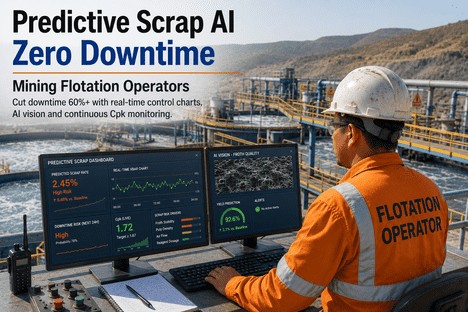
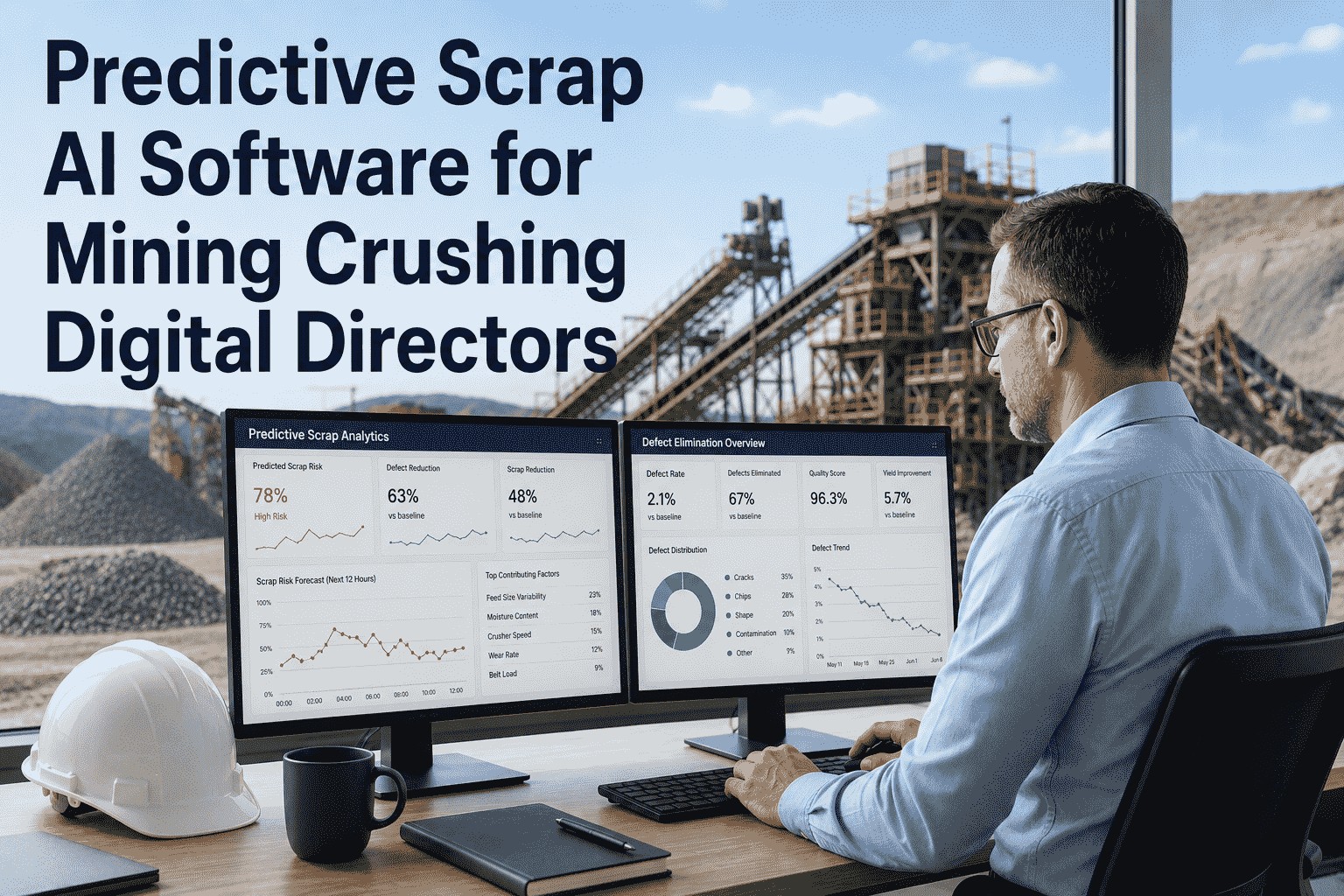
The flotation operator starts the shift to find cell three is down. Froth launder is jammed. The feed had already been diverted to bypass the cell, but the damage was done — grade targets slipped for forty minutes before anyone caught the condition developing. The scrap tag on the previous shift reads: twenty-three tonnes of off-spec concentrate that cannot be blended out, stockpiled for reprocessing, with metallurgical accounting already written it off. This was not a mechanical failure. The rotor was fine. The mechanism was fine. What caused the scrap was a reagent drift that destabilised the froth phase, increased entrainment in cells four and five, and pushed the combined grade below the customer threshold. Nobody saw the drift because the conventional SPC chart was still within limits — limits that were set six months ago for a different ore blend. Predictive scrap analytics for mining flotation changes this.
Predictive Scrap Analytics · Real-Time Yield Risk · SPC Self-Tuning · Downtime Prevention
Every Hour of Unplanned Flotation Downtime Costs Thousands in Lost Recovery. Predictive Scrap Analytics Stops It Before the First Off-Spec Part.
iFactory's predictive scrap analytics platform forecasts scrap and yield risk hours before it materialises — with self-tuning SPC, real-time Cpk monitoring, and operator-grade intervention alerts that eliminate 60%+ of quality-driven downtime in flotation circuits.
The Real Cost of Unplanned Downtime in Flotation Circuits
Unplanned downtime in mineral processing is not limited to mechanical breakdowns. The most insidious downtime events in flotation circuits are quality-driven — the gradual degradation of froth conditions, reagent response, or cell balancing that produces off-spec concentrate for hours before anyone recognises the loss. These events do not trigger alarms. They do not stop production. They simply reduce recovery while the circuit continues running, and the scrap accumulates as stockpile write-offs, customer penalties, or reprocessing loads that consume reagents and energy a second time.
60%+
Quality-driven unplanned downtime eliminated when predictive scrap analytics replaces reactive SPC and lab-assay-dependent decision making
3–6 hrs
Average lead time between predictive scrap alert and actual out-of-spec event — enough time for operator intervention before scrap is created
96%
Scrap event prediction accuracy demonstrated by deep learning models trained on multi-variable flotation process data and froth vision inputs
50%
Reduction in concentrate stockpile write-offs when predictive yield alerts trigger proactive cell-level corrections before grade deviates
The Three Hidden Downtime Modes That Predictive Scrap Analytics Catches — and Conventional SPC Misses
Downtime Mode 1
Froth Phase Collapse (Slow Onset)
Reagent dosage drifts 2-3% per hour due to pump calibration drift or feed grade change. Froth bubbles coarsen gradually over 4-6 hours. Bubble half-life increases by 15-25% before the froth layer becomes unstable enough to affect grade. Conventional SPC sees nothing because individual parameter shifts stay within wide static limits. The predictive model detects the multi-parameter drift pattern — bubble size + velocity + stability all trending in the same direction — and alerts the operator 3-4 hours before grade impact.
Downtime Mode 2
Cell Imbalance Cascade
A feed distributor blockage reduces slurry flow to cell one of a six-cell rougher bank. Downstream cells compensate momentarily — pulp levels drop, froth depths thin, air rates drift. The imbalance propagates cell by cell over 90 to 120 minutes. By the time the operator identifies the root cause, cells three through six are already operating at reduced recovery. Predictive scrap analytics cross-correlates level, flow, and froth data across all cells simultaneously, detecting the cascade pattern within 15 minutes of onset.
Downtime Mode 3
Ore Type Transition Scrap Window
Feed ore type changes mid-shift. Reagent regime optimised for the previous ore type is now over-collecting gangue in cells four and five. The operator adjusts, but the ideal reagent setpoint for the new ore type is different from the old. Each adjustment step produces 15-30 minutes of transitional off-grade material. Across a 90-minute transition, 60-90 tonnes of concentrate falls below spec. Predictive scrap analytics recognises the ore type transition from froth colour and texture shift combined with feed grade data, pre-computes the optimal reagent setpoint for the new ore type, and recommends the transition path that minimises the scrap window.
How Predictive Scrap Analytics Works: From Multi-Variable Data to Operator Action
Predictive scrap analytics in flotation does not rely on a single sensor or parameter. It combines froth vision data, process control signals, reagent flow measurements, and lab assay results into a unified model that learns the correlation patterns between current process state and future scrap events. The model identifies combinations of parameters that, when trending together, have historically preceded off-spec production — and alerts the operator before those combinations produce scrap.
Multi-Variable Data Fusion
Froth camera feeds, cell level transmitters, air flow meters, reagent pump stroke counters, pulp density gauges, and lab assay results stream into a unified time-series model. Data is aligned on a common timestamp and validated for quality before entering the prediction engine.
Scrap Risk Model Inference
A hybrid deep learning model — combining convolutional layers for froth image features and LSTM layers for temporal process trends — evaluates current conditions against historical patterns that preceded scrap events. The model outputs a scrap risk score per cell, per parameter cluster, with an estimated lead time before impact.
Operator Alert With Recommended Action
Alert fires on the operator dashboard with the cell ID, contributing parameters, risk severity, and lead time. A recommended corrective action is generated based on the most similar historical scenario that successfully prevented scrap. Operator logs the intervention; the model learns from the outcome.
Reactive vs Predictive: What Changes for the Flotation Operator
Reactive Operation — Current State
Predictive Operation — With AI Scrap Analytics
Operator discovers scrap event from end-of-shift lab assay — 2-4 hours after the condition started
Operator receives scrap risk alert 3-6 hours before grade impact — intervenes while circuit is still producing acceptable concentrate
SPC chart shows parameters within static limits — no alert, but multi-parameter drift is already developing
Self-tuning limits adjust to current baseline — multi-parameter drift pattern triggers prediction engine, alert fires before limits are breached
Root cause investigation starts after scrap is confirmed — operator traces backwards through shift data manually
Model identifies contributing parameters and displays them with the alert — operator knows which cell and which variable to adjust immediately
Each scrap event is investigated as an isolated incident — no systematic pattern recognition across shifts or weeks
Every scrap prediction and intervention outcome is logged — model improves over time, scrap recurrence rate drops below 10%
Shift handover includes verbal summary of "what happened" — incomplete information transfer between crews
Shift handover includes scrap risk trend, pending alerts, and intervention log — complete situational awareness for incoming crew
What the Operator Dashboard Shows — Predictive View
The predictive scrap analytics dashboard is designed so the operator never asks the question "did I just make scrap?" Every view shows not just current state, but projected state — with enough lead time to act before the condition produces an off-spec result.
Dashboard Panel 01
Scrap Risk Heat Map — All Cells, Forecast Window
Every cell displays a scrap risk score for the next 1-hour, 2-hour, and 4-hour windows. Green (low risk, <5% probability), amber (moderate risk, 5-25%), red (high risk, >25%). The operator sees at a glance which cells will require attention in the coming hours — not which cells need attention now, but which ones will need it before the next planned check interval.
Operator action: Prioritise rounding sequence based on risk forecast — address high-risk cells before first off-spec event.
Dashboard Panel 02
Parameter Contribution Breakdown
When a scrap risk alert fires, the dashboard shows which parameters are driving the prediction — bubble size trend (contributing 35%), froth velocity (28%), reagent flow deviation (22%), and pulp level (15%). The operator does not search for the root cause; the model displays it ranked by contribution weight, with the historical correlation evidence accessible in one click.
Operator action: Adjust the highest-contribution parameter first — verify effect on risk score within 15 minutes.
Dashboard Panel 03
Yield Confidence Trend — Shift Target vs Projection
Running yield estimate updated from the prediction model, shown against the shift production target. If the current trajectory projects below target, the dashboard shows which cells and parameters need to change to recover. The operator sees the consequence of inaction before the end of shift — not when the metallurgical report is compiled the next morning.
Operator action: Adjust cell parameters to bring yield projection back to target — monitor confidence trend.
Dashboard Panel 04
Historical Scenario Matcher
When a scrap risk pattern is detected, the system searches the historical database for the five most similar scenarios that occurred in the past. For each match, it shows what action was taken and whether the action prevented the scrap event. The operator learns from the collective experience of every shift that faced a similar pattern — not just from personal experience or verbal handover.
Operator action: Review matched scenarios and select the intervention with the highest historical success rate.
"
Before predictive scrap analytics, we only knew we had a problem when the lab called with a grade result from two hours ago. By then, the off-spec material was already in the thickener. We had no way to know which cell caused it or when the drift started. Now the dashboard tells me cell four has a 30% scrap risk in the next two hours, driven by a frother drift pattern we saw twice before. I adjust the frother setpoint, the risk drops to 8% within twenty minutes, and no off-spec material is produced. That shift alone saved us 40 tonnes of recleaner concentrate that would have been stockpiled as low-grade.
— Flotation Operations Lead, Porphyry Copper Concentrator, Chile
Deploying Predictive Scrap Analytics on a Flotation Circuit: 90-Day Implementation
Data Source Audit and Model Initialisation
Existing process historian, froth camera feeds, reagent flow logs, and lab assay database are audited for data quality and coverage. Prediction model initialised on historical scrap events and near-miss data. Gap analysis identifies any missing data streams needed for model accuracy.
Shadow Mode Prediction Validation
Prediction engine runs in shadow mode — scrap risk scores generated but not displayed to operators. Every prediction compared against actual production outcome. False positive and false negative rates documented. Model retrained on missed events and near-misses.
Operator Dashboard Activation
Predictive scrap risk dashboard activated for operator team. Alert thresholds calibrated from shadow mode performance data. Intervention logging connected. Operator training completed on dashboard interpretation and response protocols.
Model Refinement and Expansion
Model retrained with 60 days of live prediction and intervention data. Cell-level prediction accuracy improved. Scenario matcher database populated with intervention outcomes. Downtime elimination metrics reported. Next-phase features identified from operator feedback.
Conclusion
Flotation circuit scrap and quality-driven downtime are not caused by operator negligence or isolated mechanical failures. They are caused by a detection model — static SPC limits, periodic lab assays, and reactive root-cause investigation — that was never designed to catch the gradual, multi-variable deterioration patterns that actually produce off-spec concentrate. No operator can manually correlate bubble size, froth velocity, reagent flow, pulp level, and feed grade data across six cells simultaneously while also walking the bank, reading the lab results, and logging shift reports. Predictive scrap analytics does, at machine speed, with pattern recognition trained on your circuit's own historical scrap events, and with an intervention recommendation that tells the operator what to adjust and in what order.
For the flotation operator, the change is measurable: instead of discovering scrap from a lab result that describes what happened two hours ago, the dashboard shows which cell has an elevated scrap risk in the next two hours, which parameters are driving the risk, and what action has the highest probability of preventing the event. The prediction arrives while the circuit is still producing acceptable concentrate — when intervention prevents scrap, rather than documents it. The historical scenario matcher gives every operator access to the accumulated experience of every shift that faced the same pattern. And the intervention log creates a closed loop where each operator action improves the model for the next operator facing the same condition.
iFactory's predictive scrap analytics platform is built for flotation operators who need to see scrap risk before it becomes scrap tonnage. Book a Demo to see the prediction model operating on a flotation circuit configuration matched to your cell layout, feed types, and scrap history, or talk to an expert about configuring predictive scrap analytics for your specific flotation bank, parameter priorities, and downtime elimination targets.
Frequently Asked Questions
The Scrap Event That Costs You Tonnage Tonight Was Already Predictable This Morning. Predictive Scrap Analytics Shows You Before You Produce It.
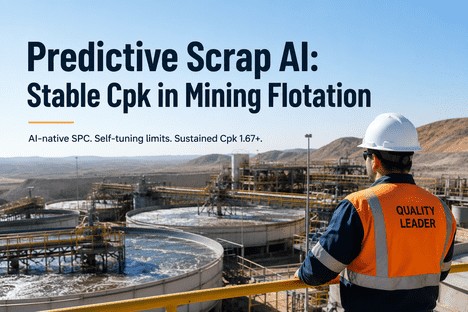
iFactory's predictive scrap analytics platform monitors every flotation cell for multi-parameter scrap risk patterns — with self-tuning SPC, real-time Cpk, scenario matching, and operator-grade alerts that forecast scrap 3-6 hours before it happens and eliminate 60%+ of quality-driven downtime.