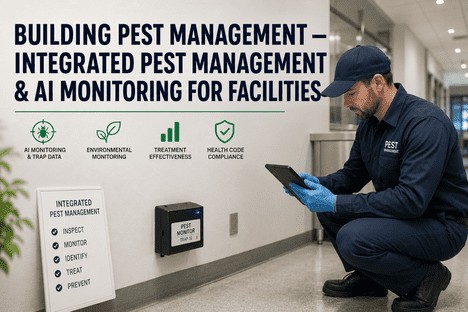
Building Pest Management — Integrated Pest Management & AI Monitoring for Facilities
By Grace on June 20, 2026
A single live cockroach observed during a New York City health inspection adds 28 points to a restaurant's violation score. A restaurant accumulating 28 or more points drops from an A grade to a C grade on the same day. Research consistently shows that a single-letter grade reduction correlates with measurable revenue decline that lasts months. The pest itself is not the problem the facility manager must solve. The systemic question is why the pest was discovered by a health inspector rather than by the facility's own monitoring programme days or weeks earlier. Across commercial kitchens, multi-family buildings, healthcare facilities, and food processing plants, the same pattern repeats: pest activity is detected not through continuous monitoring but through complaints, inspections, or infestation events that trigger emergency remediation costing 20 to 50 times the annual cost of a properly implemented Integrated Pest Management programme. The smart pest monitoring market has reached $960 million in 2025 and is projected to grow to $1.63 billion by 2034 as facility operators recognise that reactive pest management is not a cost-saving strategy. It is a liability accumulation strategy with a delayed expense curve.
Integrated Pest Management · AI Pest Monitoring · Smart Trap Analytics · IPM Compliance · Pest Prevention
The Health Inspector Should Never Be the First to Discover a Pest Problem in Your Building. iFactory's AI Monitoring Makes Sure of It.
iFactory's IPM module combines AI-powered trap monitoring, environmental condition tracking, treatment documentation, and compliance reporting into a single platform that transforms pest management from reactive extermination to continuous prevention.
The Real Cost of Reactive Pest Management Is Not the Service Call. It Is Everything That Happens After.
Most facility managers view pest control as a fixed operational expense that they try to minimise. The cost structure tells a different story. A preventive IPM programme for a commercial building typically runs $2,000 to $8,000 annually depending on facility size and risk profile. The cost of a single emergency infestation event averages $15,000 to $50,000 for health department fines alone, plus remediation, tenant disruption, lost revenue during closures, and reputational damage that compounds through online reviews and public inspection records. In food processing and distribution, a failed third-party audit triggered by pest findings can cost major customer contracts worth millions. The arithmetic is not close. Preventive IPM is not an expense. It is the single highest-return operational investment in facility management when measured against the cost of the failure it prevents.
20-50x
Cost multiplier of emergency pest remediation vs. annual preventive IPM programme for the same facility area
30%
Reduction in pest management labour costs reported by facilities using AI-powered smart trap monitoring vs. manual inspection
$1.63B
Projected global smart pest monitoring market by 2034, growing at 6% CAGR as facilities digitise pest management
28
Health inspection violation points for a single live cockroach in NYC — enough to drop a restaurant from A to C grade in one finding
The Four Pillars of Integrated Pest Management — and Where AI Monitoring Changes the Equation
Integrated Pest Management is not a single technology or treatment. It is a systematic framework structured around four sequential pillars that collectively eliminate the conditions that allow pest populations to establish and grow. Each pillar has traditionally relied on manual effort and periodic inspection. AI monitoring transforms every pillar by replacing intermittent observation with continuous intelligence.
01
Prevention
Eliminate entry points, harborage, and food sources before pests arrive.
Traditional approach relies on periodic walkthroughs to identify cracks, gaps, and sanitation issues. AI enhances prevention by analysing environmental sensor data — temperature, humidity, moisture — to predict conditions conducive to pest activity before an infestation begins, prioritising maintenance actions where they prevent the most risk.
02
Monitoring
Detect pest activity early through continuous surveillance rather than periodic inspection.
This is the pillar where AI creates the most significant shift. Traditional monitoring relies on manual trap checks on weekly or monthly schedules — meaning activity detected between inspections went unnoticed for days or weeks. AI-powered smart traps with IoT sensors transmit activity data in real time, detecting rodent motion, insect capture, and bait consumption within minutes. Facilities using smart monitoring reduce unnecessary trap checks by up to 70% and detect incursions at the earliest possible stage.
03
Treatment
Apply targeted, minimal-intervention treatments based on verified activity data.
IPM emphasises targeted treatment over broad-spectrum chemical application — reducing pesticide use by 60 to 80% compared to calendar-based spraying programmes. AI monitoring ensures treatment is triggered only when a verified pest event occurs, with species identification, location data, and environmental context attached to every treatment decision. The result is effective pest control with minimal chemical footprint and complete treatment traceability for regulatory review.
04
Documentation
Maintain audit-ready records that demonstrate compliance to every inspector and auditor.
Health departments and third-party auditors increasingly evaluate IPM documentation as part of every inspection. Missing trap logs, incomplete treatment records, and expired certifications are among the most frequently cited violations. iFactory automatically generates the complete documentation trail — trap placement maps, activity logs, treatment records, pesticide application reports, and corrective action documentation — in the format that each jurisdiction and audit standard requires.
How AI Monitoring Transforms Each Pest Type — Rodent, Insect, and Environmental Risk
Different pest types require different monitoring technologies and response protocols. iFactory's AI platform integrates with smart traps, environmental sensors, and visual detection systems to provide comprehensive pest intelligence across every category.
Pest Category — Traditional Weakness — AI Monitoring Solution
Rodents
Manual trap checks miss activity between visits. Rodents can establish populations and cause structural damage in the gap between inspections.
IoT-connected traps transmit real-time catch alerts. Activity heat maps identify entry paths. Bait consumption tracking reduces poison use by up to 90%.
Cockroaches & Flies
Visual inspections miss early-stage populations. Infestations grow behind equipment for weeks before detection.
UV light smart traps with AI image recognition capture and identify insects in real time. Population trend data triggers treatment at threshold levels, not on calendar schedules.
Bed Bugs
Detection relies on tenant complaints or bite marks. By the time bed bugs are reported, the infestation has often spread to adjacent units.
CO2-based smart monitors detect bed bug presence before visible signs. Real-time alerts enable targeted heat treatment within 24 hours, preventing cross-unit spread.
The Compliance Exposure — What a Single Missed Inspection Costs
The financial risk of inadequate pest management documentation is not theoretical. Health departments in major jurisdictions impose escalating penalties for non-compliance, and third-party auditors can terminate contracts on the basis of a single failed pest-related finding. iFactory's automated documentation ensures that every trap check, treatment application, and corrective action is recorded with timestamp, technician attribution, and photographic evidence before the inspector arrives.
NYC Health Department
Live cockroach in food area: 28 violation points. Grade drops from A to C immediately. Revenue loss follows within weeks.
Re-inspection window: 48 hours. A-grade restoration requires documented proof of complete remediation. iFactory generates the documentation package within minutes of treatment completion.
California Retail Food Code
Visible pest droppings: critical violation. Fines: $500 to $5,000 per finding. Mandatory closure possible.
County health departments publish inspection results publicly. Single critical violation can drive measurable revenue decline. AI monitoring detects droppings and activity signs before the inspector does.
HPD Violations (NYC Housing)
Class B hazardous pest violations: $300 initial fine, $1,000+ if uncorrected after 30 days.
Buildings with pattern of uncorrected violations face 7A receivership — court-appointed administrator takes over management. Documented IPM programme is strongest defence against receivership proceedings.
AIB / SQF / BRC Audits
Pest-related finding in food facility audit: potential loss of major customer contracts worth millions.
Third-party food safety audits require documented pest monitoring data, treatment records, and corrective action logs for every reporting period. iFactory's audit trail is always current, always accessible, always complete.
Every Day Without AI Pest Monitoring Is a Day You Are Relying on Luck Instead of Data.
iFactory's IPM module deploys in weeks, not months. Start detecting pest activity before your next scheduled inspection.
The Outcome — What Facilities Report After Implementing AI-Powered IPM
The transition from calendar-based pest management to AI-powered continuous monitoring produces measurable outcomes that compound across every dimension of facility operations: lower cost, fewer infestations, reduced chemical use, stronger compliance, and better tenant and customer outcomes. Early adopters across commercial real estate, food service, healthcare, and hospitality report consistent results that validate the investment case.
70%
Reduction in unnecessary trap checks by shifting from scheduled inspection to exception-based servicing triggered by AI alerts
60-80%
Pesticide reduction achieved by IPM programmes using targeted treatments based on verified activity data rather than calendar spraying
99%
Pest-free outcome rate reported by major commercial facilities deploying AI-powered pest intelligence platforms
11 mo
Typical payback period for AI-powered pest monitoring hardware and installation costs in commercial property deployments
We manage a portfolio of twelve commercial buildings including four food-grade facilities that require AIB certification. Our pest management costs were predictable on paper, but every quarter brought at least one emergency infestation event that consumed management attention, triggered expedite fees, and risked our audit scores. After deploying iFactory's IPM module with smart traps and continuous monitoring, we eliminated emergency pest events entirely in the first nine months. Our trap check labour dropped by more than half because technicians only visit triggered stations. The documentation that auditors used to request three weeks in advance is now generated automatically. The platform paid for itself within the first six months from labour savings alone, before counting the avoided emergency costs and the value of never having to explain a pest finding to an AIB auditor again.
— Director of Facilities Operations, Regional Commercial Real Estate and Food Distribution Portfolio — 1.2M Square Feet
Conclusion
Pest management in commercial facilities is not primarily a pest problem. It is a data problem. The pests are present in every building. The question is whether the facility's monitoring programme detects them before the health inspector, before the tenant complaint, before the infestation reaches the threshold where emergency remediation becomes the only option. Traditional pest management — monthly inspections, calendar-based spraying, paper documentation, reactive treatment — creates the illusion of control while leaving buildings exposed to the enforcement actions, revenue losses, and reputational damage that a single missed pest detection can trigger. iFactory's AI-powered Integrated Pest Management module closes every gap in the traditional approach: real-time smart trap monitoring that detects activity within minutes instead of weeks, environmental condition tracking that predicts risk before infestation begins, targeted treatment protocols that reduce chemical use by 60 to 80%, and automated documentation that keeps every record audit-ready for health inspectors, HPD compliance officers, and third-party food safety auditors.
The investment case is arithmetic. A single prevented emergency infestation event typically covers the full annual cost of the platform. Every additional prevented event is compounding return on a system that also reduces labour, eliminates chemical waste, and protects the revenue and reputation that pest-related enforcement actions put at risk every day. Book a Demo to see how iFactory's IPM module maps to your facility type and regulatory environment, or Talk to an Expert to review your current pest management programme and identify the gaps that AI monitoring can close.
Frequently Asked Questions
No. AI monitoring transforms pest management from periodic inspection to continuous intelligence, but professional expertise remains essential for treatment execution, exclusion work, and regulatory compliance. What changes is the efficiency and effectiveness of the service. Instead of a technician spending 70% of their visit checking empty traps, they arrive with a dashboard showing exactly which stations have activity, the species detected, the environmental conditions, and the recommended treatment protocol. The result is fewer site visits, more targeted interventions, lower chemical use, and better outcomes. Most facilities that deploy AI monitoring report that their existing service provider delivers better results with fewer visits because the data removes guesswork. Talk to an Expert to discuss how iFactory integrates with your current pest management provider.
iFactory maintains configurable documentation templates that align with each jurisdiction's specific requirements and audit standard. For New York City health department compliance, the platform generates violation-specific corrective action reports with the documentation required for grade restoration within the 48-hour re-inspection window. For AIB, SQF, and BRC food safety audits, iFactory produces the full audit trail including trap placement maps, monitoring logs by date and station, treatment records with product and applicator details, pest activity trend analysis, and corrective action documentation. For HPD housing violations, the platform generates the Certification of Correction filing with supporting service records. All documentation is timestamped, attributed, and available for export at any time. Book a Demo to configure the documentation templates for your jurisdiction set.
No. iFactory's IoT monitoring solutions include retrofit devices that integrate with your existing trap and bait station infrastructure. For rodent monitoring, retrofit sensors fit inside standard bait boxes and transmit activity data through cellular connectivity — no WiFi required. For insect monitoring, smart traps with UV light and AI image recognition can be deployed alongside existing glue traps and pheromone stations. The retrofit approach means you digitise your pest monitoring without replacing the hardware infrastructure already in place. Typical deployment for a commercial facility involves installing IoT sensors on 30 to 60 percent of the existing station count, with coverage focused on high-risk zones identified during the initial site assessment. Book a Demo to review the hardware assessment for your facility layout and current station configuration.
Deployment timeline depends on facility count and current trap infrastructure, but most single-building deployments are operational within one to two weeks from site assessment to live monitoring. For a multi-building portfolio of five to twenty facilities, the phased deployment typically completes within four to eight weeks, with the highest-risk facilities prioritised in the first wave. IoT sensor installation takes one to two hours per station cluster. The iFactory platform begins generating activity data immediately upon sensor activation, with the first actionable alerts typically appearing within 24 to 48 hours of installation as the system establishes baseline activity patterns. Most facilities identify their first missed pest activity — activity that would have gone undetected until the next manual inspection — within the first week of monitoring. Talk to an Expert to get a deployment timeline specific to your portfolio size, facility types, and current pest management infrastructure.
The Health Inspector Should Never Be the First to Know. iFactory Gives You the Warning Weeks Before They Arrive.
AI-powered smart trap monitoring, environmental risk detection, automated IPM documentation, and compliance reporting for every jurisdiction and audit standard. One platform that transforms pest management from reactive expense to preventive intelligence.