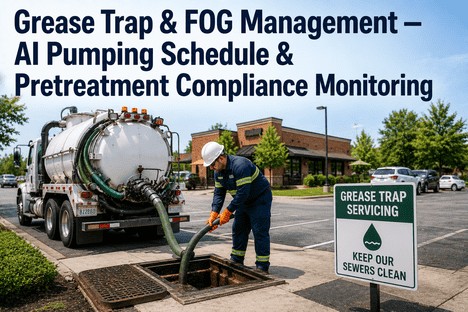
Every municipality knows the smell. Every maintenance manager knows the call. A sanitary sewer overflow in a downtown corridor. A lift station clogged with congealed grease. A restaurant that has not pumped its interceptor in eight months and the paper trail to prove it does not exist because the inspection forms are still on a clipboard in someone's truck. Fats, oils, and grease cause roughly 47 percent of the 400,000-plus sewer blockages that occur annually across U.S. collection systems. The EPA estimates that municipalities spend $25 billion each year unplugging grease-clogged pipes, repairing pump stations damaged by FOG accumulation, and cleaning up sanitary sewer overflows that were entirely preventable. Yet the municipal FOG programmes responsible for preventing these blockages still run on paper inspection forms, manually updated spreadsheets, and filing cabinets stuffed with cleaning manifests that nobody has reviewed in three years. The gap between the scale of the FOG problem and the tools used to manage it is not a technology gap. It is a management infrastructure gap. And it is costing municipalities billions that AI-powered FOG compliance and pumping optimisation can recover.
Why Most Municipal FOG Programmes Cannot Keep Up With the Problem They Were Created to Solve
The EPA's General Pretreatment Regulations under 40 CFR Part 403 require publicly owned treatment works to control pollutant discharges that could cause interference or pass-through at treatment plants. FOG is the most common offender. In response, most municipalities have established FOG control programmes that require food service establishments to install grease interceptors, maintain pumping schedules, and submit cleaning manifests. The intent is correct. The execution is where the gap opens. A typical mid-sized municipality with 400 food service establishments generates approximately 1,600 cleaning manifests, 800 inspection reports, and 200 violation notices per year. Managing this volume of compliance data through paper forms, spreadsheets, and email chains produces a programme that is perpetually behind, perpetually reactive, and perpetually unable to demonstrate its effectiveness to regulators or the public.
What AI-Powered FOG Compliance Looks Like for the Maintenance Manager
The transition from a paper-based FOG programme to an AI-powered one is not primarily a technology change. It is a visibility change. The maintenance manager who previously operated with fragmented data across spreadsheets, email inboxes, and file cabinets suddenly sees the entire programme in a single real-time view: every FSE, every interceptor, every pumping cycle, every inspection, every manifest, every violation. The AI layer does not just display this data. It analyses it continuously to flag risks, optimise schedules, and automate the enforcement actions that previously consumed weeks of administrative time.
We were managing 600 food service establishments with two inspectors, a shared spreadsheet, and a filing cabinet that had not been opened in two years. Our compliance rate was approximately 60 percent, and we had no way to know which of the 600 establishments were the ones driving the risk. The first week on the digital platform, the AI model identified that 40 of the 600 establishments were generating the majority of the manifest gaps. We directed our inspection resources to those 40 and raised our programme compliance rate from 60 percent to 88 percent within six months. The grease-related SSO calls dropped by 35 percent in the same period. We did not add staff. We added visibility.
— Maintenance Manager, Municipal Utilities Department — 60,000 Service Connections, 18 YearsThe FOG Compliance Dashboard — Programme Intelligence at a Glance
The maintenance manager's dashboard is designed around the operational questions that determine whether the FOG programme is preventing blockages or merely documenting them. Every view is generated from live programme data that updates with each submitted manifest, each completed inspection, and each enforcement action. The goal is to surface exceptions, trends, and risks that would be invisible in a paper-based programme operating at the same headcount.
Live percentage of FSEs that are current on their required pumping cycles, calculated from manifest submission data. Trend line shows weekly, monthly, and quarterly compliance trajectory. Establishments that fall below the compliance threshold are automatically flagged and routed to the enforcement workflow. The maintenance manager sees the programme's overall health in a single number and can drill into any segment — by FSE type, by geographic zone, by interceptor size — to identify which population is driving compliance gaps.
Geographic map of the service area with every FSE plotted and colour-coded by AI-computed risk score. The risk score integrates compliance history (pumping cycle adherence, inspection findings), interceptor characteristics (size relative to kitchen volume, age, type), and environmental sensitivity (proximity to waterways, storm drain connections, residential areas). High-risk establishments appear in red and are prioritised for inspection. The heat map enables the maintenance manager to allocate field resources to the locations where intervention prevents the most damage.
Every manifest submitted by a grease hauler appears in the verification queue with GPS-stamped service location, timestamp, volume pumped, disposal facility receipt, and photo documentation. The AI model cross-references each manifest against the FSE's service history and flags anomalies: a manifest submitted for an FSE that was not on the hauler's scheduled route, a volume that deviates significantly from the interceptor's design capacity, or a disposal facility that does not match the hauler's typical destination. The maintenance manager reviews only flagged manifests instead of auditing every submission manually.
Complete lifecycle tracking of every enforcement action from automatic courtesy notice generation to notice of violation issuance to administrative fine assessment and payment. The tracker displays the current status of all active enforcement actions by stage, the average resolution time, and the escalation history for each FSE. The maintenance manager can see at a glance whether enforcement actions are being resolved within the programme's target timeline and which establishments are repeat violators requiring escalated intervention or legal referral.
When a sanitary sewer overflow occurs, the correlation view maps the incident location against the surrounding FSE population and their compliance status. The AI model identifies which establishments were within the contributing drainage area, whether they were current on their pumping cycles, and whether any manifest gaps or inspection findings preceded the event. Over time, the correlation data trains the risk model to identify the specific combination of factors that precede blockages in different parts of the collection system, enabling preemptive intervention before the next incident.
All data required for EPA pretreatment reporting, state DEP FOG programme reports, and annual programme effectiveness assessments is generated automatically from live programme data and available for export or direct submission in the format required by the regulatory authority. The reporting centre tracks compliance with each regulatory requirement, displays the data collection status for each reporting period, and generates the programme metrics that demonstrate FOG programme effectiveness to elected officials, utility boards, and regulatory inspectors.
Conclusion
Fats, oils, and grease cause nearly half of all sewer blockages in the United States. Municipalities spend $25 billion every year responding to blockages that were set in motion months earlier when a grease interceptor was not pumped on schedule. The FOG programmes created to prevent these blockages operate with tools — paper forms, spreadsheets, filing cabinets, email chains — that were not designed for the volume of compliance data they must manage. The result is a structural gap between programme intent and programme effectiveness that no amount of additional inspector hours or enforcement pressure can close, because the gap is not in effort. It is in visibility. A maintenance manager managing 400 FSEs with paper-based tools does not know which establishments are overdue for pumping, which haulers are submitting incomplete manifests, which interceptors are undersized for the kitchens they serve, or which neighbourhood is one missed pumping cycle away from a sanitary sewer overflow. The data exists. It is in the filing cabinet and the spreadsheet and the email inbox. But it is not connected, not analysed, and not actionable until after the blockage occurs.
iFactory's AI-powered FOG compliance platform connects that data. It digitises every programme function — FSE registration, interceptor profiling, pumping schedule generation, manifest verification, inspection management, enforcement automation, and regulatory reporting — into a single real-time system where the maintenance manager sees the entire programme at a glance. The AI layer analyses the data continuously to identify risk, optimise schedules, and automate the enforcement actions that consume administrative hours. The result is a programme that prevents blockages instead of documenting them after the fact, and a maintenance manager who manages by exception instead of by exhaustion.
Talk to an expert about digitising your municipality's FOG compliance programme, or book a demo to see the AI-powered FOG programme dashboard configured for your service area and establishment count.