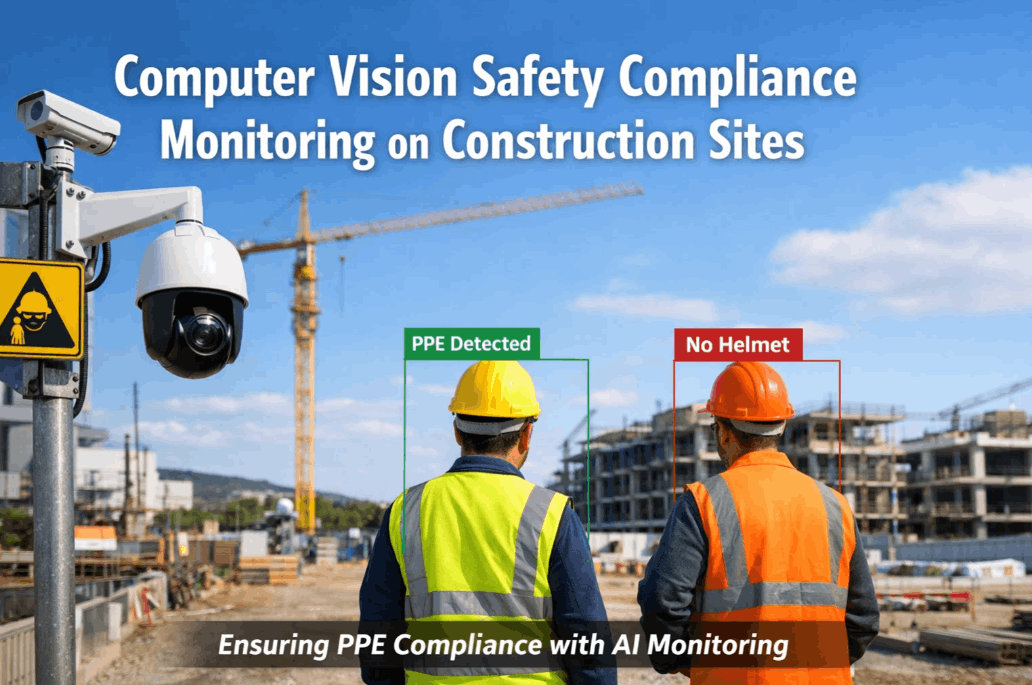
The construction industry is entering a new era of proactive risk management where manual safety audits are being replaced by autonomous, real-time oversight. Computer vision safety compliance monitoring on construction sites has transitioned from an experimental technology to a mandatory operational layer for high-scale infrastructure projects. By utilizing deep learning models to identify personal protective equipment (PPE), detect unauthorized entry into hazardous exclusion zones, and monitor for fall risks, agencies can intervene before an incident occurs. Conventional safety officer walkthroughs, while valuable, often miss up to 70% of transient safety violations due to the sheer scale and complexity of active job sites. Schedule a safety technology review to see how iFactory's computer vision platform automates OSHA compliance and visual risk detection natively.
CONSTRUCTION SAFETY AI PLATFORM
Enforce Site Safety Rules Automatically with Computer Vision.
Detect PPE missing, track exclusion zone violations, and identify high-risk behaviors in real-time. Transform standard site cameras into active safety enforcement agents.
The Critical Role of Computer Vision in Modern Construction Safety Compliance
Modern construction sites are dynamic environments where hazards change hourly. Traditional safety management systems rely on retrospective reporting and intermittent inspections, leaving vast windows of unmanaged risk. Computer vision safety compliance monitoring on construction sites addresses this by providing a continuous visual audit trail. Using YOLO (You Only Look Once) architectures and specialized CNNs (Convolutional Neural Networks), AI systems can now process high-definition video feeds to distinguish between a worker wearing a hard hat and one without—even in low-light or high-dust conditions typical of civil infrastructure projects.
Beyond simple object detection, advanced AI safety platforms utilize skeletal tracking to identify fatigue, improper lifting techniques, or workers in proximity to heavy machinery blind spots. By integrating these visual insights directly into site management workflows, project leads can transition from reactive incident investigation to proactive hazard mitigation, significantly lowering the Total Recordable Incident Rate (TRIR) and insurance premiums.
Real-time detection of hard hats, high-visibility vests, gloves, and safety glasses. Systems can be tuned to site-specific rules, such as mandatory hearing protection in high-decibel zones or harness attachment checks for elevated work.
AI-defined virtual fences around crane swing radii, trench openings, or high-voltage areas. The system triggers immediate audible or visual alerts if a worker enters a prohibited zone without proper authorization or during active machine operation.
Detecting workers standing near unprotected edges or working on scaffolding without tie-offs. Behavioral AI can identify the act of falling within milliseconds, triggering emergency response protocols in situations where a worker might be incapacitated.
Monitoring the interaction between heavy vehicles (excavators, loaders) and ground personnel. The system alerts operators if a pedestrian enters a high-risk proximity zone, preventing backing accidents and struck-by incidents.
Implementation Steps: Deploying AI Safety on the Job Site
Effective safety AI deployment requires more than just mounting cameras. It involves a structured integration with site-specific rules and supervisor workflows. Agencies that book a demo with iFactory follow this proven deployment roadmap to ensure maximum safety ROI within the first 30 days of site mobilization.
Site Survey and Strategic Camera Placement
Initial assessment of site topography and high-risk zones. Cameras are mounted to maximize field-of-view over exclusion zones, site entrances, and elevated work areas. Using PTZ (Pan-Tilt-Zoom) and wide-angle 4K sensors ensures no safety-critical area is left unmonitored during active construction phases.
AI Model Customization and Baseline Training
The computer vision models are tuned to recognize site-specific gear colors, vest types, and unique machinery profiles. AI trainers establish behavioral baselines, ensuring the system can distinguish between normal activity and high-risk unauthorized movements in complex environments.
Closed-Loop Alert and Notification Workflow
Configuration of the alert hierarchy. Low-priority violations (e.g., missing gloves) are logged for weekly reporting, while high-priority events (e.g., edge proximity without harness) trigger immediate SMS or app notifications to on-site safety managers and site-wide sirens if necessary.
Integration with Site Management Software
The safety AI feed is integrated with Procore, Autodesk, or iFactory's native infrastructure management platform. This ensures that safety data is automatically correlated with man-hours, weather conditions, and project milestones for comprehensive risk analysis.
Continuous Model Optimization and Site Feedback
Human safety officers review flagged events to provide ground-truth feedback to the AI. This "human-in-the-loop" approach ensures the computer vision system continuously improves its accuracy while adapting to changing site conditions, dust levels, and camera angles.
Core Capabilities: Computer Vision Safety Features
Computer vision for site safety goes beyond simple video recording. It involves active, analytical processing of visual data to enforce compliance and protect worker lives. Book a demo to explore these capabilities in a live site environment.
Simultaneous tracking of hard hats, safety glasses, vests, and safety footwear across hundreds of workers in a single frame, ensuring 100% compliance at all site access points.
AI zones that move with the machinery. A 'safety bubble' is automatically projected around excavators and cranes, alerting any personnel entering the dynamic strike zone.
Processing video at the site edge reduces latency, allowing for sub-second alerting times critical for preventing falls or machinery strikes in high-speed environments.
Every violation is captured with a high-res image and timestamp, generating a non-refutable digital audit trail for OSHA compliance and insurance verification purposes.
Specialized IR-enhanced models ensure safety rules are enforced during night shifts and inside tunnels where standard lighting is insufficient for human safety officers.
Visualizing site congestion and 'near-miss' hotspots, allowing safety managers to redesign site traffic flows to reduce the probability of worker-vehicle collisions.
Construction Safety Compliance: OSHA vs. AI Monitoring
Understanding how AI monitoring aligns with and exceeds traditional regulatory frameworks is essential for site leaders. The following comparison highlights the transformative impact of computer vision on safety governance. Agencies can book a demo to see how iFactory maps directly to OSHA 1926 standards.
| Safety Variable | Traditional OSHA Compliance | AI-Driven Monitoring | Status |
|---|---|---|---|
| Inspection Frequency | Intermittent / Weekly walkthroughs | Continuous / 24/7 autonomous monitoring | AI Enhanced |
| PPE Enforcement | Spot checks and verbal warnings | Automated alerts and digital logging | Real-Time |
| Exclusion Zone Safety | Physical signage and barriers | Virtual geofencing and audible alerts | Proactive |
| Incident Investigation | Post-event interviews and reports | Full video replay and behavioral analysis | Forensic |
| Risk Prediction | Historic trend analysis | Real-time anomaly detection | Predictive |
| Audit Accuracy | Subjective/Variable human reporting | Objective/Scalable data-driven logs | Certified |
The Anatomy of an AI Safety System: Feature Grid
Building a resilient site safety posture requires a combination of hardware and specialized software features designed for the harsh conditions of construction. These visual features form the core of the iFactory Safety AI system.
Ruggedized 4K Camera Hardware
IP67-rated cameras designed for dust, vibration, and extreme temperature. Equipped with self-cleaning lenses to maintain visual clarity in high-debris environments like earthmoving and demolition sites.
Behavioral AI Model Library
Access to pre-trained models for common construction behaviors: improper ladder usage, jumping between scaffolding levels, and working underneath suspended loads.
Supervisor Mobile Dashboard
A unified mobile interface giving safety officers a 'God's eye view' of all active job sites, with real-time video streaming and one-click violation reporting for immediate corrective action.
Automated Daily Safety Briefing Reports
AI-generated summaries of yesterday's safety trends, highlighted 'near-miss' videos for toolbox talks, and departmental compliance rankings to drive a culture of site safety.
Voice-Over-Site Emergency Public Address
Integration with site PA systems allowing the AI or safety managers to broadcast immediate warnings to specific zones when a critical hazard (like an advancing excavator) is detected.
Private Cloud Data Residency
Secure storage of safety video and employee data, ensuring compliance with local privacy laws and project-specific security requirements while maintaining high-speed access for audit.
ROI and Impact: The Business Case for Site Safety AI
Investing in computer vision safety compliance monitoring on construction sites is not just a safety decision—it is a financial one. Sites that implement AI oversight consistently see significant reductions in insurance costs, legal exposure, and lost-time injuries. Agencies can book a demo to review ROI data from actual project deployments.
Proactive behavioral interventions prevent minor errors from cascading into recordable incidents, dramatically improving site safety metrics within six months.
The 'observer effect' driven by continuous monitoring significantly increases self-compliance among workers, reducing the daily burden on human safety teams.
Calculating direct medical costs, legal fees, and lost productivity, a single prevented incident often pays for the entire AI safety platform for the project's life.
Replacing manual logbook reconciliation with automated digital safety reports allows safety officers to focus on field implementation rather than paperwork.
Challenges in AI Safety Deployment — and How to Resolve Them
Worker Privacy and Ethical AI Concerns
Implementation of 'face-blurring' and anonymous tracking ensures safety rules are enforced without compromising worker privacy. Clear communication of the platform's role as a lifesaver—not a disciplinary tool—is essential for workforce buy-in.
Occlusion and Visual Obstruction
Construction sites are cluttered. Overcoming 'occlusion' (where a worker is partially hidden) requires multi-angle camera coverage and 'temporal tracking' where the AI remembers a worker's PPE status even if they are briefly obscured behind a load.
Site Connectivity and Bandwidth Limits
Remote infrastructure project sites often lack fiber connections. Deploying 'heavy edge' compute modules allowed the AI to process video locally on-site, only sending compressed alert data and metadata to the cloud over standard LTE/5G connections.
Best Practices for Construction AI Safety Monitoring
Mount Cameras for Maximum Top-Down Perspective
High-angle placement on tower cranes or temporary masts reduces occlusion and provides the best view of exclusion zones and edge hazards, ensuring 360-degree coverage of active work zones.
Establish a Tiered Notification System
Avoid 'alert fatigue' by ensuring only critical safety threats (e.g., fall risks) trigger site-wide alarms, while minor infractions are logged for shift-end summaries or supervisor coaching sessions.
Use AI Data to Lead Site Safety Briefings
Transform the daily 'toolbox talk' by showing anonymized clips of actual site near-misses. Visual evidence of a crane strike or exclusion zone breach is 10x more effective than verbal warnings for worker education.
Regularly Re-Optimize for Dynamic Site Changes
As the structure rises, ensure cameras are repositioned to cover new floors, scaffold levels, and changing crane radii. AI safety is not a 'set and forget' system; it must evolve with the physical project.
Prioritize Edge Processing for Instant Alerts
In life-safety scenarios, latency of even a few seconds is unacceptable. Ensure the core AI models are running on local jobsite hardware rather than relying on round-trip cloud processing for critical exclusion zone alerts.
Frequently Asked Questions: AI Site Safety Monitoring
Does the computer vision system replace human safety officers?
No. It acts as a force multiplier, allowing a single safety officer to monitor multiple job sites or vast geographic areas effectively. The AI identifies the hazards; the human officer provides the leadership, corrective action, and site coordination.
How does the system handle different weather conditions like rain or fog?
iFactory's models are trained on diverse datasets including adverse weather. Ruggedized cameras with hydro-phobic coatings and internal heaters ensure consistent visual data even in severe rain, snow, or coastal fog conditions.
What is the typical setup time for a new construction site?
A standard site can be active within 2-4 days. This includes camera mounting, LTE gateway setup, and initial AI model configuration. For larger infrastructure projects like bridges or tunnels, full calibration may take 1-2 weeks.
Can the system detect if a safety harness is actually tied off?
Yes. Advanced models can identify the lanyard connection state and verify 'two-point' contact compliance for workers on ladders or scaffolding, alerting if a worker is at height without positive attachment to an anchor point.
How does this impact the project's insurance premiums?
Most major insurers recognize AI safety monitoring as a significant risk-reduction factor. Agencies frequently report substantial bill reductions and improved coverage terms by providing objective proof of continuous site safety oversight.
ZERO ACCIDENTS THROUGH AI OVERSIGHT
Protect Your Workers and Your Bottom Line with Computer Vision.
iFactory's computer vision platform delivers the 24/7 autonomous safety oversight required for modern complex construction. Enforce PPE, monitor exclusion zones, and predict hazards with the industry's most advanced site safety AI.