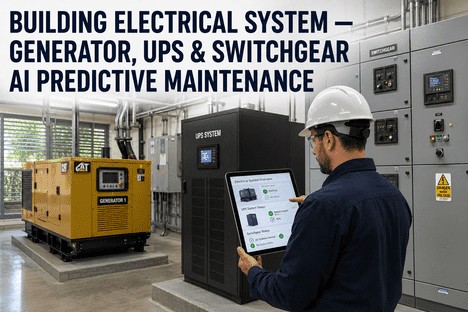
Building Electrical System — Generator, UPS & Switchgear AI Predictive Maintenance
By Grace on June 20, 2026
A 28-story commercial tower in Chicago lost its main switchboard at 9:47 AM on the hottest Tuesday in August. The emergency repair cost $47,000. Tenant disruption claims added another $29,000. Root cause: a loose bus bar connection that had been producing measurable thermal anomalies for 51 days. The building management system recorded every temperature deviation. Nobody was watching. That single failure, multiplied across the thousands of commercial buildings operating without predictive electrical monitoring, represents one of the largest controlled cost leaks in facility management today. The question is not whether your building's electrical system is showing early warning signs. It is whether anyone is looking at them before the breaker trips, the generator fails to start, or the UPS silently discharges its last usable cycle into a load it was never tested to carry.
AI Predictive Maintenance · Electrical System Monitoring · Generator UPS Switchgear Analytics
Your Backup Power Is Only Reliable If Someone Is Watching the Data Between the Tests. iFactory Watches Continuously.
iFactory's AI-powered electrical system monitoring tracks generator health, UPS battery condition, and switchgear integrity in real time — detecting failures weeks before they happen and eliminating the silent degradation that calendar-based maintenance misses entirely.
The Electrical System Blind Spot Most Facility Managers Do Not Know They Have
Commercial buildings lose an estimated $150,000 to $900,000 annually from unplanned electrical failures — yet most facilities still manage their generator, UPS, and switchgear maintenance on fixed calendar schedules, with visual inspections that catch failures only after they have already happened. The Uptime Institute reports that power issues remain the most common cause of serious and severe outages across critical facilities, with 54% of organisations reporting their most recent significant outage cost more than $100,000. Meanwhile, NFPA data shows that 40% of emergency generators fail to start during actual power outages — not because of mechanical defects, but because testing protocols and calendar-based maintenance missed the early degradation that AI analytics would have flagged weeks in advance.
The problem is structural. A monthly generator exercise run under no-load conditions does not validate the system's ability to carry real emergency loads. An annual UPS battery impedance test captures a single data point that tells you nothing about the trend. A switchgear infrared scan performed once per year provides a thermal snapshot that is already outdated the moment the technician leaves the building. These are not maintenance programmes. They are compliance checkboxes that create the illusion of reliability without delivering it.
40%
of emergency generators fail to start during actual power outages — the vast majority had passed their last scheduled test
$900K
Upper-range annual loss from unplanned electrical failures in commercial buildings — most of it preventable
67%
of organisations still operate under reactive or calendar-based maintenance models with no predictive analytics layer
45%
Average reduction in unplanned downtime reported by facilities that deploy AI-driven electrical system monitoring
Three Electrical Assets, Three Failure Modes, One Predictive Solution
Every commercial building relies on three interconnected electrical systems to maintain operations during grid disturbances: the standby generator for extended outages, the UPS for instantaneous ride-through, and the switchgear to distribute and isolate power paths. Each has distinct failure signatures. Each requires a different monitoring approach. And in most buildings, none of them are monitored continuously.
Asset 01
Standby Generator — The Failure You Will Not Discover Until the Grid Goes Down
Emergency Power Reliability
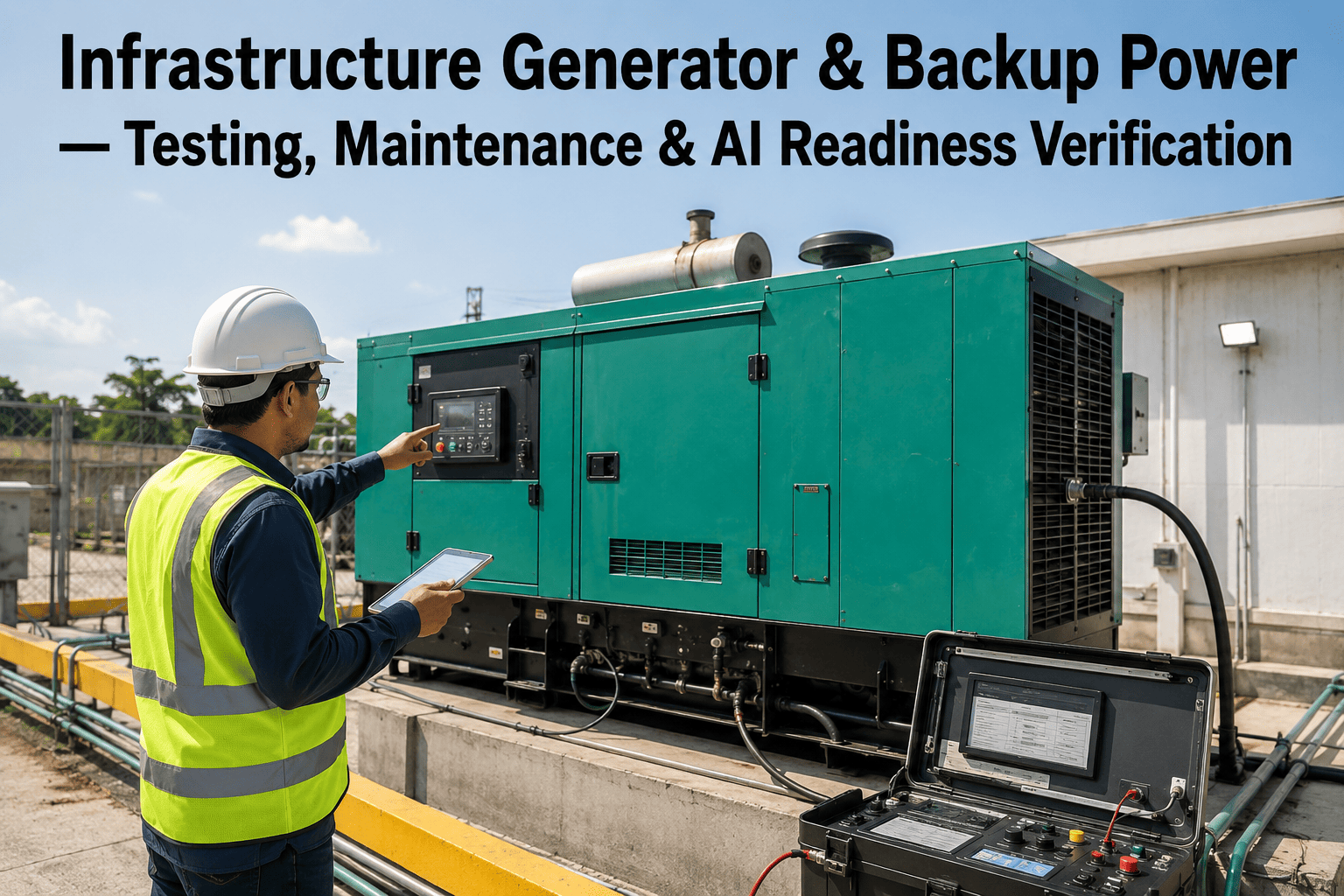
The diesel generator is the most trusted and the least tested piece of equipment in any commercial building. Industry data shows that 35% of generator failures during actual outages trace to neglected maintenance — not mechanical defects, not age, but skipped inspections and batteries that failed silently while nobody checked. A generator that passes its monthly no-load exercise run can still fail catastrophically under full load because coolant system degradation, fuel contamination, and alternator bearing wear only manifest under sustained operation. iFactory's AI generator monitoring tracks coolant temperature trends, battery voltage under simulated load, fuel system pressure, starter motor current draw, and load bank test outcomes continuously — building a degradation model that predicts failure 30 to 60 days before the next scheduled test would discover it. Buildings using AI predictive monitoring achieve 99.5% generator startup reliability compared to 82% for buildings relying on manual testing alone.
Real-time coolant and battery health tracking
30-day failure prediction window
Automated load test documentation
Asset 02
UPS & Battery Banks — Calendar-Based Replacement Replacing Batteries That Still Have 14 Months of Life
Condition-Based Intelligence
A data centre operator managing 47 UPS units across three facilities discovered after a $2.3 million unplanned outage that their battery replacement programme was based entirely on calendar age, not battery condition. Seventeen of the failed batteries had been installed within the previous 24 months. The problem was not the batteries. It was the absence of a monitoring programme that would have flagged the internal resistance trending in those units 60 to 90 days before failure. iFactory tracks four primary indicators for UPS battery health: internal impedance measured against individual string baseline, temperature deviation from rated operating range, cumulative discharge event count and depth, and float voltage drift from manufacturer specification. The AI model weights these inputs against the battery's age-adjusted degradation curve to produce a failure probability score per string — replacing the calendar-based replacement schedule with a condition-based one that saves 34% of battery lifecycle cost on average.
Four-parameter battery health scoring
60-90 day failure advance warning
Condition-based not calendar-based replacement
Asset 03
Switchgear & Distribution — The Thermal Anomaly That Grows for 51 Days While Nobody Is Looking
Arc Flash Prevention
Switchgear failures are among the most expensive and dangerous events in any commercial building — often preceding arc flash incidents, electrical fires, and complete building power loss. A single switchgear failure costs between $80,000 and $300,000 in emergency repair, tenant disruption, and liability exposure. Yet most facilities rely on annual infrared scans that capture a single moment in time, missing the trend entirely. iFactory's continuous switchgear monitoring tracks bus bar temperature at multiple load levels, current imbalance across phases, harmonic distortion patterns, breaker operation counts, and partial discharge activity — building a thermal and electrical baseline per panel. When a connection begins to degrade, the AI model detects the temperature drift relative to load within the first week, not the 51st day when the loose bus bar finally arcs. Facilities using continuous electrical analytics catch 60 to 70 percent of failures before they become outages, with typical payback from a single prevented switchgear failure recovering the full annual monitoring platform cost.
Continuous multi-point thermal monitoring
Load-aware anomaly detection engine
Partial discharge and breaker analytics
How AI Transforms Electrical Maintenance — From Calendar-Based to Condition-Based
The difference between conventional electrical maintenance and AI-powered predictive monitoring is not incremental. It is the difference between knowing whether a generator passed its test last month and knowing it will fail next week before the test would have detected it. The AI market for predictive maintenance is valued at $12.8 billion in 2026 and growing at 18.2% CAGR toward $105.6 billion by 2035, driven by facilities that have documented 10:1 to 30:1 ROI within 18 months of deployment. But adoption remains at only 27%, meaning 73% of facilities are still paying for failures that AI detected weeks before they happened.
Traditional Electrical Maintenance vs. AI Predictive Monitoring — The Four-Stage Comparison
Stage
Calendar-Based Maintenance
AI Predictive Monitoring
Detection
Annual infrared scan. Visual inspection every 30 days. Failure found after it happens.
Continuous sensor monitoring. AI detects thermal anomalies, impedance drift, and vibration changes 30-60 days before failure.
Response
Emergency breakdown repair. Premium labor and parts. Tenant disruption. Reactive.
Scheduled intervention during off-peak hours. Parts procured in advance. Planned labor. Zero disruption.
Cost Profile
Emergency costs 4x to 8x planned. $80K-$300K per switchgear failure. Premium freight and overtime.
Planned maintenance cost. 60-73% savings per event. Predictable annual budget. Single prevented failure covers full platform cost.
Compliance
Paper logs. Manual documentation. NFPA 70B audit preparation takes days. Gaps hidden until inspection.
Auto-generated audit trail. Continuous compliance proof. NFPA 110, 70B, and insurance documentation on demand. Audit-ready 24/7.
The Economic Case — Why AI Electrical Monitoring Pays for Itself Before the First Prevented Failure
The ROI calculation for AI predictive electrical monitoring is not theoretical. It is arithmetic. A single prevented switchgear failure at $80,000 to $300,000 recovers the full annual platform cost. Each additional prevented failure is compounding return. Facilities deploying AI comprehensive electrical monitoring report 10:1 to 30:1 ROI within 18 months, with first-year savings driven by reduced emergency repair costs of 18 to 25 percent, lower overtime labor expenses, and avoided tenant disruption liabilities. By year two, savings expand to include optimised preventive schedules, extended equipment lifecycles of 10 to 20 percent, and energy savings from load-optimised equipment operation.
10-30x
Average ROI within 18 months for facilities deploying AI predictive maintenance across critical electrical assets
60-73%
Cost savings per switchgear or electrical failure when caught by predictive monitoring vs. emergency breakdown
34%
Average UPS battery lifecycle extension achieved by switching from calendar-based to condition-based replacement
30 days
Typical time to first high-confidence predictive alert after iFactory AI model baselining is complete
Conclusion
The electrical systems that keep commercial buildings operational during grid disturbances — generators, UPS units, switchgear, and distribution infrastructure — are the most relied-upon and the least continuously monitored assets in any facility. The industry spends billions on emergency repairs, premium freight, tenant disruption claims, and premature equipment replacement that could have been avoided with a monitoring layer that detected the degradation pattern before the failure event. iFactory's AI-powered electrical system monitoring closes that gap: continuous generator health analytics, condition-based UPS battery management, real-time switchgear thermal monitoring, and automated compliance documentation that satisfies NFPA 110, NFPA 70B, and insurance audit requirements without manual effort.
The data exists in every building. Every breaker panel, every generator controller, every UPS management card generates thousands of data points per day that contain the early signature of the failure that will eventually happen unless someone is watching for it. iFactory's AI platform connects to your existing building management infrastructure — BACnet, Modbus, OPC-UA — and begins detecting electrical degradation patterns within 30 days, with most portfolios identifying their first preventable failure within 60 days of activation. Book a Demo to see how your facility's electrical monitoring compares, or Talk to an Expert to build the predictive monitoring programme for your specific electrical infrastructure.
Frequently Asked Questions
iFactory's AI models establish normal operating baselines for each electrical asset by analysing data from existing BMS sensors, electrical meters, and generator controllers via BACnet, Modbus, and OPC-UA protocols. The algorithm learns how temperature varies with load, how impedance changes with age, and how current draw patterns evolve over time — then flags deviations that indicate developing faults. For older panels or switchgear without existing monitoring points, targeted wireless sensors cost $200 to $600 per point and are typically recovered from the first prevented failure event. Most commercial buildings already have sufficient sensor infrastructure — the gap is not hardware, it is the AI model layer that translates raw data into predictive intelligence. Talk to an Expert to assess your current sensor coverage and integration path.
Monthly load testing verifies that the generator can start and carry load at a single point in time. Continuous AI monitoring tracks the degradation trends between those tests — battery voltage drift, coolant temperature rise under varying load, fuel system pressure changes, and starter motor current draw patterns. EPRI data shows that 27% of emergency generator failures during real power outages occur in units that passed their last scheduled test. The test passes because the degradation was not yet severe enough to cause failure during a 30-minute exercise, but was advanced enough to cause failure during a multi-hour outage. AI monitoring detects that degradation trajectory 30 to 60 days before the failure point, giving you the intervention window that monthly testing cannot provide. You still need NFPA 110 load testing for compliance. AI monitoring makes sure the generator will actually pass when the test matters. Book a Demo to see how both work together in a single platform.
iFactory automatically logs every generator exercise run, UPS battery impedance test, switchgear thermal scan, and electrical maintenance event with timestamp, asset ID, measured values, technician attribution, and pass-fail determination against your configured thresholds. The platform generates NFPA 110 weekly, monthly, and annual compliance reports on demand, NFPA 70B electrical preventive maintenance documentation with equipment condition history, and insurance-grade records showing continuous monitoring activity between scheduled tests. For facilities undergoing annual audits or insurance reviews, the documentation that previously required days of manual compilation is available in the platform as a single export with full traceability. Book a Demo to see the compliance dashboard configured for your jurisdiction's requirements.
For buildings with existing BMS or electrical metering infrastructure, typical per-building integration takes 3 to 5 business days via BACnet, Modbus, or OPC-UA connection. A ten-building portfolio can be fully operational within 3 to 4 weeks. AI baseline models are established within the first 2 to 4 weeks of data collection, after which predictive alerts become active. Most portfolios see their first high-confidence predictive catch within 60 days of deployment — often on electrical assets that had passed their most recent manual inspection but were showing early-stage degradation detectable only through continuous trending. For buildings without existing digital monitoring points, sensor installation adds 1 to 3 days per building depending on panel accessibility and measurement point count. Talk to an Expert to get a deployment timeline for your specific portfolio size and current infrastructure.
The Building That Discovers Its Generator Failure During a Power Outage Has Already Lost. iFactory Makes Sure You Never Discover It That Way.
AI generator health monitoring, condition-based UPS battery analytics, continuous switchgear thermal detection, and compliance documentation that satisfies NFPA 110, NFPA 70B, and insurance audits — in a single platform connected to your existing building infrastructure.