On May 1, 2026, every building owner in New York City over 25,000 square feet must submit their twelfth consecutive month of energy and water data through ENERGY STAR Portfolio Manager or face quarterly fines of $500. In Washington D.C., the threshold drops to 10,000 square feet starting this year. In Maryland, third-party verification is now mandatory. In Colorado, buildings must demonstrate a 7% emissions reduction by 2026 or begin paying performance penalties. These are not isolated municipal requirements. They are the leading edge of a regulatory wave that has expanded from three cities in 2008 to more than fifty jurisdictions today — with Building Performance Standards now enforcing actual energy reduction targets, not just disclosure. The era of voluntary benchmarking is over. For operations directors managing multi-building portfolios, the question is no longer whether to benchmark. It is whether your current approach to benchmarking — spreadsheets, manual data entry, annual compliance scrambles — is exposing your organisation to penalties, missed savings, and regulatory risk that AI-powered energy analytics eliminates entirely.
The Benchmarking Mandate Is Expanding Faster Than Most Portfolio Teams Can Keep Up
What began as a trio of city-level ordinances in 2008 has become a nationwide compliance framework that now covers more than half of all U.S. commercial building space. New York's Local Law 97 imposes carbon emission caps with penalties of $268 per metric ton over the annual limit. Washington D.C.'s BEPS programme requires buildings to meet performance thresholds or follow prescribed improvement pathways or face penalties up to $10 per square foot. Colorado mandates 7% emissions reductions every five years. Washington State's Clean Buildings Standard enforces Energy Use Intensity targets with compliance deadlines beginning June 1, 2026. Across all jurisdictions, ENERGY STAR Portfolio Manager has become the universal compliance platform — yet most building owners still manage their benchmarking through manual utility data entry, annual compliance scrambles, and disconnected spreadsheets that provide no operational insight between reporting deadlines.
What ENERGY STAR Portfolio Manager Does and What It Does Not Do
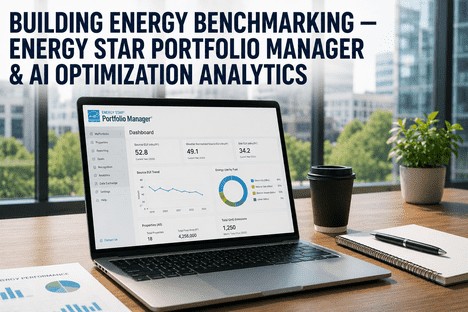
ENERGY STAR Portfolio Manager is the industry-standard benchmarking tool developed by the EPA. It allows building owners to track energy and water consumption, generate a 1-to-100 ENERGY STAR score that compares performance against similar buildings nationwide, and produce compliance reports for any jurisdiction that requires them. A score of 50 represents median performance. Buildings scoring 75 or higher may qualify for ENERGY STAR certification. The platform is free, secure, and supports every commercial building type. It has transformed how building performance is measured and compared.
But Portfolio Manager is a measurement tool. It does not optimise your energy consumption. It does not detect the faulty damper actuator that is wasting 12% of your HVAC energy. It does not tell you which building in your portfolio will benefit most from a retrofit investment. And it does not automate the data collection process that consumes hundreds of hours of staff time every year across a multi-building portfolio. It answers the question "how is my building performing?" It does not answer "what should I do about it?" That is the gap that AI-powered energy analytics fills.
The Compliance Timeline Is Accelerating — Every Jurisdiction Has Different Rules and Every Deadline Matters
An operations director managing buildings across multiple states cannot afford to track compliance requirements through manual calendar entries. The regulatory landscape is shifting too fast. New York City's Local Law 97 began carbon emission cap enforcement in 2025 with escalating penalties. Washington D.C. expanded benchmarking to buildings over 10,000 square feet starting in 2026. Maryland now requires third-party data verification for 2025 data submitted by June 1, 2026. Colorado moved its reporting season to July through November and removed non-compliance penalties for 2026 targets but established a new Building Decarbonization Enterprise fund with a $400 fee per covered building. Washington State's Clean Buildings Standard begins compliance enforcement on June 1, 2026. Missing any of these deadlines triggers fines, penalty accumulation, and regulatory scrutiny that compounds with every subsequent reporting period.
From Benchmarking to Optimisation — The Operational and Financial Case for AI-Powered Energy Analytics
The regulatory pressure to benchmark is real and growing. But the organisations that extract the highest value from energy compliance are those that treat benchmarking not as a reporting obligation but as the foundation of a portfolio-wide energy optimisation programme. The AI energy optimisation market reached $8.4 billion in 2025 and is projected to hit $19.2 billion by 2028. Verified data from more than 1,200 commercial deployments compiled by Lawrence Berkeley National Laboratory shows median energy savings of 18%, with commercial offices achieving 17%, data centres 23%, and healthcare facilities 16%. Typical payback periods range from 18 to 36 months for buildings over 100,000 square feet with modern BMS infrastructure. The ACEEE reports that organisations reduce energy use by 10 to 25% using building energy management and control systems enhanced by AI.
We were managing compliance across eighteen buildings in four jurisdictions with separate benchmarking deadlines, different utility data formats, and a spreadsheet-based tracking system that consumed roughly 300 staff hours per year. The first year on iFactory, we eliminated the manual data entry entirely, cut our compliance preparation time from three weeks to two days, and identified $187,000 in annual energy savings from HVAC faults that Portfolio Manager scores had flagged as underperformance but could not diagnose. The compliance reports that used to trigger panic two weeks before every deadline now generate automatically. Benchmarking used to be our biggest operational headache. Now it is the data foundation for our entire energy reduction programme.
— Director of Operations, Regional Commercial Real Estate Portfolio — 1.8M Square Feet Across 18 BuildingsConclusion
Energy benchmarking is no longer a voluntary best practice. It is a regulatory requirement enforced by more than fifty jurisdictions across the United States, with Building Performance Standards that impose real financial penalties for non-compliance and real reduction targets that escalate every five years. Operations directors managing multi-building portfolios face a rapidly expanding compliance landscape where the cost of manual benchmarking is measured not just in staff hours but in missed savings, penalty exposure, and the absence of the portfolio-wide energy intelligence that AI-powered analytics provides. iFactory connects your building data directly to ENERGY STAR Portfolio Manager, automates compliance reporting across every jurisdiction your portfolio operates in, and adds the AI optimisation layer that transforms benchmarking from a regulatory obligation into an energy reduction engine — with fault detection, investment prioritisation, and portfolio-wide savings that pay for the platform multiple times over within the first year.
The regulatory deadlines are not slowing down. The penalties are not decreasing. And the technology to turn compliance from a cost centre into a competitive advantage is available today. Book a Demo to see how iFactory maps to your portfolio's specific jurisdictional requirements, or Talk to an Expert to assess your current benchmarking compliance status and identify the savings hidden in your Portfolio Manager data.