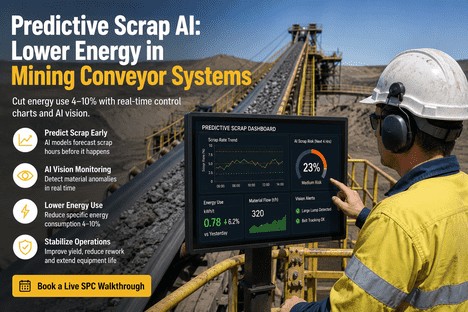
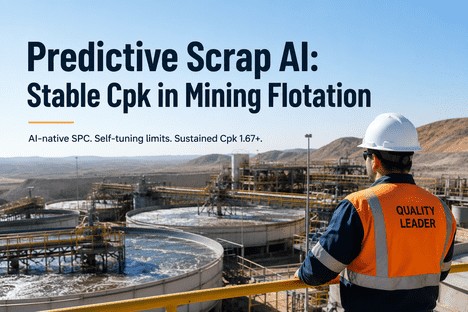
Every tonne of scrap in mineral processing carries an invisible cost that does not appear on the quality report: the energy that was already consumed to mine, crush, grind, and float that material before the assay result declared it off-grade. A copper concentrator processing 85,000 tonnes per day at 0.6% feed grade typically consumes 22 to 28 kWh per tonne milled, or roughly 2,000 MWh daily. When a scrap event sends 1,200 tonnes of material into the wrong stream, the embedded energy loss is approximately 30,000 kWh that produced nothing of value. This hidden energy waste, repeated shift after shift, represents the single largest sustainability opportunity most quality leaders have never been asked to quantify. Predictive scrap analytics changes that by forecasting scrap risk before energy is consumed, enabling quality leaders to reduce specific energy consumption by 4 to 10% while improving product quality and process capability in a single, measurable initiative.
4-10%
Reduction in specific energy consumption per tonne processed achieved by operations using predictive scrap analytics to prevent off-grade production before energy is expended.
30k
Kilowatt-hours of embedded energy wasted per typical scrap event in a mid-size concentrator, representing energy spent on material that yielded no recoverable value.
2.5hrs
Average advance warning from predictive models before scrap material reaches final product streams, giving quality teams time to intervene and avoid embedded energy loss.
The Energy-Scrap Connection
How Off-Grade Material Wastes Energy at Every Processing Stage
Crushing
2-4
kWh per tonne consumed regardless of final quality outcome
Grinding
12-18
kWh per tonne, the largest energy consumer, fully wasted on scrap material
Flotation
4-6
kWh per tonne including cell aeration, agitation, and reagent pumping energy
Tailings
3-5
kWh per tonne for pumping and depositing material that failed quality specifications
Every Tonne of Scrap Is a Tonne of Energy That Produced Nothing. Predictive Scrap Analytics Is the Tool That Closes That Gap.
iFactory manages every sensor, analyser, and model in your predictive scrap pipeline with automated calibration tracking, energy monitoring integration, and compliance audit trails built for ISO 9001 and CSRD frameworks.
What Predictive Scrap Analytics Means for Quality Leaders
For the quality leader in mineral processing, predictive scrap analytics is not primarily a quality tool. It is an energy and sustainability instrument that happens to improve quality as a byproduct. The conventional framing positions scrap analytics as a yield improvement initiative measured in percentage points of recovery. That framing is correct but incomplete. Every point of yield improvement is also an energy intensity reduction of approximately 1 to 2% because the same fixed energy input produces more on-spec output. A model that reduces scrap by 5% in a concentrator consuming 2,000 MWh daily saves approximately 100 MWh per day, or 36,500 MWh annually, without installing a single solar panel or upgrading a single motor. Predictive scrap analytics allows quality leaders to report energy and sustainability outcomes alongside traditional quality metrics, Cpk improvement, defect rate reduction, and assay variance shrinkage, making it one of the few initiatives that simultaneously improves process capability, energy intensity, and regulatory compliance.
Three Levers for Energy Reduction Through Predictive Scrap Analytics
Quality leaders deploying predictive scrap analytics activate three distinct energy reduction mechanisms, each measurable and independently verifiable through existing plant metering infrastructure.
1
Eliminating Embedded Energy in Off-Grade Material
The most direct energy lever. When a predictive model alerts the control room that material currently in the grinding circuit has a high probability of becoming off-grade concentrate, the supervisor can adjust reagent dosages, redirect the stream, or change the grind target before the energy for the remaining processing stages is consumed. The energy already invested in that material is protected because the material is brought back to specification before it is lost. Operations typically recover 40 to 60% of the embedded energy that would otherwise be wasted on scrap material within the first three months of model deployment.
2
Reducing Recirculation Loads and Rework Energy
Off-grade material that is not scrapped entirely is often recirculated: reground, refloated, or blended back into fresh feed. Each recirculation cycle consumes 60 to 80% of the energy of the original processing pass. Predictive scrap analytics reduces recirculation loads by 20 to 25% by preventing the initial quality deviation, which means less material is sent back through the mill and flotation circuit. The energy saved from avoided recirculation is typically 1.5 to 2 times greater than the energy saved from avoided final scrap, because recirculated material is processed multiple times before it eventually meets specification.
3
Optimising Mill Energy Throughput Efficiency
When scrap events are reduced, the mill does not need to process replacement tonnes to make up for lost production. This means the same daily throughput target can be achieved at a lower instantaneous grinding rate, which reduces specific energy consumption because mill motors operate more efficiently at steady state than during the ramp-up and ramp-down cycles caused by scrap-driven production gaps. Quality leaders report that mills operating with predictive scrap analytics show 3 to 5% lower specific energy consumption at identical throughput, purely from the elimination of scrap-driven production instability.
36,500
MWh of annual energy savings from a 5% scrap reduction in a mid-size concentrator, equivalent to removing approximately 8,000 tonnes of CO2 emissions per year
1.5-2x
Greater energy savings from avoided recirculation compared to avoided final scrap, because reworked material is processed multiple times before meeting specification
3-5%
Reduction in mill specific energy consumption from steady-state operation alone, achieved by eliminating scrap-driven production disruptions and throughput fluctuations
The Quality Leader Who Connects Scrap Reduction to Energy Savings Reports Two Wins for Every Initiative. One Improves Cpk. The Other Reduces Carbon.
iFactory registers every sensor, analyser, energy meter, and model asset in your predictive scrap pipeline with automated calibration tracking, energy data integration, and compliance audit trails for ISO 9001, CORSIA, and CSRD reporting frameworks.
For the quality leader, the key insight is that standard quality metrics are also leading indicators of energy performance. A decline in Cpk or an increase in assay variance is not just a quality issue. It is an early signal that energy intensity is about to rise. Predictive scrap analytics enables quality leaders to track both dimensions simultaneously and report energy outcomes in the same governance reviews where quality metrics are already discussed.
Process Capability Index
A Cpk improvement of 0.3 to 0.5 correlates with a 4 to 7% reduction in specific energy consumption in grinding and flotation circuits, as tighter process control reduces both scrap and the energy overhead of managing out-of-spec material.
Assay Variance
A 15% reduction in concentrate grade variance produces an average 2.5% improvement in energy intensity, because the circuit operates closer to its optimal setpoint and spends less time recovering from grade excursions.
Scrap Rate
Every 1% reduction in scrap rate reduces specific energy by approximately 1.2 to 1.8%, with the energy leverage increasing at higher scrap rates because the embedded energy in each scrapped tonne compounds across processing stages.
First-Pass Yield
A 5-point improvement in first-pass yield reduces total processing energy by 6 to 9%, because material that meets specification on the first attempt avoids the 60 to 80% energy cost of recirculation and reprocessing.
From Reactive Quality to Predictive Energy Optimization
The quality leader's journey from reactive quality management to predictive energy optimization follows a progression. Each stage builds on the previous one and delivers measurable outcomes that justify the next investment.
1
Reactive Quality
Scrap detected by lab assays 3 to 4 hours after the event. Energy waste not measured. Quality and energy reported in separate silos. Cpk tracked but not connected to energy intensity.
2
Predictive Detection
ML model forecasts scrap 2 to 4 hours before assays confirm. Supervisors intercept events. Scrap rate declines but energy savings are not yet quantified or attributed to the quality improvement initiative.
3
Energy-Aware Quality
Energy meters integrated with quality data. Each scrap event is costed in kWh as well as tonnes. Quality leaders report energy savings alongside Cpk improvements. Model retrained to optimise for both quality and energy outcomes.
4
Continuous Optimization
Closed-loop model retraining on quality and energy outcomes. Specific energy consumption tracked as a quality KPI. Energy savings reported in sustainability disclosures with audit trails. iFactory manages model versioning and calibration schedules.
Conclusion
Predictive scrap analytics gives quality leaders in mineral processing a rare opportunity: an initiative that simultaneously improves process capability, reduces specific energy consumption, and strengthens regulatory compliance. The technology is production-ready, the data infrastructure exists in most concentrators, and the business case compounds across quality and energy dimensions. The operations that have deployed it are reporting 4 to 10% energy reduction, measurable Cpk improvement, and a direct line of sight between their quality management system and their sustainability targets. The remaining gap is not technological. It is organisational: connecting the quality function to the energy outcomes that quality data has always been capable of predicting. Book a Demo to see how iFactory integrates quality and energy data into a single managed asset platform, or Get In Touch to discuss a deployment timeline for your operation.
Frequently Asked Questions
The most defensible methodology starts with your current specific energy consumption in kWh per tonne milled, your current scrap rate, and the embedded energy per tonne at each processing stage. Multiply the scrap rate by the total embedded energy to calculate annual energy waste from off-grade material. A predictive scrap analytics deployment typically recovers 30 to 50% of that waste within six months. For a concentrator processing 85,000 tonnes daily at 24 kWh per tonne with a 4% scrap rate, the annual energy waste is approximately 29,800 MWh. A 40% recovery rate yields 11,900 MWh of annual energy savings, which at an average industrial electricity cost of 60 to 80 US dollars per MWh represents 714,000 to 952,000 dollars in direct energy savings alone, before accounting for avoided recirculation energy, improved throughput, and reduced carbon liability. Book a Demo to see how iFactory maps quality and energy data for business case development.
The four most informative quality metrics for energy correlation are first-pass yield, Cpk, assay variance, and scrap rate by root cause category. First-pass yield has the strongest direct correlation with energy intensity because material that passes on the first attempt avoids the 60 to 80% energy penalty of recirculation. Cpk trends are the best leading indicator: a Cpk decline of 0.15 typically precedes a measurable energy intensity increase of 2 to 3% within the following 48 to 72 hours. Tracking these four metrics alongside specific energy consumption in a single dashboard enables quality leaders to demonstrate the energy impact of quality improvements in terms that plant management, sustainability teams, and financial controllers all recognise. iFactory integrates quality and energy data into unified asset records with automated reporting for ISO 9001 and CSRD compliance. Get In Touch to discuss how iFactory supports combined quality-energy dashboards.
The EU CSRD requires detailed disclosure of energy consumption, greenhouse gas emissions, and the actions taken to reduce both, with third-party verification of reported data. Predictive scrap analytics supports CSRD compliance in three ways. First, it generates verifiable energy reduction data by directly linking quality improvements to metered energy consumption, providing the audit trail that verifiers require. Second, it quantifies Scope 2 emissions reductions from reduced electricity consumption and Scope 3 reductions from reduced embedded energy in purchased materials. Third, it documents the management system and controls that demonstrate the organisation is actively managing energy performance rather than reporting static historical data. Quality leaders who deploy predictive scrap analytics can report specific energy consumption reduction as a verified outcome of their quality management system, creating a direct connection between ISO 9001 and CSRD reporting that auditors recognise and value. Book a Demo to see how iFactory generates CSRD-ready compliance documentation from quality and energy asset data.
Quality Leaders Who Connect Scrap Reduction to Energy Savings Report Both Cpk Improvement and Carbon Reduction from the Same Initiative.
iFactory manages every asset in your predictive scrap and energy pipeline, from sensors and analysers to energy meters and model servers, with automated PM scheduling, calibration tracking, and compliance audit trails for ISO 9001, CORSIA, and CSRD frameworks.