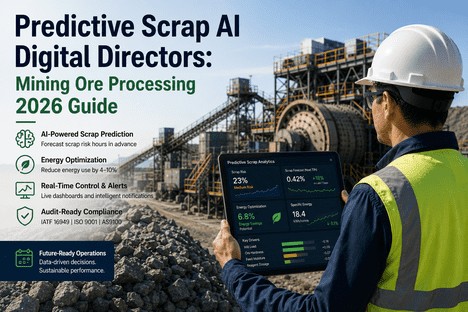
Predictive Scrap AI Digital Directors: Mining Ore Processing 2026 Guide
By Grace on June 6, 2026
Scrap in mineral processing is not a material loss line item. It is an energy invoice. Every ton of ore that enters a grinding circuit and exits as waste has already consumed crushing energy, grinding power, reagent chemistry, water, and transport fuel before it is discarded. For digital manufacturing directors accountable for both production targets and energy budgets, the structural inefficiency is the same across every commodity: conventional quality control detects scrap after energy has already been spent producing it. Predictive scrap analytics changes this equation by forecasting scrap risk before the energy is consumed — using machine learning models trained on process parameters, feed characteristics, and historical quality outcomes to predict which tons will meet specification and which will not. Mining operations deploying predictive scrap analytics today are not reducing waste after the fact. They are preventing energy expenditure on material that will never make grade, and the 4-10% energy reduction that results is not a theoretical target. It is a measured outcome of controlled production data.
Predict Scrap Before It Consumes a Single Kilowatt-Hour. Your Energy Budget Depends on It.
iFactory predictive scrap analytics connects to your existing process data infrastructure, forecasts scrap risk before energy is consumed, and delivers measurable 4-10% energy reduction within a single quarter. No additional sensors required. No cloud dependency. No infrastructure replacement.
Reduction in specific energy consumption achieved by predictive scrap analytics in mineral processing operations.
11%
Share of global energy consumed by the mining industry — 38% of all industrial energy use, with comminution alone accounting for 3-4% of worldwide electricity.
15%
Improvement in mineral classification accuracy from hybrid AI models that correlate feed characteristics with downstream quality outcomes for real-time scrap prediction.
2-5%
Recovery rate improvement when scrap is predicted upstream — preventing energy spend on material destined for the tailings stream before it enters the grinding circuit.
The Scrap-Energy Equation
A copper concentrator processing 80,000 tons per day with a 2% uncaptured scrap rate is spending roughly $4.2 million annually in grinding energy alone on material that never reaches the concentrate. Predictive scrap analytics eliminates this expenditure by identifying the specific feed conditions that produce off-spec material before the first kilowatt-hour is consumed on that ton.
Where Energy Goes in Ore Processing and Why Scrap Compounds the Cost
Comminution — the crushing and grinding of ore — accounts for 50-70% of total energy consumption in a typical mineral processing operation. A SAG mill drawing 12-18 MW and a ball mill circuit drawing 8-12 MW run continuously, consuming power regardless of whether the material being ground will ultimately meet concentrate grade specifications. When feed variability, hardness spikes, or reagent imbalances produce off-spec material, every kilowatt-hour spent grinding that ton is unrecoverable. The energy cannot be reclaimed. The scrap can only be detected after the fact.
Research published in 2025 demonstrates that hybrid deep learning models combining channel attention convolutional networks with LSTM architectures achieve 93.5% R-squared accuracy in predicting SAG mill power consumption from seven key operating parameters — ore feed rate, sand return rate, feed pressure, grinding noise, water feed rate, bearing temperature, and motor temperature. These models do not merely measure energy consumption after it occurs. They forecast it, enabling operators to adjust feed strategy before energy is wasted on material that will not meet downstream quality specifications.
Predictive scrap analytics extends this same forecasting capability from equipment energy consumption to product quality outcomes. By training models on historical feed characteristics, process parameters, and final concentrate quality, a single AI layer can predict with 85-95% accuracy whether any given production segment will produce on-spec material — and redirect or adjust the process before energy is expended on scrap.
How Predictive Scrap Analytics Cuts Energy Cost in Mineral Processing
Three connected capabilities transform scrap from a post-process discovery into a pre-process forecast, with energy savings compounding at every stage.
1
Forecast Scrap Before Grinding
AI models analyze incoming feed characteristics — mineralogy, hardness, particle size distribution — against historical quality outcomes to predict scrap probability at the belt. When the model flags a high-scrap-risk feed segment, operators adjust blend ratios or redirect material before it enters the high-energy grinding circuit. Every ton diverted before the SAG mill saves 12-18 kWh that would otherwise be consumed grinding scrap.
2
Optimize Process for Every Feed
When feed variability cannot be avoided, AI recommends real-time process parameter adjustments — crusher gap, mill feed rate, flotation reagent dosing, cyclone pressure — tuned specifically to the material entering the circuit. Instead of running fixed recipes designed for average feed, every production segment receives a customized energy-optimized process plan that maximizes the probability of on-spec output while minimizing energy consumption per ton.
3
Close the Energy Feedback Loop
Every production outcome feeds back into the prediction model. When a heat, batch, or production segment meets specification, the energy consumed to produce it is logged as efficient. When scrap occurs, the model traces the specific feed and process conditions that produced it and adjusts its forecasts accordingly. Over 90-120 days, the model converges on an increasingly precise scrap-energy prediction surface that captures the unique characteristics of your specific ore body and circuit configuration.
Five Energy Leaks That Predictive Scrap Analytics Closes
E1
Grinding Scrap at 12-18 MW per Hour
When feed variability goes undetected until the flotation circuit, the SAG and ball mill have already consumed megawatt-hours grinding material that will never make concentrate grade. Predictive scrap analytics flags high-risk feed at the primary crusher discharge, before the first grinding stage begins.
E2
Reagent Chemistry Wasted on Off-Spec Feed
Flotation reagents, leaching agents, and pH modifiers are consumed proportionally to feed tonnage regardless of final product quality. When feed mineralogy shifts produce scrap, the chemistry consumed processing that material is unrecoverable. Predictive analytics detects shifts before reagents are dosed.
E3
Conveyor and Pump Energy on Recirculated Scrap
Off-spec material that must be recirculated, re-blended, or re-processed consumes additional conveying and pumping energy per cycle. Every recirculation pass adds 2-4 kWh per ton in material handling energy alone, compounding the energy cost of the original scrap decision.
E4
Standby and Re-Start Energy After Scrap Events
When a scrap event triggers a production hold or circuit reconfiguration, the energy required to restart and stabilize the process far exceeds steady-state operating consumption. Each scrap-induced restart event costs 30-60 minutes of production at 150-200% of nominal power draw as circuits re-stabilize.
E5
Downstream Processing of Inevitably Off-Spec Material
Material that carries quality defects through flotation or concentration consumes drying, filtering, and load-out energy before the defect is finally detected at the product stream. Predictive scrap analytics intercepts this chain by flagging quality deviation risk at the earliest detectable point in the circuit.
The Measured Difference: Key Performance Indicators Before and After Predictive Scrap Analytics
KPI
Conventional Operation
With Predictive Scrap Analytics
Improvement
Specific Energy Consumption
Baseline (100%)
90-96% of baseline
4-10% reduction
Scrap Detection Latency
45-90 minutes (lab assay)
Sub-second (edge AI)
99.9% faster
Scrap Rate (uncaptured)
2-5% of production
1-2% of production
40-60% reduction
Quality Audit Readiness
200+ labor hours per audit
Always-ready digital records
80% time reduction
Mineral Classification Accuracy
76-82% (manual sampling)
91-94% (AI vision + LSTM)
15% improvement
Source Data Context
KPI ranges compiled from published research on hybrid CNN-LSTM models applied to mineral processing (Applied Sciences, 2025-2026), edge-deployed YOLO-based ore classification field trials (Journal of Engineering and Applied Science, 2026), and iFactory deployment data across mineral processing operations. Individual results vary by ore body, circuit configuration, and baseline automation level.
The Deployment Path: From Baseline to 4-10% Energy Reduction in 90 Days
Predictive scrap analytics is not a research initiative. It is a deployable capability that connects to your existing SCADA, MES, and laboratory information systems without infrastructure replacement. The deployment follows a structured four-phase path that delivers measurable energy reduction within a single quarter.
Week 1-2
Connect and Calibrate
iFactory connects to existing SCADA, PLC, and lab systems via OPC-UA and REST APIs. AI models ingest 12-24 months of historical production data including feed characteristics, process parameters, energy consumption, and quality outcomes. Baseline energy-per-ton and scrap-rate KPIs are established from historical records.
Week 3-4
Train and Validate
Predictive models are trained on site-specific data and validated against held-out production records. The model learns the correlation between feed variability, process parameters, and scrap outcomes specific to your ore body. Prediction accuracy is measured against actual scrap events from the validation period before any live deployment.
Week 5-8
Advisory Mode
Predictions surface to operator dashboards in advisory mode. When the model forecasts high scrap probability for an incoming feed segment, operators receive a recommendation with the specific parameters driving the risk. Scrap events are tracked against model predictions to build operator trust and refine model accuracy.
Week 9-12
Closed-Loop Optimization
AI recommendations are integrated with the control system for automated parameter adjustment. When scrap risk exceeds configured thresholds, the system adjusts crusher gaps, mill feed rates, and reagent dosing automatically. Energy savings are tracked against baseline. Most operations achieve 3-5% energy reduction by week 12, converging toward 4-10% as the model matures.
Why iFactory for Predictive Scrap Analytics
Predictive scrap analytics requires more than a machine learning model. It requires a platform that connects process data, quality records, energy metering, and asset management into a single operational intelligence layer. iFactory provides that platform with four capabilities unique to mineral processing deployments:
✓
Native OPC-UA, MQTT, and SAP PM integration reads every process signal without infrastructure changes
✓
On-premise NVIDIA edge deployment with zero cloud dependency and sub-50ms inference latency
✓
Pre-built models for comminution energy, flotation recovery, and classification accuracy with industry-specific training datasets
✓
Automated energy KPI dashboards with scrap-energy correlation tracking, audit-ready SPC charts, and CAPA documentation generated from every prediction event
Every Kilowatt-Hour Spent on Scrap Is a Kilowatt-Hour That Cannot Be Recovered. Predictive Scrap Analytics Prevents Both.
iFactory connects your process data, quality records, energy metering, and asset management into a single predictive scrap analytics platform — deployed in weeks, running on your existing infrastructure, with measurable energy reduction from day one.
Traditional quality control detects scrap after it has been produced. A laboratory assay confirms that concentrate grade has drifted below specification 45-90 minutes after the material left the circuit. By that time, the energy consumed to produce that scrap is already spent and irrecoverable. Predictive scrap analytics uses machine learning models trained on feed characteristics, process parameters, and historical quality outcomes to forecast scrap risk before the material enters the grinding circuit or flotation cells. The system predicts with 85-95% accuracy whether a given production segment will meet specification, enabling operators to adjust feed blend, process parameters, or material routing before energy is consumed on off-spec material. The difference is not detection speed. It is the transition from post-process discovery to pre-process prevention. Book a Demo to see how iFactory applies predictive scrap analytics to your specific circuit configuration.
The model requires three data categories: feed characteristics (ore type, grade, hardness, particle size distribution), process parameters (crusher gap settings, mill feed rates, power draw, reagent dosing, flotation cell levels, cyclone pressure), and quality outcomes (concentrate grade, recovery rate, moisture content, impurity levels). Most mineral processing plants already collect this data in their SCADA, MES, and laboratory information systems. iFactory connects to these existing sources via OPC-UA, MQTT, and REST APIs. Historical data covering 12-24 months of production is used for initial model training, after which the model continuously improves through active learning from ongoing production. Plants with limited historical data can begin with a baseline model that achieves actionable accuracy within 4-6 weeks of live data collection. Get In Touch to review your existing data landscape.
Energy reduction is measured as specific energy consumption per ton of on-spec product, comparing a rolling 30-day average against the pre-deployment baseline established during the connect-and-calibrate phase. The metric accounts for both the energy saved by avoiding scrap production and the energy consumed by the AI inference layer itself. iFactory tracks both total energy consumption and energy-per-ton-of-concentrate, ensuring that energy reduction is not achieved at the expense of throughput. Third-party validation can be configured through integration with existing energy metering infrastructure. The 4-10% range represents the documented performance envelope across mineral processing operations with varying baseline automation levels and circuit configurations. The lower end of the range applies to plants with existing advanced process control; the upper end applies to plants transitioning from manual operation. Book a Demo for a site-specific energy reduction projection.
No. Predictive scrap analytics operates on process data already collected by existing SCADA, PLC, and laboratory information systems. The AI models use crusher power draw, mill feed rates, bearing temperatures, reagent dosing, flotation cell levels, and similar process variables that are already instrumented in most mineral processing plants. For operations that wish to enhance prediction accuracy with visual feed characterization, iFactory supports integration with existing ONVIF-compliant cameras for optional AI vision input, but this is not required for initial deployment. The core predictive capability is driven by the process data that your plant already generates every millisecond and currently stores without acting on. Get In Touch to confirm your existing sensor coverage against the model input requirements.
Stop Spending Energy on Material That Will Never Make Grade. Predict Scrap Before It Consumes a Single Kilowatt-Hour.
iFactory predictive scrap analytics connects to your existing process data infrastructure, forecasts scrap risk before energy is consumed, and delivers measurable 4-10% energy reduction within a single quarter. No additional sensors required. No cloud dependency. No infrastructure replacement.