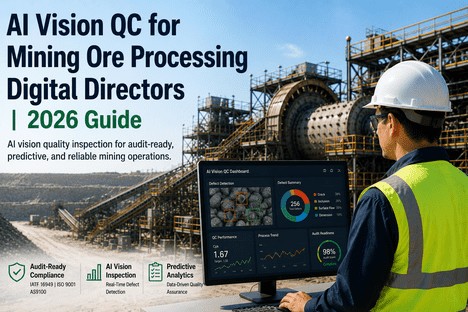
AI Vision QC for Mining Ore Processing Digital Directors | 2026 Guide
By Grace on June 6, 2026
Every ton of ore that moves through a comminution and beneficiation circuit carries quality variability invisible to manual sampling and too fast for laboratory assays to catch. For digital manufacturing directors in mineral processing operations, the structural problem is the same across every commodity: grade deviation across the concentrator feed, particle size distribution drift that compounds into recovery loss, and a reconciliation gap between what the mine plan promised and what the shipment actually delivers. AI vision quality inspection changes this equation by placing continuous, deep-learning-based defect detection and process characterization directly on the conveyor belt at line speed, with every particle and every surface measured against statistical control limits that update with every production shift. The mining operations deploying AI vision quality today are not running pilot programs. They are industrializing predictive quality as a core operational function, and the compliance frameworks that govern them are being rebuilt around audit trails that begin with an AI inference rather than a clipboard.
$50B+
Mineral processing market value exposed to undetected quality variation across crushing, grinding, and flotation circuits worldwide.
94%
AI vision defect detection accuracy achieved in live mineral sorting and quality classification at operating mine sites.
87%
Faster quality issue detection versus laboratory assay-based QC, compressing hours of delay into sub-second edge inference.
100%
Production inspection coverage versus 10-20% manual sampling — every ton measured, not every tenth ton sampled.
Your mineral processing operation runs on real-time data. Your quality intelligence should too. Deploy AI vision quality inspection in 1-2 weeks using your existing camera infrastructure.
The Blind Spot at the Heart of Mineral Processing Quality Control
Traditional quality control in ore processing depends on discrete sampling and laboratory turnaround cycles that introduce hours of latency between a process deviation and its detection. A shift in feed mineralogy, a crusher gap drift of a few millimeters, or a flotation reagent imbalance can propagate through an entire circuit before the first assay result reaches the control room. In a typical copper concentrator processing 80,000 metric tons per day, a 30-minute delay in detecting a feed grade deviation can send over $100,000 in recoverable value to the tailings stream. The same latency compounds across every downstream process stage.
The operational consequences are measurable and consistent across operations: recovery rates drift 2-5% below optimum, reagent and energy consumption rise as circuits compensate for unrecognized variability, and concentrate grade targets are met through off-spec blending rather than upstream control. A 2026 study published in Applied Sciences demonstrated that hybrid AI frameworks combining convolutional neural networks with LSTM models achieved 20-30% reduction in projected maintenance downtime and 15% improvement in mineral classification accuracy across active iron ore mines. These results are not laboratory benchmarks. They are production data from operating plants where AI vision quality is already replacing discrete sampling as the primary quality control mechanism.
For digital manufacturing directors accountable for both plant performance and compliance audit readiness, the gap between what traditional QC can detect and what real-time AI vision can measure has become the difference between reactive production management and predictive quality control. The laboratory assay is no longer the source of truth. The AI inference at the belt is.
The Cost of Latency
A 30-minute delay in detecting a flotation feed grade deviation at a copper concentrator processing 80,000 metric tons per day can result in $120,000 in recoverable value lost to the tailings stream before any corrective action is taken. AI vision inspection closes that latency gap from 1,800,000 milliseconds to less than 200 milliseconds.
How AI Vision Quality Works in Mineral Processing
Four integrated layers transform raw visual data from conveyor belts, chutes, and froth surfaces into real-time quality forecasts and compliance-ready audit records. Every layer runs on-premise with zero cloud dependency.
1
Continuous Image Acquisition
High-resolution industrial cameras capture every particle stream and surface at full belt speed using RGB, thermal, and multi-spectral sensors. Line-scan cameras operating at 200+ frames per second reveal fine-grained texture, color variation, and morphological features that human inspectors cannot resolve at production velocity. Structured lighting arrays penetrate dust and steam to maintain image quality in the harshest processing environments.
2
Edge AI Inference Engine
YOLOv8 and Vision Transformer models analyze every frame on-premise using NVIDIA edge GPU hardware at sub-50ms latency. Models are trained on site-specific mineral datasets and achieve 95%+ detection accuracy within the first week of operation through active learning. Classification covers mineral type, foreign material, particle size distribution, surface anomalies, and froth characteristics with confidence scoring on every inference.
3
Process Parameter Correlation
AI correlates visual defect patterns with upstream PLC, SCADA, and OPC-UA sensor feeds in real time — connecting crusher gap settings, mill feed rates, flotation airflow, reagent dosing, and cyclone pressure to the quality signatures they produce downstream. The correlation engine identifies which process parameter is the statistically likely root cause of every detected quality deviation.
4
Automated CAPA and Audit Trail
When quality thresholds are breached, iFactory automatically generates a work order with annotated visual evidence, identifies the upstream cause, and logs every event in an immutable audit trail. Corrective actions are tracked through closure with effectiveness verification. Every CAPA cycle generates documentation compliant with ISO 9001, IATF 16949, and AS9100 requirements without manual data entry.
What AI Vision Quality Detection Covers Across the Ore Processing Circuit
Feed and Crushing Zone
Ore type classification and contamination detection at the primary crusher feed conveyor. Real-time identification of oversized material, tramp metal, and wood or plastic contamination before it reaches downstream equipment. Particle size distribution measurement at every belt transfer point for closed-loop crusher gap optimization. AI detects feed variability shifts that would otherwise propagate through the entire circuit undetected.
Grinding and Classification
SAG and ball mill feed characterization with real-time ore hardness estimation from visual texture analysis. Cyclone overflow particle size monitoring through froth image analysis. AI detects mill liner wear patterns from visual indicators and predicts reline intervals before liner failure impacts grinding efficiency or product quality. Grinding circuit optimization feedback in milliseconds rather than hours.
Flotation and Concentration
Froth velocity, stability, color, and bubble size distribution analysis for real-time flotation cell performance monitoring. AI detects reagent imbalance, air flow deviation, and pulp level drift before they impact concentrate grade. LSTM-based prediction models forecast silica content in iron ore concentrate up to 60 minutes in advance using froth visual characteristics and process parameters.
Conveyor Belt Health
Continuous surface inspection for longitudinal rips, edge wear, cover abrasion, and splice degradation. AI vision detects belt damage at sub-millimeter resolution with 90%+ accuracy, triggering automated stop commands before catastrophic belt failure causes production downtime measured in days rather than hours. Geometry-adaptive visual measurement frameworks achieve 120.7 FPS with 4.5% mAP improvement over baseline models.
Final Product Quality
Concentrate grade estimation through multi-spectral imaging at the load-out conveyor. Moisture content monitoring, color consistency tracking, and foreign material detection at the final product stream. Every shipment carries a digital quality certificate generated from continuous AI inspection data, replacing manual sampling certificates with full-production traceability.
Safety and PPE Compliance
AI vision monitors hard hat, high-visibility vest, and safety harness compliance across all processing areas. Detects personnel entry into restricted zones, unauthorized proximity to operating equipment, and missing fall protection in elevated work areas. Automated alert generation with timestamped visual evidence supports OSHA and MSHA compliance documentation.
Commodity-Specific Quality Applications: From Copper to Iron Ore to Gold
The value of AI vision quality inspection varies by commodity, but the principle is consistent across every mineral processing operation: the faster you detect quality deviation, the less value you lose to the tailings stream. The following applications represent production-deployed AI vision quality use cases with documented results.
Copper and Base Metals
Froth flotation cell monitoring with AI-driven bubble size analysis, froth velocity tracking, and colorimetric grade estimation. Copper concentrators deploying AI vision report 3-5% improvement in recovery rates through earlier detection of reagent imbalance and air flow deviation. Sensor-based ore sorting at the pre-concentration stage removes 50-98% of gangue before it enters the grinding circuit, reducing energy consumption per ton by 15-25%.
Iron Ore
Silica content prediction in iron ore concentrate using LSTM networks fed by froth image features and process parameters. Edge-deployed deep learning models achieve 91% accuracy in classifying ore quality on conveyor belts, with 96% recall for detecting high-risk material. Hybrid AI frameworks combining CNN-based visual analysis with sensor data reduce unplanned maintenance downtime by 20-30% while improving mineral classification accuracy by 15%.
Gold and Precious Metals
Multi-sensor ore sorting combining XRT, laser, and optical systems for pre-concentration of gold-bearing material. AI vision detects veining patterns, sulfide mineral associations, and alteration halos invisible to conventional optical sorters. Case studies from orogenic gold deposits demonstrate removal of 50-70% of waste material at the pre-concentration stage, reducing downstream cyanide consumption and tailings volume.
Industrial Minerals
High-speed optical sorting for limestone, phosphate, potash, and kaolin using multi-spectral AI classification. A limestone plant deploying AI vision reduced waste-stone generation by 40% and improved product consistency from the first day of operation. Real-time contamination detection for color, transparency, and mineralogical purity at belt speeds exceeding 3 meters per second with 99%+ classification accuracy.
Measured Impact: From Reactive Sampling to Predictive Quality Control
Before AI Vision Quality
Laboratory assay turnaround of 45-90 minutes per sample, with a typical sampling rate of 1-2% of total production. Process deviations between sample points go undetected, allowing off-spec material to accumulate in stockpiles or flow downstream. Quality audit readiness requires manual data collation from multiple disconnected systems. Rework and blending costs absorb 5-8% of production value. Defect root cause analysis is retrospective and frequently inconclusive due to insufficient data granularity. Predictive maintenance and quality control operate as separate functions with no data correlation between them.
With iFactory AI Vision Quality
Continuous 100% inspection of every particle stream at line speed with sub-second inference latency. AI detects process drift before quality boundaries are breached, enabling upstream parameter adjustment before off-spec material is produced. Every inspection event is automatically logged with timestamped visual evidence in an immutable audit trail. Quality reports, SPC charts, and CAPA documentation are generated in real time and are audit-ready at any moment without manual preparation. Scrap and rework costs reduced by 30-50%. Visual defect patterns are correlated with equipment sensor data for unified predictive quality and maintenance intelligence.
30-50%
Scrap and rework cost reduction
99.7%
Defect detection accuracy at line speed
94%
Reduction in customer quality complaints
80%
Audit preparation time reduction
Audit Readiness as a Built-In Outcome, Not a Manual Exercise
For digital manufacturing directors managing ISO 9001, IATF 16949, or AS9100 compliance across mineral processing operations, the most significant operational benefit of AI vision quality inspection is not detection speed. It is the elimination of manual evidence gathering before every audit. Every AI inference generates an immutable record that satisfies the documentation requirements of each standard, without any person filling out a checklist after the fact. In a sector where audit preparation can consume 200+ labor hours per facility per year, the transition from reactive evidence gathering to always-on audit readiness represents both a compliance improvement and a direct cost reduction.
✓
Immutable Visual Evidence
Every defect detection event is logged with the AI-annotated image, confidence score, defect classification, and timestamp — creating a visual record that cannot be altered and is admissible as audit evidence under ISO 9001 and IATF 16949 documentation requirements.
✓
Automated CAPA Documentation
Non-conformance events trigger structured CAPA workflows with 5 Whys and Ishikawa root cause analysis, corrective action assignment, effectiveness verification, and closure documentation — all generated in the platform without manual data entry or spreadsheet tracking.
✓
Real-Time SPC with Audit Trail
Statistical Process Control charts update with every AI inference, not with every lab result. Control limit breaches are flagged instantly with automated notification, and every data point on every chart carries the inspection record and AI inference that produced it — full chain of custody, no gaps.
✓
Tamper-Proof Electronic Signatures
All quality records carry time-stamped e-signatures with role-based access control and AES-256 encryption, meeting FDA 21 CFR Part 11 electronic record requirements and providing the documented audit trail that every corrective action was reviewed and verified.
AI Vision Quality Is One Layer. The Platform That Manages Every Inspection, Asset, and Audit Trail Is iFactory.
AI vision cameras capture every defect. Edge GPUs run inference at sub-second latency. Automated work orders close the CAPA loop. But none of it delivers audit-ready quality management without the platform that connects every layer — asset registry, PM scheduling, calibration tracking, inspection templates, SPC dashboards, CAPA workflows, and compliance documentation — into a single source of truth. iFactory integrates with your existing SAP, MES, SCADA, and camera infrastructure. No rip-and-replace required.
Traditional machine vision relies on fixed threshold rules — color ranges, edge detection parameters, and pixel count limits — that must be manually recalibrated whenever feed mineralogy changes or lighting conditions shift in the processing environment. AI vision quality uses deep learning models trained on thousands of labeled images to recognize mineral types, defect patterns, and process conditions with the same adaptability as a human metallurgist but at machine speed and with 99%+ consistency. Traditional vision tells you whether a pixel value exceeds a threshold. AI vision tells you whether that particle is ore or waste, whether that froth indicates optimal recovery, and whether that belt defect will propagate into a failure. The difference is not incremental. It is the difference between a rule-based sensor and an adaptive quality intelligence system. Book a Demo to see iFactory AI vision running on live mineral processing feeds.
iFactory connects directly to existing plant infrastructure through OPC-UA, MQTT, REST API, and native SAP PM integration. The AI vision layer reads camera streams from existing ONVIF-compliant or RTSP-capable cameras and correlates visual data with PLC and SCADA signals — crusher power draw, mill feed rate, flotation cell level, reagent dosing — without requiring sensor replacement or network architecture changes. When AI detects a quality deviation, it can automatically generate a work order in the CMMS, adjust a process parameter through the PLC, and log the event in the quality management system, all within the same operational sequence. No rip-and-replace required. Get In Touch to discuss your specific integration requirements.
The first inspection station typically goes live in 1-2 weeks, including camera installation, network connection, model training, and shadow-run validation. The AI model reaches 95%+ detection accuracy within the first week of operation through active learning. Additional inspection zones deploy faster once the platform infrastructure is in place, since no new servers or software configuration is required — only additional camera connections. Most mineral processing operations achieve full ROI within 6-12 months, driven by scrap reduction, fewer quality-related production interruptions, and eliminated manual audit preparation costs. Book a Demo to see a deployment plan tailored to your circuit configuration.
Yes. iFactory AI vision models are trained on real-world datasets captured in operating mining and mineral processing environments, including high dust, variable lighting, steam, and fog conditions. Recent research published in 2026 demonstrates that frequency-adaptive enhancement networks and robust feature perturbation modules maintain 90%+ classification accuracy under dust coverage and uneven illumination on conveyor belt installations. The system uses structured lighting arrays and multi-spectral camera streams to penetrate airborne particulate and reveal surface features that visible-light cameras alone cannot resolve. For safety-critical applications such as conveyor belt rip detection, the system achieves 90% accuracy with 94% overall recall in field trials conducted in operating coal and iron ore plants. Get In Touch to review the environmental specification sheet for your installation site.
Every Particle on Every Belt. Every Surface on Every Shift. Every Defect Documented for Audit.
iFactory registers every AI vision camera, edge inference unit, and inspection zone as a managed asset with calibration tracking, model version control, PM scheduling, and compliance audit trails — so your quality intelligence infrastructure is maintained to the same standard as your process equipment.