Autonomous SPC Audit-Ready | Mining Ore Processing Digital Directors
By Grace on June 6, 2026
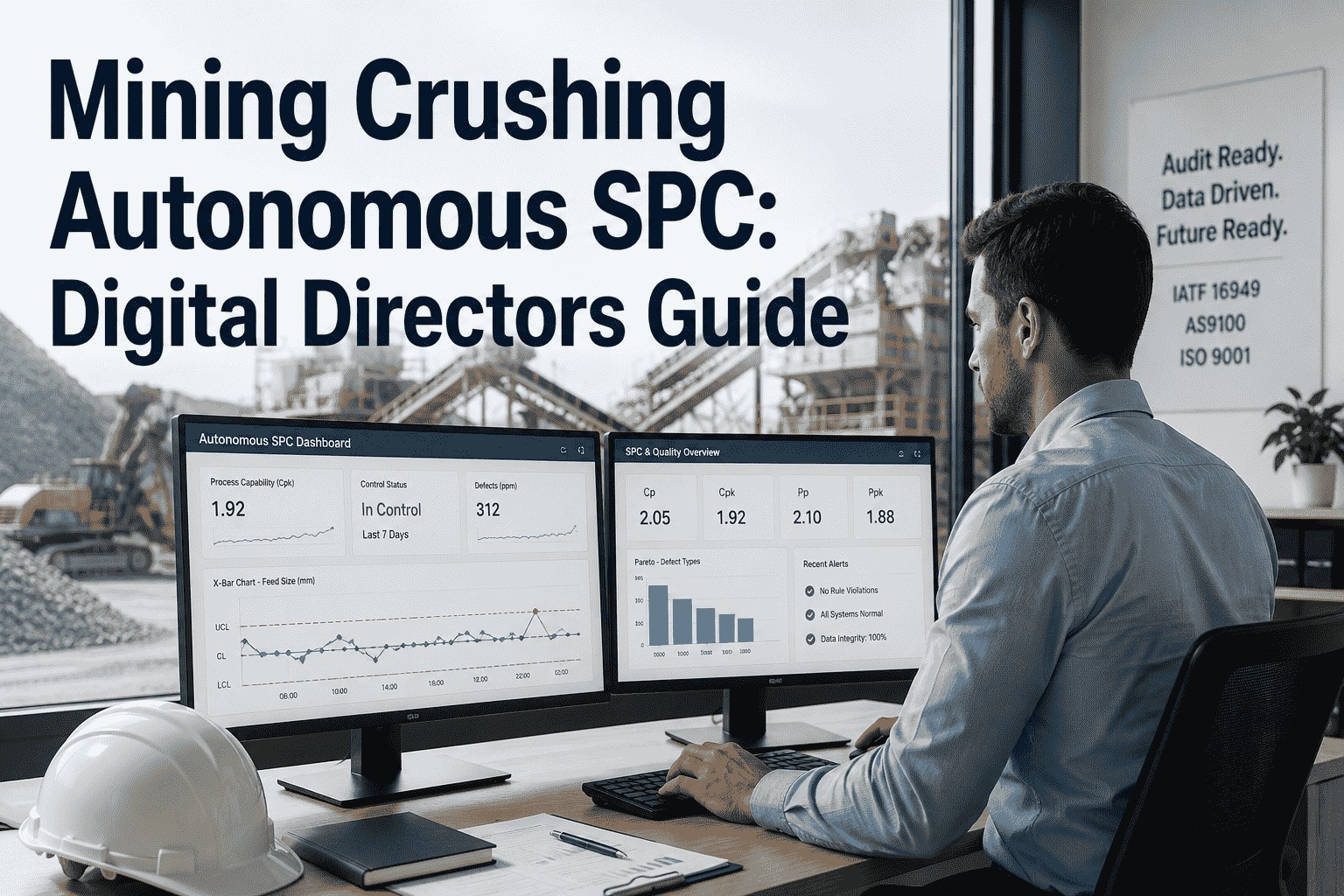
The quality manager's phone rings on the first Monday of every quarter. The auditor is arriving in three weeks. What follows is a controlled scramble: pull SPC charts, verify control limit calculations, collect Cpk reports for every critical characteristic, check that out-of-control events have corrective action records, confirm that the Western Electric rule violations were properly investigated, and assemble the evidence trail that proves the process was under statistical control for the entire audit period. The scramble consumes two to three weeks of engineering time every quarter and still produces a binder of documentation that the auditor will spend two days reviewing, with a 30 to 40% probability of finding a gap that triggers a non-conformance. The gap is rarely a quality failure. It is almost always a documentation gap: an out-of-control event that was corrected but not recorded, a control limit that was recalculated but not approved, a Cpk value that was reported but not trended. Autonomous SPC eliminates this cycle entirely by running Western Electric rules continuously, generating audit-ready control charts and capability reports in real time, and maintaining a tamper-proof audit trail of every out-of-control event, corrective action, and control limit change. For digital manufacturing directors, autonomous SPC transforms audit preparation from a quarterly fire drill into a continuously verified state of readiness that generates every required document on demand.
The Quarterly Audit Scramble Consumes Three Weeks of Engineering Time and Still Produces a Binder With Gaps. Autonomous SPC Replaces the Fire Drill With a Continuously Verified State of Readiness.
iFactory delivers autonomous SPC with real-time Western Electric rule detection, automated Cpk tracking, and tamper-proof audit trails for ISO 9001, IATF 16949, AS9100, CORSIA, and CSRD frameworks.
Tamper-proof records with timestamps and approvals
What Is Autonomous SPC for Mining Ore Processing Audit Readiness?
Autonomous SPC is a self-running statistical process control system that continuously monitors all critical process variables, applies Western Electric detection rules in real time, calculates and trends capability indices, and maintains a complete digital audit trail without requiring manual intervention for routine operation. For digital manufacturing directors in mineral processing, autonomous SPC addresses the fundamental contradiction between the need for rigorous statistical process control and the practical reality that quality engineering resources are scarce and audit preparation is time-consuming. The system ingests process data from DCS and PLC historians at the native sampling frequency, applies the configured Western Electric rules to every control chart, logs every out-of-control event with the rule that was triggered and the contributing data points, generates preventive action records automatically, and stores every control limit change, capability index calculation, and corrective action in an immutable audit trail. When an auditor requests evidence of process control for any date range, the system produces a complete package within minutes: control charts with rule violation annotations, Cpk trend graphs, corrective action records with timestamps, and control limit change history with approval documentation.
Western Electric Rule Detection Engine
Rule 1
1 Beyond 3s
One point beyond the 3-sigma control limit
X
Detects single extreme events
Rule 2
2 of 3 Beyond 2s
Two of three consecutive points beyond the 2-sigma limit on same side
Detects developing shifts
Rule 3
4 of 5 Beyond 1s
Four of five consecutive points beyond the 1-sigma limit on same side
Detects sustained shifts
Rule 4
8 Consecutive One Side
Eight consecutive points on the same side of the centerline
Detects gradual process drift
The Autonomous SPC Audit Shield
Autonomous SPC supports audit readiness through four interconnected capabilities that collectively eliminate the manual effort of preparing for ISO 9001, IATF 16949, AS9100, and other quality management system audits.
R
Real-Time Monitoring
All critical variables monitored continuously on control charts with Western Electric rules applied automatically. Every chart is audit-ready from the moment it is created.
W
Western Electric Automation
All four WECO rules run on every chart simultaneously. Rule violations generate automatic alerts with the triggered rule, contributing data, and corrective action record.
C
Capability Index Trending
Cpk, Cp, Pp, and Ppk calculated and trended continuously for every characteristic. Auditors can view capability history for any date range with a single click.
A
Audit Trail Immutability
Every event logged with timestamp, user ID, before/after values, and approval records. Trail is tamper-proof and exportable in audit-standard formats.
Audit Preparation Should Not Require Three Weeks of Manual Documentation When the Process Data and the Detection Rules Are Running Continuously. Autonomous SPC Delivers Every Audit Record on Demand.
iFactory delivers autonomous SPC with real-time Western Electric rule detection, automated Cpk tracking, and tamper-proof audit trails for ISO 9001, IATF 16949, AS9100, CORSIA, and CSRD frameworks.
The transition from reactive audit preparation to continuous audit readiness follows a four-stage maturity path. Each stage reduces the manual effort required for audit preparation while increasing the completeness and reliability of the evidence package.
Level 1
Reactive Preparation
Manual collection before each audit
SPC charts pulled manually from historians before each audit. Capability reports generated in spreadsheets. Out-of-control events documented in email threads. Audit preparation consumes 2-3 weeks per quarter. Non-conformance risk: 30-40% due to documentation gaps.
Level 2
Standardised Documentation
Templates and structured records
Standardised templates for control charts, capability reports, and corrective action records. Engineers still populate them manually. Documentation quality improves but preparation time remains at 1-2 weeks. Non-conformance risk: 15-25%.
Level 3
Automated SPC with Rules
Real-time rule detection and alerting
Autonomous SPC deployed with Western Electric rules running continuously. Control charts and capability reports generated automatically in real time. Out-of-control events logged with corrective action records. Audit preparation time: 2-4 hours. Non-conformance risk: 5-10%.
Level 4
Continuous Audit Readiness
On-demand evidence generation
Full autonomous SPC with predictive alerting, real-time Cpk trending across all characteristics, and tamper-proof audit trail. Any auditor request for any date range is fulfilled in minutes with complete documentation. Audit preparation time: zero. Non-conformance risk: below 2%.
Compliance Standards Coverage
Autonomous SPC generates audit-ready documentation that satisfies the SPC and process control requirements of the major quality management system standards applicable to mineral processing operations.
C
ISO 9001:2015 / 2026
Clause 8.5.1 - Control of Production
Autonomous SPC satisfies the requirement for monitored and measured production processes through continuous control charting, real-time rule detection, and documented corrective action records. The audit trail provides evidence of process control throughout the entire production period, not just at the audit point.
C
IATF 16949:2016
Clause 9.1.1.1 - Statistical Process Control
IATF 16949 explicitly requires the use of appropriate statistical methods including control charts and capability studies. Autonomous SPC with Western Electric rules directly meets the standard requirement for identifying process variation, taking corrective action, and maintaining documented information as evidence.
C
AS9100D / IA9100
Clause 8.5.1 - Process Control
Aerospace and defense quality standards require documented statistical process control with evidence of corrective action for non-conforming processes. Autonomous SPC provides the required control charts, capability indices, and audit trail with the additional rigour expected by aerospace auditors.
C
CORSIA / CSRD
Sustainability & Carbon Reporting
The audit trail and process control documentation generated by autonomous SPC supports sustainability reporting requirements by providing verifiable evidence of process efficiency, scrap reduction, and quality-driven resource optimisation. The tamper-proof audit trail satisfies the auditability requirements of sustainability frameworks.
The quarterly audit scramble is not a measure of how seriously your plant takes quality. It is a measure of how much of your SPC system still runs on manual effort. Autonomous SPC replaces the fire drill with a continuously verified state of readiness that generates every required document on demand.
iFactory delivers autonomous SPC with real-time Western Electric rule detection, automated Cpk tracking, and tamper-proof audit trails for ISO 9001, IATF 16949, AS9100, CORSIA, and CSRD frameworks.
Frequently Asked Questions
Standard SPC software requires a quality engineer to configure control limits, select chart types, manually review charts for out-of-control signals, calculate capability indices, and prepare documentation for audits. The quality engineer is the decision-making layer between the data and the action. Autonomous SPC replaces this manual layer with automated rule engines that continuously run Western Electric rules on every control chart, generate alerts when rules are violated, log events with corrective action records automatically, and produce audit-ready documentation on demand. The quality engineer shifts from a manual operator of SPC software to a supervisor of the autonomous system, reviewing exceptions and approving corrective actions rather than generating charts and reports manually. iFactory manages the transition from standard to autonomous SPC with automated model configuration, rule validation, and audit trail setup. Book a Demo to see how iFactory implements autonomous SPC in mineral processing operations.
Autonomous SPC supports all four standard Western Electric rules: Rule 1 for single points beyond 3-sigma control limits, Rule 2 for two of three consecutive points beyond 2-sigma limits, Rule 3 for four of five consecutive points beyond 1-sigma limits, and Rule 4 for eight consecutive points on the same side of the centerline. The rule parameters are fully configurable to match your quality plan requirements. The sigma multiplier can be adjusted per rule, the number of points in the test window can be modified, and the minimum consecutive count for Rule 4 can be set to any value between 5 and 15. Rules can be enabled or disabled per control chart and per process characteristic. Additional Nelson rules and custom rule sets can be configured based on your quality management system requirements. Each rule configuration is documented in the audit trail with version history and approval records. iFactory provides pre-configured rule templates for ISO 9001, IATF 16949, AS9100, and general manufacturing applications. Get In Touch to discuss how iFactory configures Western Electric rules for your specific quality plan requirements.
When a Western Electric rule is violated, autonomous SPC generates an out-of-control event record that includes the rule that was triggered, the control chart and variable involved, the data points that caused the violation, the timestamp of detection, and the current process state. The system then routes the event to the assigned quality engineer or control room operator for corrective action. The corrective action is documented in a standardised format that links back to the specific out-of-control event, including the root cause analysis, the corrective action taken, the person responsible, and the closure verification. All events and corrective actions are stored in the immutable audit trail with full traceability. When an auditor requests evidence of how out-of-control events were handled, the system produces a complete report showing every event for the audit period, the corrective action taken, and the verification that the process returned to control. iFactory manages the complete out-of-control event lifecycle from detection to closure verification with full audit trail integration. Book a Demo to see how iFactory handles out-of-control event documentation for audit compliance.
Autonomous SPC integrates with existing quality management systems, ERP platforms, MES systems, and data historians through standard integration protocols including REST APIs, OPC UA, and direct database connectors. The integration layer enables autonomous SPC to receive process data from DCS and PLC historians, send out-of-control event records and corrective action requests to QMS platforms, transmit capability indices and control chart status to ERP dashboards, and synchronise audit trail data with document management systems. The initial integration for data ingestion is typically completed within the first week of deployment. QMS integration for corrective action workflows can be configured in parallel. iFactory provides pre-built connectors for major QMS platforms including SAP QM, ETQ Reliance, MasterControl, and Qualio, as well as direct integration with DCS and SCADA systems used in mineral processing. Get In Touch to verify compatibility with your specific QMS, ERP, and control system infrastructure.
The deployment timeline for autonomous SPC depends on the number of process areas and characteristics to be monitored, but follows a standard schedule. Data integration and control chart configuration for the first process area takes 1 to 2 weeks. Western Electric rule configuration and validation takes 1 week. Shadow-mode parallel run where autonomous SPC generates events and audit trail without operator visibility takes 2 to 3 weeks, during which the rule detection accuracy and documentation completeness are verified. Active deployment with operator-visible alerts and audit trail generation begins approximately 4 to 6 weeks from project initiation. Continuous audit readiness, where the system can produce complete audit documentation for any date range on demand, is achieved at the end of the shadow-mode validation period. Additional process areas are added every 2 to 3 weeks thereafter for complete concentrator coverage. iFactory provides deployment milestone tracking and readiness assessment dashboards that measure progress toward continuous audit readiness across all process areas. Book a Demo to see how iFactory manages the autonomous SPC deployment timeline and audit readiness milestone tracking.
The Three-Week Audit Scramble Is Not a Quality Problem. It Is a Documentation Problem That Autonomous SPC Eliminates by Generating Every Audit Record Continuously, Not Just When the Auditor Calls.
iFactory delivers autonomous SPC with real-time Western Electric rule detection, automated Cpk tracking, and tamper-proof audit trails for ISO 9001, IATF 16949, AS9100, CORSIA, and CSRD frameworks.