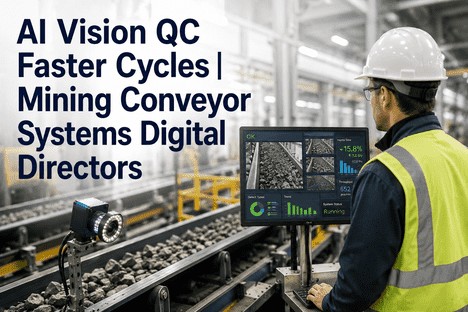
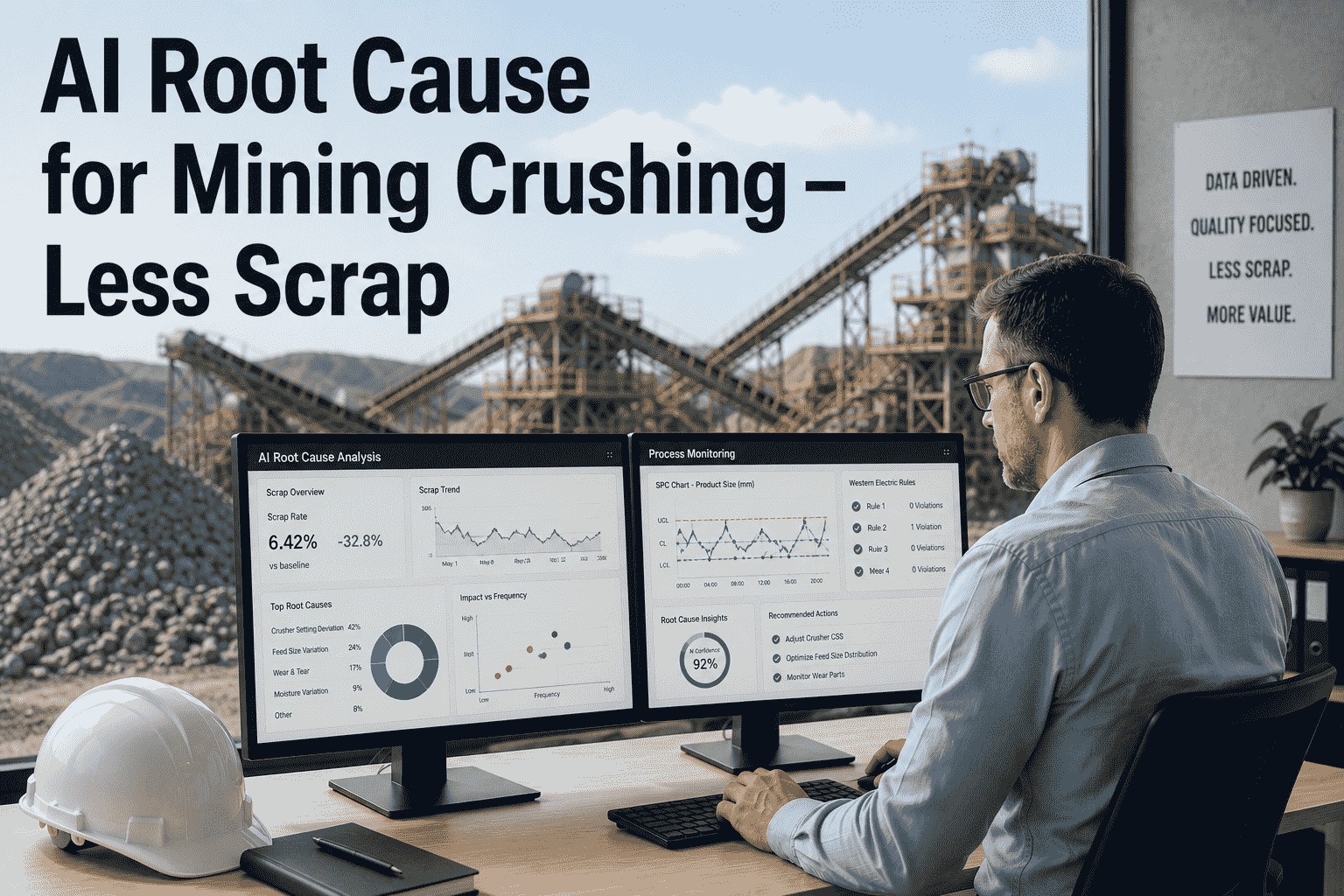
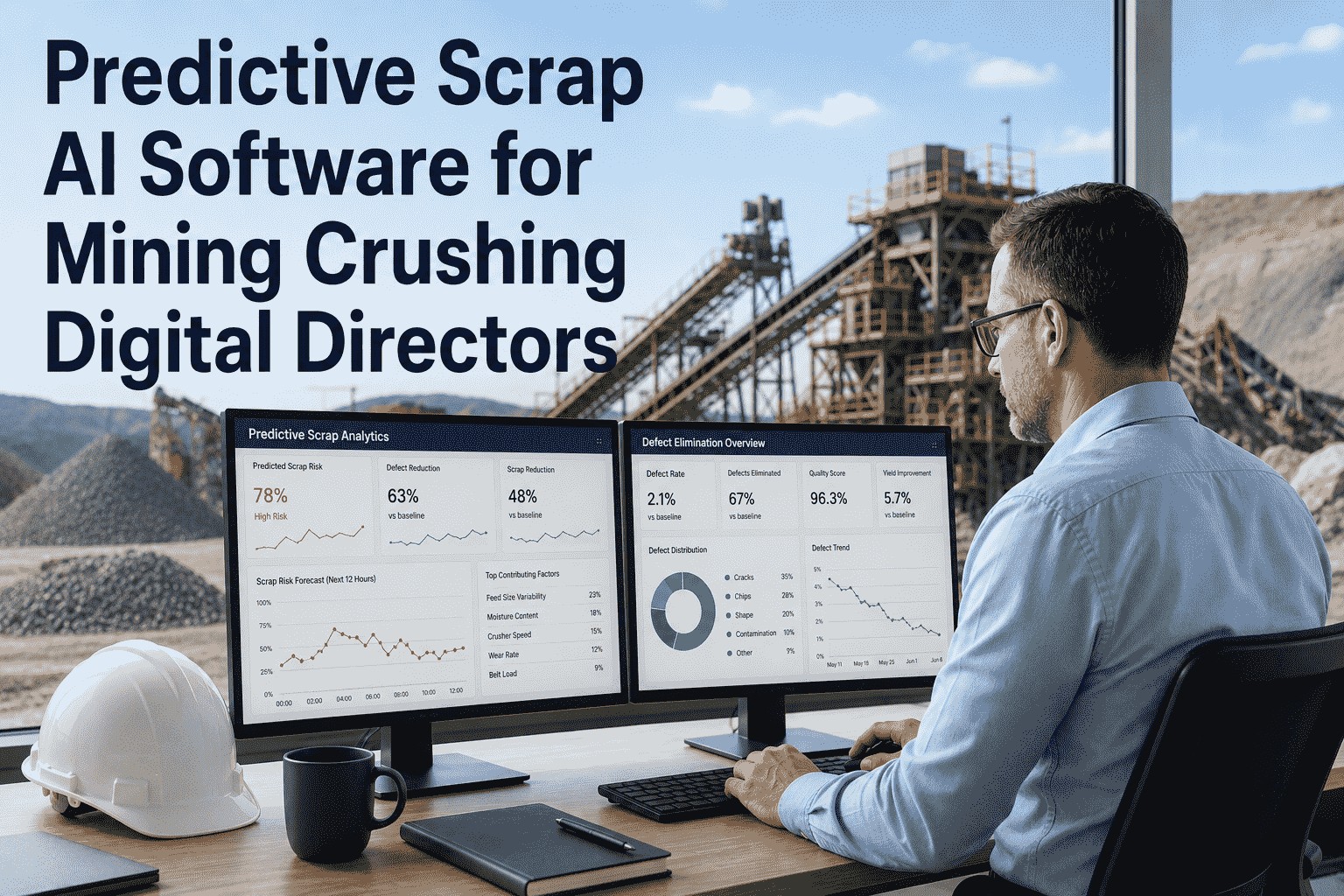
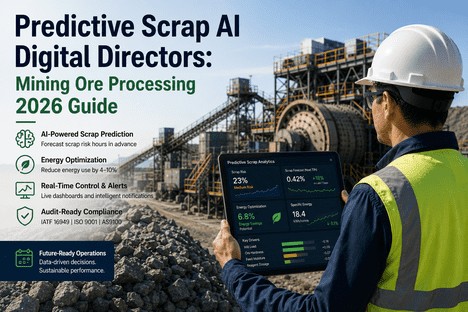
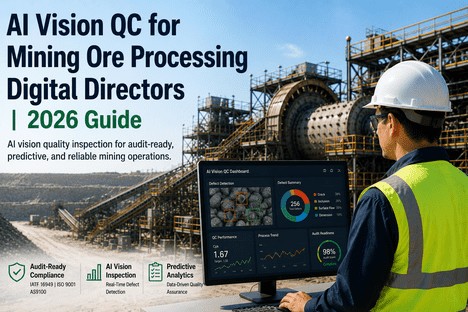
The digital manufacturing director's dashboard shows throughput, availability, and utilization in green. Energy consumption per ton is not green. It is the single largest uncontrolled variable on the plant P&L, yet most directors see energy data as a monthly reconciliation report rather than a real-time control lever. The crushing circuit runs 24 hours a day, processing ore that varies in hardness, grade, and particle size distribution with every shift. The energy consumed to crush that ore tracks those variations — rising when feed is coarser than the control room knows, spiking when oversize material recirculates through an overloaded circuit, and wasting kilowatt-hours on gangue that should have been rejected before it reached the crusher. The problem is not that the energy data does not exist. It is that the quality data and the energy data live in separate systems separated by the time it takes to move a sample from the belt to the lab and the report from the lab to the control room. AI vision quality closes that gap by replacing the lab delay with a millisecond inspection cycle that feeds quality data directly into energy-aware process control.
AI Vision Quality for Digital Manufacturing Directors
See the Energy Waste Hidden in Your Crushing Circuit Right Now
The Hidden Cost
Up to 50 percent of your plant's total energy is consumed in crushing and grinding. Up to 10 percent of that energy is wasted processing material that should never have reached the crusher.
4-10%
Energy reduction documented by AI vision deployments in mineral processing
15-25%
Material rejected at feed stage before consuming grinding energy
15-25 kWh
Energy saved per ton of waste rock rejected before the mill
The Four Circuits Where Energy Becomes Invisible
Energy waste in a crushing circuit does not appear as a single spike on a power meter. It is distributed across four material handling and processing stages, each with a distinct signature that only becomes visible when quality inspection and energy measurement are coupled in real time. AI vision quality for mining crushing makes each of these four waste signatures visible at the moment energy is being spent.
01
Feed Stage: Waste Rock That Should Not Be There
Every ton of waste rock that reaches the crushing circuit consumes energy without adding value. AI vision systems on feed conveyors classify ore versus gangue in milliseconds using deep learning models trained on material surface characteristics, colour, and texture. The vision system triggers a diverter or alerts the operator before the material enters the crusher. At 15-25 percent rejection rates and 15-25 kWh saved per ton rejected, the energy impact at a plant processing 10,000 tons per day reaches 15,000-37,500 kWh saved daily.
02
Crusher Feed: Oversize Particles That Recirculate
When feed contains particles larger than the crusher gap setting, they recirculate — consuming energy on every pass without advancing to the next stage. Camera-based particle size distribution estimation at the crusher discharge detects oversize fractions in real time. The system adjusts feed rate or alerts the operator before recirculation loads spike. Operations using vision-based feed optimisation report 8-12 percent mill throughput increases, directly translating to lower kWh per ton crushed.
03
Crushing Chamber: Blockages That Burn Power
A crusher jam does not announce itself on the power meter until the motor is already under load with zero throughput. AI vision systems detect developing blockages at the crushing mouth by analysing material flow patterns in the camera feed. The SSD and YOLO-based models achieve 95 percent detection accuracy and can trigger an alarm within seconds of a blockage forming — preventing the energy waste of running a crusher against a full chamber and avoiding the production loss of an unplanned stop.
04
Conveyor Network: Material That Should Not Be Moving
Conveyor systems consume energy moving material between stages. When off-spec product must be recirculated, the energy cost is double — once to move it forward and once to move it back. AI vision detection at transfer points identifies off-spec material, belt damage, and material carryback that increase motor load. Operations report 30-50 percent reduction in recirculation loads with vision-based quality control, directly translating to energy savings in conveying and reprocessing circuits.
How AI Vision Quality Creates the Energy-Quality Feedback Loop
The connection between quality inspection and energy consumption is not automatic. A vision system that detects defects without linking those defects to energy use is a quality tool, not an energy tool. The shift happens when the inspection output becomes an input to process control. AI vision quality for mining crushing creates this energy-quality feedback loop through five integrated stages.
Stage 1: Millisecond Visual Inspection
Industrial cameras over feed conveyors, crusher discharge, and transfer points capture images at 30+ frames per second. Deep learning models process each frame within 50 milliseconds, classifying ore type, measuring particle size distribution, and detecting anomalies.
Stage 2: Quality Defect -> Energy Impact Score
Every quality deviation detected by the vision model is assigned an energy consequence score. Oversize particles are calculated as additional kWh per ton for recirculation. Waste rock detected at the feed stage is scored as energy that would be wasted if allowed through. The score is updated in real time per frame.
Stage 3: Automated Process Adjustment
The energy impact score triggers automated or operator-validated actions. Feed rate adjusts when oversize material is detected. Diverter gates activate when waste rock is identified. Crusher gap settings are optimised when PSD drift is detected. Each action is logged with its energy impact.
Stage 4: Specific Energy Consumption Tracking
The platform tracks kWh per ton of on-spec product at the circuit and plant level. Daily, weekly, and shift-level energy reports compare actual consumption against the AI-predicted baseline. Every quality event, energy measurement, and operator action is logged, making the energy reduction auditable and repeatable across shifts.
Stage 5: Continuous Model Improvement
The deep learning models improve over time as more process data becomes available. Each confirmed detection, each corrective action, and each energy measurement trains the next model iteration. Detection accuracy and energy impact prediction improve with every operating hour.
What Changes for the Digital Manufacturing Director
For the digital manufacturing director accountable for both production throughput and energy cost per ton deployed across a multi-circuit crushing operation, AI vision quality changes the relationship between quality control and energy management. The director sees not just that material is off-spec, but exactly how much energy is being wasted on off-spec processing at every stage of the circuit — in real time, with the evidence trail that makes every kWh of savings auditable.
4-10%
Reduction in specific energy consumption across the crushing circuit
97-99%
Classification accuracy of deep learning vision models on ore and defect detection
50 ms
Frame processing time from camera capture to quality-energy decision signal
30-50%
Reduction in recirculation loads through real-time quality defect detection
AI Vision Quality versus Traditional Machine Vision
The difference between AI vision quality and traditional machine vision is the difference between a system that sees what it has been programmed to see and a system that learns to recognise what matters. In a crushing circuit where ore appearance changes with every face advance and environmental conditions shift from dust to rain to darkness, this distinction determines whether the vision system delivers energy savings or becomes another screen the operator ignores.
Traditional Machine Vision
Fixed rule sets: colour threshold, dimension check, presence-absence test
Cannot detect defects it has not been explicitly programmed to find
High false-alarm rate when lighting, dust, or material appearance changes
No learning loop: performance does not improve with more data
AI Vision Quality
Deep learning models trained on thousands of labelled ore images
Detects subtle grade shifts, gradual PSD drift, and texture patterns
97-99% accuracy under dust, vibration, and variable lighting
Continuous model improvement from every frame and operator action
We deployed AI vision cameras on the feed conveyors of our primary crushing circuit expecting a quality improvement. What we did not expect was the energy data. Within the first week, the system identified that 18 percent of the material reaching the crusher was waste rock from an adjacent face that the digger operator was blending into the feed. The energy wasted crushing that gangue over the previous quarter represented more than the total deployment cost of the vision system. The diversion decision is now automated. Our specific energy consumption dropped 6.2 percent in the first month.
— Digital Manufacturing Director, Copper-Gold Operation, Australia
Deployment: From Camera to Energy Savings in Weeks
AI vision quality does not require replacing the DCS, adding new instrumentation, or retraining the quality engineering team. The system connects industrial cameras to edge computing devices that run the deep learning models locally, with the results fed to the existing control system via OPC-UA or Modbus TCP. The first energy-quality feedback loop is typically live within two to four weeks of camera installation.
Camera installation and data pipeline
Industrial cameras installed over feed conveyor and crusher discharge. Edge computing devices deployed. Data stream configured to existing control network.
Model training and calibration
Deep learning model trained on site-specific ore images. Classification accuracy validated against lab samples. Energy impact weights calibrated.
Shadow-mode validation
System runs in parallel without control actions. Detection accuracy and energy impact scoring verified against actual meter data. Ready for active deployment.
Active energy-quality control
Automated diversion and feed adjustment live. Director dashboard showing real-time specific energy consumption with quality-energy audit trail.
Conclusion
The digital manufacturing director who achieves 4-10 percent energy reduction in the crushing circuit is not the one with the most advanced control room or the largest engineering team. It is the one whose quality inspection system is fast enough and intelligent enough to close the gap between what the camera sees and what the energy meter reads. AI vision quality transforms quality inspection from a lagging indicator that confirms what went wrong into a leading signal that prevents energy waste before it occurs.
The energy is being spent in your crushing circuits right now. The question is whether the quality feedback loop is fast enough to make every kWh count. iFactory's AI Vision Quality platform connects deep learning defect detection, real-time particle size analysis, and energy impact scoring into a single system that digital manufacturing directors can act on during the shift — not after it. The 4-10 percent energy reduction is not a benchmark. It is a shift outcome when every ton of on-spec material is verified before the energy is spent.
iFactory AI Vision Quality is purpose-built for mining crushing operations — connecting industrial cameras and edge AI to deliver continuous deep learning inspection, real-time energy impact scoring, and audit-ready quality records. Book a Demo to see AI vision quality running on your crushing circuit data, or Talk to an Expert to schedule a deployment assessment for your operation.
Frequently Asked Questions
The Energy Is Being Spent Right Now in Your Crushing Circuit. The Question Is Whether Your Quality Data Is Fast Enough to Make Every kWh Count.
iFactory AI Vision Quality for mining crushing — deep learning defect detection, real-time particle size analysis, and energy impact scoring in a single platform. Purpose-built for digital manufacturing directors.