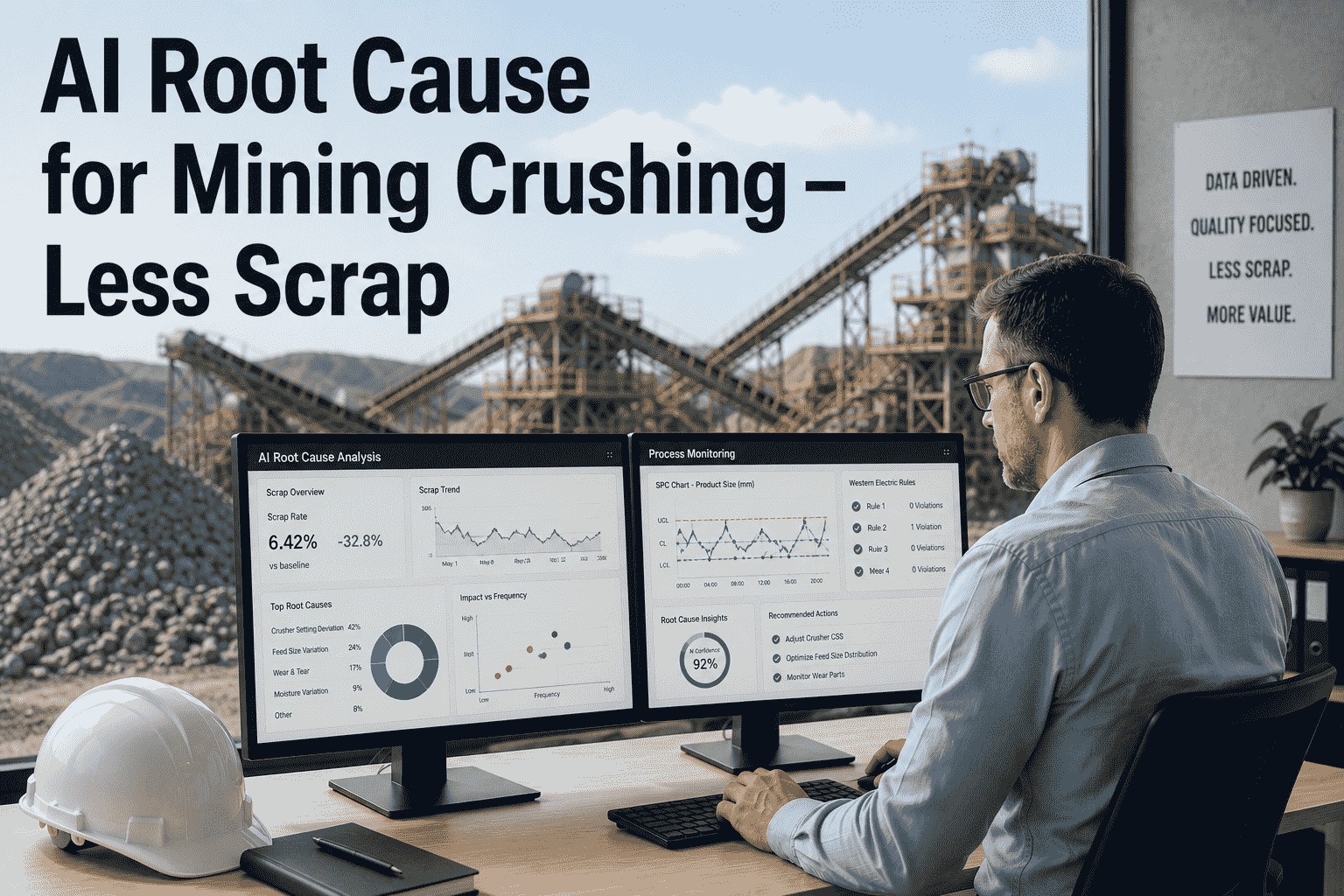
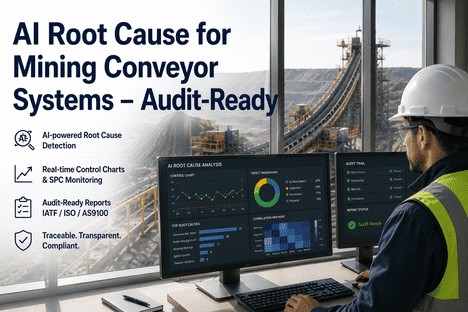
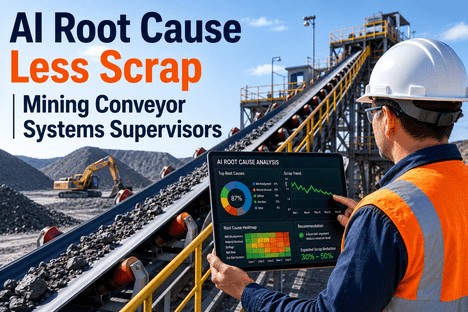
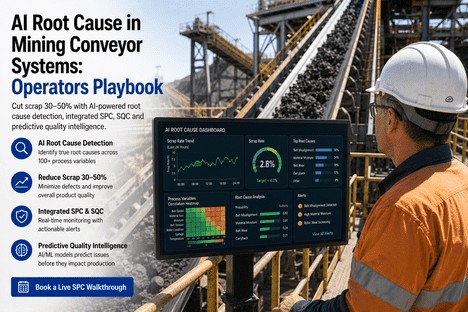
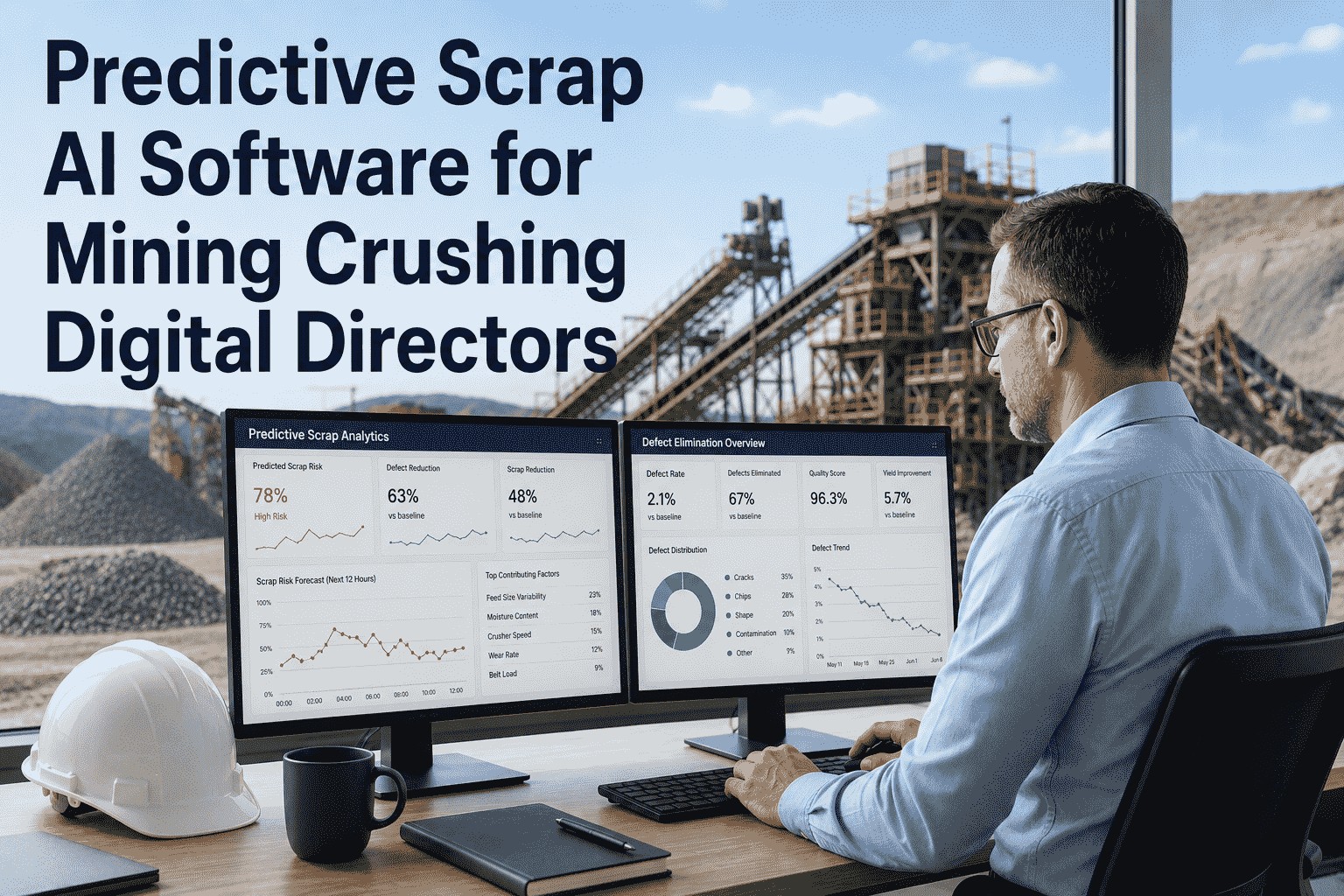
The digital manufacturing director reviews the scrap report at month-end. Three hundred tons of oversize material rejected at the screen deck. The root cause investigation lists the same finding as the previous two months: liner wear combined with feed hardness above specification. The corrective action was applied each time. The scrap event recurred each time under a different combination of operating conditions that the investigation did not capture. This pattern is not a quality system failure. It is a root cause methodology failure. Traditional root cause analysis in crushing relies on manual correlation of a handful of variables selected by experience — typically feed rate, CSS, and power draw. But scrap events in a modern crushing circuit are caused by the interaction of 100 or more variables that change simultaneously across every production shift. The variable that triggered the scrap event last month may be different from the variable driving it this month, even when the scrap signature looks identical on the screen report. AI root cause detection solves this by correlating every instrumented variable simultaneously, ranking them by contribution to each scrap event, and delivering a confirmed root cause in minutes instead of the days it takes a manual investigation team to reach a conclusion that may or may not be correct.
AI Root Cause Detection for Digital Directors
Stop Investigating the Same Scrap Event Every Quarter. AI Finds the Real Root Cause in Minutes.
The Root Cause Iceberg: What Operators See versus What Is Really Driving Scrap
Every scrap event in a crushing circuit leaves a visible signature on the operator dashboard. Power draw elevated. CSS drifted. Fines percentage above target. The operator responds to the visible signal, adjusts the parameter, and the process returns to spec. The scrap event is resolved. But the root cause that generated the visible signal remains invisible because it is buried in the interaction of variables the operator cannot see simultaneously. AI root cause detection does not look at the visible signal in isolation. It looks at the 100-plus variable interaction that preceded it — and surfaces the specific combination that triggered the event.
What the Operator Sees
Power draw elevated
Visible on the SCADA screen. Operator reduces feed rate. Power draw normalizes. Root cause not identified.
Fines percentage above target
Detected at the screen deck. Operator adjusts CSS. Fines drop. The liner wear that caused the drift continues.
CSS drift detected
Hydraulic pressure shift triggers alarm. Operator recalibrates. The feed hardness change that caused the drift is not logged.
What AI Root Cause Detection Reveals
Power draw + liner wear at 72% + feed hardness shift
ML model ranks three variables contributing to the power draw anomaly. Operator adjusts feed rate and schedules liner replacement. No recurrence.
Three-parameter interaction identified as root cause. CSS adjustment alone would not have prevented recurrence. Panel replacement scheduled.
CSS drift = tramp metal event + hydraulic valve hysteresis
Root cause traced to a mechanical issue, not a process issue. Valve replaced. CSS drift eliminated permanently.
Why Traditional Root Cause Analysis Fails in a Variable Crushing Circuit
Traditional root cause analysis methods — fishbone diagrams, 5-Whys, fault tree analysis — were designed for manufacturing environments where the number of process variables is limited and the relationships between them are well understood. A crushing circuit is none of those things. The following table compares how each method performs against the reality of a modern crushing operation where feed variability, liner wear, and 100-plus interacting variables determine quality outcomes.
5-Whys Analysis
Asks sequential "why" questions to trace a symptom to a root cause. Works when the causal chain is linear. Fails when multiple variables interact non-linearly to produce the same symptom.
Crushing circuit limitation:
Fines generation can be caused by CSS drift, liner wear, feed moisture, feed hardness, or any combination of the four. The 5-Whys traces one path and misses the interaction.
Fishbone / Ishikawa
Categorises potential causes into groups — man, machine, material, method, measurement, environment. Provides a structured brainstorming framework but no statistical basis for ranking causes.
Crushing circuit limitation:
All 100-plus variables appear on the diagram with equal weight. The operator has no way to identify which category contributed most to a specific scrap event.
Fault Tree Analysis
Maps failure modes through Boolean logic gates to identify combinations of events that produce a top-level failure. Requires predefined failure mode knowledge and static event probabilities.
Crushing circuit limitation:
A fault tree built at commissioning is obsolete within weeks as ore conditions, liner state, and equipment dynamics change. The tree does not learn.
The AI Root Cause Engine: How Multivariate ML Finds What Manual Investigation Misses
The AI root cause detection engine does not replace the operator's experience. It amplifies it by doing what no human investigation team can do: correlating every instrumented variable simultaneously, ranking them by contribution to each scrap event, and delivering a confirmed root cause in minutes. The engine operates in three integrated layers.
Layer 1
Continuous Data Ingestion and Feature Engineering
The engine ingests data from every instrumented source in the crushing circuit — typically 80 to 150-plus variables including crusher power draw, CSS position, feed rate, ore hardness index, moisture content, liner wear status, vibration spectra, bearing temperatures, hydraulic pressure, screen efficiency, and downstream product quality measurements. Raw sensor data is transformed into engineered features that capture variable interactions, rate of change, and deviation from rolling baselines.
Layer 2
Multivariate Correlation and Root Cause Ranking
When a scrap event or Cpk degradation is detected, the ML engine runs a correlation analysis across all monitored process variables — comparing the current parameter window against the full historical dataset. Engineered features are analysed through gradient-boosted tree models and SHAP (Shapley Additive exPlanations) to assign each variable a contribution score. Variables are ranked by correlation strength, and the top-ranked finding is presented as the confirmed root cause. The output is not a list of possible causes. It is a ranked, specific finding with percentage contribution.
Layer 3
Predictive Alert Generation and Continuous Learning
The engine does not wait for scrap to occur. When the combination of active process variables matches a historical pattern that preceded a scrap event, a predictive alert fires before the defect occurs. Every confirmed root cause finding, corrective action, and quality outcome feeds back into the model, continuously improving its detection accuracy and reducing false positives. The model that catches a scrap event this month is more accurate than the model that caught the same pattern last month.
What Changes When Root Cause Is Confirmed in Minutes Instead of Days
The most expensive part of a scrap event is not the material loss. It is the investigation time, the production variability during the investigation window, and the probability that the investigation reaches the wrong conclusion. AI root cause detection compresses the investigation cycle from days to minutes and eliminates the guesswork that drives recurring scrap events.
Investigation Cycle Time
Before:
2-3 days
After:
2-3 minutes
Manual investigation requires gathering shift logs, correlating sensor data across multiple systems, and interviewing operators. AI delivers a ranked root cause finding within minutes of event detection.
Recurring Scrap Events
Before:
60-70% repeat rate
After:
Below 15%
Manual RCA often identifies the wrong cause or only a contributing factor. AI correlates all variables simultaneously and surfaces the actual root cause, eliminating the conditions for recurrence.
Scrap Reduction Impact
Before:
8-15% scrap rate
After:
3-7% scrap rate
With confirmed root causes driving corrective action, scrap rate drops 30-50% within the first operating quarter. The reduction compounds as the model learns from each event.
Engineering Productivity
Before:
50-60% on RCA
After:
Under 20% on RCA
Engineering time reallocates from manual root cause investigation to process improvement. The AI engine handles the correlation work. Engineers focus on implementing corrective actions.
We had a recurring oversize event on the secondary crusher that appeared every five to six weeks. Every investigation concluded the same thing: liner wear. We replaced the liners, the event disappeared for six weeks, and then it came back. After deploying AI root cause detection, the first event that fired was different. The model identified the root cause as a combination of feed moisture above 6 percent and screen panel wear on the downstream deck — not liner wear. The liners we had been replacing prematurely were at 40 percent remaining life. The corrective action was a screen panel inspection schedule. The oversize event did not recur. The cost of the misdiagnosis over the previous six months was three sets of prematurely replaced liners and 1,200 tons of scrap that the liner replacement did not prevent.
— Digital Manufacturing Director, Iron Ore Crushing Operation, Brazil
Scrap Reduction Impact: What the Metrics Show
The scrap reduction impact of AI root cause detection is not measured in laboratory conditions. It is measured against actual production outcomes across the variability of real crushing operations. The following metrics are drawn from documented deployments of multivariate ML-based root cause detection in copper, iron ore, and gold crushing circuits.
30-50%
Scrap rate reduction within first operating quarter
93%+
Root cause identification accuracy versus manual investigation
100+
Process variables correlated simultaneously for each event
2-3 min
Time to deliver confirmed root cause finding after event detection
Recurring scrap events eliminated
60-70% reduction
Engineering RCA time recovered
50-60% reduction
Deployment: From Data Connection to Confirmed Root Cause in Weeks
AI root cause detection does not require replacing the DCS, adding new sensors, or retraining the quality engineering team. The engine ingests data from existing historians via OPC-UA, Modbus TCP, and direct exports from OSIsoft PI, Wonderware, and ABB 800xA. The first root cause findings are typically available within two to three weeks of data connectivity.
Week 1-2
Data integration and baseline establishment
Connect to DCS historian and SCADA. Configure data pipeline for 80-150 variables per crusher. Establish rolling baseline for each variable. Historical scrap events logged and correlated with process data.
Week 3
Model training and root cause validation
Multivariate ML model trained on historical scrap events and process data. Root cause findings validated against documented investigation outcomes from the same period. Model tuned for precision.
Week 4-6
Shadow-mode parallel operation
Engine runs in shadow mode, generating root cause findings for every scrap event without operator visibility. Findings compared against manual investigations. Discrepancies reviewed and model refined. Ready for active deployment.
Week 7+
Active root cause detection and continuous improvement
Engine live with operator-visible ranked root cause findings. Predictive alerts active for known scrap precursor patterns. Director dashboard showing scrap rate trajectory, recurring event trends, and engineering productivity impact.
Conclusion
The digital manufacturing director who cuts scrap 30-50 percent is not the one with the most thorough investigation process. It is the one whose root cause detection system correlates every variable simultaneously, ranks them by contribution, and delivers a confirmed finding in minutes instead of days. AI root cause detection transforms scrap reduction from a reactive investigation cycle into a proactive prevention discipline — using multivariate ML models that learn the specific variable interactions that precede each scrap type in your unique crushing circuit.
The 30-50 percent scrap reduction is not a benchmark. It is the documented outcome across copper, iron ore, and gold crushing operations that have deployed multivariate ML-based root cause detection. The 60-70 percent reduction in recurring scrap events confirms that AI does not just find the cause faster. It finds the right cause. And the 50-60 percent recovery of engineering time from manual investigations means your quality team focuses on preventing scrap instead of documenting it.
iFactory AI Root Cause Detection is purpose-built for mining crushing operations — connecting to your existing DCS and historians to deliver multivariate ML-based root cause ranking, predictive scrap alerts, and continuous model improvement. Book a Demo to see AI root cause detection running on your crushing circuit data, or Talk to an Expert to schedule a deployment assessment for your operation.
Frequently Asked Questions
Traditional root cause analysis methods — 5-Whys, fishbone diagrams, and fault tree analysis — rely on manual correlation of a limited number of variables selected by human experience. In a crushing circuit where 100-plus variables interact simultaneously, manual methods cannot capture the non-linear interactions that actually drive scrap events. AI root cause detection uses multivariate machine learning models that correlate every instrumented variable at once, ranking each by its contribution to the specific scrap event. The output is a confirmed root cause with percentage contribution for each variable — not a list of possible causes that requires further investigation to confirm. Studies published in mining engineering journals demonstrate that AI-based root cause detection achieves 93 percent plus accuracy compared to manual investigation, with the additional benefit of identifying root causes that manual methods routinely miss — particularly multi-variable interactions and gradual drift patterns. Book a Demo to see a comparison between AI and manual root cause findings on your circuit data.
AI root cause detection covers the full spectrum of scrap events in crushing operations, including oversize material recirculation, excessive fines generation, crusher chamber packing, screen blinding, product contamination, and downstream mill feed specification deviation. The engine identifies root causes across three categories. Process-related root causes include CSS drift, feed rate variability, and feed hardness shifts. Mechanical root causes include liner wear progression, bearing degradation, hydraulic system faults, and screen panel wear. Material-related root causes include feed moisture variation, ore blend changes, and tramp metal ingress. The engine correlates variables across these categories simultaneously — a scrap event may have its root cause in a process variable, a mechanical variable, or an interaction between the two. The AI surfaces the specific combination that triggered the event, which no single-category investigation can achieve. Talk to an Expert to discuss which scrap types are most relevant to your specific crushing circuit configuration.
The multivariate ML engine is designed specifically for the high-variability environment of a crushing circuit. Unlike rule-based systems that use fixed thresholds, the model learns the non-linear relationships between feed characteristics, process parameters, and quality outcomes continuously. When ore hardness, moisture content, or particle size distribution changes, the model detects the shift in the combined parameter signature and adjusts its correlation analysis accordingly. The model maintains separate baseline profiles for different feed types where data is available, and uses transfer learning to generalize across ore blends where site-specific data is limited. Each root cause finding includes the contribution of feed variability to the scrap event, giving directors visibility into whether the root cause was controllable — a process or mechanical adjustment — or related to incoming feed quality that requires upstream coordination. Book a Demo to see how the model adapts to changing feed conditions on a live crushing circuit simulation.
Every root cause finding, corrective action, and quality outcome is logged automatically with a timestamp, the process variable state at the time of the event, and the ranked root cause analysis. This creates an audit trail that satisfies ISO 9001, IATF 16949, and other quality management system requirements without operators manually documenting findings in separate systems. The record is structured, searchable, and exportable in standard quality audit formats. Integration with existing CMMS and EQMS platforms enables automatic work order generation when a root cause finding requires a mechanical intervention. Integration with MES and ERP platforms enables scrap cost attribution per root cause category, giving directors visibility into which root cause types drive the highest scrap cost. Talk to an Expert to discuss integration with your specific quality management platform.
The AI root cause detection engine requires process data from the instrumented crushing circuit and corresponding quality outcome data. Process data includes crusher power draw, CSS position, feed rate, ore hardness index or proxy, moisture content, liner wear status, vibration data, bearing temperatures, hydraulic pressure, and screen efficiency readings. Quality outcome data includes scrap event logs with timestamps, screen oversize and fines records, and lab assay results for product quality. Most modern crushing plants already collect this data through their SCADA, DCS, and laboratory information systems. A minimum of 12 months of historical data is recommended for initial model training. Operations with limited historical data can begin with a transfer learning baseline from similar crushing circuits and achieve actionable root cause accuracy within 4-6 weeks of live data collection. The engine connects to existing data sources via OPC-UA, Modbus TCP, MQTT, and REST APIs without requiring new sensors or data infrastructure. Talk to an Expert to schedule a data readiness assessment for your crushing circuit.
The Scrap Event You Are Investigating Right Now Has a Root Cause That Manual Methods Will Miss. AI Finds It in Minutes.
iFactory AI Root Cause Detection for mining crushing — multivariate ML correlation across 100-plus variables, ranked root cause findings, and continuous model improvement. Purpose-built for digital manufacturing directors.