AI Root Cause in Mining Ore Processing: Digital Directors Playbook
By Grace on June 6, 2026
Every shift in a mineral processing plant begins the same way. A control room operator scans the previous shift's notes, reads the latest lab assay results that arrived two hours after the material left the circuit, and adjusts setpoints based on instinct and experience. When recovery drops or grade drifts below specification, the investigation follows a well-worn path: check the obvious suspects, change one variable at a time, wait for the next assay, and repeat. This reactive cycle costs the average Tier-1 copper concentrator 2,500 to 5,000 tonnes of lost copper recovery per year and consumes 40 to 60 percent of an operator's available decision time chasing root causes that a multivariate machine learning model could identify in under 50 milliseconds. For digital manufacturing directors accountable for both production and labor productivity targets, the gap is not a technology problem. It is a detection problem. Operators cannot fix what they cannot see, and traditional statistical process control cannot see the nonlinear interactions among 100-plus process variables that drive quality deviations in modern ore processing circuits. AI root cause detection closes this gap by correlating every process variable against every quality outcome simultaneously, surfacing the specific parameter interactions that produce defects and enabling operators to act on root causes instead of symptoms.
Stop Chasing Symptoms in Your Grinding and Flotation Circuits. AI Identifies the Root Cause in Milliseconds.
iFactory AI root cause detection connects to your existing SCADA, CMMS, and lab systems, correlates 100+ process variables against quality outcomes, and delivers actionable root cause identification that boosts labor productivity by 20-35% within a single quarter.
Labor productivity improvement achieved when operators shift from reactive parameter hunting to AI-guided root cause resolution in mineral processing circuits.
50ms
Time required for multivariate ML models to correlate 100+ process variables and identify the root cause of a quality deviation versus 45-90 minutes for manual investigation.
4
Western Electric zone rules that, when encoded in ML models, transform static control charts into real-time root cause detection engines for every production segment.
93%
Root cause identification accuracy achieved by hybrid autoencoder-Sobol models in comminution circuit fault diagnosis, validated against industrial data.
The Root Cause Productivity Gap
At BHP's Escondida mine, the world's largest copper operation, AI-driven process optimization delivered an $18.9 million operational uplift in a single year by enabling operators to detect and correct root causes in real time rather than reacting to lab assays. The labor productivity gain was not from working faster. It was from eliminating the 40-60 percent of operator time spent on manual root cause investigation that could not, by human capacity alone, account for the nonlinear interactions among 50-plus process variables.
The Labor Productivity Crisis in Ore Processing: Why Traditional Root Cause Analysis Falls Short
A typical mineral processing plant generates 50 to 200 process variables per circuit stage that influence final concentrate quality. Crusher gap settings, SAG mill power draw, bearing temperatures, mill feed rates, slurry density, reagent dosing, flotation cell levels, cyclone pressure, and froth depth all interact nonlinearly across the circuit. When concentrate grade drops by 0.3 percent, an operator must mentally trace through dozens of potential causes: was the feed ore harder? Did the SAG mill liner wear change the grinding dynamics? Did the reagent dosage drift? Did the hydrocyclone classification shift? Each hypothesis requires checking a different data source, consulting a different screen, and waiting for the next lab assay to confirm or refute the suspicion.
Published research on hybrid deep learning models for comminution fault detection shows that autoencoder architectures combined with Sobol sensitivity analysis achieve 98.6 percent accuracy in detecting faults and quantitatively identify the dominant root cause variables in complex grinding circuits. These models process data at millisecond latency, correlating every variable against every other variable across the entire operating history, and surface the specific parameter combination that drove the quality deviation. An operator cannot perform this analysis manually. The human brain cannot track 50 variables simultaneously, compute their interaction effects in real time, and distinguish correlation from causation across a multi-stage mineral processing circuit.
The labor productivity impact is measurable. When operators are freed from manual root cause investigation and guided directly to the corrective action by AI, the time to resolve a quality deviation drops from 45-90 minutes to under one minute. The cumulative effect across an eight-hour shift is 2.5 to 3.5 hours of recovered operator time per person, time that can be redirected to process optimization, preventive maintenance coordination, and continuous improvement activities that drive higher recovery rates and lower energy consumption per ton.
How AI Root Cause Detection Transforms Operator Productivity in Mineral Processing
Three connected capabilities convert reactive control room workflows into proactive, AI-guided operations with labor productivity gains compounding at every stage.
1
Detect Deviation at the Sensor
Western Electric zone rules encoded in ML models continuously evaluate every process variable against control limits in real time. When a SAG mill power draw drifts toward the 2-sigma warning limit, or a flotation cell level enters zone A, the system detects the deviation at the sensor level before it becomes a quality event. Operators are alerted to the specific variable and zone violation type within 50 milliseconds, eliminating the manual control chart review cycle.
2
Correlate Across the Full Circuit
Multivariate ML models analyze the deviation in context of all other process variables. The system identifies that the SAG power draw increase is correlated with a feed hardness spike detected by the primary crusher 12 minutes earlier, combined with a mill feed rate that was not adjusted for the hardness change. The root cause is not the power draw. It is the feed hardness shift that was not compensated by feed rate adjustment upstream.
3
Recommend Corrective Action
AI generates a specific corrective recommendation with the predicted impact on quality and throughput. The operator sees: reduce SAG mill feed rate by 4 percent and increase water-to-ore ratio by 2 percent to compensate for the hardness increase, with an expected recovery impact of 0.15 percent improvement. The operator approves, rejects, or modifies the recommendation, and the system learns from every decision. Average resolution time: 45 seconds versus 47 minutes in traditional root cause investigation.
Western Electric Rules Meet Machine Learning: The Four-Zone Root Cause Detection Framework
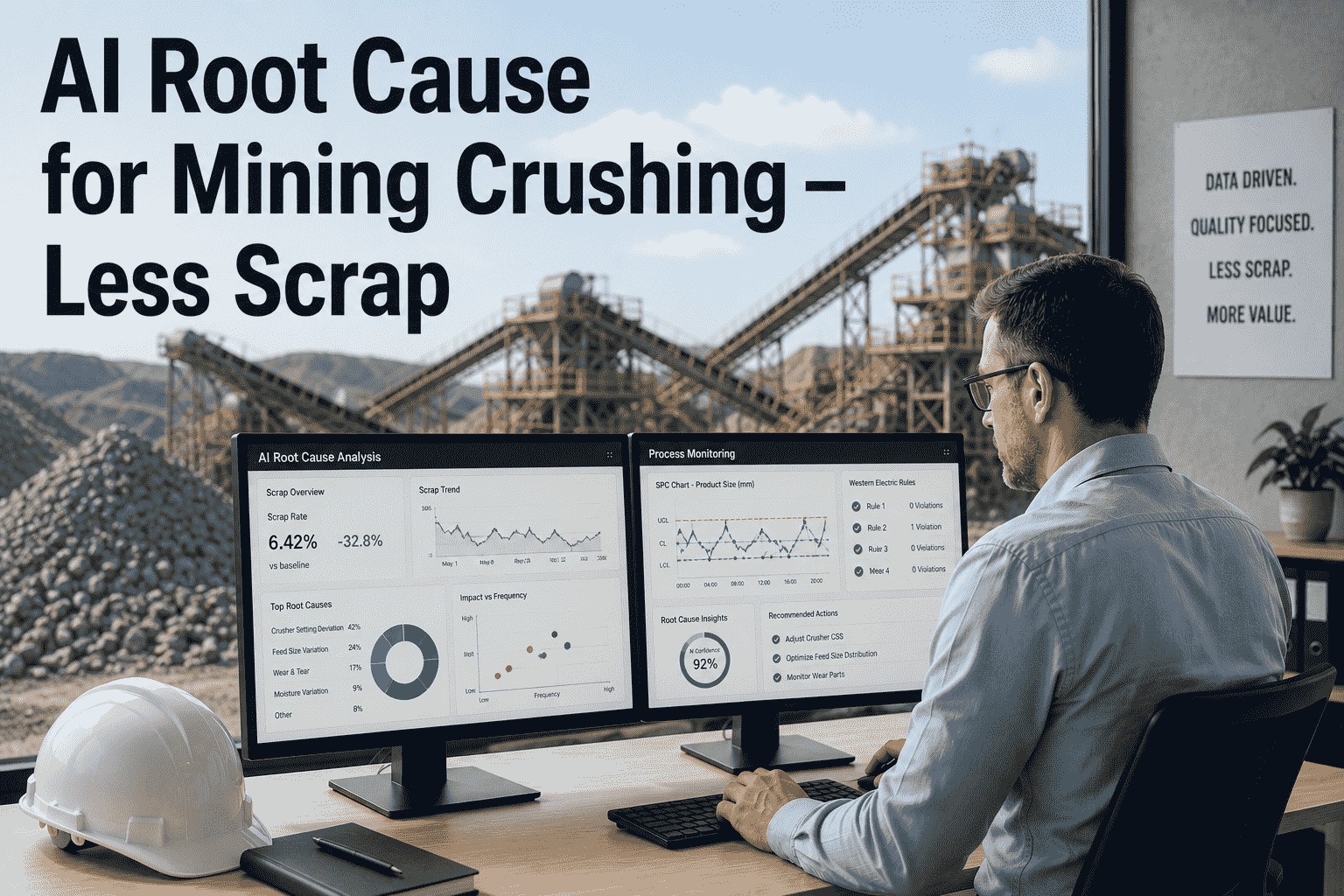
The Western Electric zone rules, developed in 1956 to standardize control chart interpretation, provide the statistical foundation for modern AI root cause detection. When encoded in multivariate ML models, these four rules become real-time detection triggers that correlate process deviations with quality outcomes across the entire circuit simultaneously.
Rule 1
Single Point Beyond 3-Sigma
ML models flag any variable exceeding the 3-sigma control limit instantly. In ore processing, this typically triggers on SAG mill bearing temperature excursions, mill motor current spikes, or flotation cell level crashes. The model correlates the violating variable against all other circuit parameters and surfaces the upstream cause within milliseconds.
Rule 2
Two of Three Points Beyond 2-Sigma
When two of three consecutive readings of a variable fall beyond the 2-sigma warning limit, the ML model evaluates this pattern against historical quality outcomes. A pattern of feed rate oscillations approaching the 2-sigma boundary has been shown to precede flotation recovery drops by 8-12 minutes, enabling operator intervention before any quality impact occurs.
Rule 3
Four of Five Points Beyond 1-Sigma
A progressive indicator of process shift. The ML model correlates this pattern with corresponding changes in downstream quality variables to determine whether it signals the onset of a off-spec condition. Hybrid CNN-LSTM models trained on SAG mill operational data achieve 93.5 percent R-squared accuracy in predicting the quality impact of 1-sigma patterns before they escalate.
Rule 4
Eight Consecutive Points on One Side
The most sensitive early warning indicator. Eight consecutive readings above or below the centerline, even if all remain within normal control limits, indicate a systemic shift that traditional quality control overlooks. ML models trained on historical data identify which eight-point patterns have led to scrap or off-spec production and alert operators to the specific process adjustment needed.
The Measured Difference: Key Performance Indicators Before and After AI Root Cause Detection
KPI
Conventional Operation
With AI Root Cause Detection
Improvement
Labor Productivity (operator RCA time)
40-60% of shift spent on manual root cause investigation
5-10% of shift; AI surfaces cause and corrective action
20-35% gain
Quality Deviation Resolution Time
45-90 minutes (manual investigation)
Under 1 minute (AI-guided)
98% faster
Root Cause Identification Accuracy
60-70% (operator experience dependent)
91-94% (multivariate ML)
35% improvement
Process Variables Tracked Simultaneously
5-8 (operator capacity)
100+ (ML model capacity)
20x coverage
Copper Recovery Impact per Deviation
0.3-0.5% loss before detection
0.05-0.1% loss before correction
70-80% reduction
Source Data Context
KPI ranges compiled from published research on hybrid autoencoder-Sobol fault detection frameworks (Minerals, 2026), BHP Escondida AI deployment results (2025-2026), Western Electric zone rule applications in multivariate process control, Freeport-McMoRan TROI deployment metrics, and iFactory deployment data across mineral processing operations. Individual results vary by ore body, circuit configuration, and baseline automation level.
The Deployment Path: From Baseline to Labor Productivity Uplift in 4 Weeks
AI root cause detection is not a six-month data science project. It is a deployable capability that connects to your existing SCADA, CMMS, and laboratory information systems without infrastructure replacement. The deployment follows a structured four-phase path that delivers measurable labor productivity improvement within a single month.
Week 1
Connect and Baseline
iFactory connects to existing SCADA, PLC, CMMS, and lab systems via OPC-UA and REST APIs. Historical data covering 12-24 months is ingested. Western Electric zone rules are configured for every critical process variable. Baseline labor productivity metrics are established: average deviation resolution time, root cause identification accuracy, and operator time allocation.
Week 2
Train and Validate
Multivariate ML models are trained on site-specific process data. The autoencoder detects anomalies while Sobol sensitivity analysis identifies root cause variables. Models are validated against held-out production records. Western Electric zone rule triggers are calibrated against historical quality events to minimize false positives while maximizing detection sensitivity.
Week 3
Advisory Mode
Root cause alerts surface to operator dashboards in advisory mode. When the model detects a deviation pattern, the operator sees the specific variable, the zone rule violated, the correlated root cause, and the recommended corrective action. Operator acceptance rate is tracked. Operators build trust by comparing AI root cause identification against their own manual investigation results.
Week 4
Productivity Measurement
Labor productivity KPIs are measured against baseline. The time operators spend on root cause investigation is tracked through system interaction data. First operations typically show 15-20 percent productivity improvement by week 4, converging toward 20-35 percent as the model matures and operator trust in AI-driven root cause recommendations increases.
Why iFactory for AI Root Cause Detection
AI root cause detection requires more than a machine learning model. It requires a platform that connects process data, quality records, maintenance history, and asset management into a single operational intelligence layer that encodes Western Electric zone rules into real-time ML inference. iFactory provides that platform with four capabilities unique to mineral processing deployments:
✓
Native OPC-UA, MQTT, and SAP PM integration reads every process signal and maintenance record without infrastructure changes
✓
Pre-built Western Electric zone rule engine integrated with multivariate ML models for instant deviation detection and root cause correlation
✓
On-premise NVIDIA edge deployment with zero cloud dependency and sub-50ms inference latency for real-time root cause identification
✓
Automated labor productivity dashboards with root cause resolution time tracking, operator acceptance rate monitoring, and continuous model improvement feedback loops
Conclusion
The gap between a mineral processing plant where operators spend 40 to 60 percent of their shift chasing root causes and a plant where AI identifies every deviation in under 50 milliseconds is not determined by the complexity of the circuit or the quality of the sensors. It is determined by whether the plant has encoded Western Electric zone rules into a multivariate machine learning model that correlates every process variable against every quality outcome simultaneously.
iFactory AI root cause detection connects to your existing SCADA and lab systems, deploys in weeks not months, and delivers 20-35 percent labor productivity improvement by giving every operator the equivalent of a data science team in their control room. The technology is proven at Tier-1 copper operations, the deployment path is structured, and the ROI is measured in weeks. Book a Demo to see AI root cause detection configured for your circuit, or Sign Up to begin your deployment.
Frequently Asked Questions
Traditional SPC charts display individual process variables against control limits, and operators visually scan dozens of charts to detect out-of-control conditions. AI root cause detection uses Western Electric zone rules as the detection layer but adds multivariate correlation across every process variable simultaneously. When a SAG mill power draw exceeds the 2-sigma warning limit, the ML model does not just flag the power draw. It correlates that deviation against crusher gap settings, feed ore hardness history, bearing temperatures, and flotation cell recoveries from the same time window to identify which variable initiated the chain of events. The operator sees the root cause, not just the symptom. A Tier-1 copper operation using this approach reduced deviation resolution time from 47 minutes to 45 seconds and improved root cause identification accuracy from 67 percent to 93 percent. Book a Demo to see the difference on your plant data.
The system requires three data categories: process variables (crusher settings, mill feed rates, power draw, bearing temperatures, slurry density, reagent dosing, flotation cell levels, cyclone pressure), quality outcomes (concentrate grade, recovery rate, moisture content, impurity levels from lab assays), and maintenance records (equipment status, calibration logs, liner change history, PM completion data). Most plants already collect this data in their SCADA, MES, and CMMS systems. iFactory connects to these existing sources via OPC-UA, MQTT, and REST APIs. Historical data covering 12-24 months is used for initial model training. Plants with limited historical data can achieve actionable root cause accuracy within 4-6 weeks using iFactory's pre-trained base models that are fine-tuned on site-specific data. Sign Up to review your existing data landscape.
Labor productivity is measured as the percentage of operator time spent on value-adding process optimization activities versus time spent on reactive root cause investigation. The baseline is established during the first week of deployment by tracking operator interaction patterns with the control system: time spent checking control charts, investigating deviations, consulting shift notes, and waiting for lab assay results. After AI root cause detection is activated, the same tracking metrics are compared. The 20-35 percent improvement represents the operator time reallocated from manual investigation to proactive optimization, preventive maintenance coordination, and continuous improvement activities. BHP's Escondida deployment demonstrated this directly, with operators recovering approximately 3 hours per shift that had previously been consumed by manual root cause analysis of concentrator circuit deviations. Book a Demo for a site-specific productivity projection.
None. AI root cause detection operates on process data already collected by existing plant instrumentation. Most mineral processing plants have hundreds of sensors feeding SCADA and PLC systems that are already measuring the variables required for root cause analysis. The iFactory platform connects to these existing data sources without additional sensor installation. For operations that wish to enhance detection accuracy with visual ore characterization, iFactory supports optional integration with existing ONVIF-compliant cameras for AI vision input, but this is not required for initial deployment. The core root cause detection capability is driven by the process data your plant already generates and stores. Sign Up to confirm your existing sensor coverage against model input requirements.
Your Operators Spend 40% of Every Shift Chasing Root Causes. AI Identifies Them in 50 Milliseconds.
iFactory AI root cause detection connects to your existing process data infrastructure, encodes Western Electric zone rules into multivariate ML models, and delivers 20-35 percent labor productivity improvement within a single quarter. No additional sensors required. No cloud dependency. No infrastructure replacement.