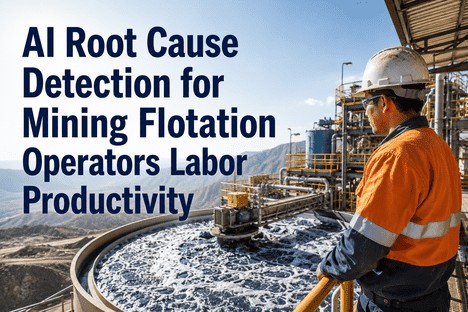
The flotation operator sees grade starting to drop on cell four. Froth looks slightly darker. Bubble size is shifting. But why? The operator checks the reagent flow — normal. Air rate — within range. Pulp density — stable. Feed grade from the upstream sampler — no change reported. Forty-five minutes of checking individual parameters, cross-referencing the control system against the shift log, and consulting the previous shift's notes. The cause turns out to be a partially blocked sparger ring on the rotor — a condition that produces no alarm, no flow deviation, and no pressure drop detectable at the panel, but that reduces aeration efficiency by enough to shift the froth regime across two cells over the course of an hour. The operator loses forty-five minutes of production time to fault finding, plus the twenty minutes of off-grade concentrate produced while the condition developed undetected. This is the hidden labor tax in flotation operations: not the mechanical failure itself, but the operator hours consumed tracing root causes through a dozen uncorrelated data sources, waiting for lab results, and troubleshooting by trial and error when no single parameter flag indicates where the problem started. AI root cause detection for mining flotation changes this.
AI Root Cause Detection · Multivariate RCA · Operator Decision Support · Labor Productivity
Every Hour Your Operator Spends Tracing a Root Cause Is an Hour Not Spent Optimising the Circuit. AI Root Cause Detection Finds It in Seconds.
iFactory's AI root cause detection platform correlates 100+ flotation variables in real time — froth vision, reagent flows, cell levels, air rates, feed characteristics — and identifies the originating cause of any process deviation before the operator finishes the first parameter check.
20–35%
Operator labour productivity gain when AI root cause detection replaces manual multi-parameter troubleshooting with instant diagnosis
93%
Root cause identification accuracy demonstrated by multivariate deep learning models on froth flotation circuits, validated against metallurgical investigation
45 min
Average operator troubleshooting time per flotation deviation event reduced to under 60 seconds with AI-generated root cause diagnosis and ranked parameter contribution
12%
Increase in operator diagnostic time reallocated from reactive troubleshooting to proactive circuit optimisation when AI handles root cause identification
Why Root Cause Detection in Flotation Is the Most Time-Consuming Diagnostic Problem in Mineral Processing
A flotation circuit comprises dozens of interacting variables — feed grade, particle size distribution, pulp density, reagent dosage rates, air flow per cell, froth depth, pulp level, impeller speed, froth stability, bubble size distribution, launder condition, and recirculating loads — each capable of influencing the others. When a grade deviation appears on cell four, the cause could be in cell four itself, in the feed distribution to cells one through three, in the reagent mixing station feeding the bank, in the grind size from the mill, or in the ore body being delivered from the mine. The operator who must check each variable sequentially, waiting for trend confirmation on each one, spends the majority of the diagnostic window on elimination rather than correction. This is not a skill gap — it is a data integration problem. The data exists, but it exists in different systems, on different time scales, and with different lag times, and no human operator can correlate them all simultaneously.
The Five Root Cause Pattern Classes AI Detects in Flotation Circuits
Pattern Class 1
Reagent System Drift
Frother or collector pump calibration drifts over 4-8 hours. Bubble size shifts gradually, froth colour changes, grade trends down. No single parameter exceeds a static limit. AI detects the multi-parameter drift signature and isolates the reagent circuit as the originating variable cluster — not froth behaviour, not air rate, not feed.
Pattern Class 2
Feed Grade or Mineralogy Shift
Ore type changes produce coordinated shifts in froth colour, bubble loading, and reagent demand across all cells simultaneously — not a single-cell pattern. AI cross-correlates the froth vision data with feed grade analyser readings and identifies the feed source as the root cause, distinguishing it from a circuit-side problem.
Pattern Class 3
Aeration or Sparger Blockage
Partial blockage reduces effective aeration in a single cell. Froth velocity drops, bubble size coarsens, and recovery declines in that cell only. The blockage produces no airflow alarm because the total flow is redistributed. AI detects the single-cell froth signature and correlates it with the local air distribution pattern — pinpointing the sparger issue before it propagates.
Pattern Class 4
Pulp Level Control Loop Fault
A sticking level control valve produces froth depth oscillation with a characteristic frequency. The oscillation propagates downstream cell by cell. Operators chasing the grade symptom in later cells miss the upstream valve. AI analyses the temporal pattern across all cell level signals and identifies the oscillating control loop as the root node in the causal graph.
Pattern Class 5
Grind Size Distribution Shift
Mill circuit disturbance produces finer or coarser flotation feed. Recovery drops across the rougher bank. The symptom appears in flotation but originates in comminution. AI correlates flotation froth characteristics with the particle size distribution trend from the mill discharge and identifies the grinding circuit as the root cause — preventing hours of unnecessary flotation-side troubleshooting.
How AI Root Cause Detection Works: From Symptom to Source in Seconds
The AI root cause detection engine does not wait for an alarm threshold to be breached. It continuously monitors all correlated variable groups — froth vision parameters, process control signals, reagent delivery data, and feed characteristics — and builds a causal graph of the flotation circuit in real time. When any variable begins to deviate, the engine traces the deviation path backwards through the causal graph to identify the originating variable, the propagation path, and the confidence level of the diagnosis.
Continuous Causal Graph Construction
The engine ingests all available data streams — froth camera images, cell level and air flow transmitters, reagent pump stroke counters, feed grade analyser outputs, and mill discharge PSD measurements. A multivariate time-series model learns the normal causal relationships between variables: which parameters influence which, with what lag, and under what operating conditions.
Anomaly Detection and Deviation Tracing
When any variable or variable cluster deviates from the expected causal pattern, the engine flags the deviation and traces backward through the causal graph. Unlike threshold-based alarms that fire only when a limit is breached, the engine detects the onset of deviation at the earliest indication — a froth colour shift, a reagent flow fluctuation, a level oscillation — and identifies the originating node before the deviation produces a visible quality impact.
Operator Diagnosis With Ranked Root Causes
The dashboard displays the root cause diagnosis with the originating variable, confidence score, propagation path, and contribution weights for each affected variable. A recommended corrective action is shown based on the most effective intervention from historical scenarios matching the same root cause pattern. The operator verifies and acts — total diagnostic time under 60 seconds.
Operator Diagnostic Time Comparison: Manual Troubleshooting vs AI Root Cause Detection
Flotation Deviation Event
Manual Troubleshooting Time
AI Root Cause Detection Time
Reagent dosage drift
35-55 min — check 6+ parameter trends, compare against shift log, wait for lab assay
Under 30 sec — frother pump drift identified from combined froth + reagent flow pattern
Pulp level control oscillation
25-40 min — detect oscillation pattern, trace upstream cell by cell, confirm valve behaviour
Under 20 sec — oscillating valve identified from level signal frequency analysis across all cells
Feed grade transition impact
20-30 min — correlate froth shift with feed analyser, confirm ore type change, adjust reagent regime
Under 15 sec — feed grade identified as root cause from cross-cell froth correlation with analyser trend
Sparger blockage (partial)
30-50 min — distinguish from reagent issue, check individual cell air distribution, inspect sparger
Under 25 sec — single-cell froth velocity and bubble size signature matched to blockage pattern
Average diagnostic time reduction: 45 minutes per event to under 30 seconds — a 98% improvement in troubleshooting efficiency
What the Operator Dashboard Shows — Root Cause View
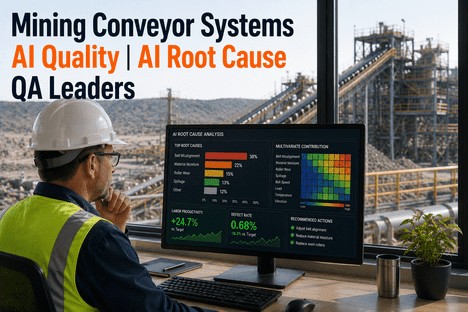
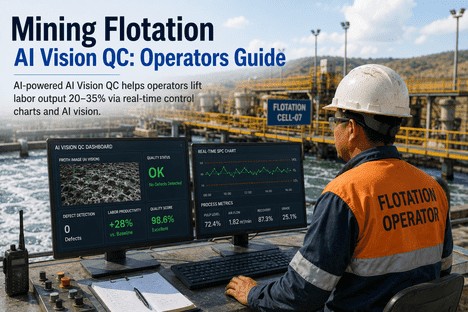
The root cause detection dashboard shifts the operator from sequential parameter checking to instant diagnosis. Every deviation displays its originating cause, propagation path, and recommended corrective action — eliminating the investigative phase of troubleshooting entirely.
Dashboard Panel 01
Live Causal Graph — Circuit Connectivity Map
The operator sees the flotation circuit as a live causal graph — each cell, reagent line, and feed source displayed as a node, with influence paths shown as connecting edges. When a deviation occurs, the originating node pulses red, and the propagation path highlights through the downstream nodes. The operator sees not just what is deviating, but exactly where the deviation started and which variables it has affected.
Operator action: Identify the red node — address root cause at source, not symptoms at downstream cells.
Dashboard Panel 02
Root Cause Ranked List — Confidence and Evidence
If multiple potential root causes exist, the dashboard lists them ranked by confidence score with the supporting evidence for each. The operator sees: Root cause A — frother pump drift (92% confidence, supported by reagent flow trend + bubble size correlation). Root cause B — feed grade change (78% confidence, supported by froth colour shift across all cells). The operator selects the highest-confidence cause and acts without needing to validate each possibility independently.
Operator action: Select root cause by confidence score — verify and execute recommended corrective action.
Dashboard Panel 03
Historical Pattern Matcher — Similar Past Events
For each root cause diagnosis, the dashboard shows the most similar historical events from the database — including what the root cause was, what corrective action was taken, and whether it resolved the deviation. The operator learns from every previous occurrence of the same pattern without having to remember it. Over time, the pattern matcher accumulates a knowledge base that captures the collective troubleshooting experience of every shift.
Operator action: Review matched historical scenario — apply corrective action with highest success rate.
Dashboard Panel 04
Operator Intervention Record — Closed-Loop Learning
Every operator action on a root cause diagnosis is logged: the diagnosis received, the corrective action taken, and the outcome. The model learns from each intervention. If the operator chose a different corrective action than the one recommended and it resolved the deviation faster, that action is recorded as a higher-weighted option for future cases. The system improves with every troubleshooting cycle.
Operator action: Confirm corrective action and outcome — model learns and improves for next occurrence.
"
Before AI root cause detection, every froth or grade deviation meant the same thing: stop what I was doing and start checking parameters one by one. Reagent flow, air rate, feed density, level control — half an hour of elimination before I could even start correcting. Now, when the grade on cell two starts to shift, the dashboard tells me within seconds that it is a frother pump drift on the reagent skid, with 91% confidence, and that the same pattern was corrected last month by recalibrating pump three. I go straight to the skid, recalibrate, and the froth returns to normal within ten minutes. My troubleshooting time dropped from hours per week to minutes per week. The time I used to spend chasing causes, I now spend tuning the circuit to run better.
— Senior Flotation Operator, Copper-Zinc Concentrator, Australia
Deploying AI Root Cause Detection on a Flotation Circuit: 90-Day Implementation
Deployment is structured so the operator team builds confidence in the root cause diagnoses through observed accuracy during parallel operation — not through replacing existing troubleshooting procedures before the system has proven its reliability on your circuit's specific variable interactions.
Data Stream Integration and Causal Model Initialisation
All available data streams connected to the causal engine — process historian, froth cameras, reagent delivery system, feed analyser. Causal graph initialised from historical data with known root cause events documented in shift logs and metallurgical reports. Gap analysis identifies any missing data connections needed for full circuit coverage.
Shadow Mode Validation
Root cause diagnoses generated in shadow mode — displayed only to the metallurgical team, not to operators. Each diagnosis compared against the actual root cause determined through existing troubleshooting. False positive and false negative rates documented. Model retrained on missed diagnoses.
Operator Dashboard Activation
Root cause detection dashboard activated for operator team. Causal graph view, ranked root cause list, and historical pattern matcher enabled. Operator training completed on dashboard interpretation and intervention logging. Confidence threshold for alerts calibrated from shadow mode data.
Model Refinement and Expansion
Causal graph refined with 60 days of live diagnosis data. Pattern matcher enriched with operator intervention outcomes. Circuit coverage extended to additional variable groups. Diagnostic time savings measured and reported. Operator feedback integrated into confidence threshold tuning.
Conclusion
Flotation circuit troubleshooting time is not caused by operator inexperience. It is caused by a diagnostic model — sequential parameter checking through uncorrelated data sources, reliance on periodic lab assays for confirmation, and experience-dependent pattern recognition — that was never designed for the multi-variable complexity of a modern flotation circuit. No operator can simultaneously monitor froth characteristics, reagent delivery, air distribution, feed conditions, and cell level control across a six-cell bank while also reading trend charts, consulting shift logs, and coordinating with the mill operator. AI root cause detection does, at machine speed, with a causal graph that traces every deviation back to its originating variable, and with a pattern matcher that gives every operator access to the accumulated troubleshooting experience of every shift that came before.
For the flotation operator, the change is specific: instead of spending 30 to 55 minutes per deviation event checking parameters one at a time, the causal graph shows the root cause in under 30 seconds with a confidence score and a recommended corrective action. The propagation path shows which downstream variables have been affected and whether they require separate correction or will self-correct once the root cause is addressed. The historical pattern matcher ensures that knowledge is never lost between shift handovers or operator rotations. And the closed-loop learning system means the model improves with every intervention — making each successive diagnosis more accurate and faster than the last.
iFactory's AI root cause detection platform is built for flotation operators who need to know why a deviation started, not just that it is happening. Book a Demo to see the causal graph operating on a flotation circuit configuration matched to your cell layout and variable interactions, or talk to an expert about configuring AI root cause detection for your specific flotation bank, data streams, and labour productivity targets.
Frequently Asked Questions
The Root Cause of Your Flotation Deviation Is Hidden in Variables You Cannot Check Fast Enough Manually. AI Finds It Before You Lose Another Hour to Troubleshooting.
iFactory's AI root cause detection platform monitors every variable in your flotation circuit simultaneously — froth vision, reagent delivery, air distribution, cell levels, and feed conditions — and traces every deviation to its originating cause in under 30 seconds, with ranked confidence scores, propagation path visibility, and historical pattern matching that gives every operator the same expert-level diagnostic capability.