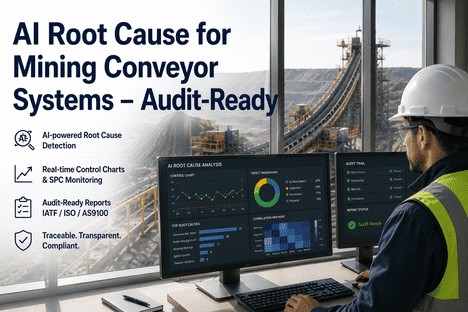
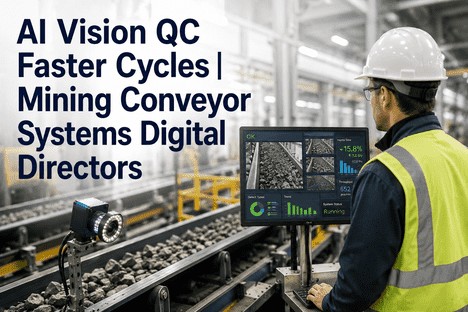
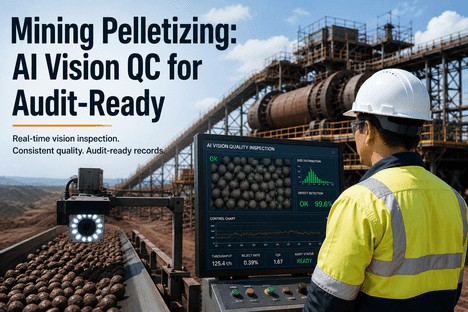
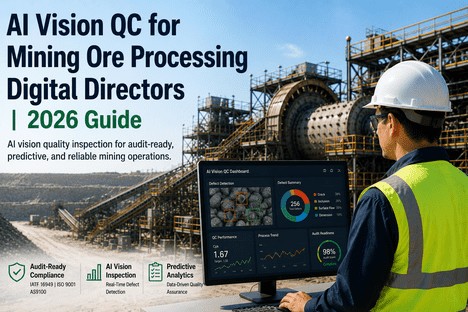
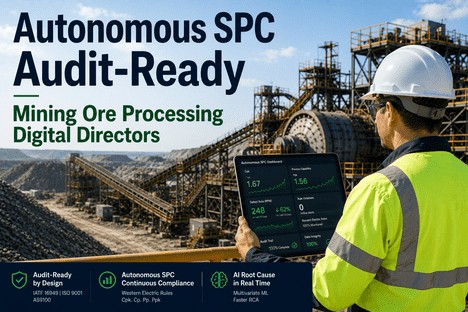
The audit arrives in eight weeks. The quality team compiles SPC charts, capability reports, defect logs, and calibration records from four separate systems. Someone discovers the control limit rationale for the February ore blend transition was never documented. Another person realises the machine vision inspection logs cover only the last six weeks because the storage retention policy was set to 90 days. The audit package takes three engineers the better part of a week to assemble — and when the auditor asks about the correlation between vision-inspected surface defects and crush-strength test results for the direct reduction grade, no one has the answer because the two data streams were never linked. This scenario repeats across pelletizing plants every audit cycle because the quality data infrastructure connects systems, not outcomes. AI Vision QC changes this by making every inspection event, every control limit change, and every defect classification audit-ready from the moment it is captured.
Deep Learning Vision · Autonomous SPC · IATF 16949 · ISO 9001
Digital Manufacturing Directors Who Pass IATF and ISO Audits With Zero Findings Share One Common Capability: Their Quality Data Is Born Audit-Ready.
iFactory's AI Vision QC platform gives digital manufacturing directors deep-learning machine vision for surface, dimensional, and assembly defect detection — with every inspection traceable, every limit change documented, and every audit package exportable in one click.
100%
Inspection coverage achieved by AI vision systems — every pellet, every cycle, every defect classified and logged against the batch record with no sampling gap
3x
Faster audit preparation when quality data is born audit-ready — from days of manual compilation across disconnected systems to a single export covering any date range and product grade
99.7%
Defect detection accuracy achieved by deep-learning vision models in mineral processing environments — consistently maintained across ore type, lighting, and pellet surface condition variations
Why Audit Readiness in Pelletizing Depends on Vision Quality Data Being Born Structured
IATF 16949 Clause 9.2 and ISO 9001 Clause 9.2 require manufacturers to demonstrate that their quality management system is implemented, maintained, and effective. For pelletizing operations, this means the auditor will ask to see evidence of three things: that every quality inspection was performed correctly, that every out-of-specification result was investigated, and that every corrective action was verified for effectiveness. When quality data lives in disconnected systems — vision inspection on one server, SPC control charts in another, LIMS results in a third, CAPA records in a fourth — producing the evidence chain for a single audit finding requires manual reconciliation across platforms. AI Vision QC eliminates this by capturing all quality data in a unified, traceable, exportable structure from the point of capture.
The Audit Evidence Gap: Disconnected Systems vs. Unified AI Vision QC
100% inspection records by batch and grade
Vision logs cover 5–15% sampled inspection. No link to batch ID or grade context.
100% of pellets inspected. Every defect classified by type, severity, and batch association.
Control limit rationale documented
Manual entry in separate log. Often incomplete or retrospective before audit.
Every limit change logged automatically with timestamp, trigger event, and statistical basis.
Vision defects correlated with mechanical test results
No correlation. Vision and LIMS are separate systems with separate databases.
Vision defect data feeds Cpk calculation for physical quality. Correlation visible per batch.
CAPA effectiveness evidence
Manual tracking. CAPA closed when action is taken — not when effect is confirmed.
CAPA re-opened automatically if defect pattern recurs. Effectiveness confirmed by Cpk trend.
Audit package export by date range and grade
Manual compilation from 3–5 systems. 2–3 days for a single audit package.
One-click export with all linked records. 30 minutes to compile a complete audit package.
How AI Vision QC Works: From Capture to Audit Record in Four Steps
The AI Vision QC pipeline transforms raw visual data from the production line into structured, traceable, audit-ready quality records without human intervention. Each step in the pipeline adds a layer of quality intelligence that is logged automatically and linked to the batch, grade, and process context in use at the time of capture.
01
Image Capture and Preprocessing
High-resolution line-scan or area-scan cameras capture images of every pellet on the conveyor at full production speed — green pellets after balling discs, fired pellets after induration, and screened pellets before loadout. Each image is associated with the current batch ID, product grade, and timestamp from the plant control system.
02
Deep Learning Inference
The trained deep-learning model analyses each image in milliseconds, classifying pellets by surface condition — cracks, spalling, shape anomalies, surface roughness deviations — and measuring dimensional characteristics. The model is trained on labelled pellet images from the specific production environment and continues learning from new defect types over time.
03
SPC Integration and Limit Correlation
Vision inspection results feed directly into the autonomous SPC engine as additional quality data streams. Surface defect frequency per batch is treated as a monitored variable with adaptive control limits. When surface defects exceed the expected range for the current grade and blend, an alert fires alongside the SPC control chart for mechanical quality characteristics.
04
Audit Record Generation
Every inspection result, every control limit change, every defect classification, and every SPC alert is logged automatically with the full process context — product grade, ore blend code, binder batch ID, recipe version, and operator shift. The audit record is searchable, filterable, and exportable in a structured format that complies with IATF 16949 and ISO 9001 documentation requirements.
Image Capture · Deep Learning · SPC Integration · Audit Record
When Every Pellet Is Inspected and Every Result Is Traceable to a Batch, Grade, and Blend, the Audit Becomes a 30-Minute Export — Not a Three-Day Data Hunt.
iFactory's AI Vision QC platform makes quality data born audit-ready — deep-learning inspection, autonomous SPC integration, and traceable records across every product grade and ore blend in your pelletizing operation.
Five Audit-Ready Outcomes the Digital Director Gets With AI Vision QC
The AI Vision QC platform delivers five specific outcomes that directly address the most common audit findings in pelletizing quality programmes. Each outcome is measurable, auditable, and generated automatically without manual effort.
A
100% Inspection Traceability
Every pellet image captured, every defect classified, every inspection event logged with a unique identifier linked to the batch, product grade, ore blend, and timestamp. The auditor can select any batch, grade, or date range and pull the complete inspection record for that population — not a sample, not a summary report, but the full inspection history with individual defect classifications and images.
B
Closed-Loop Defect Resolution
Every vision-detected defect that triggers a corrective action is tracked through the full resolution cycle — detection alert, root cause investigation, parameter correction, and effectiveness verification via subsequent vision inspection results. The auditor sees a closed loop for every defect category that exceeded the acceptable threshold, not just a corrective action report with no outcome evidence.
C
Cross-Stream Correlation Evidence
Vision defect frequency data is correlated with mechanical quality test results — crush strength, tumble index, and size distribution — within the same dashboard and audit record. The auditor can see whether surface defect rates on green pellets correlate with crush-strength outcomes on fired pellets, providing evidence that the quality programme understands the relationship between process parameters and final product quality.
D
Cpk History by Grade and Blend
Continuous Cpk for every monitored quality characteristic — including vision-derived surface quality metrics — segmented by product grade and ore blend. The auditor can compare capability on blast furnace grade versus direct reduction grade for the same period, or compare capability before and after a process change, with no manual data sorting required. Cpk trend lines include the control limit change history for full transparency.
E
One-Click Audit Package
All records required for IATF 16949 and ISO 9001 audits — vision inspection logs, SPC compliance charts, control limit change history, CAPA records with effectiveness evidence, Cpk trend reports by grade — are generated automatically and exportable as a single structured package covering any date range, product grade, process zone, or ore blend the auditor specifies. Audit preparation time drops from days of manual compilation to a 30-minute export.
Our IATF 16949 surveillance audit used to require three weeks of preparation — pulling vision logs from the inspection server, SPC data from the historian, capability reports from the quality database, and CAPA records from the QMS platform. Every system had a different data format, a different date range available, and a different export structure. The first time we used the AI Vision QC one-click audit package, the auditor spent more time reviewing the completeness of the data than trying to find gaps in it. Our audit findings dropped from seven in the previous cycle to two in the first cycle after deployment. Both findings were minor and unrelated to quality data management.
— Digital Manufacturing Director, Iron Ore Pelletizing Plant — Straight-Grate System, 8 Mtpa Annual Capacity
Conclusion
Audit readiness in pelletizing quality management is not determined by how much data the plant generates — it is determined by whether that data is structured, traceable, and exportable from the moment it is captured. When machine vision inspection logs, SPC control limit records, capability calculations, and CAPA documentation live in separate systems with separate formats, the audit preparation effort is driven by data reconciliation, not by quality management. AI Vision QC closes this structural gap by making every quality data point born audit-ready — captured with full process context, linked across quality streams, and exportable in a package that meets IATF 16949 and ISO 9001 documentation requirements.
The documented outcomes from pelletizing operations that have deployed unified AI vision and SPC platforms are consistent: audit findings related to data completeness and traceability are eliminated, audit preparation time drops from days to minutes, and the quality team's focus shifts from assembling records for auditors to using the same structured data for defect reduction and process improvement. The digital manufacturing director who deploys AI Vision QC is not just investing in defect detection technology — they are investing in a quality data infrastructure that serves the audit, the improvement cycle, and the customer simultaneously.
iFactory's AI Vision QC platform is built for digital manufacturing directors who need to demonstrate audit readiness alongside defect reduction and labour productivity. Book a Demo to see the AI Vision QC dashboard configured for your pellet grade portfolio and vision inspection requirements, or talk to an expert about a free audit-readiness assessment for your pelletizing quality programme.
Frequently Asked Questions
Stop Assembling Audit Packages From Disconnected Systems. Make Every Quality Record Born Audit-Ready With AI Vision QC.
iFactory's AI Vision QC platform for mining pelletizing digital manufacturing directors — deep-learning vision with 100% inspection coverage, autonomous SPC with continuous Cpk, and IATF 16949 and ISO 9001 audit-ready documentation generated automatically from every inspection event. Schedule a free audit-readiness assessment for your pelletizing quality programme.