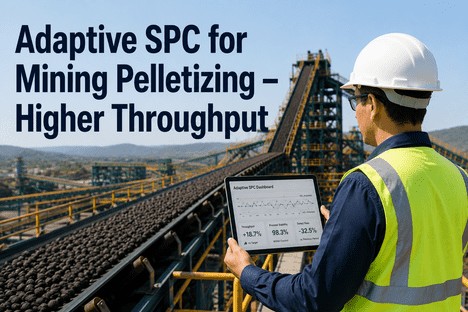
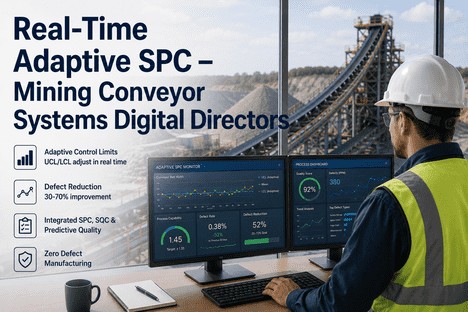
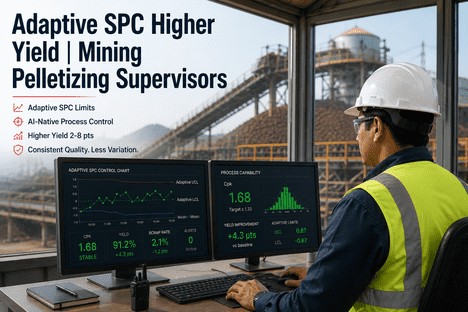
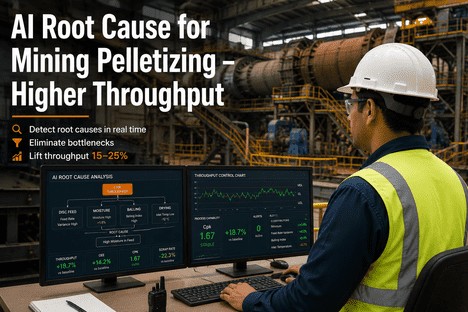
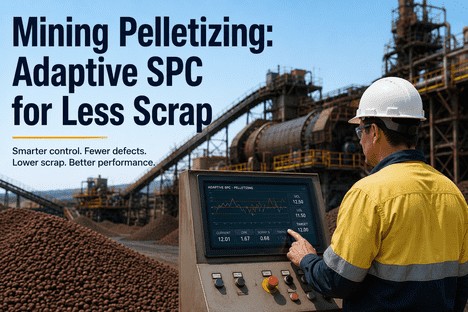
Every plant executive in iron ore pelletizing has heard the same line from the floor: "we're running at capacity." But capacity against what — the rated design throughput, or the throughput the plant is actually achieving after every unplanned slowdown, every recycle loop, every batch held back for re-testing is subtracted? The gap between those two numbers is rarely a feed-rate problem. It is a quality-variability problem wearing a throughput costume. When SPC limits are static, the balling and induration circuits are run conservatively to avoid breaching limits that no longer reflect the real process — and that conservatism is throughput left on the table, every single shift. Adaptive SPC closes that gap by letting control limits move with the process, so the plant can run closer to its true capability without increasing defect risk. This is the throughput case for adaptive SPC, written for the executives who own the production number.
Adaptive UCL/LCL · Western Electric Rules · Root-Cause ML · Throughput Analytics
Plant Executives Lifting Throughput 15-25% Aren't Running Harder — They're Running With Limits That Actually Match the Process.
iFactory's adaptive SPC platform gives mining pelletizing plants self-adjusting UCL/LCL boundaries, automated Western Electric rule detection, and ML-driven root-cause analysis — so production rates can rise without quality risk rising with them.
15-25%
Throughput increase documented when adaptive SPC limits replace static limits in mineral processing plants
50-70%
Reduction in false-alarm SPC alerts when control limits adapt automatically to recipe and material changes
92%
Forecast accuracy of AI-driven SPC models predicting quality and yield deviations up to 24 hours ahead
30-70%
Defect rate reduction across pelletizing, sintering and flotation operations after deploying adaptive control limits
Why "Running Safe" Static Limits Are Quietly Capping Your Throughput
Static control limits are usually set once — during a capability study, with a particular ore blend, a particular binder batch, and a particular recipe in use. From that point on, every operating decision is made relative to those frozen numbers. When the real process drifts (and it always does — new stockpile, new binder source, ambient humidity change, wear on the balling discs), operators don't know whether the drift is benign or dangerous, because the limits never moved to tell them. The safe response is to back off the feed rate, slow the disc speed, or run a wider moisture buffer than necessary — all of which cost throughput. Multiply that conservative buffer across every shift, every grade change, every blend transition, and the cumulative throughput loss becomes the single largest unaccounted variance between rated and actual plant capacity.
Four Places Throughput Disappears Under Static SPC — and What Adaptive Limits Recover
01
Conservative Feed Rate Buffers
Operators run below the design feed rate to leave margin against limits that may already be too tight or too loose for current ore characteristics. That margin is rarely revisited once set, even after months of stable operation prove the process can run tighter.
Adaptive fix: Limits tighten automatically as Cpk improves, signalling when feed rate headroom genuinely exists.
02
Extended Grade-Change Ramp-Down
When switching pellet grades, plants often slow production well before and after the transition because static limits flag the transition itself as a deviation, generating alerts that have nothing to do with actual risk.
Adaptive fix: Grade-change events trigger an automatic limit-set switch, shortening the conservative ramp window.
03
Alert Fatigue Slowing Decisions
When operators face a flood of false alarms during normal blend or binder variation, they hesitate to push throughput even when conditions allow, because they cannot quickly tell a real deviation from background noise.
Adaptive fix: False alarms drop 50-70%, restoring operator confidence to run at higher rates with fewer interruptions.
04
Recycle Load on the Balling Circuit
Oversize and undersize pellets returned to the balling circuit consume capacity that should be producing new, on-spec product — and the volume of recycle is directly tied to how tightly size distribution is controlled in real time.
Adaptive fix: Tighter, current-state limits on size distribution reduce recycle volume, freeing balling capacity for net new output.
How Adaptive SPC Translates Into Throughput — Not Just Quality
Quality and throughput are often treated as competing priorities on the plant floor — push production and risk quality, or protect quality and accept lower output. Adaptive SPC dissolves that trade-off by making the quality envelope itself dynamic. The control limits become a live representation of what the process can currently sustain, rather than a fixed boundary set months ago under different conditions. For a plant executive, this means production targets can be set based on current process capability, not historical caution — and the system continuously tells operators exactly how much headroom exists before that capability is exceeded.
Capability 01
Self-Adjusting UCL/LCL Boundaries
Control limits recalculated continuously from live process data
Rather than fixed UCL/LCL values revisited only during periodic capability studies, the adaptive engine recalculates upper and lower control limits on a rolling basis using current process variable distributions — moisture, disc speed, feed rate, induration temperature zones, and size distribution. When the process is running stable and capable, limits tighten, giving operators a clear, current signal of how much production rate or recipe adjustment is available before risk increases. When a known regime change occurs — ore blend, binder batch, recipe — limits transition to the new baseline within a configurable window, avoiding the long conservative settling period that static systems force on every transition.
Continuous recalculation
Faster regime transitions
Live capability headroom
Capability 02
Automated Western Electric Rule Detection
Pattern-based early warnings against the current baseline
Western Electric rules — runs of points trending in one direction, points clustering near a limit, alternating patterns — are powerful early indicators of process drift, but only when applied against limits that reflect the current process. Applied against stale static limits, these rules generate as much noise as signal. iFactory applies the full rule set continuously against the adaptive baseline, so a run of seven points trending toward a limit means something real — a genuine early warning that lets operators intervene before a control limit is breached and before a production slowdown becomes necessary.
Trend run detection
Near-limit clustering alerts
Early intervention window
Capability 03
ML Root-Cause Analysis Across Process Stages
From symptom to source — automatically, across the full circuit
When a deviation is detected, the ML model traces it back through correlated process variables across balling, induration, and screening to identify which upstream parameter most likely drove the change — rather than leaving operators to manually cross-reference trend charts across three control systems. For an executive, the practical effect is fewer hours lost to diagnostic guesswork per shift, and faster return to target production rate after any deviation, because the cause is identified in minutes rather than hours.
Cross-stage correlation
Faster diagnosis
Quicker return to target rate
COPQ Reduction · Throughput Modelling · Live Capability Dashboards
The Cost of Poor Quality Isn't Just Scrap — It's the Throughput You Never Attempted Because the Limits Said No.
See what adaptive SPC could be worth on your line. iFactory's COPQ reduction assessment models your current recycle rates, alert volumes, and capability margins against an adaptive-limit baseline.
What the Plant Executive Dashboard Shows
For an executive, the value of adaptive SPC has to be visible at a glance — not buried in process engineer tooling. The executive dashboard surfaces the four numbers that matter most to a production-rate conversation: current capability versus rated capacity, recycle volume trend, alert-to-action response time, and the projected throughput gain available at current process stability.
Executive View 01
Capability vs. Rated Capacity, Live
A single gauge comparing current achievable throughput, based on live process capability, against the plant's rated design capacity — updated continuously rather than recalculated only during periodic reviews.
Executive action: When the gap narrows consistently, production targets can be reviewed upward with confidence.
Executive View 02
Recycle Volume Trend by Grade
Tracks oversize and undersize recycle as a percentage of total balling output, segmented by product grade, so the executive can see directly how much of the circuit's capacity is being consumed by rework rather than new production.
Executive action: A falling recycle trend is a direct, quantifiable throughput gain — translatable to tonnes per day.
Executive View 03
Alert Volume and Response Time
Shows total SPC alerts per shift, the proportion confirmed as genuine deviations, and the average time from alert to operator action — the leading indicator of how much alert fatigue is costing the plant in slowed decisions.
Executive action: Falling alert volume with stable or improving Cpk confirms limits are now correctly calibrated.
Executive View 04
Predicted Throughput Gain at Current Stability
Based on current process capability and recent stability trends, the system projects the additional production rate that could be sustained without increasing defect risk — expressed in tonnes per day and as a percentage of rated capacity.
Executive action: This projection becomes the data-backed basis for the next production rate review.
Executive View 05
Transition Time by Grade and Blend Change
Measures the time between a recipe or blend change and the process returning to full-rate stable production — a number that shrinks steadily as the adaptive limit set learns each transition pattern.
Executive action: Shorter transition times mean more productive hours per grade-change shift across the year.
Executive View 06
COPQ Trend — Quarter on Quarter
Combines scrap, recycle, rework labour, and quality-hold lost production into a single cost-of-poor-quality figure, tracked quarter on quarter alongside the throughput gain figures, to connect quality investment directly to financial outcome.
Executive action: COPQ trend becomes the headline metric for the adaptive SPC programme's business case.
"
We had been told for years that our pelletizing line was running at near-rated capacity, and on paper the numbers looked close. What changed when we deployed adaptive limits was the recycle figure — it dropped steadily over the first quarter as the size-distribution limits tightened to reflect what the line was actually capable of holding. That recycle reduction alone freed enough balling capacity that we increased net saleable output by close to 18% without touching the feed rate setpoint on paper. The conversation in our operations review meetings shifted from "can we push the line" to "the data already shows we can, here's the number."
— Plant Operations Executive, Iron Ore Pelletizing Facility — Straight Grate System
Conclusion
For plant executives, the throughput conversation has traditionally been a capital conversation — more equipment, more capacity, more spend. Adaptive SPC reframes it as a data conversation. The capacity that adaptive limits unlock was already present in the process; static limits and the conservative operating habits they create were simply preventing the plant from using it. By letting control limits move with the real process — recalculating continuously, applying Western Electric rules against a current baseline, and tracing deviations to root cause across the full circuit automatically — plants close the gap between rated and actual capacity without new capital investment.
The documented range of 15-25% throughput improvement, alongside 30-70% defect reduction and 50-70% fewer false alarms, reflects what happens when a quality system stops working against production targets and starts actively supporting them. The plants seeing results at the higher end of that range are the ones where the executive team treated adaptive SPC as a production lever from the outset — reviewed the COPQ and capability dashboards as part of regular operations meetings, and used the throughput projections as the basis for setting new production targets rather than waiting for a capital project to justify the change.
iFactory's adaptive SPC platform is built for mining pelletizing operations where the next throughput gain is sitting inside the existing process, waiting for limits that reflect it. Book a Demo to see adaptive limits modelled against your current line data, or talk to an expert to calculate your COPQ reduction ROI.
Frequently Asked Questions
Your Next Throughput Gain Is Already Inside Your Process Data. Calculate Your COPQ Reduction ROI.
iFactory's adaptive SPC platform for mining pelletizing executives — self-adjusting UCL/LCL limits, automated Western Electric rule detection, ML root-cause analysis across process stages, and live capability dashboards built around the metrics that drive production decisions.