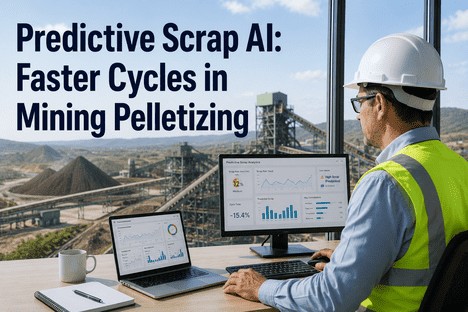
Predictive Scrap AI: Faster Cycles in Mining Pelletizing

By Grace on June 12, 2026

predictive-scrap-analytics-mining-pelletizing-plant-executives-cycle-time-optimization

Every minute lost to an unplanned hold in the balling circuit or induration furnace is a minute the plant cannot get back. For plant executives in iron ore pelletizing, cycle time is the quiet number behind every other number — throughput, energy cost per tonne, labour efficiency, and ultimately, annual production capacity. Most plants treat scrap and cycle time as separate problems, tracked on separate dashboards, owned by separate teams. Predictive Scrap Analytics changes that. By forecasting scrap risk hours before it materialises, it removes the unplanned stops, recycle loops, and rework cycles that quietly stretch every production cycle longer than it needs to be — and the plants using it are documenting 10–20% faster cycle times as a direct result.

Predictive Scrap Analytics · Mining Pelletizing · Cycle Time Optimization · 2026
Scrap isn't just a yield problem. It's the hidden reason your cycle times keep drifting longer.
iFactory's Predictive Scrap Analytics platform gives pelletizing plant executives AI vision inspection, real-time control charts, and machine-learning scrap forecasts — built to flag risk hours before it turns into a production hold.
10–20%
Cycle time reduction documented in pelletizing plants using predictive scrap analytics with real-time AI vision and control charts
4–8 hrs
Typical lead time before a confirmed crush strength or scrap event — enough time to isolate a batch before it disrupts the cycle
30–50%
Reduction in oversize recycle volume — recovering balling circuit capacity that would otherwise loop back through the cycle
50–70%
Fewer false alarms versus static SPC charts, so the operator response that protects cycle time actually happens, every time

Why Cycle Time Drifts Long — Even When Nothing Looks "Broken"

In a pelletizing operation, cycle time isn't set by a single bottleneck machine — it's the cumulative effect of every micro-delay across the balling circuit, induration furnace, and cooling stage. A batch that drifts toward oversize gets screened out and recycled, adding a loop to the circuit. A pellet bed with inconsistent surface integrity forces the furnace to run a longer dwell time at a given temperature to guarantee crush strength. A cluster of fused green balls causes uneven heat distribution, which triggers a manual check and a brief hold while operators confirm the firing profile is still on target.

None of these events show up as a single dramatic stoppage. They show up as a cycle that used to take X minutes now quietly taking X plus a few minutes, shift after shift, until the plant's annual throughput is meaningfully below nameplate capacity — without anyone being able to point to the cause on a maintenance log. Predictive Scrap Analytics exists to make that invisible drift visible, and then to remove it before it happens again.

Three Cycle Time Drains — And How Predictive Scrap Analytics Closes Each One

The Oversize Recycle Loop
When green ball size distribution drifts toward oversize, the roller screen rejects a growing share of material back to the balling circuit. Every recycled tonne re-enters the cycle, consuming disc time and capacity that should be producing new product. Predictive analytics catches the drift while disc speed and moisture can still be adjusted — before the recycle loop forms.

The "Just-In-Case" Dwell Extension
When the quality system can't confirm incoming green ball strength is consistent, operators extend furnace dwell time as insurance against crush strength rejects. That extra dwell, multiplied across every cycle, becomes a permanent cycle time penalty. A forecast that confirms quality hours ahead removes the need for the insurance buffer.

The Manual Verification Hold
A static control chart fires a late or false alarm, and operators pause to manually verify whether the process is actually drifting. Self-tuning limits and AI vision reduce false alarms by 50-70%, so the holds that remain are real — and resolved faster because the system already points to the cause.

How Predictive Scrap Analytics Actually Forecasts Risk

The core of the system is a machine-learning model trained on the plant's own historical production data — process variables from the historian, quality test results from the LIMS, and AI vision inspection data from cameras at the balling discharge and furnace inlet. The model learns the specific combinations of conditions that, in this plant's history, preceded a scrap event: a particular moisture trend paired with a particular surface crack density, occurring during a specific blend transition, for example.

Once trained, the model monitors live data continuously and scores the probability of a scrap event before it occurs — typically with a 4 to 8 hour lead time for crush strength failures. That window is what makes the difference for cycle time. An operator with 4 to 8 hours of notice can isolate the affected batch, adjust a setpoint, or schedule a quality hold during a natural break in the cycle — rather than discovering the problem after the batch has already gone through the furnace and needs to be reworked.


AI Vision: The Early Warning Layer

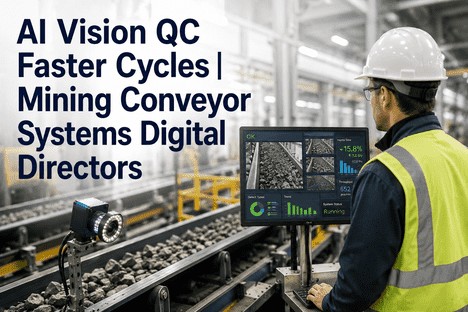
Deep learning cameras at the balling discharge and furnace inlet classify pellet size, shape, surface cracks, and clustering events at line speed. These visual signals often shift before they show up in process sensor data — giving the scrap forecast its earliest possible input and extending the lead time available to act.

Surface crack detection
Continuous size monitoring
Clustering detection
Line-speed inspection

Self-Tuning Control Charts: No More Stale Limits

Every ore blend change and pellet grade transition shifts what "normal" looks like. Static SPC limits, set months ago, generate false alarms during these transitions — the exact moments when a real hold disrupts cycle time most. Self-tuning limits recalibrate automatically with each recipe change, so every alert reflects current conditions.

Auto recipe switching
Live Cpk/Ppk tracking
Blend-aware baselines
Fewer, more trusted alerts
What the Plant Executive Sees on the Cycle Time Dashboard
View A
Live Scrap Risk Score

A continuously updated probability score for the current production batch, broken down by zone — balling, drying, induration. When the score rises, the dashboard shows which visual or process variable is driving it, giving operators a clear, specific starting point rather than a generic warning.

View B
Cycle Time by Shift, by Grade

Actual cycle times segmented by shift and pellet grade, with recycle loops and dwell extensions flagged as separate line items. This is where plant executives can see exactly how much of their cycle time is being consumed by avoidable scrap-driven delays — and track the trend as predictive alerts reduce them.

View C
COPQ Dashboard — Live

Scrap events, recycle tonnage, and dwell-time extensions translated into their cost and capacity-loss equivalents in real time. When avoidable cycle time loss is expressed as lost tonnes per shift, the business case for predictive analytics becomes visible at the executive level without a separate analysis.

We had quietly accepted a longer induration cycle as the cost of running a multi-grade plant. After running the predictive scrap model in shadow mode, we realised most of our holds were happening during blend transitions our old SPC charts simply weren't built for. Once the self-tuning limits and the scrap forecast went live, cycle time on our main line came down by 14% within three months. Nothing about our equipment changed. Only what we could see in advance changed.

— Operations Director, Iron Ore Pelletizing Plant, Multi-Grade Production, 5 Mtpa

The Capacity Case: What 10–20% Faster Cycles Means at Scale

Cycle time and annual capacity are directly linked. A plant running a 5 Mtpa nameplate capacity that recovers even 10% of cycle time through reduced recycle loops, shorter dwell extensions, and fewer manual holds is recovering roughly 500,000 tonnes of equivalent annual capacity — without adding a single piece of equipment. At the upper end of the documented range, 20% faster cycles approach a full additional production day's worth of output every week.

The financial impact compounds because the same forecasting that protects cycle time also reduces the scrap itself — meaning fewer rejected tonnes, less rework, and a lower cost of poor quality baseline. For plant executives building a capital case, the relevant comparison isn't the cost of the platform against a hypothetical efficiency gain. It's the cost against the value of capacity the plant already owns but currently isn't using.

Three Pathways From Scrap Forecasting to Faster Cycles
Pathway A
Fewer Recycle Loops
Catching size distribution drift before oversize peaks reduces recycle rate by 30-50%, freeing balling circuit capacity that was being consumed by material the plant had already processed once.
Pathway B
Shorter Dwell Buffers
With 4-8 hours of forecast confidence on incoming pellet quality, the furnace no longer needs a precautionary dwell extension on every cycle — only on the batches the model actually flags.
Pathway C
Fewer Manual Holds
With 50-70% fewer false alarms, the holds that do occur are real and well-targeted, cutting the time operators spend verifying alerts that turn out to be nothing.

Deployment: From Connection to Live Forecasting

Plant executives evaluating predictive scrap analytics generally ask three things: how long until it's live, what internal effort is required, and how is the forecast validated before operators trust it for production decisions. For a plant with an existing process historian and LIMS, deployment typically takes 6 to 10 weeks from first data connection to live forecasting.

The first phase connects the historian, LIMS, and AI vision cameras, and compiles a baseline dataset — usually 1 to 2 weeks. Model training and control chart configuration follow, typically 3 to 4 weeks, drawing on 6 to 18 months of historical production data paired with quality outcomes. Shadow mode then runs the model alongside existing operations for 2 to 4 weeks, generating forecasts without driving decisions, so the quality and operations teams can validate accuracy before going live. Internal effort is modest — typically 3 to 5 days of engineering time for data mapping, with no change to operator workflows during deployment.

Conclusion

Cycle time in pelletizing isn't lost to one big problem — it's lost in small, recurring increments to recycle loops, precautionary dwell extensions, and manual verification holds, all of which trace back to the same root cause: the quality system can't tell operators what's about to happen, only what already has. Predictive Scrap Analytics closes that gap by giving the plant 4 to 8 hours of forecast lead time, built on AI vision inspection and self-tuning control charts that stay accurate through every blend and grade transition.

For plant executives, the result is 10-20% faster cycles, recovered capacity without new equipment, and a quality system that finally works at the speed the process actually runs. iFactory's platform is purpose-built for pelletizing operations ready to turn that recovered cycle time into measurable output. Book a Demo to see it configured for your production lines, or talk to an expert about a cycle time assessment for your plant.

Frequently Asked Questions

Traditional SPC charts flag a deviation once a variable crosses a fixed limit, after the fact. Predictive scrap analytics combines AI vision inspection with machine-learning models trained on your plant's history to forecast the probability of a scrap event 4 to 8 hours before it happens, and the control limits self-tune to every blend and grade change so alerts stay accurate instead of going stale. The two systems answer different questions: SPC tells you something is already out of range, predictive analytics tells you it's about to be. Talk to an expert about how this layers onto your existing SPC programme.

Cycle time improvement comes from acting on the forecast, not just viewing it. Earlier visibility into oversize drift means fewer recycle loops; earlier confidence in green ball quality means shorter precautionary dwell times; fewer false alarms mean fewer manual verification holds. Each of these directly removes time from the cycle. The reporting is the mechanism that lets operators act early enough for it to matter. Book a Demo to see the live dashboard views that drive these actions.

The platform connects to standard process historians (OSIsoft PI, AVEVA, AspenTech IP.21, OPC-UA) and LIMS systems without requiring upgrades. AI vision cameras are the main new hardware addition, deployed at the balling discharge and furnace inlet, and they supplement existing sensor data rather than replacing it. No changes to operator workflows are needed during deployment. Talk to an expert about the connection options for your plant.

iFactory's COPQ reduction assessment builds a baseline from your plant's current cycle times, recycle rates, scrap rates, and false-alarm frequency, then projects an improvement range based on comparable pelletizing deployments. The output is plant-specific figures for a capital submission, not industry averages. The assessment is offered at no cost as part of an expert consultation. Book a Demo to start your assessment.

Each pellet grade is registered as its own specification profile, with its own control limits and scrap risk baselines. When the line transitions between grades, the active profile switches automatically, so the forecast and control charts stay accurate through the changeover instead of generating false alarms during it — which is typically when cycle time losses are highest. Talk to an expert about multi-grade configuration for your line.

Calculate Your COPQ Reduction ROI — Get a Free Plant-Specific Assessment Based on Your Own Cycle Time and Scrap Data.
iFactory's Predictive Scrap Analytics platform for plant executives in mining pelletizing — AI vision inspection, self-tuning control charts, machine-learning scrap forecasts, and a live cycle time dashboard that shows exactly where your production cycle is being shortened.

Share This Story, Choose Your Platform!