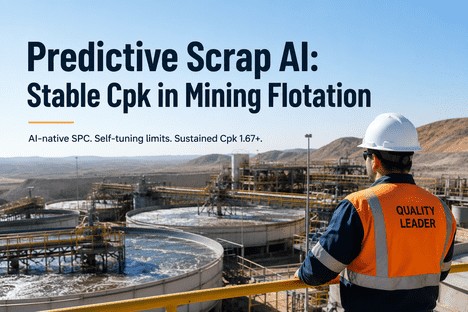
Predictive Scrap AI Software for Mining Pelletizing QA Leaders
By Grace on June 11, 2026
The difference between a quality leader who reacts to scrap and one who prevents it is measured in hours — the hours between when a defect forms at the balling disc and when the screen analysis confirms it, between when the firing zone temperature drifts and when the cold crush strength test returns a below-spec result, between when the cycle time starts stretching and when the shift report reveals that throughput has dropped by 8%. In most pelletizing plants, those hours are lost to a quality workflow that waits for defects to confirm themselves before taking action. The result is a cycle time that is defined not by how fast the process can run, but by how long it takes to discover that something went wrong.
Predictive scrap analytics changes the sequence. Instead of waiting for laboratory confirmation to validate what the process has already produced, machine learning models trained on the relationship between upstream process variables and downstream quality outcomes forecast scrap risk in real time — before the defective pellet is fired, before the oversize material reaches the screen, before the cycle time extension has already cost a hour of production. For quality leaders accountable for both quality and throughput, this is not an analytics dashboard feature. It is the mechanism that compresses the gap between detection and prevention from hours to seconds, and in doing so, compresses the cycle time that determines plant capacity.
ML Scrap Forecasting · Yield Prediction · Cycle Time Compression
Your Quality Lab Confirms Scrap After It Happens. Predictive Scrap Analytics Forecasts It Before It Forms.
iFactory's predictive scrap analytics platform uses machine learning models trained on upstream process variables to forecast scrap risk in real time — compressing detection-to-correction cycle time by 10-20% and shifting quality from reactive confirmation to predictive prevention.
Cycle time compression achieved by shifting from reactive defect confirmation to predictive scrap risk forecasting across the pelletizing process
2-4 hrs
Hours of scrap accumulation avoided per quality event — ML models flag risk at the disc, not at the lab, saving hours of off-spec production
85%+
Scrap event prediction accuracy achieved by ML models trained on upstream process variables — before laboratory confirmation is available
Real-time
Scrap risk scores updated every process cycle — quality leader sees the probability of a defect before the defect exists
Today's Workflow: React and Confirm
1Process deviation occurs at the disc
2Scrap accumulates for 20 min to 4 hrs unnoticed
3Lab confirms the defect after delay
4Operator adjusts — but scrap already produced
Cycle Time = Process Speed + Detection Delay
Predictive Workflow: Forecast and Prevent
1ML model detects risk from upstream variables
2Scrap risk score alerts operator instantly
3Corrective action taken before scrap forms
4Process continues — zero scrap accumulated
Cycle Time = Process Speed Only
The Cycle Time That Quality Leaders Do Not See
Cycle time in pelletizing is conventionally measured from ore feed to finished pellet stockout. But the cycle time that matters for quality leaders is the one that runs from defect generation to defect correction — the hours between when a process parameter drifts outside the optimal window and when the operator adjusts it back. In most pelletizing plants, this quality cycle time is determined not by how fast the process can respond, but by how long it takes the quality system to confirm that a problem exists. Every hour of that detection delay is an hour of scrap production, an hour of energy consumed on material that will be rejected, and an hour of capacity consumed by product that will never ship.
How Detection Delay Inflates Quality Cycle Time in Pelletizing
Oversize at the Balling Disc
Manual sieve analysis every 20-40 minutes. The disc produces oversize from the first minute of drift. Quality cycle time: 20-40 minutes of continuous scrap before detection.
Predictive compression: 20-40 min to instant
Surface Cracking in the Furnace
Cold crush strength test 2-4 hours after sampling. The furnace produces cracked pellets for the entire delay. Quality cycle time: 2-4 hours of unrecoverable scrap.
Predictive compression: 2-4 hrs to seconds
Moisture Drift at the Disc
Moisture measurement every 15-30 minutes. The disc continues producing pellets outside the optimal moisture window between measurements. Quality cycle time: 15-30 minutes per event.
Predictive compression: 15-30 min to real-time
Size Distribution Widening
Fired pellet screen analysis after cooling. The process runs with compromised bed permeability for 1-3 hours. Quality cycle time: 1-3 hours of reduced throughput.
Predictive compression: 1-3 hrs to minutes
How Predictive Scrap Analytics Works in a Pelletizing Process
Predictive scrap analytics uses machine learning models that learn the relationship between upstream process variables — green pellet moisture, balling disc speed, feed particle size distribution, binder addition rate, firing zone temperature profile — and downstream quality outcomes such as fired pellet crush strength, size distribution, and surface quality. Once trained, these models continuously score the current process state against the historical patterns that preceded scrap events. When the model detects that the combination of current process variables resembles the conditions that led to scrap in the past, it generates a scrap risk score and alerts the quality leader before the defect has actually formed. The prediction lead time depends on the variable set — moisture-driven defects can be forecast 20-40 minutes before confirmation, while firing zone drift can be predicted 1-3 hours before the cold crush strength test would return a failure.
The Four Prediction Layers of the Scrap Analytics Engine
Layer 1: Scrap Risk Scoring
A continuous risk score from 0 to 100 for each monitored quality characteristic. Scores above the configured threshold trigger an alert with the contributing variables ranked by influence. The quality leader sees not only that risk is elevated, but which process parameter is driving it.
Layer 2: Yield Prediction
The model forecasts the expected yield for the current production run based on the trajectory of process variables. If the predicted yield is trending below the target, the system alerts the quality leader before the shortfall materialises, enabling proactive intervention rather than end-of-shift disappointment.
Layer 3: Anomaly Detection
Unsupervised models monitor all process variables for combinations that deviate from the normal operating envelope — even combinations that have not previously caused scrap. This catches novel failure modes that the supervised scrap model has not been trained on.
Layer 4: Recommendation Engine
When a scrap risk alert fires, the recommendation engine suggests the corrective action with the highest probability of returning the process to the safe zone — based on which adjustments have been most effective in similar historical situations.
What Cycle Time Compression Means for Plant Capacity
Cycle time compression from predictive scrap analytics does not come from running the process faster. It comes from eliminating the time spent producing material that will be scrapped. When a quality leader can forecast that the current combination of moisture, disc speed, and feed size distribution is trending toward oversize production, the corrective action happens before the oversize is produced — not after 20 minutes of off-spec material has already accumulated. The capacity that was previously consumed producing scrap is converted to producing saleable product. Over the course of a shift, the cumulative effect of eliminating multiple detection-delay windows adds 10-20% to the effective quality cycle time — more saleable tonnes per hour without changing a single process speed setpoint.
Eliminates Rework Loops
When off-spec material is detected at the end of the line, it must be re-screened, re-blended, or downgraded. Each rework cycle extends the effective cycle time for every tonne in the affected batch. Predictive analytics eliminates the rework loop by preventing off-spec production.
Compresses Correction Time
With predictive scrap alerts, the operator receives a recommendation for the specific adjustment needed before the defect forms. The time between deviation detection and correction drops from hours to minutes because the root cause is identified by the model rather than investigated manually.
Increases Effective Capacity
Every tonne of scrap that is prevented represents capacity that is available for saleable production without any increase in feed rate, energy consumption, or equipment utilisation. For a plant operating at 90% OEE, a 5% scrap reduction effectively increases capacity by 4-5% without capital expenditure.
From Reactive Confirmation to Predictive Prevention — What Shifts for the Quality Leader
The shift from reactive to predictive quality changes the quality leader's operating rhythm in three fundamental ways. First, the primary information source changes from laboratory results that arrive hours after the event to a live risk dashboard that updates every process cycle. Second, the decision-making horizon extends from reacting to what has already happened to intervening in what is about to happen. Third, the performance metric shifts from scrap rate reported at the end of the month to cycle time efficiency measured in real time — how quickly the process detects and corrects deviations before they become defects.
Live Risk Visibility
The quality leader monitors a single dashboard that shows scrap risk scores for every quality characteristic, yield predictions for the current production run, and anomaly alerts for emerging conditions that do not match the normal operating envelope. No waiting for lab results.
Proactive Intervention
When a scrap risk score crosses the alert threshold, the quality leader sees not only the elevated risk but the specific process parameter driving it and the recommended corrective action. The intervention happens before the defect forms, not after the scrap report is generated.
Cycle Time as a KPI
The system tracks the time from deviation onset to correction for every quality event. This detection-to-correction cycle time becomes a leading indicator of scrap risk — when cycle time starts extending, scrap is about to increase. The quality leader manages cycle time, not scrap after the fact.
ML Scrap Forecasting · Yield Prediction · Cycle Time Intelligence
Every Hour You Spend Confirming Scrap Is an Hour of Capacity You Cannot Recover. Predictive Analytics Eliminates the Confirmation Delay.
iFactory's predictive scrap analytics platform forecasts scrap risk before defects form, compresses detection-to-correction cycle time by 10-20%, and converts quality from a cost centre to a capacity driver with real-time yield prediction and live risk scoring.
Why Predictive Scrap Analytics Is Becoming a Cycle Time Imperative in 2026
Three pressures are converging to make predictive scrap analytics a cycle time necessity for pelletizing quality leaders. First, customer demand for consistent quality at tighter specifications means that the margin between acceptable and rejectable product is shrinking — the detection delay that was tolerable when specifications were wider now produces scrap at a rate that directly impacts order fulfilment. Second, energy costs have made every tonne of scrap more expensive, which means the economic value of preventing scrap has never been higher. Third, the capacity pressure on pelletizing plants is increasing as steelmakers shift toward direct reduction routes that require higher-quality pellets — plants that can compress cycle time and increase effective capacity without capital expenditure will have a competitive advantage.
Tolerable Window Is Shrinking
As DR-grade pellet specifications tighten, the gap between in-spec and out-of-spec narrows. The detection delays that were acceptable for blast furnace pellets now produce scrap at rates that threaten order fulfilment and customer confidence.
Scrap Cost Is Rising
Each tonne of scrap carries the energy cost of balling, drying, and firing plus the material cost of concentrate and binder. At current energy prices, a 3% scrap rate at a 4 Mtpa plant represents millions in annual losses that predictive analytics can cut by half or more.
Capacity Without Capital
Compressing detection-to-correction cycle time increases effective capacity without adding equipment, energy, or labour. Every tonne of scrap prevented is a tonne of capacity recovered. For plants operating at or near nameplate capacity, this is the most cost-effective capacity expansion available.
Conclusion: Cycle Time Compression Is the Quality Metric That Drives Capacity
The relationship between predictive scrap analytics and cycle time compression in pelletizing is straightforward: every hour of detection delay eliminated is an hour of scrap production avoided, an hour of energy not wasted on reject material, and an hour of capacity recovered for saleable product. The quality leader who shifts from waiting for laboratory confirmation to acting on predictive risk scores compresses the detection-to-correction cycle from hours to minutes — not by running the process faster, but by eliminating the time spent discovering what the machine learning model already knows. The result is a cycle time that reflects the actual speed of the process, not the latency of the quality confirmation system.
For quality leaders who are measured on scrap reduction, cycle time efficiency, and plant capacity utilisation, predictive scrap analytics combined with real-time risk scoring is the system that delivers improvement in all three dimensions from a single data platform. Machine learning models that forecast scrap risk hours before confirmation — using the upstream process variables that are already being measured. Live risk scores and yield predictions that tell the quality leader what is about to happen, not what already did. A recommendation engine that tells the operator which adjustment to make and in which direction. And a closed-loop cycle time metric that tracks detection-to-correction performance as a leading indicator of quality health.
iFactory's predictive scrap analytics platform is built for the pelletizing quality leader — with ML-based scrap forecasting that predicts defects before they form, real-time yield prediction that shows production trajectory during the shift, and cycle time intelligence that converts quality from a cost centre to a capacity driver. Book a Demo to see predictive scrap analytics running on a pelletizing use case matched to your production profile, or talk to an expert about deployment for your plant configuration.
Frequently Asked Questions
The model requires a minimum of three to six months of historical process data that includes both the upstream variable readings and the corresponding downstream quality outcomes. The key requirement is that the data captures multiple scrap events across different operating conditions — ore blend changes, binder batch transitions, and product grade switches — so the model learns the variable combinations that precede scrap in each regime. Data resolution should match the measurement frequency of the process variables: one-minute averages for DCS variables such as temperatures and pressures, and per-sample records for laboratory measurements such as moisture and size distribution. Plants with existing process historians typically have sufficient data available. For plants where historical data is limited or not readily accessible, iFactory deploys a data collection phase before model training — typically two to four weeks of parallel data collection from the DCS and quality lab establishes the initial training dataset. The model improves over time as more production data accumulates. Talk to an expert about data requirements for your plant's historian system.
The distinction comes from the training data. The model is trained on historical data where the outcome is known — each set of process variable readings is labelled with the corresponding quality result. The model learns to identify which combinations of variable values and trajectories historically preceded scrap events versus which combinations were associated with on-spec production. A moisture reading of 9.8% at the disc is normal variation if the feed size distribution and binder rate are within their optimal ranges. The same moisture reading combined with a shifted particle size distribution and elevated disc speed may be a high-risk combination that the model has learned precedes oversize production. The model outputs a continuous risk score, not a binary alarm — the quality leader sets the threshold that defines actionable risk based on their tolerance for false positives versus missed detections. The threshold is configurable and can be adjusted per quality characteristic and per product grade. Book a Demo to see how the risk scoring thresholds are configured and validated.
The model uses an adaptive learning architecture that continuously incorporates new production data into its training set. When an ore blend or product grade change is logged, the system flags the transition and begins collecting data from the new regime. The model does not require a full retraining cycle for every transition — it maintains a rolling training window that includes data from the current and recent regimes, weighted toward the most recent data. For significant process changes such as a new ore source or a different product grade, the system accelerates data collection in the new regime and automatically adjusts the model weighting within hours of the transition being logged. The quality leader receives a notification that the model is adapting to the new regime and can monitor the prediction accuracy during the transition window. Full model validation against the new regime is typically confirmed within two to four weeks of steady production under the new conditions. Talk to an expert about adaptive model configuration for multi-grade production environments.
Detection-to-correction cycle time is calculated from two timestamps: the time when the predictive model first identified the scrap risk above the configured threshold, and the time when the corrective action was taken and the risk score returned below the threshold. The system tracks this interval for every scrap risk event and reports the average, median, and trend for each shift. As a leading indicator, cycle time trend predicts scrap rate with a lead time that depends on the process characteristic — for oversize production at the disc, cycle time trend predicts scrap rate 20 to 40 minutes before the scrap is confirmed by screen analysis. For fired pellet quality, the lead time is two to four hours. When the quality leader sees cycle time extending, they know scrap rate will increase if the trend is not reversed. This enables intervention before scrap increases, rather than investigation after the fact. The system also tracks the cycle time components: detection latency, diagnosis time, and correction implementation time — so the quality leader knows which stage of the cycle needs improvement. Book a Demo to see the cycle time dashboard and trend analysis demonstrated for a pelletizing use case.
The system integrates with existing plant systems through standard connectivity protocols. For DCS and SCADA data, the platform ingests process variable readings via OPC-UA, REST API, or direct database connection to the process historian — compatible with ABB, Siemens, Rockwell, Emerson, and other major DCS platforms. For laboratory data, the system connects to LIMS via REST API, flat file exchange, or manual entry. For MES integration, the platform supports REST API and database-level connectivity. The system does not require a separate parallel data infrastructure — it connects to the data sources that already exist in the plant. The deployment assessment maps the available data sources and defines the integration architecture before any hardware or software installation. For plants where direct connectivity requires IT procurement lead time, the system supports a phased approach starting with manual data entry or spreadsheet import for the initial model training and validation period. Talk to an expert about integration architecture for your plant's existing systems.
The deployment follows a phased timeline. Phase one is data integration and model training: two to four weeks to connect to the DCS historian and LIMS, extract the relevant process variable and quality data, train the initial predictive models, and validate the prediction accuracy against historical scrap events. Phase two is model validation and threshold calibration: two to four weeks of parallel operation where the model predictions run alongside existing quality control processes, and the quality leader calibrates the risk score thresholds and validates the prediction accuracy against live production outcomes. Phase three is go-live: the quality leader begins using the predictive scrap risk scores as the primary decision-support tool for process adjustments. Initial cycle time improvements are typically visible within the first month of go-live, with full cycle time compression of 10-20% achieved within three to six months as the model accumulates more production data and the quality team builds confidence in the predictive alerts. Book a Demo to discuss a deployment timeline specific to your plant configuration and data availability.
Your Quality Lab Confirms Scrap After It Happens. Predictive Analytics Forecasts It Before It Forms. The Difference Is 10-20% More Capacity from the Same Process.
iFactory's predictive scrap analytics platform for mining pelletizing quality leaders — ML-based scrap risk forecasting, real-time yield prediction, and detection-to-correction cycle time intelligence that converts quality from a cost centre to a capacity driver. Schedule a personalised walkthrough on your production line data.