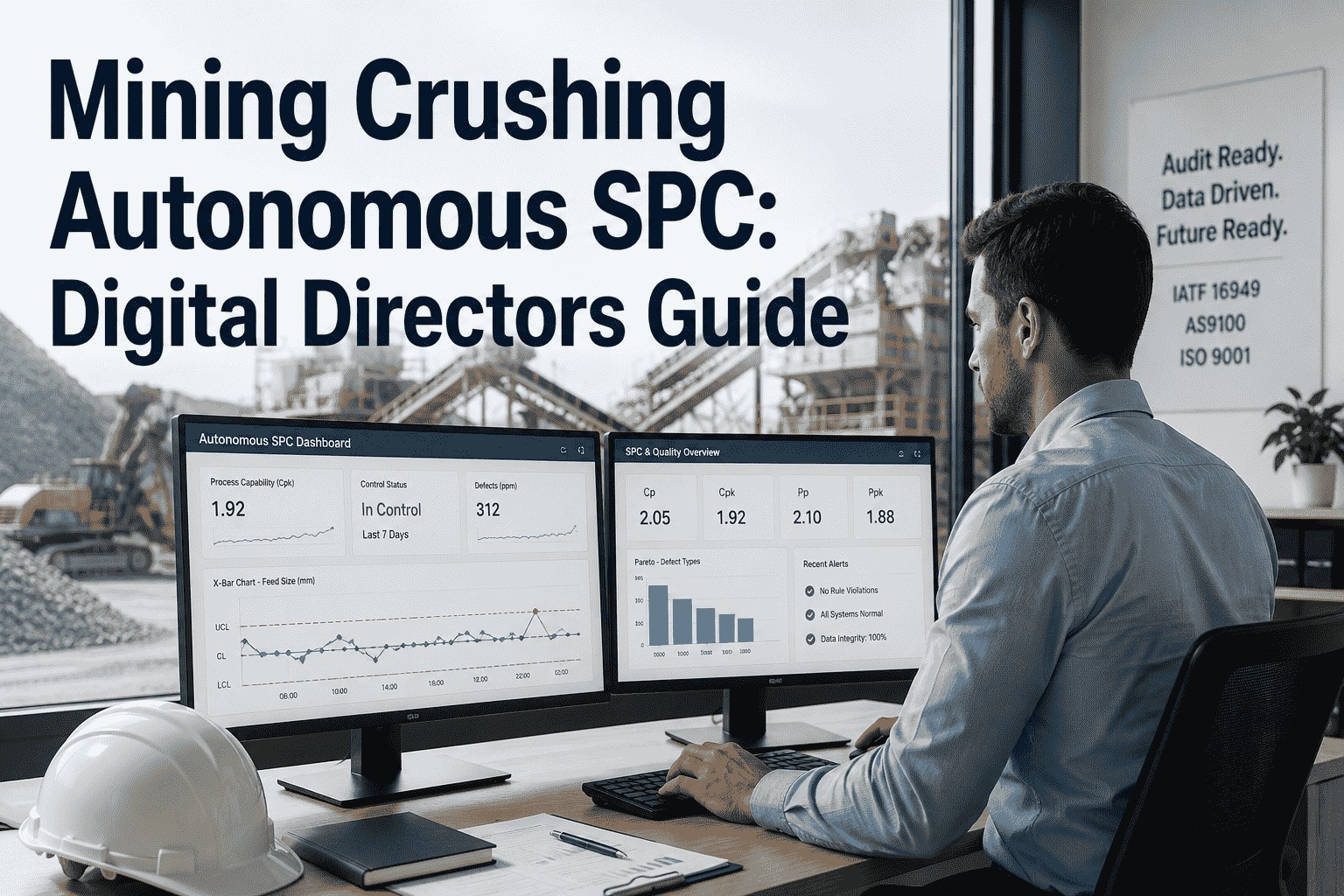
Mining Crushing Autonomous SPC: Digital Directors Guide
By Grace on June 8, 2026
The quality manager's phone rings on the first Monday of every quarter. The auditor is arriving in three weeks. What follows is a controlled scramble: pull SPC charts, verify control limit calculations, collect Cpk reports for every critical characteristic, confirm that every out-of-control event has a corrective action record attached, and assemble the evidence trail that proves the process was under statistical control for the full audit period. That scramble consumes two to three weeks of engineering time every quarter — and still produces a binder of documentation with a 30 to 40 percent probability of a gap that triggers a non-conformance. The gap is rarely a quality failure. It is almost always a documentation gap: an out-of-control event that was corrected but not recorded, a control limit that was recalculated but not approved, a Cpk value that was reported but not trended. For digital manufacturing directors accountable for both plant performance and certification integrity, this cycle is the single largest drain on quality engineering productivity. Autonomous SPC eliminates it entirely by running Western Electric rules continuously, generating audit-ready control charts and capability reports in real time, and maintaining a tamper-proof audit trail of every out-of-control event, corrective action, and control limit change. Audit preparation transforms from a quarterly fire drill into a continuously verified state of readiness that produces every required document on demand.
Eliminate the Audit Scramble with Autonomous SPC
See an IATF-Ready Audit Trail Generated from Your Crushing Data
The Audit Readiness Gap: It Is Not Quality. It Is Documentation.
The crushing circuit runs under statistical control for 90 percent of the audit period. The operators adjust feed rate when ore hardness changes, replace liners on schedule, and maintain Cpk above 1.33 across the majority of production windows. The non-conformance does not come from poor quality. It comes from a Western Electric rule violation that was corrected on shift but the corrective action was not logged with enough detail. It comes from a control limit that the quality engineer recalculated after a recipe change but the approval record was not filed. It comes from a Cpk report that covers the audit period but does not show the trend line the auditor needs to confirm stability.
The cost of this gap is measurable. Two to three weeks of engineering time per quarter spent on audit preparation. A 30 to 40 percent probability of at least one non-conformance finding per audit cycle. Recurring findings that eat management review time and create corrective action loops. For the digital manufacturing director, the root cause is not a quality system failure. It is the structural gap between SPC as a monitoring tool and SPC as a documentation system. The process generates the data continuously. But turning that data into audit-ready evidence is a manual workflow that runs in batches — quarterly, under pressure, and with incomplete traceability. Autonomous SPC closes this gap by making audit documentation a continuous by-product of process monitoring rather than a periodic manual compilation.
The Four Capabilities That Make SPC Autonomous and Audit-Ready
Autonomous SPC is not SPC with a faster update rate. It replaces the manual quality engineer layer between the data and the documentation with automated rule engines that continuously monitor, detect, log, and produce evidence — without human intervention for routine operation. Four integrated capabilities deliver this outcome for digital manufacturing directors managing crushing circuit quality.
01 Continuous Western Electric Rule Detection
All four standard Western Electric rules run on every control chart continuously. Rule 1 detects single points beyond 3-sigma limits. Rule 2 catches two of three points beyond 2-sigma. Rule 3 identifies four of five beyond 1-sigma. Rule 4 flags eight consecutive points on the same side. Custom Nelson rules and rule parameter configurations are supported per chart and per characteristic. Every rule violation generates an automatic event record with the triggered rule, contributing data points, and timestamp.
02 Live Capability Index Tracking
Cpk, Cp, Pp, and Ppk calculated and trended continuously for every critical characteristic — not computed at month-end for the audit package. The system tracks Cpk against the industry-standard threshold of 1.33 and flags divergence between short-term Cpk and long-term Ppk as the earliest indicator of liner wear or feed variability drift. Compliance evidence includes the full calculation history, not a snapshot.
03 Automated Out-of-Control Event Lifecycle
When a rule violation occurs, the system generates a structured event record: rule triggered, control chart, variable, contributing data points, timestamp, and current process state. The event routes to the assigned quality engineer or operator for corrective action. The corrective action is documented in a standardised format linked to the specific event, including root cause analysis, action taken, responsible person, and closure verification. Every event is stored in the audit trail with full traceability.
04 On-Demand Audit Documentation
When an auditor requests evidence of process control for any date range, the system produces a complete package within minutes: control charts with rule violation annotations, Cpk trend graphs with calculation history, corrective action records with timestamps and closure verification, and control limit change history with approval documentation. No manual compilation. No document search. No missing records. Audit preparation time drops from weeks to zero.
Compliance Standards That Autonomous SPC Satisfies Out of the Box
Autonomous SPC is not designed for a single standard. It delivers documented evidence of statistical process control that satisfies the core requirements of every major quality management system. The table below maps each standard's SPC-related requirements to the autonomous SPC capability that fulfils them.
Standard
SPC Requirement
Autonomous SPC Capability
ISO 9001:2015
Monitored and measured processes. Documented evidence of process control and corrective action.
Continuous control charting. Real-time rule detection. Automated corrective action records.
IATF 16949:2016
Statistical methods including control charts and capability studies. Cpk >= 1.33 for CTQ characteristics.
Western Electric rules. Live Cpk/Cp/Ppk tracking. Automated event lifecycle and audit trail.
AS9100D / IA9100
Configuration-managed SPC. Statistical verification with full traceability and approval records.
Immutable audit trail. Control limit version history. Approval documentation per change.
FDA 21 CFR Part 11
Electronic records with audit trail, timestamps, and e-signatures for corrective actions.
From Manual SPC to Autonomous: The Audit Readiness Maturity Model
The transition to autonomous SPC follows a structured maturity path. Each stage reduces audit preparation time and non-conformance risk while improving the quality of process control evidence available to the digital manufacturing director.
Level 1 Manual
Standard SPC with manual chart review and audit prep
Quality engineer configures charts, reviews for rule violations, calculates Cpk per batch, and assembles audit documentation manually. Audit preparation: 2-3 weeks per quarter. Non-conformance risk: 30-40%.
Level 2 Monitored
Automated rule detection with manual corrective action logging
Western Electric rules run automatically and generate alerts. Corrective actions logged manually. Charts auto-generated. Audit preparation: 2-4 days. Non-conformance risk: 15-20%.
Level 3 Automated
Full autonomous SPC with automated event lifecycle and audit trail
Rules run continuously. Events logged with corrective actions automatically. Cpk tracked live. Audit documentation generated on demand. Audit preparation: 2-4 hours. Non-conformance risk: 5-10%.
Level 4 Predictive
Autonomous SPC with predictive alerting and full digital audit readiness
Predictive alerts fire before Cpk degrades. Real-time Cpk trending across all characteristics. Tamper-proof audit trail. Any request fulfilled in minutes. Audit preparation: zero. Non-conformance risk: below 2%.
What Autonomous SPC Changes for the Digital Manufacturing Director
For the digital manufacturing director accountable for both plant performance and certification integrity, autonomous SPC changes three things that directly affect the metrics that matter. First, audit preparation shifts from a quarterly project consuming engineering time to a continuous state that produces every required document on demand. Second, non-conformance risk drops from a recurring probability to a controlled variable — below 2 percent at full maturity. Third, the quality engineering team reallocates effort from documentation assembly to process improvement, because the documentation system runs itself. The director sees a live dashboard showing the audit readiness state of every monitored characteristic across every crushing circuit, with non-conformance risk trending visible in the same view as Cpk and defect rate.
Audit Preparation Time
Before: 2-3 weeks per quarter of engineering time spent pulling charts, verifying limits, and assembling binders. After: zero. Any auditor request for any date range produces a complete documentation package within minutes.
Non-Conformance Risk
Before: 30-40% probability of at least one finding per audit cycle, typically a documentation gap rather than a quality failure. After: below 2% at full autonomous SPC maturity, with every event, action, and limit change documented.
Quality Engineering Productivity
Before: engineering team spends 50-60% of quarterly quality cycle on documentation and audit prep. After: team shifts to process improvement, root cause analysis, and system optimisation — the work that actually improves Cpk.
Audit Trail Integrity
Before: manual logs, spreadsheets, and email trails that require auditor cross-referencing and trust. After: tamper-proof audit trail with time-stamped e-signatures, role-based access, and complete traceability from detection to closure.
Before autonomous SPC, our quarterly IATF 16949 surveillance audits consumed two full weeks of our quality engineering team's time. We would print control charts, verify Cpk calculations manually, cross-check corrective action records against event logs, and assemble evidence binders that the auditor would spend two days reviewing. We passed every audit, but the cost in engineering hours was enormous. After deploying autonomous SPC, the first audit was a different experience entirely. When the auditor requested evidence of process control for the previous quarter, we opened the dashboard, selected the date range, and exported the complete package in under 10 minutes. The auditor spent the rest of the time reviewing our continuous improvement initiatives instead of verifying documentation. The engineering hours we saved in that single audit cycle exceeded the deployment cost.
— Digital Manufacturing Director, Copper Concentrator Operation, Peru
Your Next Audit Should Confirm Quality, Not Test Your Documentation System. Autonomous SPC Makes Preparation Zero.
iFactory Autonomous SPC delivers continuous Western Electric rule detection, live Cpk tracking, and a tamper-proof audit trail that satisfies ISO 9001, IATF 16949, and AS9100 requirements — with audit documentation generated on demand, not assembled under pressure.
Deployment: From Data Connection to Continuous Audit Readiness
Deploying autonomous SPC on a crushing circuit does not require replacing the DCS, adding instrumentation, or retraining quality engineers. The system ingests data from existing historians via OPC-UA, Modbus TCP, and direct exports from OSIsoft PI, Wonderware, and ABB 800xA. The first control charts with Western Electric rule detection are typically live within one to two weeks of data connectivity.
Week 1-2
Data integration and chart configuration
Connect to DCS historian. Configure control charts for all critical crushing parameters — PSD, feed rate, power draw, CSS, liner wear, bearing temperatures. Establish initial control baselines.
Week 3
Western Electric rule configuration and validation
Configure rule parameters per characteristic. Run system in validation mode against historical data to verify detection accuracy. Adjust sigma multipliers and test window sizes.
Week 4-6
Shadow-mode parallel run
System generates events and audit trail in shadow mode without operator visibility. Rule detection accuracy and documentation completeness verified against manual review. Ready for active deployment.
Week 7+
Active deployment and continuous audit readiness
Autonomous SPC live with operator-visible alerts and full audit trail. Digital manufacturing director dashboard active. System can produce complete audit documentation for any date range on demand. Additional process areas added every 2-3 weeks.
Conclusion
The digital manufacturing director who eliminates the audit scramble is not the one with the largest quality engineering team. It is the one whose SPC system generates audit-ready documentation as a continuous by-product of process monitoring rather than a quarterly manual compilation. Autonomous SPC makes this possible by replacing the manual quality engineer layer between the process data and the audit evidence with automated rule engines that run Western Electric rules continuously, track Cpk in real time, log every out-of-control event with corrective action records, and produce complete audit packages on demand for any date range.
The result is audit preparation time that drops from weeks to zero, non-conformance risk that falls from 30-40 percent to below 2 percent, and quality engineering teams that spend their time on process improvement instead of document assembly. For the crushing circuit that operates 24 hours a day across multiple ore blends and liner wear cycles, autonomous SPC is the difference between hoping the documentation is complete and knowing it is.
iFactory's Autonomous SPC platform is purpose-built for mining crushing operations — connecting to your existing DCS and historian to deploy continuous Western Electric rule detection, live capability index tracking, automated event lifecycle management, and on-demand audit documentation that satisfies ISO 9001, IATF 16949, AS9100, and FDA Part 11 requirements. Book a Demo to see an audit-ready documentation package generated from your crushing circuit data, or Talk to an Expert to schedule a deployment assessment for your operation.
Frequently Asked Questions
Standard SPC software requires a quality engineer to configure control limits, select chart types, manually review charts for out-of-control signals, calculate capability indices, and prepare documentation for audits. The quality engineer is the decision-making layer between the data and the action. Autonomous SPC replaces this manual layer with automated rule engines that continuously run Western Electric rules on every control chart, generate alerts when rules are violated, log events with corrective action records automatically, and produce audit-ready documentation on demand. The quality engineer shifts from a manual operator of SPC software to a supervisor of the autonomous system, reviewing exceptions and approving corrective actions rather than generating charts and reports manually. For auditors, the difference is visible in the completeness and traceability of the evidence trail — autonomous SPC leaves no gap between the event and the documentation. Book a Demo to see both approaches compared using your crushing circuit data.
Yes. IATF 16949 explicitly requires the use of appropriate statistical methods including control charts and capability studies. Autonomous SPC with Western Electric rules directly meets the standard requirement for identifying process variation, taking corrective action, and maintaining documented information as evidence. The system supports Cpk calculation against the IATF-specified threshold of 1.33 for critical-to-quality characteristics, continuous capability trending, and documented out-of-control event response. The audit trail includes every control limit change, every rule violation, and every corrective action with timestamps and electronic signatures — satisfying the standard's documentation requirements without manual compilation. The system is pre-configured with rule templates that match IATF 16949 expectations and can be mapped to your specific customer-specific requirements. Talk to an Expert to discuss IATF 16949 compliance mapping for your crushing operation.
When an auditor requests evidence of process control for any date range, the system produces a complete documentation package within minutes. The package includes: control charts for every monitored characteristic with Western Electric rule violation annotations marked directly on the charts, Cpk trend graphs showing capability history across the full audit period with calculation data, a complete out-of-control event log listing every rule violation with the triggered rule, contributing data points, timestamp, and process state at the time of detection, corrective action records linked to each event with root cause analysis, action taken, responsible person, and closure verification, and control limit change history showing every limit modification with approval documentation, version history, and effective date range. Every record in the package carries time-stamped electronic signatures and is exportable in PDF and structured data formats for direct submission to the auditor. The complete package for a three-month audit period across 20 monitored characteristics is typically generated in under 10 minutes. Book a Demo to see a complete audit documentation package generated from live crushing circuit data.
When a Western Electric rule is violated, autonomous SPC generates an out-of-control event record that includes the rule that was triggered, the control chart and variable involved, the data points that caused the violation, the timestamp of detection, and the current process state. The system then routes the event to the assigned quality engineer or control room operator for corrective action. The corrective action is documented in a standardised format that links back to the specific out-of-control event, including the root cause analysis, the corrective action taken, the person responsible, and the closure verification. All events and corrective actions are stored in the immutable audit trail with full traceability. When an auditor requests evidence of how out-of-control events were handled, the system produces a complete report showing every event for the audit period, the corrective action taken for each, and the verification that the process returned to control. The entire lifecycle from detection to closure is documented without manual data entry. Talk to an Expert to see the out-of-control event lifecycle demonstrated on your crushing circuit.
Yes. Autonomous SPC is designed as an intelligence layer on top of your existing infrastructure. The system connects to standard industrial historians via OPC-UA, Modbus TCP, REST API, and direct exports from OSIsoft PI, AspenTech IP.21, Inductive Automation Ignition, Wonderware, ABB 800xA, and standard SQL-based process data stores. No DCS replacement, no MES migration, and no additional instrumentation is required to begin. The autonomous SPC engine runs alongside your existing control systems and quality management platforms, adding the self-tuning control charts, Western Electric rule detection, event lifecycle management, and audit documentation capabilities without disrupting current operations. Integration with existing SAP, MES, or EQMS platforms for corrective action workflow and documentation storage is supported through standard APIs. The first control charts are typically live within one to two weeks of data connectivity. Talk to an Expert to confirm connectivity for your specific DCS platform and confirm your deployment timeline.
The Auditor Is Not Testing Your Quality. The Auditor Is Testing Your Documentation System. Autonomous SPC Makes Both Pass Every Time.
iFactory Autonomous SPC for mining crushing operations — self-tuning control charts, continuous Western Electric rule detection, live Cpk tracking, and a tamper-proof audit trail that satisfies ISO 9001, IATF 16949, and AS9100. Purpose-built for digital manufacturing directors.