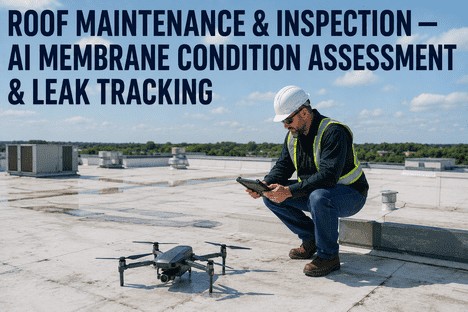
A commercial roof is the single largest deferred maintenance expense most building owners will face — and the most neglected. It sits out of sight, out of mind, until the first water stain appears on a ceiling tile, and by then the damage has been accumulating for weeks or months. The global commercial roof maintenance services market reached $15.8 billion in 2025 and is projected to grow to $25 billion by 2035, driven by a simple economic reality: proactive maintenance costs $0.05 to $0.15 per square foot annually, while reactive repair costs $0.25 or more — and an emergency roof replacement triggered by catastrophic failure costs 15 to 30 percent more than a planned replacement. Human roof inspections miss approximately 50 percent of critical issues, from micro-cracks in membrane seams to subsurface moisture intrusion that has already begun degrading insulation and structural decking. The water that enters through an undetected membrane puncture does not just stain ceilings — it saturates insulation, corrodes metal decking, feeds mould growth, and can compromise the structural integrity of the building, with remediation costs that dwarf the roof repair itself. iFactory's AI-powered roof maintenance and inspection module was built to close this detection gap — combining drone-based thermal imaging, AI membrane condition assessment, and automated leak tracking into a single platform that delivers the visibility that every commercial roof needs but rarely receives.
The Leak You Cannot See Today Will Cost Ten Times More Tomorrow. iFactory's AI Finds It Before the Water Does.
AI-powered drone-based thermal inspection, automated membrane condition assessment, moisture intrusion detection, and leak tracking — all in a single platform designed for maintenance managers protecting their building's largest asset.
Projected to reach $25B by 2035 at 4.6% CAGR — driven by AI-powered inspection, drone thermography, and predictive maintenance adoption
50%
Critical Issues Missed by Human Inspection
Gecko Robotics reported that traditional visual inspections miss approximately half of all critical roof defects — micro-cracks, membrane degradation, and early moisture intrusion invisible to the naked eye
94%
AI Defect Detection Accuracy
Machine learning models trained on millions of roof images achieve automated defect categorisation accuracy exceeding 94% — with temperature resolution below 0.1 degrees Celsius for moisture detection
$0.14
Proactive Maintenance Cost Per Sq Ft
A 15-year Firestone and Prologis study found proactive roof maintenance costs $0.14/sq ft annually versus $0.25/sq ft for reactive repairs — a 44% savings before counting avoided interior damage
Why Roofs Fail — and Why Most Building Owners Do Not Know Until It Is Too Late
01
Undetected Membrane Damage
A single puncture in a TPO or EPDM membrane, a cracked seam at a flashing joint, or a split in a modified bitumen surface can allow water to enter the roof assembly without any visible sign on the interior ceiling for weeks or months. By the time water appears inside the building, the insulation may be saturated, the metal deck may be corroding, and mould may have begun spreading through the affected area. The repair cost at this stage includes not just the membrane patch but also insulation replacement, deck repair, interior finish restoration, and mould remediation — multiplying the original repair cost by a factor of five to ten. AI-powered drone thermography detects these failures at the membrane level, before water migration causes interior damage, by identifying the temperature differentials that indicate subsurface moisture as small as 0.1 degrees Celsius above the surrounding dry area.
02
Drainage & Ponding Water Damage
Clogged drains, settled roof sections, and inadequate slope create ponding water that accelerates membrane degradation through prolonged UV exposure, freeze-thaw cycles, and biological growth. Standing water that remains for more than 48 hours after a rain event increases the leak risk in that zone by approximately 300 percent. Most facility teams do not know which roof zones have persistent ponding because they cannot inspect the roof after every rain event. AI-powered drone surveys with 3D mapping and elevation analysis identify low spots, drain blockages, and ponding zones automatically — enabling targeted drain clearing and corrective action before ponding causes membrane failure. Drone-based inspections reduce roof survey time by 60 to 75 percent compared to manual walking inspections, making frequent post-storm assessments practical for the first time.
03
Flashing & Penetration Seal Failure
Roof penetrations — HVAC curbs, skylights, vent pipes, conduit supports, and solar panel mounts — account for the majority of commercial roof leak sources. The seals around these penetrations degrade faster than the field membrane due to thermal cycling, UV exposure, and mechanical stress from equipment vibration. A failed curb seal on an HVAC unit can allow water to track along the ductwork and appear as a leak dozens of feet from the actual entry point, sending maintenance teams on time-consuming leak-chasing exercises. AI-powered anomaly detection applied to high-resolution thermal and RGB imagery identifies seal degradation at penetrations with precision that eliminates the guesswork from leak source identification, reducing mean time to repair by 50 to 70 percent.
How AI Transforms Roof Inspection — From Walk-and-Guess to Data-Driven Condition Assessment
Traditional roof inspection relies on a technician walking the roof surface, visually examining membrane condition, and documenting findings with handwritten notes and smartphone photos. The process is slow, subjective, and inherently dangerous — falls from roofs account for a significant percentage of workplace fatalities in the construction and maintenance sector. AI-powered roof inspection replaces this analogue process with a systematic data collection and analysis pipeline that produces objective, measurable, and comparable condition assessments for every square foot of roof surface.
Traditional
Manual Visual Inspection
Technician walks the roof, visually examines membrane, flashings, and penetrations. Documents findings on paper or tablet. Subjective assessment varies by inspector experience. Safety risk from roof falls. Typical inspection rate of 10,000 to 15,000 square feet per hour. Limited to visible surface defects — subsurface moisture, insulation degradation, and early membrane delamination are invisible. Studies show that 50 percent of critical defects are missed in manual inspections, and the time between inspection cycles — typically six to twelve months — allows minor issues to become major failures before the next walk.
AI-Powered
iFactory AI Drone Inspection
Autonomous drone flight with high-resolution RGB and thermal imaging sensors captures the entire roof surface at 48+ megapixel resolution and 0.1 degrees Celsius thermal sensitivity. A 50,000-square-foot commercial roof is scanned in under two hours with zero safety risk. AI models trained on millions of roof images automatically classify membrane defects, flashing degradation, ponding zones, and moisture anomalies with 94 percent accuracy. Geo-referenced orthomosaics and defect maps are delivered within 24 hours, with each defect tagged by type, severity score, and precise GPS location for targeted repair deployment. Inspection cost drops from $800 to $1,500 for manual to $300 to $500 for drone-based with AI analysis.
The operational impact of this transition is measurable across every dimension that matters to maintenance managers: inspection time reduced by 60 to 75 percent, defect detection accuracy improved from approximately 50 percent to over 94 percent, safety risk eliminated by removing personnel from roof-edge work, and inspection frequency increased from semi-annual to quarterly or monthly without additional labour cost — because the drone flight plus AI analysis costs less than one manual inspection cycle.
AI Membrane Assessment · Thermal Moisture Detection · Automated Leak Tracking · Roof Life Extension
Every Commercial Roof Tells a Story About Its Condition. iFactory's AI Reads It — Before the Leak Writes the Ending.
AI-driven drone thermography, automated membrane defect classification, moisture intrusion mapping, and predictive leak tracking — delivering the roof condition visibility that maintenance managers need to extend asset life and prevent interior damage.
What iFactory's AI Roof Maintenance Module Actually Does
iFactory is not a drone service that delivers PDF inspection reports. It is a complete roof asset management platform that integrates drone-based data collection, AI condition assessment, moisture tracking, leak history management, and maintenance planning into a single system designed for maintenance managers responsible for protecting their building's largest capital asset.
AI Membrane Condition Assessment
AI analysis of high-resolution RGB and thermal imagery identifies membrane defects including punctures, seam splits, blistering, shrinkage, and delamination — with defect type classification, severity scoring, and GPS location tagging. Condition trends are tracked over successive inspection cycles, enabling maintenance managers to quantify deterioration rates and predict when membrane replacement will be needed rather than discovering failure through an interior leak.
Thermal imaging sensors detect temperature differentials as small as 0.1 degrees Celsius across the roof surface, identifying subsurface moisture pockets, saturated insulation, and thermal bridging that indicate insulation failure. Each moisture anomaly is mapped against the roof's GPS coordinate grid and assigned a risk score based on size, temperature differential, and proximity to interior areas with moisture-sensitive equipment or finishes.
Every leak event — detected through thermal anomaly scanning or reported through interior water intrusion — is logged with date, location, suspected source, repair action, and post-repair verification status. The leak history database enables maintenance managers to identify recurring failure zones, evaluate repair effectiveness, and build the data set needed for capital planning and roof replacement timing decisions. Leak tracking integrated with thermal scanning means that a repair claimed by a contractor can be verified through a follow-up thermal scan that confirms moisture levels have returned to dry baseline.
Leak Event LoggingRepair Verification ScanningCapital Planning Data
Condition-Based Maintenance Scheduling
Rather than relying on a fixed semi-annual inspection calendar, iFactory recommends inspection frequency based on actual roof condition, age, weather exposure, and historical defect rate. A roof in good condition with low defect density may need only an annual thermal scan. A roof approaching the end of its expected service life with moderate defect density may require quarterly monitoring. The condition-based scheduling engine optimises inspection resource allocation across a portfolio of roofs, ensuring that maintenance budget is directed toward the roofs that need it most rather than spread evenly across all assets regardless of condition.
The Financial Case — What Roof Maintenance Data Reveals About the Cost of Waiting
Reactive Approach
$0.25/sq ft
Annual reactive maintenance cost based on the Firestone-Prologis 15-year study. Emergency call-outs, after-hours repair premiums, and interior damage remediation add costs that are not captured in the direct roof repair expense.
iFactory AI-Powered Proactive
$0.14/sq ft
Annual proactive maintenance with AI-driven inspection, early defect detection, and condition-based scheduling. Includes drone thermal scans, AI analysis, and targeted repairs — total cost including the inspection programme.
Reactive
$160K emergency
Emergency roof replacement cost for a 20,000 sq ft building triggered by catastrophic failure. Includes 15-30% premium for expedited mobilisation, overtime labour, and emergency material procurement with no time for competitive bidding.
AI Proactive
$112-136K planned
Planned roof replacement for the same 20,000 sq ft building with competitive bidding, scheduled timing, and no interior damage remediation. AI condition data provides 3 to 5 years of advance notice for capital budget planning.
Reactive
50% missed defects
Human visual inspections miss approximately half of all critical roof defects. Undetected membrane punctures and moisture intrusion continue to degrade the roof assembly between inspection cycles, accelerating replacement timing.
AI Proactive
94% detection rate
AI-powered thermal and RGB analysis detects defects with 94% accuracy. Subsurface moisture identified before interior damage occurs. Condition trends tracked over time, enabling predictive lifecycle management and extended roof service life by 5 to 10 years.
We manage a campus of seven buildings with a combined roof area of over 300,000 square feet. Before iFactory, we were doing manual roof inspections twice a year, and we still had leaks. The inspectors would walk the roofs, note what they could see, and produce a report with a few photos and a paragraph of general observations. We had no way to track whether a repair was actually effective, no way to compare conditions between buildings on the same campus, and no data to support our capital budget requests for roof replacement. The first iFactory drone thermal scan found eleven moisture anomalies across three roofs that the manual inspection had missed entirely. One of them was a saturated insulation section below a failed HVAC curb seal that had been leaking for an estimated eight months — the water had tracked along the ductwork and was appearing as a ceiling stain in a corridor 40 feet from the actual entry point. We repaired it in a single day. Without the thermal scan, we would have spent weeks chasing the leak source and the interior damage would have been far more extensive. We have now extended the service life of two roofs that we were planning to replace, saving over $400,000 in deferred capital expenditure.
— Director of Facilities, Corporate Research Campus — 22 Years Facility Management
Conclusion
The commercial roof maintenance market is projected to reach $25 billion by 2035, yet the majority of commercial building owners still manage their roofs reactively — waiting for a visible leak before taking action, despite overwhelming evidence that proactive maintenance costs less per square foot, extends roof life by 5 to 10 years, and prevents interior damage that can cost five to ten times the roof repair itself. A 15-year study of proactive versus reactive roof maintenance found that the reactive approach costs 44 percent more per square foot annually — and that figure does not include the cost of interior damage remediation, mould abatement, structural repairs, or the operational disruption of emergency roof replacements that require tenants to relocate and operations to halt.
The technology that eliminates the reactive premium now exists and is cost-effective. AI-powered drone thermography can scan a 50,000-square-foot commercial roof in under two hours with zero safety risk, detect moisture anomalies at 0.1 degrees Celsius resolution, classify membrane defects with 94 percent accuracy, and deliver a complete condition assessment within 24 hours — for less than the cost of a single manual inspection. The only missing piece is the platform that integrates drone-based data collection, AI condition analysis, leak tracking, and maintenance planning into a single system that maintenance managers can actually use to make proactive decisions. That platform is what iFactory provides.
iFactory's AI roof maintenance and inspection module gives maintenance managers the visibility they need to protect their building's largest capital asset — with automated drone-based thermal scanning, AI membrane condition assessment, infrared moisture detection, leak tracking with repair verification, and condition-based maintenance scheduling that directs resources to the roofs that need them most. Every roof in your portfolio can be scanned every quarter for less than the cost of one annual manual inspection. Every defect can be detected before water enters the building envelope. Every repair can be verified before the next rain event. The question is whether you want to discover your roof's condition through a ceiling stain on a Monday morning — or through an AI-generated condition report that gives you six months of lead time to plan the repair. Talk to an expert to discuss how the platform maps to your specific roof portfolio, or book a demo to see AI-powered roof inspection and leak tracking in action on your own facility data.
Frequently Asked Questions
Both models are supported. iFactory can deploy certified drone operators with FAA Part 107-compliant thermal imaging equipment for facilities that do not have in-house drone capability. For organisations with existing drone programmes, iFactory accepts data from any compatible drone platform — the AI analysis engine processes RGB and thermal imagery regardless of the capture device, as long as the data meets resolution and geo-tagging specifications. The platform handles the full pipeline from imagery upload to AI defect classification to condition reporting, so your existing drone operation gains AI-powered analytics without changing your capture workflow. For multi-building portfolios, iFactory typically recommends the managed service model for consistency of data quality across all sites, with the option to transition to in-house capture as the programme matures. Talk to an expert to discuss which deployment model fits your current operation.
The AI model uses multi-spectral fusion — combining thermal data with high-resolution RGB imagery and LiDAR-derived surface geometry — to distinguish moisture-related thermal anomalies from benign temperature variations. Moisture typically appears as a well-defined area with higher thermal retention that cools more slowly than the surrounding dry membrane after sunset, which is why thermal scans are conducted during the evening or early morning when the temperature differential between wet and dry areas is maximised. Equipment exhaust creates distinct thermal signatures that the AI identifies through shape analysis and contextual awareness of rooftop asset locations. Reflective heat variations from standing water are differentiated from subsurface moisture through thermal response rate analysis — standing water cools differently than moisture-saturated insulation. The system flags all anomalies for review but only classifies them as confirmed moisture after multi-layer analysis. Core sampling verification is recommended for high-severity anomalies before committing to major repair expenditure, in alignment with ASTM C1153 standards for infrared moisture survey verification.
iFactory's AI models are trained on all major commercial roof types and can classify defects specific to each membrane system. Single-ply membranes such as TPO, PVC, and EPDM are analysed for seam separation, flashing pull-off, punctures, and shrinkage — with the AI trained to identify the specific visual and thermal signatures of each defect type on each membrane material. Modified bitumen roofs are analysed for surface cracking, blistering, alligatoring, and flashing degradation. Built-up roofs are analysed for surfacing loss, alligatoring, and ponding damage. Metal roofs are analysed for corrosion, fastener back-out, seam failure, and thermal expansion damage at sheet overlaps. The thermal moisture detection pipeline is effective across all insulated roof types because the physics of wet insulation creating a thermal mass differential is material-independent — moisture in insulation beneath any membrane type will appear as a thermal anomaly when scanned under the correct environmental conditions. Book a demo to see how the platform handles your specific roof type in the analysis dashboard.
For a single building, the programme begins with an initial AI drone thermal scan and baseline condition assessment, followed by AI analysis and defect report delivery within 24 hours. The platform is configured with ongoing condition monitoring at the recommended inspection frequency based on roof age, condition, and weather exposure. For multi-building portfolios, iFactory deploys a portfolio management layer that aggregates condition data from all roofs into a single dashboard, enabling portfolio-wide condition comparison, capital planning prioritisation, and resource allocation optimisation. Pricing for single buildings is structured on a per-scan basis with annual monitoring plans available. Multi-building portfolios benefit from volume pricing on drone operations and platform licensing, with typical per-building costs decreasing as portfolio size increases. The portfolio-level dashboard and capital planning tools are included with multi-building deployments. Talk to an expert to receive a pricing estimate based on your building count, roof areas, and inspection frequency requirements.
Yes. iFactory's platform includes API and webhook-based integration with major CMMS platforms including Maintenance Connection, Fiix, Hippo, Maximo, and others. When the AI analysis identifies a defect that exceeds the configured severity threshold, the platform can automatically generate a work order in your CMMS with the defect type, severity score, GPS location, and recommended repair action included in the work order description. Completed repairs can be logged back to iFactory and verified through the next thermal scan cycle, creating a closed-loop defect detection to repair verification workflow. Asset records in your CMMS can be linked to specific roof sections in iFactory's digital roof model, enabling condition data to inform asset lifecycle management decisions. Book a demo to see the CMMS integration workflow and how detected defects are converted into actionable work orders.
Your Roof Is Leaking Somewhere Right Now. iFactory's AI Can Show You Exactly Where — Before the Ceiling Does.
AI-powered drone thermography, membrane condition assessment, moisture intrusion detection, automated leak tracking, and condition-based maintenance scheduling — all in a single platform designed for maintenance managers protecting their building's largest capital asset.