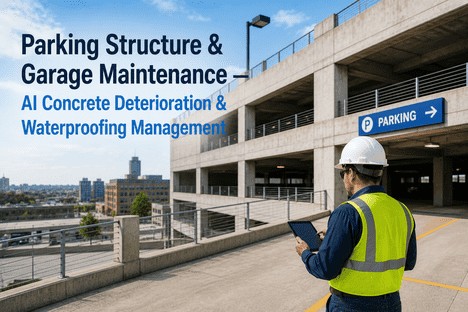
A $500,000 parking structure repair bill. A $75,000 emergency deck closure. A structural engineer's report that could have been a $12,000 membrane recoat six years earlier. Across the United States, facility managers responsible for parking structures are caught in the same compounding trap: deterioration that begins invisibly, accelerates exponentially, and becomes a capital emergency at exactly the moment the budget cannot absorb it. The science is unambiguous — deferred maintenance on parking structures compounds at approximately 7% annually, and the moment chloride-induced corrosion reaches reinforcing steel, the repair scope multiplies by a factor of three to eight within five years. The problem is not that maintenance managers do not know their structures are deteriorating. The problem is that without AI-powered condition monitoring, concrete deterioration tracking, and waterproofing membrane management, they cannot see it happening until the damage has already compounded beyond the budget's capacity to address it proactively.
The Deterioration Sequence That Catches Every Facility Manager Off Guard
Parking structures deteriorate in a sequence that is predictable, well-documented, and almost always managed reactively rather than proactively. The reason is not negligence — it is visibility. The most destructive phase of concrete deterioration in a parking garage is invisible. Chloride ions from road salt tracked in by vehicles penetrate the concrete surface, migrate to the reinforcing steel depth over a period of ten to fifteen years, and initiate corrosion before a single visual symptom appears. By the time a maintenance manager sees surface cracking, rust staining, or concrete spalling, the corrosion has already been progressing for two to five years. The visible damage is the late signal, not the early one.
This is the mechanism that converts a manageable maintenance programme into a structural emergency: the window for low-cost intervention — membrane recoating, crack sealing, joint reseal — closes before the deterioration becomes visible. Once visible spalling and delamination are present, the repair scope has already expanded from surface protection to structural concrete remediation. And once structural remediation begins, the revenue disruption from deck closures adds a cost multiplier on top of the repair cost itself. AI condition monitoring changes this dynamic by detecting the early-stage signatures — moisture infiltration rates, membrane degradation patterns, drainage performance trends — that precede visible damage by years, not months.
Why Waterproofing Membrane Management Is the Highest-ROI Maintenance Category
If there is one maintenance intervention that has a clearer return on investment than any other in the parking structure asset class, it is waterproofing membrane maintenance. The lifecycle cost analysis is unambiguous: a programme of regular traffic membrane maintenance — waterproofing repairs at approximately $15 per square foot at years 20 and 40, with major rehabilitation at $40 per square foot at year 35 — consistently outperforms the alternative of deferred waterproofing leading to full replacement at $250 per square foot at year 50. The margin is not marginal. It is transformative.
The challenge for maintenance managers is not understanding this lifecycle calculus — it is tracking the condition of waterproofing systems continuously across a multi-structure portfolio without the data infrastructure to catch membrane degradation before it crosses the threshold from maintenance to structural damage. iFactory's AI monitoring layer does exactly this: tracking moisture infiltration signatures, drainage performance, and membrane condition indicators across every structure in the portfolio, and surfacing the intervention window before it closes.
What iFactory's AI Does for Parking Structure Maintenance That Traditional Inspection Cannot
Traditional parking structure maintenance management follows a cycle that is structurally inadequate for the pace of concrete deterioration: annual walk-round inspections producing written reports, engineering assessments commissioned every three to five years, and repair work orders generated reactively when visible damage is observed. The problem with this cycle is the gap it creates between when deterioration begins and when it is detected — a gap that is almost always long enough for minor deterioration to become major remediation. iFactory replaces this cycle with four integrated capabilities that move the detection window from years to weeks.
iFactory's concrete condition module tracks deterioration indicators across every deck section of every structure in the portfolio — updating as inspection findings are logged, work orders are completed, and sensor data is received from connected monitoring points. Rather than a periodic snapshot, the system maintains a live condition map of the structure: which sections show chloride infiltration risk based on membrane age and drainage performance, which areas have active delamination based on inspection findings, and which sections have progressed from observation to repair priority since the last engineering visit. For facility managers responsible for multiple structures, this continuous condition layer is the difference between knowing a structure has deterioration somewhere and knowing exactly where, how advanced, and what the intervention window looks like before structural staging begins.
Waterproofing systems in parking structures have defined service lives — typically ten to twenty years for traffic-bearing membrane systems before reapplication is required — but most maintenance programmes track membrane age as a field in a spreadsheet rather than as a dynamic condition metric that updates with drainage data and inspection findings. iFactory maintains a membrane condition profile for every structure in the portfolio: installation date, system type, expected service life, drainage performance trends (which are the earliest operational indicator of membrane degradation), and the projected intervention window based on current condition trajectory. When a membrane's drainage performance data signals early degradation six to twelve months before visual symptoms appear, the system generates a planned maintenance flag — giving the facility manager the lead time to schedule membrane work during a planned low-occupancy period rather than as an emergency response to water infiltration damage to the structural concrete below.
Parking structure inspections in multiple states — including New York's August 2024 mandate requiring initial observation of all garages regardless of scheduled inspection cycle, and emerging ordinances in New Jersey, Wisconsin, and Illinois — require documented evidence of structural condition, inspection history, and repair completion against identified deficiencies. iFactory's structural capacity management module maintains the full inspection record for each structure: every engineering finding, every deficiency classification, every repair work order generated against a finding, and every completion record. When a regulatory inspection requires evidence that deficiencies identified in a prior assessment have been addressed, the platform produces the audit trail automatically — without manual assembly from paper reports filed across multiple binders. For structures approaching structural load capacity limits due to deterioration, the platform also tracks the condition-adjusted capacity against the original design load, flagging sections where observed deterioration warrants a formal engineering capacity review.
The most powerful argument for parking structure capital investment is the cost of waiting — not the cost of action. iFactory's capital planning module generates five-year cost escalation projections for every deferred item in the structural repair backlog, showing ownership and budget authorities exactly what the mathematical consequence of inaction looks like in dollar terms. A $105,000 concrete spall repair on a 1,400 square foot delaminated section deferred for three years into structural staging territory becomes a $300,000 to $500,000 remediation project with deck closure costs added. Presented in this format — action now versus cost of inaction — the capital conversation changes from a facilities budget request into a financial risk management decision. The platform also models total deferred liability across the portfolio under different funding scenarios, producing the multi-year capital improvement programme documentation that ownership, lenders, and insurance carriers increasingly require from parking facility operators.
Parking Structure Type — Deterioration Risk Profile and iFactory Priority Configuration
Not all parking structures face the same deterioration risk profile. A surface-level municipal lot in Arizona and an eight-story post-tensioned cast-in-place garage in Chicago are the same asset class but face completely different deterioration drivers, regulatory environments, and maintenance priority sequences. iFactory's prioritisation engine accounts for structure type, construction system, climate exposure zone, and occupancy profile in its condition scoring and repair sequencing output.
We had an engineering report identifying fourteen delamination areas on Level 2. The report was filed. Twelve months later, the same engineer came back and found that eleven of the fourteen had progressed — because no work orders had ever been generated from the first report. The inspection and the repair system were completely disconnected. iFactory closed that gap on day one: every inspection finding becomes a tracked work order, and every deferred finding has a visible escalation clock next to it. We haven't had a structural finding go unaddressed since we deployed it.
— Director of Facilities Operations, Municipal Parking Authority — 14 Structures, 8,200 SpacesThe Regulatory Environment Is Tightening — What That Means for Parking Structure Documentation
The Miami Surfside collapse in 2021 changed the regulatory trajectory for parking structures in the United States in a way that is now moving from coastal states to inland jurisdictions. New York State mandated periodic parking garage assessments and required initial observation of all structures before August 1, 2024, regardless of the scheduled inspection cycle. New Jersey, Wisconsin, Illinois, and multiple municipalities are in various stages of enacting similar inspection and compliance ordinances. Fort Lee's ordinance 17-2025 added specific deadline compliance requirements. The pattern is clear: regulators are moving toward mandatory documented inspection cycles with verified repair completion requirements.
For parking facility operators and maintenance managers, this regulatory shift has a direct operational implication: inspection findings that were previously filed and deferred now carry regulatory and legal exposure if they are not tracked, addressed, and documented within defined timeframes. A facility manager who can demonstrate a continuous inspection and repair record — showing every deficiency identified, every work order generated against it, and every completion record — is in a fundamentally different position when a regulatory inspector arrives than one who can produce a binder of annual walk-round reports with no documented repair history. iFactory's continuous inspection and work order integration produces that audit trail automatically, as a byproduct of normal maintenance operations rather than as a separate documentation effort.
Conclusion
The parking structure maintenance challenge is not a funding problem in its first form — it is a detection and documentation problem. The deterioration sequence is predictable. The intervention windows are well-understood. The lifecycle cost math overwhelmingly favours proactive membrane maintenance and early concrete repair over deferred remediation. What breaks down is the link between the early signals — drainage performance trends, membrane age, chloride infiltration risk — and the maintenance actions that keep repair costs in the manageable range before they compound into structural emergencies.
AI-powered condition monitoring closes that link. When every deck section has a condition score that updates with inspection findings and sensor data, when every waterproofing membrane has a service life trajectory rather than just an installation date, and when every deferred deficiency has a cost escalation clock showing what it costs to wait another year — the maintenance manager's role shifts from discovering emergencies to preventing them. The inspection finding becomes a work order automatically. The deferred item becomes a capital argument with a cost escalation projection attached. The regulatory compliance record is a byproduct of normal operations, not an annual scramble.
iFactory's parking structure maintenance module gives facility managers the continuous concrete condition monitoring, waterproofing membrane management, structural compliance documentation, and cost escalation modelling that transforms a reactive inspection programme into a proactive capital management system. Book a demo to see how iFactory maps to your portfolio's structure types and generates your first prioritised repair programme, or talk to an expert about your current condition management approach and how AI monitoring would change what you can see — and when you can see it.
Frequently Asked Questions
iFactory operates in two layers. The inspection and work order integration layer — which covers concrete condition tracking, deficiency management, waterproofing service life monitoring, and compliance documentation — requires no hardware and builds its condition picture from the inspection data, work order records, and asset information your maintenance team already generates. This layer is operational from deployment without any infrastructure investment. The predictive sensor layer — which adds continuous drainage performance monitoring, moisture infiltration detection, and ambient condition tracking for connected structures — uses IoT sensor nodes that can be deployed selectively at high-risk areas or structures with complex drainage systems. Most parking facility operators begin with the inspection integration layer and add sensor monitoring to specific structures as condition priorities are identified. Talk to an expert about which configuration fits your portfolio's current data environment.
This is the most common gap iFactory addresses in parking structure maintenance programmes — the disconnect between the engineering assessment and the work order system. iFactory's inspection integration module accepts findings from third-party engineering reports in structured format, allowing maintenance managers to log each identified deficiency as a tracked item with defect classification, location, severity, recommended repair action, and required response timeline. Once logged, every finding generates a linked work order, and the completion of that work order closes the finding in the compliance record. For facilities with existing engineering assessment history, prior findings can be imported to build a baseline condition record. The result is that the next time an engineer re-inspects, the platform can produce documentation showing the response taken on every prior finding — which is exactly the evidence that regulatory inspections and insurance assessments increasingly require. Book a demo to see the inspection-to-work-order workflow for a structure with an active deficiency list.
iFactory's compliance documentation module is configured to the specific inspection interval, observation checklist, and deficiency response requirements of the jurisdiction in which each structure operates. For New York State structures subject to the periodic garage assessment mandate, the platform maintains the inspection cycle record, annual observation checklist completions, identified deficiency log, and repair completion documentation in the format that local Departments of Buildings require. For structures in jurisdictions where inspection ordinances are emerging — New Jersey, Wisconsin, Fort Lee, and others — iFactory's implementation team configures the compliance framework to the ordinance's specific requirements during deployment. The practical advantage is that facilities already operating on iFactory when a new ordinance takes effect have the historical inspection and repair record the ordinance requires, rather than needing to reconstruct it. Talk to an expert about compliance configuration for your jurisdiction's current and anticipated requirements.
Portfolio prioritisation across multiple structures is where iFactory's scoring engine delivers the most direct capital planning value. Every deficiency and deferred item in the portfolio is scored across four factors: safety consequence and regulatory compliance exposure (structural findings, life safety systems, and accessibility compliance are auto-escalated regardless of cost); cost escalation rate (concrete deterioration and waterproofing items with steep escalation curves score higher than shallow-escalation items); structural system risk (deficiencies in post-tensioned tendon zones or at connection plates in precast structures score higher due to structural consequence of progression); and cascade risk (findings whose progression damages adjacent systems — a failed expansion joint leading to rebar exposure in the structure below, for example — score higher because deferral risks triggering multi-system remediation). The output is a cross-portfolio ranked project list that the maintenance manager can present to ownership with the scoring logic visible and auditable — not a subjective recommendation but a defended capital sequence. Book a demo to review the portfolio prioritisation configuration for your specific structure types and current deficiency list.