Road Maintenance Management — Pothole Repair, Crack Sealing & AI Work Order Scheduling
By Grace on June 19, 2026
Every maintenance manager responsible for a road network wakes up to the same backlog every spring: hundreds of pothole reports flooding in from citizen hotlines, 311 systems, and field crews — far more than any team can repair in a week. The crack sealing that should have been completed the previous autumn was deferred because the crew was pulled onto emergency pothole duty. The work orders stacked on the desk are prioritised by whoever called most recently or whichever route the supervisor drove this morning. And every day that passes without a systematic scheduling system, the gap widens between the repairs being done and the repairs that actually matter — the cracks that could have been sealed for USD 5 per linear foot before they became potholes costing USD 200 each to patch, the arterial roads deteriorating under heavy truck traffic while crews patch residential streets with a fraction of the user impact. The cost of reactive road maintenance is not measured only in repair budgets. It is measured in citizen complaints, vehicle damage claims, liability exposure, and the steady erosion of public trust in the department's ability to manage the network. AI-powered work order scheduling eliminates this structural gap by making every repair decision data-driven, every crew dispatch optimised, and every treatment timed to prevent the next defect before it forms.
Maintenance Managers Who Cut Pothole Complaints by 55% in One Season Have One Thing in Common: They Schedule Repairs by Data, Not by Whom Called First.
iFactory's AI road maintenance platform gives maintenance managers intelligent work order prioritisation that scores every pothole, crack, and defect by traffic volume, safety risk, deterioration velocity, and citizen impact — with automated crew dispatch, crack sealing optimisation, and complaint tracking built in from day one.
Annual cost of pothole damage to US drivers in vehicle repairs — averaging USD 300 per incident across 16 million drivers over five years
67%
Percentage of US cities that still prioritise road repairs manually — using first-come-first-served or supervisor judgment rather than objective risk-based scoring
55%
Average reduction in pothole-related citizen complaints reported by municipalities that deploy AI-based prioritisation and automated crew dispatch scheduling
6:1
Return on investment ratio for preventive crack sealing versus reactive pothole repair — every USD 1 spent on crack sealing eliminates USD 6–10 in future reconstruction costs
The Maintenance Manager's Core Problem: Why Reactive Repair Cycles Are Structurally Inefficient
A pothole is reported on Monday. The work order is logged on Tuesday. The supervisor assigns it to a crew on Wednesday. The crew arrives on Thursday to find that the pothole has expanded under three more days of traffic and a rain event, requiring a larger patch than the original assessment indicated. Meanwhile, a crack on a primary arterial that has been deteriorating for six months — measurable, preventable, and carrying 15,000 vehicles per day — has no work order at all because no one reported it. This is not a resource problem. It is a scheduling architecture problem. When work orders are prioritised by the order they arrive rather than by the objective impact of leaving them unaddressed, the maintenance programme is structurally biased toward the loudest complaint rather than the highest-risk defect. AI-powered work order scheduling eliminates this bias by scoring every repair against criteria that predict the consequence of inaction — traffic volume, defect severity, safety risk, deterioration velocity, and proximity to critical facilities — and dispatching crews to the highest-scoring defects first, regardless of which phone rang first.
The Six Failure Modes of Reactive Road Maintenance — and How AI Scheduling Eliminates Each One
01
First-Reported-First-Fixed Ignores Actual Risk
When pothole repairs are prioritised by the order in which complaints arrive, a shallow 10mm pothole on a low-traffic residential street reported by a persistent citizen is repaired before a 50mm failed patch on a primary arterial carrying 20,000 vehicles per day that no one has reported yet. The consequence is that the road with the highest user impact, safety risk, and deterioration velocity waits longest for attention — because the prioritisation system has no mechanism to distinguish between the loudest complaint and the most urgent defect. Maintenance managers who inherit this system spend more time defending their scheduling decisions to elected officials and angry citizens than optimising their repair programmes.
AI fix: Every defect scored by traffic volume, severity, and safety risk → work orders ranked by consequence of inaction, not time of report.
02
Crack Sealing Is Deferred Until Potholes Force the Budget
Crack sealing is the most cost-effective pavement preservation treatment available — a USD 5 per linear foot application that can extend pavement life by 3 to 5 years and prevent the USD 30 to 60 per square foot cost of full-depth pothole repair. Yet crack sealing is consistently the first programme deferred when emergency pothole repairs consume the maintenance budget. The reason is structural: crack sealing requires proactive survey and scheduling, while potholes arrive with a complaint attached. Without a system that tracks which road segments need crack sealing before potholes form, the maintenance manager is forced to choose between visible emergencies and invisible prevention. The invisible prevention loses every budget cycle until it becomes a visible emergency, at which point the repair cost has multiplied by six to ten times.
AI fix: Crack sealing schedule generated from deterioration data → preventive treatments are never displaced by reactive repairs in the work order queue.
03
Crew Dispatch Routes Waste Time on Suboptimal Sequencing
When work orders are assigned to crews in the order they appear on the dispatch board, a crew may repair a pothole on one side of the district in the morning and another on the opposite side in the afternoon — with 45 minutes of travel time between them that could have been eliminated if the two jobs had been grouped into a sequenced route. For a team repairing 15 to 20 defects per day, unoptimised routing can consume 3 to 5 hours of productive crew time in unnecessary travel. The maintenance manager sees the crew as busy all day but may not recognise that half the working hours are spent driving between scattered jobs rather than repairing road surface. Route-optimised dispatch eliminates this waste by sequencing work orders into logical geographic clusters that minimise travel time and maximise repair time.
AI fix: Work orders clustered by geographic proximity and priority score → routes optimised to maximise repair minutes per crew hour.
04
Citizen Complaints Drive the Schedule Instead of Informing It
Citizen-reported potholes are valuable data, but they should inform the maintenance programme — not drive it. When the repair schedule is dictated by the volume and persistence of complaints rather than by an objective assessment of network-wide need, the result is predictable: wealthier neighbourhoods with higher complaint rates receive faster service, while underserved areas with deteriorating infrastructure wait longer because their residents call less frequently. This produces a maintenance equity gap that widens over time, as roads in lower-complaint areas deteriorate past the point where crack sealing would have been effective and into the reconstruction cost range. The maintenance manager who relies on complaints as the primary scheduling input is effectively delegating network-level prioritisation decisions to the uneven distribution of citizen engagement.
AI fix: Complaints ingested as data points within the scoring model → repair schedule driven by condition and risk, not by complaint volume alone.
05
Liability Exposure Grows With Every Unrepaired Defect
Every pothole that goes unrepaired represents a liability exposure that compounds with time. When a vehicle is damaged or an accident occurs, the first question from the claims adjuster or the plaintiff's attorney is: when was this defect first reported and how long did it take to repair? Without a documented prioritisation system, the maintenance manager must answer that question with incomplete records — a paper log, a supervisor's memory, or a complaint form with no linkage to the repair timeline. A documented AI prioritisation system answers the question with an evidence chain: the defect was scored on this date with a priority score of 72, the work order was generated with this timestamp, the crew was dispatched within this window, and the repair was completed with a geo-tagged photograph on this date. Municipalities with documented AI dispatch systems consistently report faster claim resolution and reduced liability payouts because the evidence of timely, risk-based response is verifiable.
AI fix: Every repair documented with timestamps, scores, and geo-tagged completion photos → liability claims can be defended with verifiable response records.
06
Seasonal Planning Is Reactive, Missing the Preventive Window
The annual maintenance cycle follows a predictable pattern that reactive scheduling cannot exploit. Cracks should be sealed in late summer and early autumn before winter moisture accelerates deterioration. Pothole patching materials perform best in warm, dry conditions. Crews need to be redeployed from winter snow operations to spring pothole patrol on a schedule that anticipates the seasonal surge. Without a scheduling system that incorporates seasonal constraints, treatment windows, and weather forecasts, the maintenance manager is perpetually behind the seasonal curve — crack sealing is deferred to November when the sealant will not cure properly, pothole patching is rushed in April rain, and the crew is always one week too late to apply the treatment that would have prevented the spring surge. A seasonal scheduling model that anticipates these windows and reserves crew capacity for preventive treatments before the emergency arrives transforms the maintenance programme from reactive to strategic.
AI fix: Seasonal treatment windows mapped against deterioration forecasts → preventive capacity reserved months before the emergency surge arrives.
When Every Pothole Is Treated as an Emergency, No Repair Is Prioritised by Impact. AI Scheduling Changes the Logic Entirely.
iFactory builds the distinction between urgent and important directly into every work order — so maintenance managers dispatch crews to the defects that cause the most damage to road users, vehicle budgets, and public trust, regardless of which phone rang first.
The iFactory AI road maintenance platform operates as a three-layer intelligence system — intelligent work order intake and scoring at the defect level, automated crew dispatch and route optimisation at the operations level, and performance reporting and liability documentation at the programme level. Each layer serves a distinct maintenance management function, and all three work together without requiring the maintenance manager to build schedules manually or reconcile spreadsheets between systems.
Layer 01
Intelligent Work Order Intake and Scoring
Every defect rated by risk, impact, and urgency before a crew is assigned
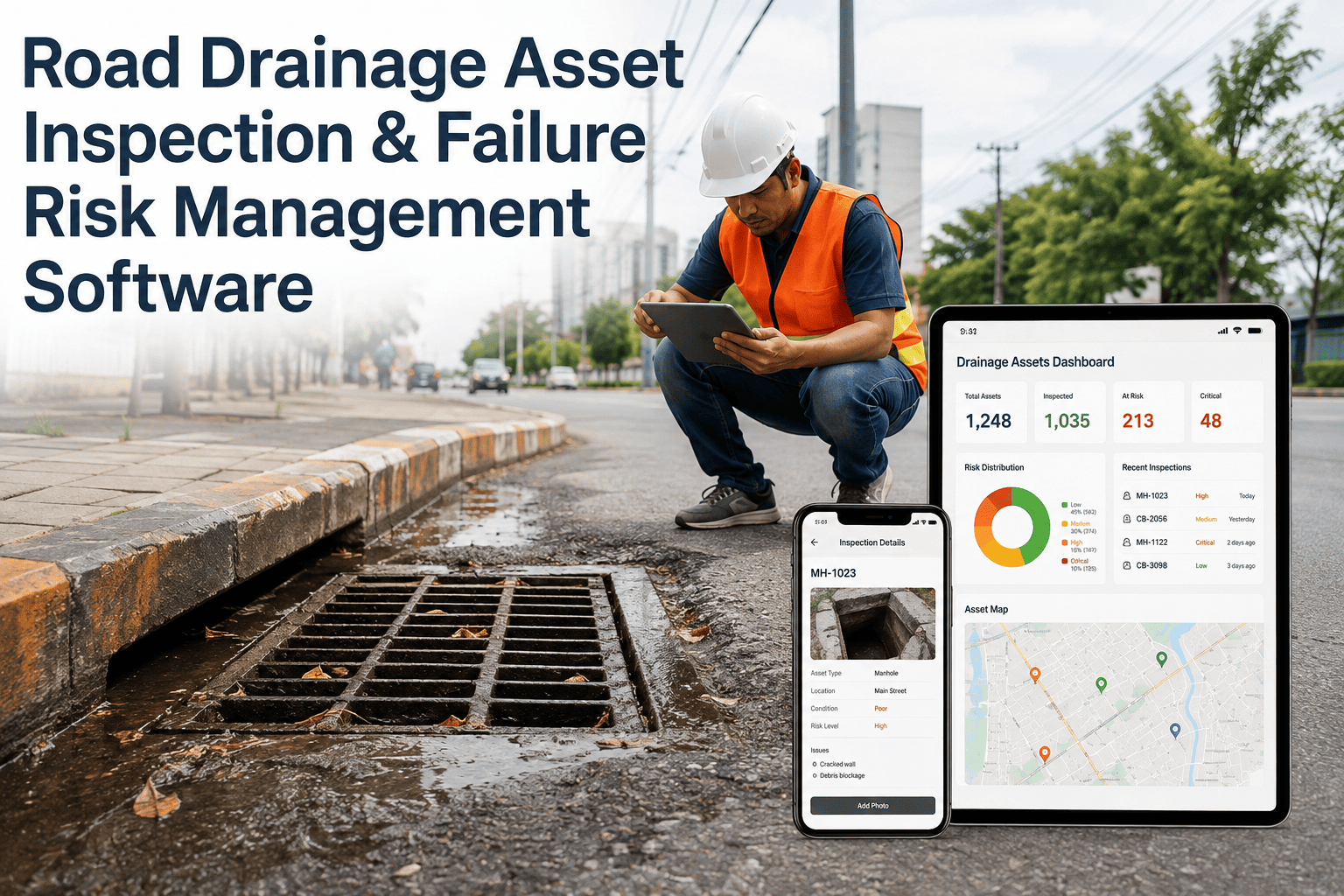
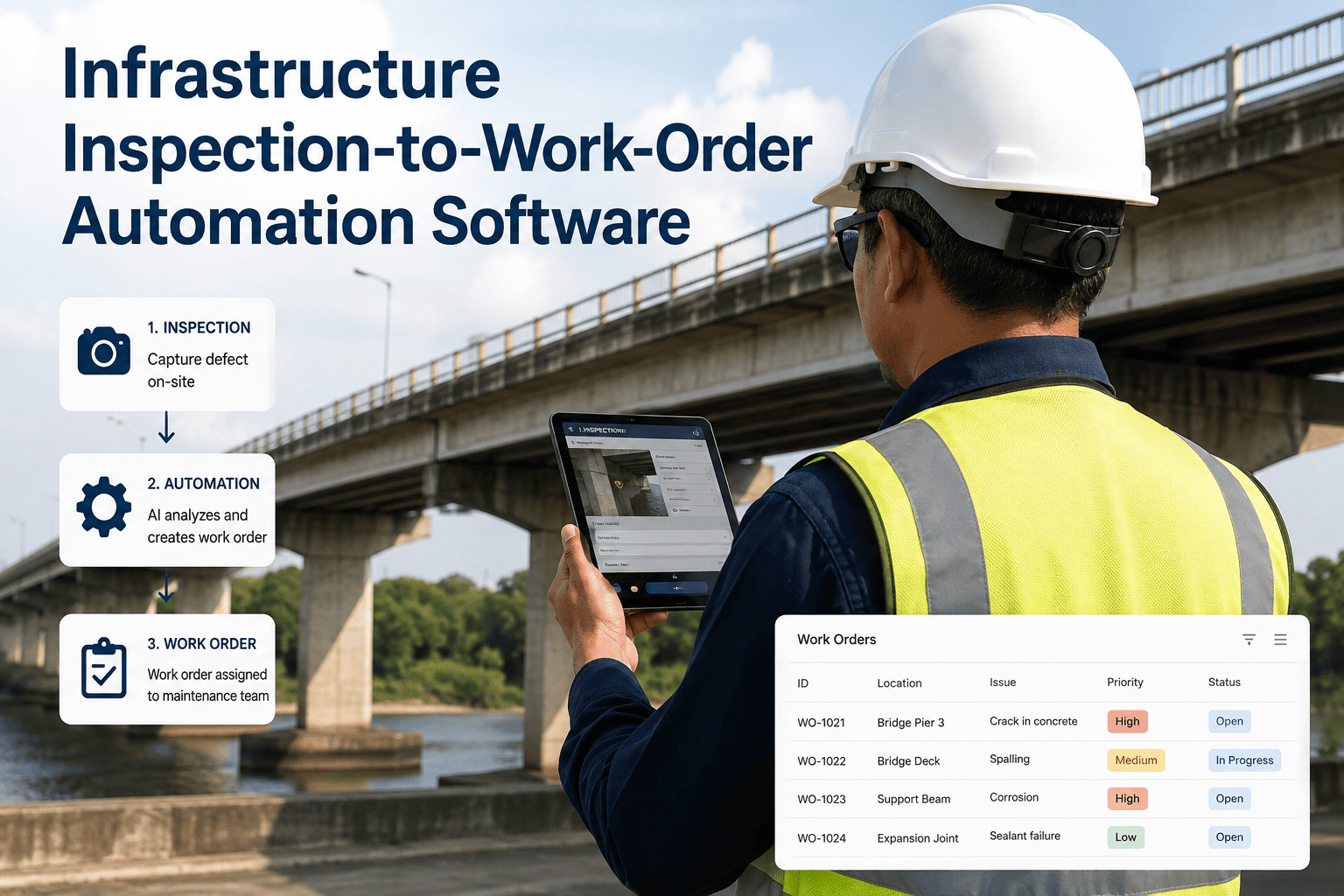
The intake layer ingests defect reports from every channel — citizen calls and 311 submissions, field crew observations, automated survey vehicle data, and drone inspection outputs — and processes each report through a multi-criteria scoring engine that evaluates traffic volume (AADT), defect severity (depth, width, and extent), safety risk (proximity to schools, hospitals, pedestrian crossings, and bike lanes), deterioration velocity (rate of degradation since first observation), days since report, and prior repair history. Each defect receives a composite priority score on a 0-to-100 scale. Scores of 80 to 100 are designated for emergency dispatch, 60 to 79 for priority queue, and below 60 for scheduled batch repair. The maintenance manager sees a single ranked work order queue where every defect's position is determined by its objective impact score, not by the time of day the report arrived. Work orders can be created automatically from survey imagery when AI defect classification identifies a pothole or crack that exceeds the intervention threshold — even if no citizen reported it.
Multi-channel intake ingestion
Six-factor priority scoring
Auto-generated work orders
Layer 02
Automated Crew Dispatch and Route Optimisation
Crews assigned and routes sequenced for maximum repair productivity
The dispatch layer takes the scored work order queue and assigns each defect to the optimal crew based on crew specialisation, equipment availability, geographic proximity, and current workload. For crews assigned multiple work orders in a shift, the route optimisation engine sequences the jobs into the most efficient travel path — clustering defects within the same road corridor, minimising deadhead travel between job sites, and accounting for traffic patterns and time-of-day restrictions on lane closures. The maintenance manager sees each crew's daily route displayed on a map view with estimated travel time, repair time, and completion sequencing. When a new high-priority defect is reported mid-shift — an emergency dispatch with a score above 80 — the system recalculates the crew's route in real time, inserting the new job at the optimal position in the sequence. Crews receive push notifications with the updated route and job details on their mobile devices, eliminating radio calls and paper dispatch sheets.
Skill-based crew assignment
Live route optimisation
Real-time emergency insertion
Layer 03
Performance Reporting and Liability Documentation
Automated metrics, trend analysis, and verifiable repair records
The reporting layer captures every action in the maintenance cycle — the defect report, the priority score, the work order assignment, the crew dispatch time, the route sequence, the repair completion with geo-tagged timestamp and photograph, and the final work order closure — and aggregates these records into programme-level performance metrics. The maintenance manager views average response time by priority band, crew productivity trends (repairs per shift, travel versus repair time ratio), complaint volume trends by district and season, and crack sealing completion rates against the annual target. For liability documentation, every repair record includes the full evidence chain: the initial defect report, the priority score that determined its place in the queue, the dispatch and completion timestamps, and the geo-tagged completion photograph. This record is exportable in a format suitable for claims defence, audit review, and public records requests. The maintenance manager who can show a documented, risk-based dispatch system has a materially stronger legal position than one who relies on paper logs and supervisor memory.
Crew productivity analytics
Complaint trend tracking
Liability evidence chain export
What the AI Road Maintenance Dashboard Shows the Maintenance Manager
The maintenance manager's view of the AI road maintenance platform is not a work order spreadsheet — it is a real-time operations command centre. The dashboard is designed around the questions that maintenance managers must answer continuously: What is the current repair backlog and which defects are most urgent? Is each crew on the most productive route for today's work order queue? Are we completing more preventive crack sealing than emergency pothole repairs this month? And when a claim arrives or a council member asks about response times, is the evidence ready to present?
Ops View 01
Live Work Order Queue — Ranked by Priority Score
Every open defect in the network displayed in a single ranked queue sorted by composite priority score. Each work order shows the defect type, location, priority score, days since report, and the top contributing factor — traffic volume, safety proximity, or severity. Filters by district, defect type, priority band, and source channel allow the maintenance manager to isolate any segment of the backlog in one click. Emergency items with scores above 80 are flagged visually and include an estimated response time target. The queue updates in real time as new reports are ingested, ensuring the maintenance manager always works from the current prioritisation, not yesterday's printout.
Maintenance manager action: Review inbound queue at shift start. Dispatch crew to the highest-scoring emergency item first, regardless of when it was reported.
Ops View 02
Crew Dispatch Map With Live Route and Status Tracking
A map view showing every active crew, their assigned route for the current shift, and the status of each work order — en route, in progress, or completed. The route line shows the optimised sequence of jobs with estimated travel and repair times for each segment. When a new emergency defect is reported, the system displays the optimal insertion point in the nearest crew's route and the impact on the estimated completion time for existing jobs. The maintenance manager can approve the route adjustment with one click, and the crew receives the updated route and job details on their mobile device without radio communication.
Maintenance manager action: Monitor crew map throughout the shift. Approve route adjustments for emergency insertions within the estimated time impact.
Ops View 03
Preventive vs. Reactive Work Balance — Monthly Trend
A trend chart comparing the volume of preventive treatments — crack sealing linear feet, surface treatment square yards — against reactive pothole repairs each month. The maintenance manager sees at a glance whether the programme is shifting toward the preventive end of the spectrum or being pulled back into reactive mode. The ratio of preventive to reactive expenditure is calculated automatically, with a target band that the maintenance manager can configure based on the department's preservation goals. When the reactive proportion exceeds the target band for two consecutive months, the dashboard alerts the maintenance manager that the crack sealing programme may be under-resourced relative to the deterioration rate.
Maintenance manager action: Review preventive-to-reactive ratio monthly. Adjust crew allocation toward crack sealing when ratio falls below the target band.
Ops View 04
Crew Productivity Dashboard — Repairs per Shift and Travel Ratio
Every crew's productivity is tracked and displayed as a per-shift summary: number of defects repaired, total repair time, total travel time, travel-to-repair ratio, and average repair duration by defect type. Crews with above-average travel ratios are flagged for route optimisation review — the system may detect that their assigned territory is geographically too dispersed for efficient single-shift coverage, suggesting a territory boundary adjustment. Crews with below-average repair durations are flagged for training needs assessment. The maintenance manager uses this view to identify operational inefficiencies that are invisible in a paper-based system — a crew that looks fully occupied on paper may be spending 45% of its shift driving between scattered jobs instead of repairing pavement.
Maintenance manager action: Review crew productivity weekly. Investigate crews with travel ratios above 35% for route optimisation or territory boundary adjustment.
Ops View 05
Citizen Complaint Trend Analysis by District and Category
Citizen complaints are tracked by district, defect category, and source channel — phone, 311 app, email, social media — and displayed as trend lines showing whether complaint volume is increasing, stable, or declining in each area. The maintenance manager can correlate complaint trends with repair activity: a district where complaint volume is declining while repair volume is stable indicates that the prioritisation system is working as intended. A district where complaint volume is increasing despite steady repair volume may indicate a coverage gap that the survey-based defect detection has missed. The correlation view overlays complaint trends with the preventive-to-reactive ratio, allowing the maintenance manager to see whether complaint reductions follow increases in crack sealing activity — the evidence that the preventive strategy is working at the community level.
Maintenance manager action: Monitor complaint trends by district monthly. Investigate districts where complaint volume is rising despite stable repair output.
Ops View 06
Liability Documentation Export — Full Evidence Chain
Every repair record in the system carries the full evidence chain from defect report through work order closure. For any work order, the maintenance manager can export a single-page document showing the initial defect report timestamp and source, the priority score and the factor weights that produced it, the work order creation timestamp, the crew assignment and dispatch time, the route sequence showing the job's position, the completion timestamp with geo-tagged photograph, and the final quality check notation. This export is designed for direct submission as evidence in liability claims, public records requests, and audit reviews. The system also generates a monthly liability readiness summary showing the number of work orders with incomplete evidence chains — missing completion photographs, unverified closure timestamps, or defects that remain open beyond the target response time — allowing the maintenance manager to close documentation gaps before a claim arrives.
Maintenance manager action: Generate liability readiness summary monthly. Resolve incomplete evidence chains before a claim or audit request arrives.
"
Our road maintenance programme was drowning in citizen complaints every spring. We had five crews working 10-hour shifts, six days a week, and we were still falling behind because we were repairing potholes in the order they were called in — which meant we were patching residential streets while our primary arterials deteriorated. The AI prioritisation platform changed our entire approach. Within 90 days, we had every defect scored by traffic volume, severity, and safety risk. Our crews were routing to the highest-impact repairs first, and we had a crack sealing schedule that kept our preventive programme on track even during the spring surge. Our complaint calls dropped by 52% in the first season. Our average response time for priority defects went from 11 days to 3 days. And when a liability claim came in for a vehicle damaged on one of our roads, we produced the complete evidence chain — defect report, priority score, dispatch time, repair completion with photograph — in under five minutes. The claim was resolved in our favour because the documentation demonstrated timely, risk-based response.
— Maintenance Manager, City Public Works Department — 840 Lane-Miles, 5 Crews, USD 4.2 Million Annual Maintenance Budget
Conclusion
Road maintenance management is not a resource problem — it is a scheduling intelligence problem. When pothole repairs are assigned in the order complaints arrive rather than by the objective risk each defect represents, when crack sealing is deferred because reactive repairs consume every budget cycle, when crews drive unoptimised routes that waste half the working day in travel, and when liability claims are defended with paper logs that cannot demonstrate timely response, the maintenance programme is structurally incapable of delivering the outcome that citizens, elected officials, and risk managers demand. AI-powered work order scheduling addresses all four dimensions simultaneously: risk-based prioritisation that ranks every defect by traffic volume, severity, and safety impact before a crew is dispatched; preventive treatment scheduling that protects crack sealing capacity from reactive displacement; route-optimised crew dispatch that maximises repair minutes per crew hour; and verifiable evidence chains that document every repair from report to completion.
The evidence from municipal deployments in 2025 and 2026 is consistent and compelling. Cities using AI-based pothole prioritisation and automated crew dispatch report 50 to 55% reductions in citizen complaints, 30 to 40% reductions in crew travel time through route optimisation, and 40% faster average repair completion through intelligent work order sequencing. The financial case is equally clear: every dollar invested in preventive crack sealing eliminates six to ten dollars in future pothole repair costs — savings that compound across a network of hundreds or thousands of lane-miles. The maintenance managers achieving the upper end of these outcomes are the ones who deployed risk-based prioritisation, integrated citizen reports with survey-based defect detection, and used the liability documentation capability to convert their maintenance records from a compliance burden into a risk management asset.
iFactory's AI road maintenance platform is designed for maintenance managers who need to reduce complaints, extend pavement life through preventive crack sealing, optimise crew productivity, and defend every repair decision with verifiable data — not just fill potholes in the order they are reported. Book a Demo to see the AI work order scheduling platform configured for your road network, crew structure, and maintenance programme, or talk to an expert about a free maintenance operations review and scheduling optimisation pilot.
Frequently Asked Questions
Every defect that enters the system — whether reported by a citizen, detected by survey vehicle AI, or logged by a field crew — is scored against six weighted criteria. Traffic volume measured as average annual daily traffic receives the highest weight at 30% because roads carrying more vehicles affect more users per repair hour. Defect severity measured by depth, width, and extent accounts for 25% because deeper defects pose greater vehicle damage risk and require more urgent intervention. Proximity to critical facilities such as schools, hospitals, pedestrian crossings, and bike lanes accounts for 18% because safety risk increases with vulnerable road user exposure. Weather forecast risk accounts for 15% because a defect that will be worsened by an incoming rain or freeze-thaw event should be repaired before the weather arrives. Days since reported accounts for 8% to ensure that older reports do not fall through the queue indefinitely. Prior repair history accounts for the remaining 4% because a segment with repeated failure in the same location may indicate an underlying structural issue that needs investigation. The weights are configurable by the maintenance manager to reflect the department's specific prioritisation policy — a district with high pedestrian activity may increase the safety proximity weight, while a district with extreme freeze-thaw cycles may increase the weather forecast weight. Talk to an expert about configuring the scoring weights for your maintenance programme priorities.
Yes. The platform provides standard API connectors for major 311 and citizen reporting platforms including Open311 GeoReport v2, Granicus, SeeClickFix, and custom API endpoints. When a citizen submits a pothole or road defect report through the city's app, website, or phone system, the report is ingested into the work order queue automatically with the location data, description, and submitted photograph. The platform's AI analyses the photograph to classify the defect type and estimate severity, which feeds into the priority scoring model alongside the other five factors. Citizens who submit reports can optionally receive automatic status updates — received, assigned to crew, en route, repaired — through the same channel they used to report, closing the communication loop that most manual systems leave open. The integration is configured during implementation and typically requires two to three weeks for full deployment across all intake channels. Talk to an expert to confirm integration compatibility with your current citizen reporting systems.
When a new defect with a priority score above 80 is reported during an active shift, the route optimisation engine evaluates every active crew's current location, assigned job sequence, and remaining workload to identify the optimal insertion point. The engine calculates the increase in total route time caused by inserting the new job at each possible position in each crew's sequence and selects the crew-position combination that minimises the overall schedule impact while maximising the responsiveness to the emergency defect. The maintenance manager receives a notification showing the recommended insertion with the estimated time impact on the affected crew's existing jobs — typically 10 to 25 minutes for an emergency insertion in a compact service area. The manager can approve the adjustment with one click, and the affected crew receives an automatic route update on their mobile device with the new job inserted at the optimal position in their sequence. Jobs whose completion time is pushed beyond the end of the shift by the insertion are flagged for re-scheduling to the next available shift or crew. This capability eliminates the need for radio communication, manual route re-planning, and the difficult decision of which existing job to defer — the optimisation engine calculates the best trade-off automatically and presents it for the maintenance manager's approval. Book a Demo to see emergency insertion routing in action.
The crack sealing module generates a preventive treatment schedule based on pavement condition data, crack density measurements from survey imagery, and deterioration curve projections. Road segments are ranked by crack sealing priority using a separate scoring model that considers crack density, current PCI, deterioration velocity, and the estimated cost saving of sealing now versus repairing potholes later. The resulting schedule allocates crew capacity to crack sealing during the optimal seasonal window — typically late summer and early autumn when temperatures and moisture levels allow proper sealant curing. Once allocated, the crack sealing capacity is protected in the crew schedule: reactive pothole repairs are assigned to a separate reactive crew or to overflow capacity, rather than displacing the crack sealing crew. If emergency reactive demand exceeds the reactive crew capacity, the system alerts the maintenance manager with the projected impact on the crack sealing completion target, allowing an informed decision about whether to temporarily redeploy rather than having the crack sealing programme erode invisibly. At the end of each month, the preventive-to-reactive ratio report shows exactly how much crack sealing capacity was protected versus displaced, giving the maintenance manager the data to defend the preventive programme in budget discussions. Talk to an expert about configuring crack sealing scheduling for your treatment window and crew structure.
When a pothole damage claim is filed, the claims adjuster or legal team needs to answer two questions: when was the defect first known to the municipality, and what action was taken within a reasonable timeframe after that knowledge? The liability documentation export answers both questions with a verifiable evidence chain. The export includes the initial defect report with timestamp and source channel, establishing the date of first knowledge. It includes the AI priority score with the six weighted factors that determined the defect's position in the work order queue, demonstrating that the response timing was determined by an objective, documented process — not by neglect or random assignment. It includes the work order creation timestamp, crew dispatch timestamp, and route sequence showing the job's position, establishing that the defect was scheduled within the normal workflow of the prioritisation system. It includes the completion timestamp with geo-tagged photograph showing the repair in place, establishing that the defect was addressed and providing the current condition of the site. Municipalities using documented AI dispatch systems report that claims are resolved faster and more favourably because the evidence chain eliminates the ambiguity that drives litigation. The export can be generated for any work order in under one minute and is admissible in the standard format used by municipal risk managers and claims adjusters. Book a Demo to see a sample liability documentation export and discuss your risk management requirements.
Every Pothole Has a Risk Score Behind It. AI Work Order Scheduling Finds the Ones That Matter First. Get a Free Maintenance Operations Review.
iFactory's AI road maintenance platform for maintenance managers — intelligent work order prioritisation that scores every defect by traffic impact, safety risk, and deterioration velocity, automated crew dispatch with route-optimised sequencing, crack sealing scheduling that protects preventive capacity from reactive displacement, and liability-ready documentation generated automatically from the repairs your crews complete every day.