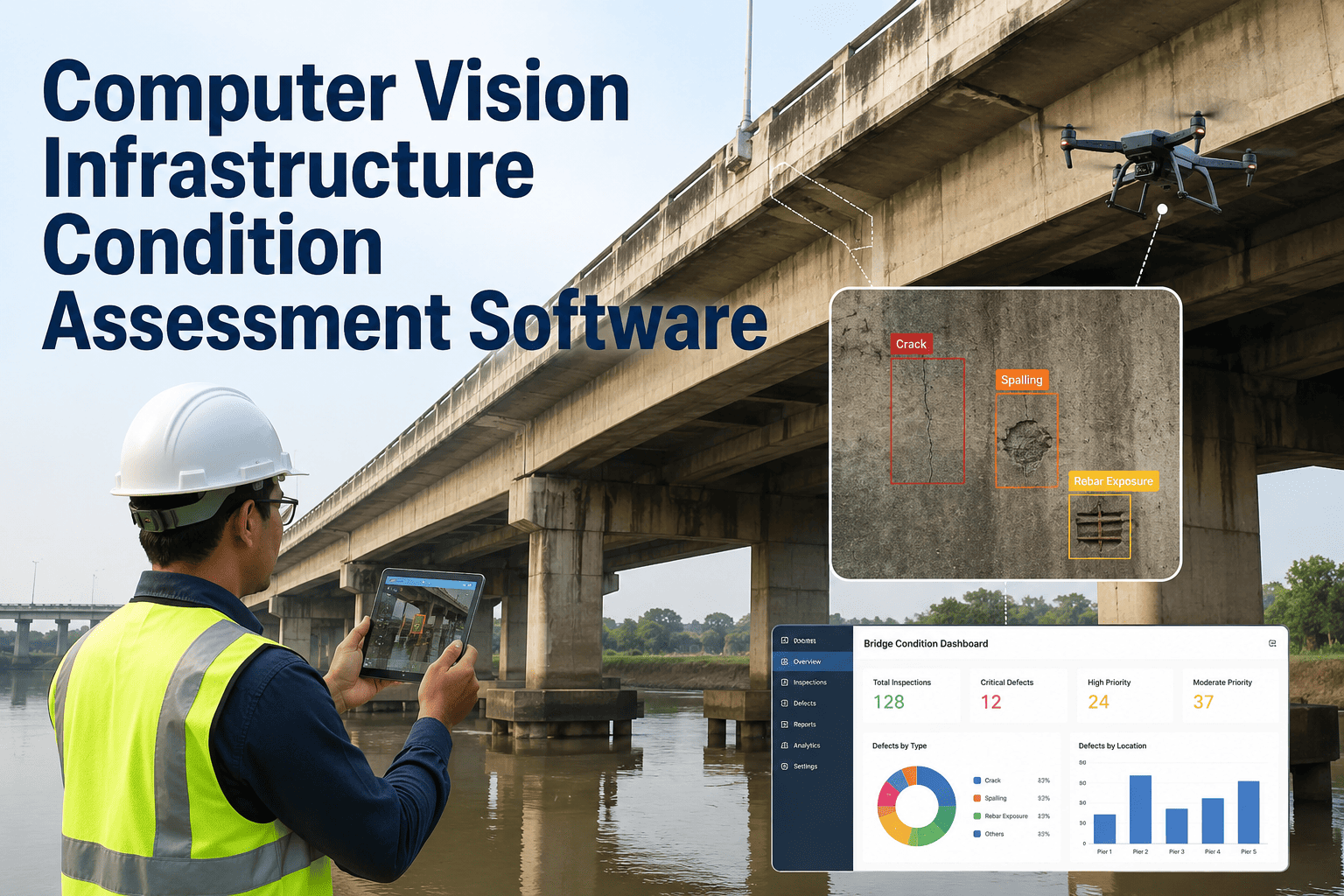
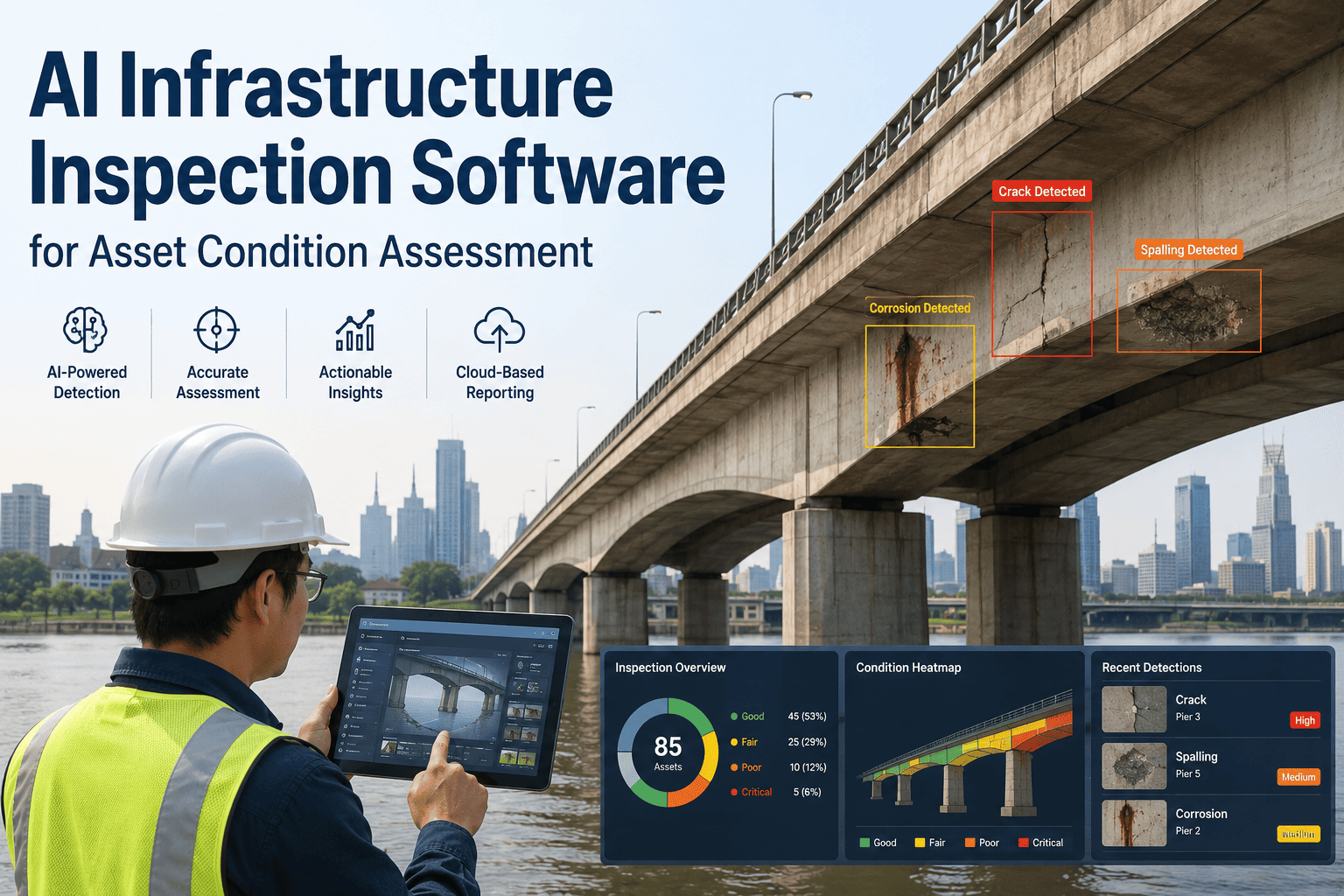
Every steel bridge, transmission pylon, port crane, pipeline gantry, and offshore platform on the planet is engaged in a slow, continuous chemical war with oxygen, water, and chloride ions. Corrosion is the single largest driver of replacement cost in steel infrastructure — the global cost runs into trillions of dollars annually — and yet inspections that grade corrosion severity still depend largely on a human with a clipboard, a 12-month rotation, and the ISO 12944 colour chart. Computer vision is rewriting that workflow. Modern deep-learning models trained on millions of rust images now classify corrosion stages with accuracy above 90%, segment rust pixels for area quantification, and map severity against the SSPC, NACE, and ISO standards engineers already use — from drone flyovers, vehicle cameras, and inspector smartphones. The result is what corrosion engineers have wanted for decades: continuous, quantitative, repeatable, geo-referenced corrosion intelligence across the entire asset network. This article walks through how CV-powered corrosion detection actually works on steel infrastructure — the severity grades, the CNN architectures, the training datasets, the accuracy benchmarks, and the integration realities. Book a Demo to see iFactory's corrosion-detection pipeline running on live steel infrastructure today.
Technical Article · CV-Powered Corrosion AI
Stop Reading Rust Charts. Start Measuring Corrosion at Pixel Resolution.
iFactory orchestrates CNN classification, U-Net segmentation, and Mask R-CNN multi-defect detection — grading steel corrosion against ISO 12944, SSPC-VIS, and NACE standards across bridges, pylons, ports, and pipelines.
90%+
CNN classification accuracy typical on steel corrosion stages
0.85+
Mean IoU on pixel-level rust segmentation in published research
5 grades
ISO 12944 corrosivity categories — from C1 indoor to CX offshore
130+ countries
Where AMPP (NACE + SSPC) standards govern steel inspection
The Corrosion Severity Ladder — What the AI Must Recognise
Computer vision corrosion models do not just say "rust / no rust" — they grade severity against industry standards engineers already use to plan repaint cycles, repair priorities, and end-of-life decisions.
G1
Pristine / Intact Coating
No visible corrosion. Full coating integrity. SSPC-VIS-2 Grade A. Asset in design condition.
Action: Continue routine inspection
G2
Light Surface Rust
Spot rust on coating surface. SSPC-VIS-2 Grade B–C. Low immediate risk; tracked for progression.
Action: Schedule touch-up within 12 months
G3
Active Corrosion & Coating Loss
Substrate exposed across measurable area. SSPC-VIS-2 Grade D. Material loss beginning.
Action: Plan coating renewal next cycle
G4
Severe Pitting & Section Loss
Deep pitting, scale formation, measurable cross-section reduction. SSPC-VIS-2 Grade E. Structural concern.
Action: Engineering assessment within 30 days
G5
Structural Compromise
Plate perforation, weld failure, or load-bearing section loss. SSPC-VIS-2 Grade F. Safety-critical.
Action: Immediate engineering response
Three CV Approaches — Choosing the Right One for the Asset
Corrosion detection on steel infrastructure is not a single problem. Three CV approaches dominate — each with a different output and a different deployment niche.
Approach 01
Image-Level Classification
What grade is this corrosion?
A CNN classifies each image or image patch into one of the severity grades. Fast, cheap, and the standard for high-volume drone or smartphone inspection.
Models: VGG-16, ResNet-50, EfficientNet, MobileNet
Pixel-Level Segmentation
Approach 02
What percentage of the surface is rusted?
A segmentation model labels every pixel as corroded or not — enabling exact rust-area measurement and quantitative progression tracking over time.
Models: U-Net, FCN, DeepLabv3+, SegFormer
Approach 03
Multi-Defect Detection
What is each defect, and where exactly is it?
Object-detection models locate corrosion, cracks, coating failure, and weld defects in the same image with per-region masks and confidence scores.
Models: Mask R-CNN, YOLOv8, Faster R-CNN
How CV Corrosion Detection Actually Runs on a Bridge or Pylon
From a drone photo to a CMMS work order — six stages, fully automated. The engineer enters only at the severity-grade approval step.
1
Image Capture
Drone, UAV, fixed camera, vehicle-mounted rig, or inspector smartphone. 4–12 MP with GPS metadata.
2
Quality Filtering
Blurred or out-of-focus frames rejected automatically. Lighting normalisation via Retinex enhancement.
3
CNN Severity Classification
Trained model assigns a G1–G5 severity grade per image patch with confidence score.
4
Pixel Segmentation & Quantification
Rust-pixel area, perimeter, and progression tracked vs prior inspections — geo-referenced to the asset.
5
Standards Mapping
Output mapped to SSPC-VIS-2, ISO 12944 corrosivity, and NACE rust-grade equivalents for engineering reports.
6
CMMS Work-Order Trigger
Severity threshold auto-generates work order in SAP PM, Maximo, Fiix, or OxMaint with evidence attached.
The CNN Architectures Powering Steel Corrosion AI
Six architecture families dominate. Each has a distinct strength on different parts of the corrosion problem.
A1
VGG-16 / VGG-19
Reliable baseline for severity classification with transfer learning from ImageNet. Used widely in published corrosion grading studies.
A2
ResNet-50 / ResNet-101
Residual connections enable deeper, more accurate networks. The default for high-accuracy multi-class corrosion grading.
A3
EfficientNet
Compound scaling delivers state-of-the-art accuracy at lower compute cost — strong on rust classification benchmarks.
A4
U-Net & DeepLabv3+
Encoder-decoder architectures for pixel-level rust segmentation. The standard when quantitative rust-area measurement is required.
A5
Mask R-CNN
Two-stage detector with per-region masks. Excels when corrosion co-occurs with cracks, weld defects, and coating failure in one image.
A6
YOLOv8 & MobileNet
Real-time edge inference for drone and smartphone deployment. With quantisation-aware training, runs on consumer hardware.
Where CV Corrosion AI Is Already Working
The deployment maturity differs significantly by asset class. These six are where production deployments live today.
Asset 01
Steel Highway Bridges
Drone surveys of girders, trusses, and bearings. Severity grading against FHWA NBI condition codes.
Asset 02
Rail Bridges & Viaducts
Track-mounted cameras during scheduled possessions. Network Rail and Deutsche Bahn-style corridor monitoring.
Asset 03
Transmission Pylons
UAV survey of lattice towers across high-voltage networks. Galvanising integrity and connector corrosion grading.
Asset 04
Port Cranes & Quay Equipment
Saltwater-exposed steel under continuous load. C5-M and CX corrosivity environments per ISO 12944.
Asset 05
Pipeline Gantries & Racks
Oil & gas, petrochemical, and water transmission. Fixed and mobile camera coverage of support steelwork.
Asset 06
Offshore Platforms & Wind
Highest-corrosivity (CX) environment. Drone-based monitoring between costly rope-access campaigns.
Real Accuracy Benchmarks — Not Vendor Marketing
Published research on steel corrosion CV consistently reports the following accuracy ranges. Real deployments typically land 5–10% lower until facility-specific fine-tuning closes the gap.
CV Task
Architecture
Metric
Typical Range
Binary corrosion classification
VGG-16 / ResNet-50 + transfer learning
Test accuracy
94–98%
Multi-grade severity classification
ResNet-50 / EfficientNet ensemble
Top-1 accuracy
88–93%
Pixel-level rust segmentation
U-Net / DeepLabv3+
Mean IoU
0.82–0.89
Multi-defect detection
Mask R-CNN
mAP (mean Average Precision)
0.65–0.80
Real-time drone inference
YOLOv8 / MobileNet QAT
F1-score
0.78–0.88
Vendor accuracy claims above these ranges deserve scrutiny — ask which dataset, which severity scheme, and which lighting conditions were used.
Five Realities of Deploying CV Corrosion AI on Real Steel
01
Weathering steel confuses naïve models
Cor-Ten and similar weathering steels develop intentional protective patina. Models must distinguish protective oxidation from active corrosion — explicit training classes solve this.
02
Coating colour drives false positives
Red and brown paint systems trigger rust classifiers trained on standard imagery. Multi-coating training data with explicit colour augmentation is essential.
03
Severity is harder than detection
Saying "rust here" is easy; saying "this is SSPC Grade D not Grade C" requires balanced training across all severity classes, which most public datasets lack.
04
Lighting and weather matter more than architecture
An advanced model on poor-quality images underperforms a basic model on good-quality images. Image-capture protocol is half the engineering work.
05
Section-loss estimation needs more than CV
Visual severity does not equal residual cross-section. For structural reliability, fuse CV grading with ultrasonic thickness measurement or eddy-current array data.
iFactory CV Corrosion Detection Platform
Quantify Every Square Metre of Rust. Across Every Asset. Continuously.
iFactory orchestrates classification, segmentation, and multi-defect detection — mapped to SSPC-VIS, ISO 12944, and NACE standards — already deployed on highway bridges, transmission pylons, ports, and offshore steel across the UK, EU, and MENA.
Trusted by bridge engineers, transmission operators, port authorities, and offshore asset owners managing billion-dollar steel portfolios.
Frequently Asked Questions
Tap any question to reveal the answer.
It depends on the task. For binary corrosion / no-corrosion classification on image patches, VGG-16 or ResNet-50 with transfer learning typically reaches 94–98% accuracy. For multi-class severity grading mapped to SSPC, ISO 12944, or NACE scales, ResNet-50 or EfficientNet ensembles deliver 88–93% top-1 accuracy. For pixel-level rust-area measurement, U-Net and DeepLabv3+ are the standards, reaching mean IoU 0.82–0.89. For multi-defect detection where corrosion co-occurs with cracks, weld defects, and coating failure, Mask R-CNN is the default. Real-time drone or smartphone deployment uses YOLOv8 or quantised MobileNet. Book a demo to see the full stack.
Yes. Modern CV corrosion models are typically trained to output a severity class that maps directly to SSPC-VIS-2 (Grade A through F), ISO 12944 corrosivity categories (C1 indoor through CX offshore), and NACE rust grading scales. The standards-mapping step happens after the raw CNN classification: the model outputs its own internal severity score (typically G1–G5), then a mapping layer converts that to the standard your engineers and regulators require. This means the same model produces multiple report formats from a single inference pass — useful when one asset portfolio crosses multiple regulatory jurisdictions.
This is one of the harder problems in steel CV. Cor-Ten and similar weathering steels develop a deliberate, protective rust patina that visually resembles active corrosion to a naïve model. The solution is explicit training data: weathering steel patina is added as its own class in the training set, not as either "rust" or "no rust." The model then learns the specific texture, distribution, and colour signature of stable patina versus the irregular pitting and scale of active corrosion. Multi-temporal imagery (the same surface over months or years) further helps — protective patina is stable, while active corrosion grows.
Not by vision alone — and this matters for structural reliability. Computer vision measures what is visible: surface rust area, severity grade, coating loss extent. The remaining steel thickness (residual cross-section) requires through-thickness measurement — typically ultrasonic thickness gauging or eddy-current array methods. Modern best practice fuses CV severity grading with periodic ultrasonic spot measurements: CV flags the locations to ultrasonically verify, and ultrasonic data calibrates the CV model's severity-to-section-loss correlation over time. The combined approach delivers continuous monitoring at the cost of periodic, targeted instrument deployment.
No — and regulators do not currently allow it to. Periodic visual inspections by qualified engineers remain mandatory under FHWA NBI, AASHTO, UK National Highways, EU regulators, and offshore safety regimes. CV corrosion AI augments those inspections by providing continuous monitoring between mandated cycles, flagging emerging severity changes that human inspection between visits would miss, and producing audit-ready documentation aligned to SSPC, ISO 12944, and NACE standards. The combined approach — mandated inspection plus continuous CV monitoring — produces measurably better outcomes than either alone, particularly for aging steel portfolios in C4–CX corrosivity environments.
iFactory connects natively to SAP PM, IBM Maximo, Fiix, Infor EAM, OxMaint, and other major CMMS platforms via REST API. Corrosion findings flow with their geo-referenced location, severity grade (mapped to your chosen standard), rust-area measurement, annotated image evidence, and AI confidence score directly into your maintenance workflow — auto-generating work orders against your existing approval process. Drone, smartphone, and fixed-camera image ingestion is bidirectional with your existing inspection management software. The platform layers on top of your existing inspection stack — no rip-and-replace required, with typical integration completed in 2–4 weeks.