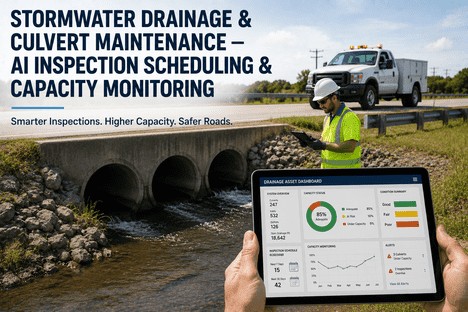
Pavement gets inspected on a schedule, bridges get load-rated and logged, and the drainage structures running underneath both of them — culverts, cross-drains, ditches, inlets — routinely get none of that attention until water is already standing where it shouldn't be. A blocked or corroding culvert doesn't announce itself; it just quietly lets water sit against a road base that was never designed to stay wet, and the pavement failure that follows gets logged as a pavement problem even though the drainage asset underneath it caused it. A short session with our team can show what it looks like to bring that same inspection discipline to the drainage network hiding beneath your road system.
Road Infrastructure · AI Drainage Asset Management
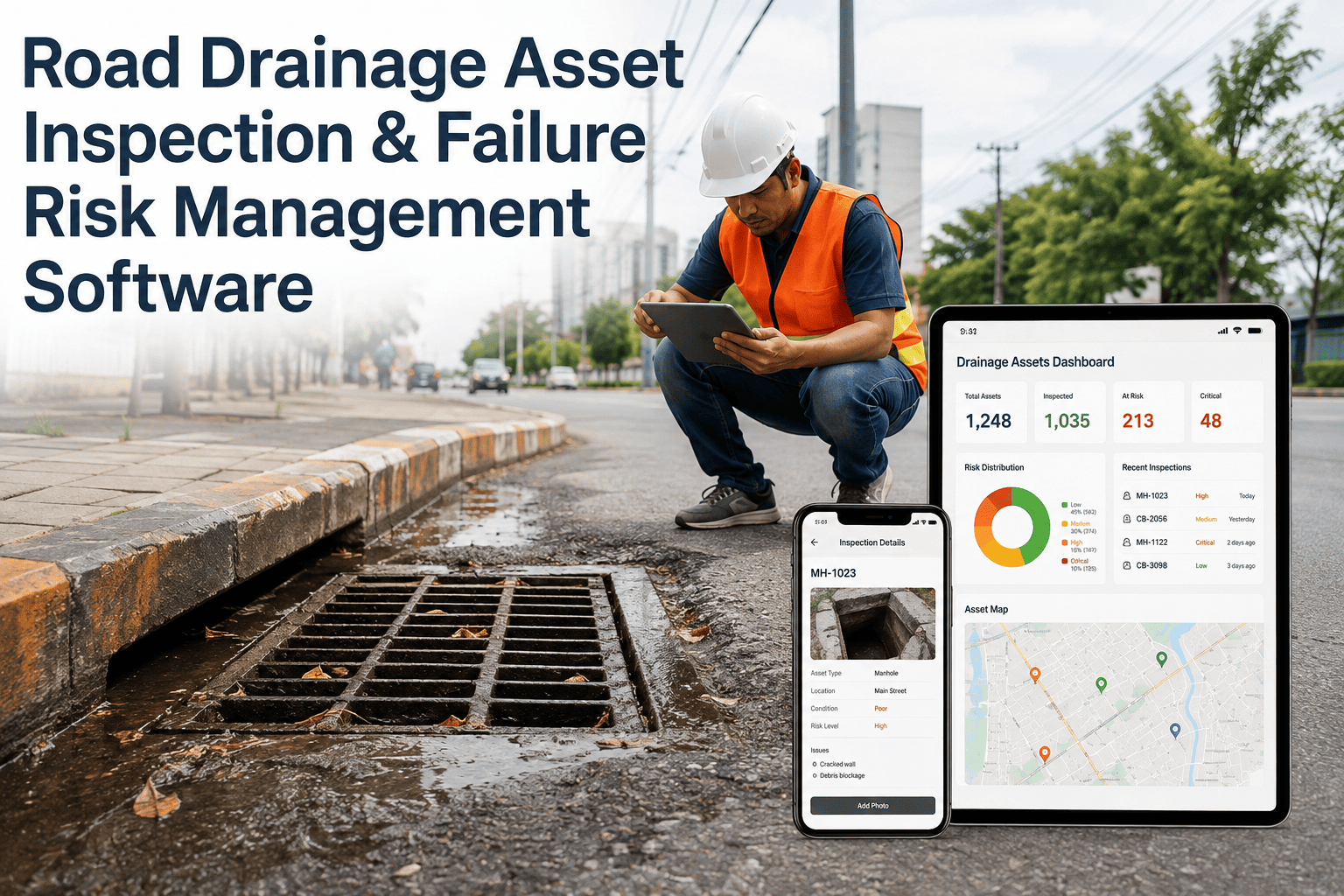
Road Drainage Asset Inspection and Failure Risk Management Software
Culverts, cross-drains, and roadside ditches carry the water that pavement and embankments depend on staying away from. When one of them blocks, corrodes, or erodes without anyone noticing, the failure usually shows up months later as a sinkhole, a pothole cluster, or an embankment slump with no obvious cause. This gives every drainage asset a condition record, a risk score, and a maintenance queue built before the water finds its way into the road structure.
100%
of mapped drainage assets tracked in one inventory
4
defect categories scored on every inspection pass
Before
the next storm event, not after the sinkhole appears
The Overlooked Asset Class
Drainage Gets Less Attention Than Pavement and Bridges, and It Shows
Road agencies have mature, well-funded inspection programs for pavement condition and bridge structural ratings, because both are highly visible and both have long-established rating systems tied directly to safety and funding decisions. Drainage structures sit underneath both of those programs, literally and organizationally, and have historically been managed with far less consistency — no standard inventory, inspection intervals that vary by crew availability, and condition notes that live in a filing cabinet rather than a system anyone can query. That gap matters because drainage failure doesn't stay contained to the drainage asset itself. A culvert choked with sediment backs water up against an embankment or road base, and the resulting saturation weakens the very structure the drainage was installed to protect, so the failure that eventually surfaces gets attributed to the pavement or the embankment rather than to the blocked pipe that caused it.
How One Missed Blockage Becomes Pavement Damage
The Chain Reaction From a Blocked Culvert to a Failed Road
1
Blockage or Corrosion
Sediment, debris, or structural corrosion reduces flow capacity inside the culvert or drain
2
Water Backs Up
Flow that should pass through pools instead against the embankment or road base
3
Base Saturation
Prolonged water contact softens subgrade material never designed to stay wet
4
Pavement Failure
Sinkholes, potholes, or embankment slumps appear with no visible drainage cause
What Gets Flagged
Four Defect Categories a Drainage Inspection Needs to Separate
Not every drainage defect carries the same urgency, and lumping sediment buildup in with structural corrosion produces a maintenance list nobody can prioritize confidently. Separating defects by category is what turns a raw inspection log into a queue a crew can actually work through in order.
Sediment and Debris Blockage
Leaves, gravel, and silt accumulation that looks structurally fine but chokes hydraulic capacity ahead of a storm event.
Structural Corrosion
Pipe wall thinning, joint separation, or invert deterioration that weakens the structure regardless of current flow condition.
Erosion and Undercutting
Scour around inlets, outlets, or footings that destabilizes the surrounding embankment and headwall over time.
Settlement and Deformation
Pavement dips or depressions directly above a culvert alignment, often the first visible sign a structure has already failed below the surface.
Prioritizing the Response
Not Every Flagged Structure Needs a Crew This Week
A road network can carry thousands of drainage structures, and treating every flagged one as equally urgent spreads a limited maintenance crew too thin to matter anywhere. Scoring each structure by defect severity, hydraulic importance, and proximity to the next expected storm turns a long inspection list into a schedule with a clear order.
See Your Drainage Network Scored and Ranked in One View
Most agencies have never seen their culverts and drainage structures ranked by actual failure risk on a single list. A short session shows what that ranked view looks like for your own network.
Applied Example
How a Choked Cross-Drain Became a Sinkhole Six Months Later
A rural arterial road crossed a drainage line through a corrugated metal culvert installed decades earlier, last inspected years before with no defects noted at the time. Sediment from an upstream field gradually accumulated at the inlet over successive seasons, reducing effective flow capacity well below its design level, a change no scheduled inspection happened to catch since none had been triggered. Water that could no longer pass through the culvert backed up against the embankment during a series of moderate storm events, saturating the base beneath the adjacent lane over several months without any visible surface sign. A shallow depression eventually appeared in the pavement directly above the culvert alignment, and by the time a crew investigated, the base had eroded enough to require a full excavation and culvert replacement rather than the sediment-clearing job that would have resolved the original blockage. The repair cost and lane closure both ended up far larger than the maintenance that would have prevented them, and the root cause traced back to a blockage that had been building for months before it ever reached the surface.
Inspection Methods Compared
Manual Crew Inspection vs Continuous Drainage Monitoring
Manual inspection remains essential for structures that need a physical look inside the pipe, but it can only realistically reach a fraction of a large network on any given cycle, which is exactly the gap continuous monitoring is built to close.
Manual Ground Inspection
Detailed structural detail on the day it's performed, but limited by crew hours and access across a large network.
CCTV or Camera Survey
Good internal pipe visibility, but typically scheduled infrequently and still requires manual review of footage.
Continuous AI Monitoring
Surface-level and imagery-based signals tracked network-wide, flagging where a physical inspection is worth prioritizing.
What's Actually at Stake
Where a Missed Drainage Defect Shows Up on the Maintenance Budget
A sediment blockage caught early is a routine clearing job measured in a small crew's time. The same blockage left unaddressed through several storm seasons can progress to base saturation, pavement settlement, and in more severe cases a full sinkhole or road collapse requiring emergency excavation, structure replacement, and an extended lane or road closure. Beyond the direct repair cost, an undiagnosed drainage failure tends to get logged and budgeted as a pavement problem, which means the underlying drainage asset never gets the corrective attention that would prevent the same failure from recurring nearby. Public safety exposure compounds the financial case — a sinkhole or sudden pavement collapse on an active roadway is precisely the kind of incident an asset management program exists to prevent, and it is far cheaper to prevent than to explain after the fact.
Culverts fail the same way almost every time — slowly, underground, and completely out of sight until the pavement above them gives it away. Agencies that have gotten ahead of this problem didn't do it by inspecting more often with the same crews, they did it by knowing which structures actually needed a crew this month instead of treating every culvert on the network the same. That prioritization is the whole game.
Renata Coelho-Vance
Roadway Drainage and Asset Management Specialist · 13 years in transportation infrastructure
Getting Started Guidance
What to Confirm Before Adding Drainage Monitoring to Your Asset Program
A short readiness check shows how quickly your existing records can turn into a prioritized inspection queue.
| Question | Why It Matters |
|---|---|
| Is there a complete inventory of culverts and drainage structures on the network? | Sets the baseline every risk score and inspection record gets attached to |
| How are inspection results currently recorded and stored? | Determines how quickly historical condition data can be brought into a live system |
| Which segments have had recurring pavement issues with no confirmed cause? | Often points directly at an underlying drainage defect worth investigating first |
| Who currently approves and schedules drainage maintenance work? | Defines the workflow a risk-scored inspection queue needs to route into |
Common Questions
Road Drainage Asset Management — Frequently Asked
These are the questions road agencies and maintenance teams tend to ask first when they start bringing drainage structures into a formal asset management program.
Does this replace physical culvert inspections?
No, physical inspection is still necessary for confirming structural condition inside a pipe, particularly for corrosion, joint separation, and other defects that can only be verified by direct or camera-based access. What changes is how that inspection capacity gets allocated — instead of working through a network on a fixed rotation, crews go first to the structures showing the clearest signs of elevated risk, whether that's surface settlement, reported flooding, or a hydraulic capacity flag. Book a demo to see how the prioritization fits alongside your existing inspection program.
Can this detect problems inside a culvert without a camera survey?
Surface-level and imagery-based signals can flag many of the downstream effects of an internal problem — pavement settlement above a culvert alignment, standing water at an inlet, erosion around a headwall, or vegetation stress from chronic saturation — well before those effects become obvious to a passing crew. These indirect signals are strong indicators that a structure needs a closer look, but confirming the specific internal defect still typically requires a CCTV survey or direct inspection once a structure is flagged. Ask our team about how flagged structures move into a physical inspection queue.
How does this help justify drainage maintenance budget to decision-makers?
A ranked list of structures by actual risk level, backed by inspection history and defect trends, gives budget decisions a much stronger foundation than a general request for more drainage maintenance funding. Being able to show which specific culverts are approaching a critical condition, and what pavement or embankment damage a delay is likely to cause, turns a maintenance ask into a clear risk-avoidance case that's easier for decision-makers to prioritize against competing budget needs. Contact support about building that kind of reporting for your agency.
Does this work for both culverts and open roadside ditches?
Yes, the same underlying approach applies to both closed structures like culverts and cross-drains and open drainage features like roadside ditches and swales, though the specific defects being tracked differ between them. Ditches are monitored more for vegetation encroachment, sediment buildup, and erosion along the channel, while culverts add structural and hydraulic capacity concerns specific to an enclosed pipe. Both feed into the same network-wide risk view rather than being managed as separate programs. Book a session to see both asset types covered together.
How quickly can a drainage inventory be built if one doesn't already exist?
Building a complete inventory from scratch takes longer than adding monitoring to an existing one, but it's a common starting point for agencies that have historically managed drainage informally, and the process typically combines available GIS data, aerial imagery, and targeted field verification to establish structure locations and baseline condition. Once that inventory exists, ongoing monitoring and risk scoring can layer on top of it relatively quickly. Book a call to discuss what your agency currently has to work with.
Find the Blocked Culvert Before It Becomes a Pavement Failure
iFactory builds a scored, prioritized view of every drainage structure on your network, turning scattered inspection records into a maintenance queue your team can act on before the next storm finds the weak point for you.