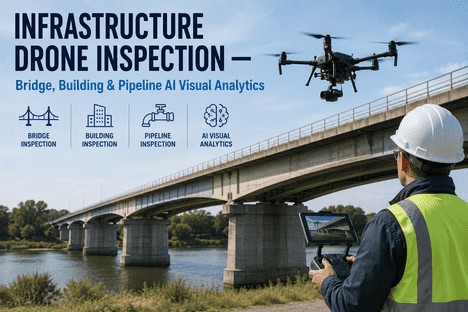
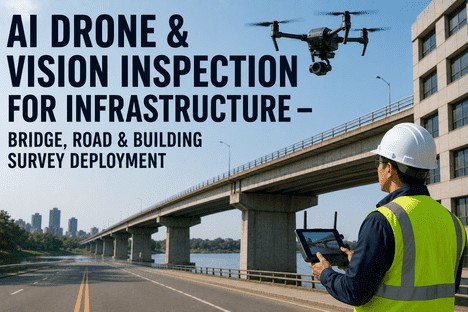
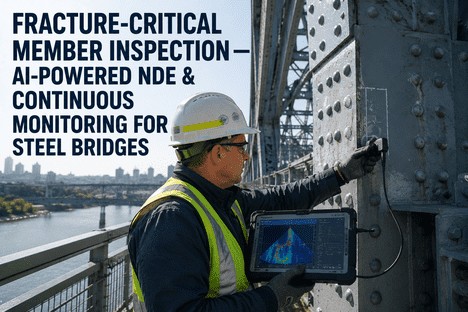
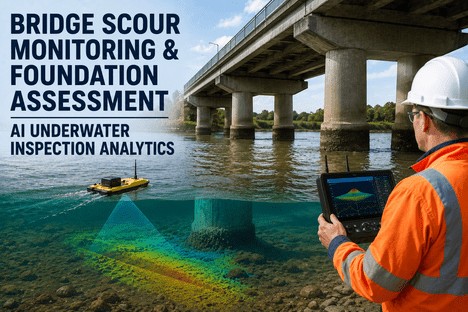
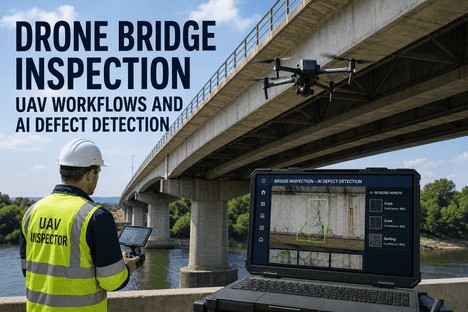
Infrastructure Drone Inspection — Bridge, Building & Pipeline AI Visual Analytics
By Grace on June 23, 2026
Every day, thousands of infrastructure inspectors climb scaffolding, rappel down bridge faces, squeeze into confined pipeline spaces, and operate heavy equipment at dangerous heights — not because they want to, but because there has been no other way to see what needs to be seen. The bridge inspection market alone is projected to reach $7.96 billion by 2034, yet the methods that dominate the industry remain fundamentally unchanged: manual visual observation, rope access, snooper trucks, and helicopter flyovers that cost $150 to $500 per mile. The result is a system that is slow, inconsistent, expensive, and increasingly unable to keep pace with the scale of aging infrastructure. Drone-based AI visual analytics changes the equation entirely. Aerial platforms equipped with high-resolution optical cameras, thermal sensors, and LiDAR can capture every visible surface of a structure in hours rather than days. Computer vision algorithms process the resulting imagery to detect cracks, measure corrosion, identify thermal anomalies, and flag structural displacement at a speed and accuracy that no human inspection team can match. The global inspection drone market has already reached $4 billion in 2025 and is growing at 16.6% annually — not because drones are novel, but because they solve a cost and safety problem that traditional methods cannot.
Drone Inspection · AI Visual Analytics · Infrastructure Asset Management · Bridge Pipeline Building Inspection
Stop Sending People Into Dangerous Places. Start Sending Data Into Your Maintenance Workflow.
iFactory's inspection management platform integrates drone-captured visual data, AI defect detection outputs, and asset condition records into a single maintenance workflow — so every inspection result becomes an actionable work order, every defect is tracked over time, and every asset has a complete condition history.
The global inspection drone market is projected to grow from $4 billion in 2025 to $16 billion by 2034 at a 16.6% CAGR — the fastest growth segment in commercial UAV applications
60–75%
Cost reduction achieved by organisations that replace traditional scaffolding, rope access, or helicopter inspections with drone-based aerial visual data capture and AI analysis
50%
Reduction in total inspection time from site arrival to final report when drone-based AI visual analytics replaces manual inspection methods across comparable asset portfolios
95%
AI defect detection accuracy achieved by production-grade computer vision models trained on infrastructure inspection imagery — exceeding human visual detection rates in controlled studies
Bridges, Buildings, Pipelines — Three Asset Classes Where Drone AI Visual Analytics Is Reshaping Inspection
The value of drone-based AI visual analytics varies by asset type, but the core advantage is consistent across all three: better data, captured faster, at lower risk, with lower cost, feeding directly into a maintenance management system that translates visual findings into work orders. Each asset class presents its own inspection challenges, and each benefits from a tailored combination of sensor payload, flight pattern, and AI analysis model.
Bridges
Under-deck scanning
Pier & abutment
The challenge
Over 600,000 bridges in the US with an average age of 42 years. Manual inspection requires lane closures, snooper trucks, and rope access teams — each bridge inspection costs $4,500 to $10,000 and disrupts traffic for days. A single structurally deficient bridge collapse can cost hundreds of millions in liability.
The drone AI solution
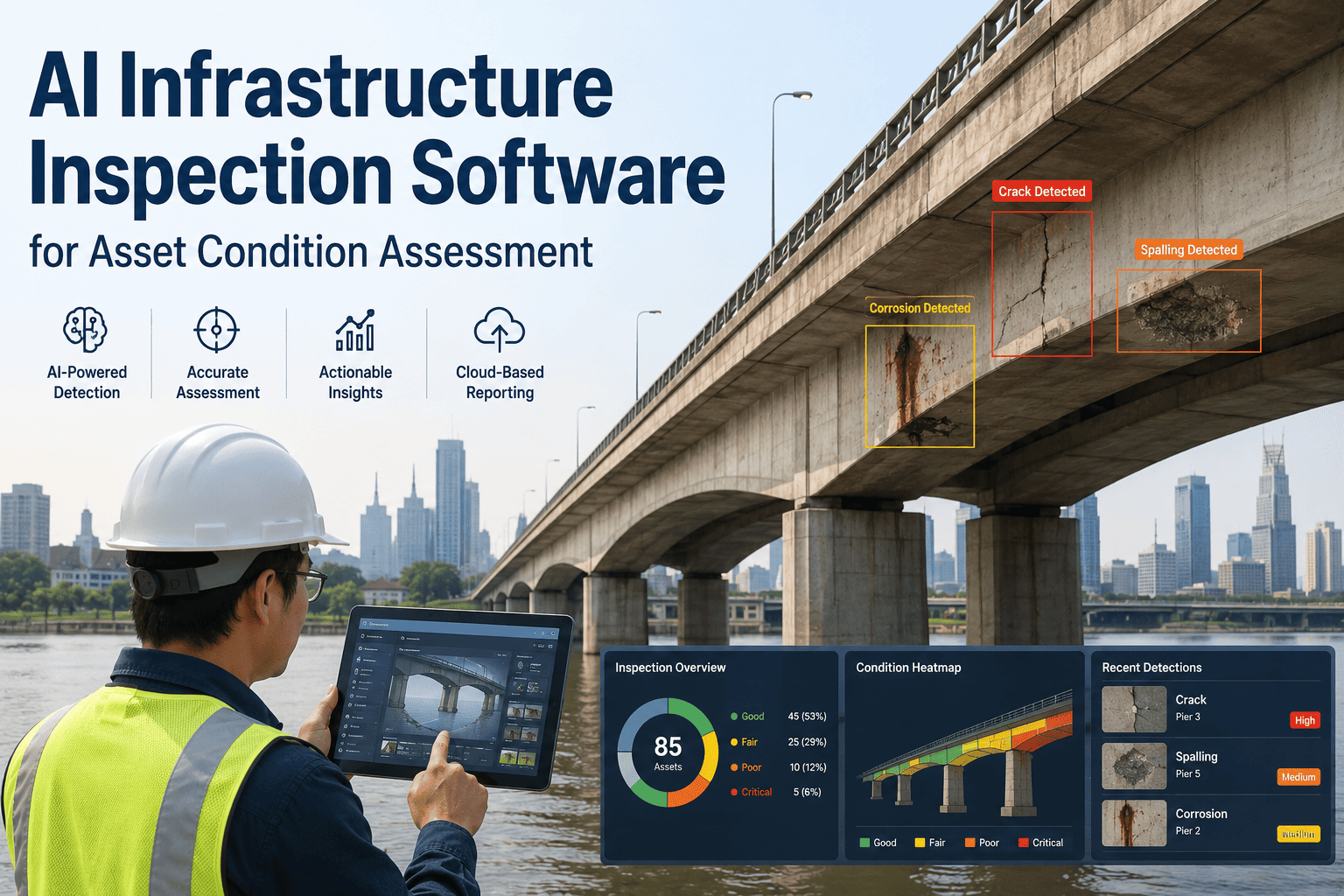
Multi-rotor drones with 4K RGB and thermal cameras capture deck surfaces, expansion joints, bearing assemblies, pier caps, and girder ends in a single two-hour flight — no lane closures, no scaffolding. AI models detect concrete spalling, crack patterns exceeding 0.3 mm, corrosion staining, and bearing displacement. Defect locations are geotagged and exported directly to iFactory as inspection records with severity classifications, enabling condition-based maintenance scheduling rather than calendar-based biannual cycles.
Buildings & Structures
Facade facades
Roof membrane
The challenge
High-rise building facade inspections require swing stages, scaffolding, or rope access — each setup costing $15,000 to $50,000 and taking days to erect. Routine roof inspections for commercial facilities are often deferred due to access difficulty, leading to undetected membrane failures that cause interior water damage costing 10x the inspection cost.
The drone AI solution
Drones with 20MP+ cameras and obstacle avoidance navigate building perimeters autonomously, capturing every elevation at 1 cm per pixel resolution. AI algorithms classify facade materials and flag detached panels, sealant failures, moisture intrusion indicators, and crack propagation. Thermal cameras identify insulation gaps and flat roof moisture entrapment invisible to the human eye. Inspection outputs integrate with iFactory's work order system — each detected defect generates a condition record that can be assigned to a contractor, tracked through repair completion, and re-inspected on the next flight cycle for progression analysis.
Pipelines
R-O-W corridor
Thermal leak
The challenge
Enough oil and gas pipelines exist worldwide to circle the earth 20 times. Ground patrols cover 20 to 30 miles per day at a cost of $300 to $500 per mile. Helicopter surveys cost $150 to $500 per mile but miss subtle ground-level indicators. A 1% leak in a 20-inch pipeline can lose 450,000 barrels per year and contaminate up to 10 square kilometres before detection.
The drone AI solution
Fixed-wing drones cover 50+ miles per mission with thermal infrared sensors that detect temperature anomalies as small as 2 degrees Celsius — indicating potential leaks, corrosion hotspots, or third-party interference. AI models classify vegetation stress patterns along the right-of-way, identify unauthorized excavation activity, and flag coating disbondment from thermal signature variation. Data feeds into iFactory as georeferenced inspection events with GPS coordinates, severity scores, and imagery evidence, enabling ground crews to be dispatched only where AI has confirmed a finding rather than patrolling the full corridor.
AI Defect Detection · Workflow Integration · Condition History
A Single Drone Flight Generates Thousands of Images. iFactory Turns Them Into Trackable Maintenance Actions.
Every AI-detected defect captured from bridge, building, or pipeline inspection can become a condition record, a work order, or a scheduled task in iFactory — linked to the asset, time-stamped, severity-graded, and ready for assignment to your maintenance or contractor teams.
The AI Visual Analytics Pipeline — From Raw Footage to Scheduled Maintenance in Five Stages
The difference between a drone photography project and an AI-powered inspection programme is the pipeline that connects raw sensor data to maintenance action. Without this pipeline, drone footage sits on hard drives and yields no operational improvement. With it, every flight produces structured, actionable intelligence that enters the maintenance management system without human transcription or interpretation.
01
Capture
Autonomous flight path captures 500–5,000 high-resolution images per asset with RGB, thermal, and LiDAR sensors at 1–3 cm per pixel ground resolution
02
Process
Orthomosaic stitching and 3D reconstruction create a single, georeferenced digital model of the asset from individual overlapping images — the foundation for pixel-level comparison across inspection cycles
03
Detect
Trained computer vision models classify and measure defects across the digital model — crack width, spalling area, corrosion extent, thermal anomaly delta, vegetation encroachment — with severity scoring per finding
04
Report
Structured inspection report with geotagged defects, severity levels, comparative trending from previous cycles, and recommended maintenance actions — exported to iFactory as condition records linked to each asset
05
Act
iFactory generates work orders from inspection findings automatically — assigns to internal crew or external contractor, tracks repair completion, updates asset condition score, and schedules the next inspection cycle based on defect progression rate
Traditional Inspection vs. Drone AI Visual Analytics — The Quantified Comparison
The decision to adopt drone-based AI inspection is not a technology choice — it is a financial and operational choice. The numbers below are drawn from industry benchmarks across bridge, building, and pipeline inspection programmes that have replaced traditional methods with drone-based AI analytics and integrated the outputs into a CMMS-based maintenance workflow.
Traditional Inspection vs. Drone AI Visual Analytics — Five Critical Dimensions
Dimension
Traditional Method
Drone AI Visual Analytics
Cost per inspection
$4,500–$10,000 per bridge (including traffic control, snooper truck, crew of 3–5, and reporting). $150–$500 per mile for helicopter pipeline patrol. $15,000–$50,000 for high-rise facade setup and access equipment.
$800–$2,500 per asset for comprehensive multi-sensor capture, AI analysis, and structured report generation. Pipeline corridor inspection at $15–$75 per mile. 60–75% total cost reduction across all asset classes.
Safety exposure
Workers at heights, in confined spaces, over water, in active traffic lanes, or near energised infrastructure. Falls, struck-by, and confined-space incidents are the leading causes of inspection-related fatalities.
Zero personnel in hazardous zones. All data capture is conducted from a safe remote position. Insurance claims related to inspection activities drop by 80–90% in organisations that transition to drone-first inspection programmes.
Data coverage
Sampling-based — the inspector sees what is reachable from access points. Bridge undersides, pipe overheads, and upper building elevations are often assessed from a single vantage point or not at all.
100% visible surface coverage from multiple angles. Every square metre of the asset is captured at 1–3 cm resolution and preserved in a georeferenced digital model. Areas invisible to ground-based inspectors become fully documented.
Defect detection
Human visual detection with variance of 20–40% between inspectors. Fatigue, lighting conditions, and experience levels produce inconsistent results. Sub-millimetre cracks and subtle thermal anomalies are routinely missed.
Consistent computer vision detection at 95%+ accuracy with repeatable measurement. Every defect is measured to sub-millimetre precision, classified by type and severity, and tracked across inspection cycles for progression analysis. Zero fatigue-related misses.
Workflow integration
Handwritten notes, PDF reports, or spreadsheets — each finding must be manually transcribed into the maintenance system. Transcription lag of days to weeks. No structured link between inspection finding and work order creation.
AI-detected defects are exported as structured data objects that map directly to iFactory asset condition records. Each finding can trigger an automatic work order, update a condition score, or reschedule the next inspection interval — without human data entry.
"
We were spending over $600,000 annually on third-party bridge inspection contracts — snooper trucks, traffic control, rope access teams, and the reporting overhead. The first year we switched to drone-based AI visual inspection, we spent $180,000 on the drone programme, captured 100% surface coverage on all 14 bridges in our portfolio, and identified three critical defects that had been missed in the previous manual cycle. The defects were repaired before failure. The programme paid for itself in the first inspection cycle. The real value, though, was not the cost saving. It was knowing that every square metre of every bridge was documented, measured, and tracked in our maintenance system with a condition score that updated automatically each cycle.
— Director of Infrastructure Asset Management, Regional Transportation Authority — 22 Years in Bridge and Highway Maintenance
Four Factors That Determine Whether Your Drone Inspection Programme Delivers Maintenance Impact
Organisations that successfully integrate drone-based AI inspection into their maintenance operations share common characteristics. They do not treat drone inspection as a standalone activity that produces standalone reports. They treat it as a data input into a living maintenance management system — which is where iFactory enters the picture.
Sensor payload matches the defect types you need to detect
Standard RGB cameras capture surface cracks, spalling, and corrosion staining. Thermal cameras detect moisture intrusion, insulation gaps, overheating components, and pipeline leaks. LiDAR measures structural displacement, deflection, and clearance violations. The most effective programmes combine two or more sensor types on the same flight — capturing visual and thermal data in a single pass so that the AI model can cross-reference findings across sensor modalities.
AI model is trained on your asset types and defect categories
Pre-trained computer vision models detect generic defects across concrete, steel, and composite surfaces. Programmes that achieve highest accuracy invest in fine-tuning their models on site-specific defect examples — capturing the particular crack patterns, corrosion morphology, and thermal signatures that appear on their specific bridge designs, building cladding types, and pipeline coatings. This customisation lifts detection accuracy from 85% to 95%+ and reduces false positive rates that erode operator trust in the system.
Inspection frequency is driven by condition data, not calendar cycles
The most advanced programmes use condition trajectory data from each inspection cycle to determine the next inspection interval. An asset with no defects and stable condition is inspected at a longer interval. An asset with active crack propagation or corrosion progression is inspected sooner. iFactory supports this dynamic scheduling by tracking condition scores over time and flagging assets whose degradation rate exceeds programmed thresholds — so inspection resources are allocated to the assets that need them most, rather than spread uniformly across a portfolio.
Inspection data enters a CMMS that connects findings to work orders
The single most important factor separating effective drone inspection programmes from ineffective ones is the integration between the visual analytics output and the maintenance management system. If a defect detected by AI requires a person to manually create a work order, transcribe the location, upload the image, and assign a priority, the inspection-to-repair cycle loses the speed advantage that drone capture provides. iFactory ingests structured inspection data directly — each AI-detected finding becomes a condition record with asset linkage, geotag, severity score, and imagery, and can trigger an automatic or supervisor-approved work order without manual data entry at any stage.
Conclusion
The inspection drone market is projected to grow from $4 billion to $16 billion by 2034 because the economics are undeniable: 60 to 75 percent cost reduction, 50 percent faster inspection cycles, 95 percent AI defect detection accuracy, and zero personnel exposure to hazardous access conditions. But the organisations that capture the full value of this transformation are not the ones that buy drones and generate imagery. They are the ones that connect the AI inspection output to a maintenance management system that turns every detected defect into a tracked, assigned, and completed work order — and every inspection cycle into a condition data point that improves the accuracy of the next maintenance decision.
iFactory bridges the gap between drone-based AI visual analytics and operational maintenance execution. The platform ingests structured inspection data from any AI provider, maintains a complete condition history for every asset, triggers work orders from severity-graded defect records, and dynamically adjusts inspection schedules based on condition progression. Talk to an expert to discuss how iFactory can connect your drone inspection programme to your maintenance workflow, or book a demo to see the platform in action with your asset data.
Every Structure Has a Story. iFactory Makes Sure Yours Has a Maintenance Plan.
Bridge, building, or pipeline — every asset your team maintains deserves an inspection programme that captures more data, at lower cost, with zero safety risk. iFactory turns that data into action.
iFactory can ingest structured inspection data from any asset type that can be captured by drone-mounted sensors — bridges, buildings, pipelines, transmission towers, wind turbine blades, solar arrays, dams, ports, and railway infrastructure. The platform maps each inspection finding to the specific asset record, creating a condition history that accumulates across every inspection cycle. This means a bridge inspected quarterly generates a condition trend line that a director can review in a single view, rather than comparing PDF reports from different inspection vendors. iFactory's asset hierarchy supports nested structures — a bridge has decks, piers, abutments, and bearings as child assets — so inspection findings are recorded at the component level while rolling up to the parent asset condition score. Talk to an expert to discuss how your specific asset classes and inspection data formats can integrate with iFactory's condition tracking and work order automation.
iFactory does not ingest raw imagery. The platform ingests the structured output of the AI analysis layer — a compact dataset containing each detected defect's asset identifier, GPS coordinates or structural location, defect type classification, severity score, measurement data, and a reference to the source image or image patch. A drone flight that captures 3,000 images might generate 40 structured defect records. Those 40 records enter iFactory as condition records that are immediately actionable — linked to the correct asset, severity-graded for prioritisation, and ready for work order creation. This means the maintenance team never has to browse thousands of images to find actionable findings. They review 40 condition records, prioritise by severity, assign work orders to the critical findings, and the system schedules the next inspection cycle automatically based on the findings from the current one. Book a demo to see how iFactory's condition record ingestion pipeline processes structured inspection data from any AI analytics provider.
Yes. iFactory maintains a complete condition history for every asset — each inspection cycle adds a new set of condition records while preserving all previous records. This means a crack detected in a bridge girder during the 2025 inspection is still in the system during the 2026 inspection, and when the 2026 data arrives showing the same crack has widened from 0.4 mm to 0.7 mm, the system records the progression. The platform can flag assets where any defect severity has increased beyond a configurable threshold across cycles, triggering a priority review or an accelerated inspection schedule. For directors managing large infrastructure portfolios, this condition trending capability transforms inspection data from a periodic compliance snapshot into a continuous decision-support signal — showing not just which assets have defects, but how quickly those defects are progressing and which ones require intervention before they reach critical severity. Talk to an expert about setting up condition progression tracking for your infrastructure asset portfolio.
The maintenance team does not need to pilot drones or operate AI software. The typical workflow involves a drone service provider or in-house UAV team conducting the flight and running the AI analysis. The output — a structured dataset of detected defects with severity scores, locations, and imagery references — is delivered to iFactory through an API or structured file import. The maintenance team interacts with the results inside iFactory's familiar work order and asset management interface. They review condition records, prioritise findings by severity, assign work orders to internal crews or external contractors, track repair completion, and update asset condition scores — all within the same platform they use for daily maintenance operations. Training requirements are limited to the iFactory interface itself, which most maintenance teams already know. Book a demo to see the full workflow from AI defect detection to work order completion in iFactory.