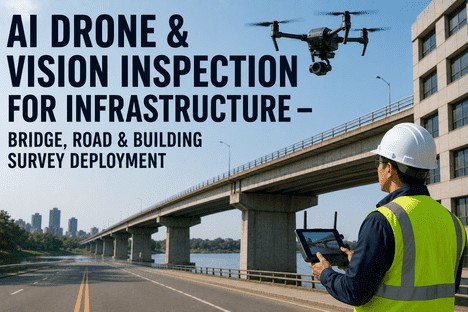
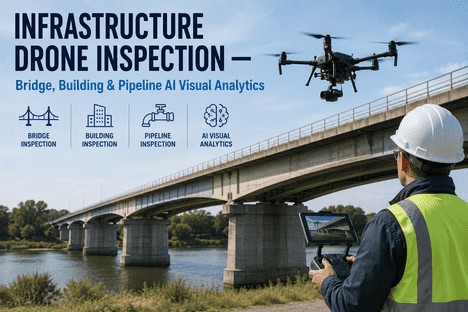
AI Drone & Vision Inspection for Infrastructure — Bridge, Road & Building Survey Deployment
By Grace on June 24, 2026
More than 46,000 bridges in the United States are structurally deficient. Over 171 million daily crossings occur on bridges rated in poor condition. Roads and highways require trillions in deferred maintenance. Yet the inspection methods that evaluate these critical assets have remained largely unchanged for decades — manual visual checks by engineers using scaffolding, under-bridge units, and lane closures that cost time, money, and expose workers to significant safety risks. The global drone inspection and monitoring market has reached $18.4 billion and is growing at 19% annually, not because drone hardware became cheaper, but because AI-powered computer vision finally makes the data captured from an aerial survey as actionable as a physical inspection — detecting cracks in concrete, corrosion in steel, and deterioration in pavement with accuracy that matches or exceeds manual inspection. iFactory's AI drone and vision inspection platform closes the gap between aerial data collection and infrastructure decision-making, delivering bridge deck surveys, road condition assessments, and building envelope inspections with computer vision analytics that turn flight data into maintenance priorities.
AI Drone Inspection · Computer Vision · Bridge Survey · Road Assessment · Building Inspection
Manual Inspection Puts Workers at Risk and Assets on Hold. iFactory Makes Inspection Autonomous, Accurate, and Actionable.
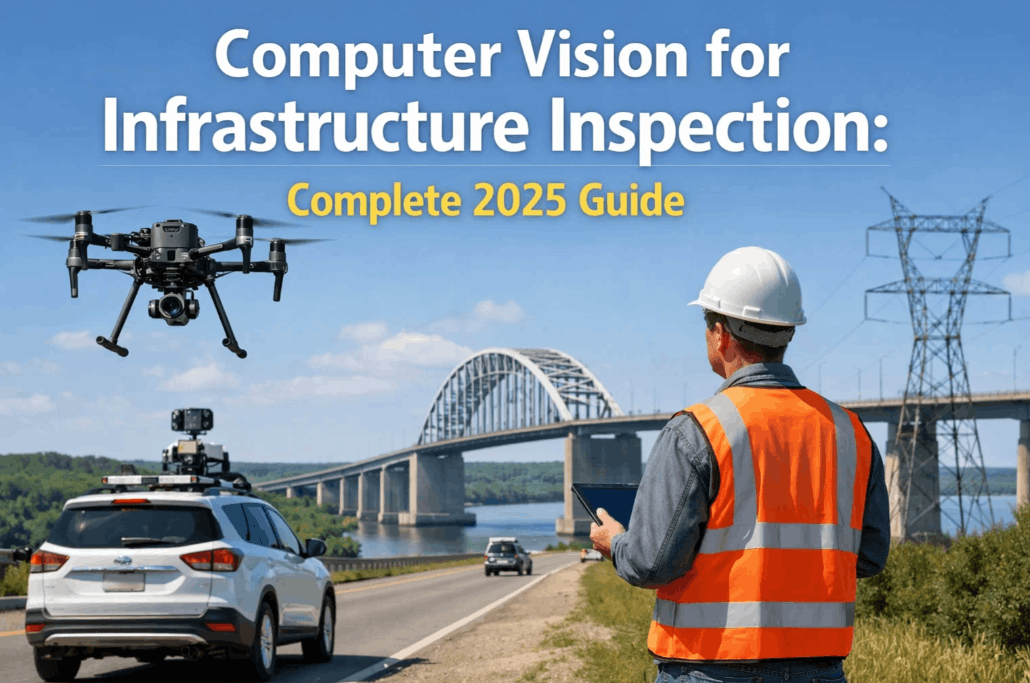
iFactory's AI drone vision inspection platform combines autonomous UAV flight, computer vision defect detection, and a unified analytics dashboard — purpose-built for bridge, road, and building infrastructure surveys at a fraction of traditional cost and time.
U.S. bridges are structurally deficient — each requiring frequent, detailed inspection that manual methods cannot deliver at the necessary scale or frequency
70%
Reduction in inspection time with AI-powered drone surveys — a single bridge inspection drops from 8+ hours to under 2 hours with computer vision analysis
$18.4B
Global drone inspection and monitoring market in 2026, growing at 19% CAGR — infrastructure inspection is the fastest-growing segment within this market
91%
Fewer accidents reported by organisations that switch from manual rope-access inspection to drone-based structural surveys with AI defect detection
Why Traditional Infrastructure Inspection Is Failing — and the Data That Proves It
The inspection methods that have served infrastructure operators for decades were designed for a different era — when assets were newer, traffic volumes were lower, and inspection frequency requirements were less demanding. Today, with aging infrastructure, growing inspection backlogs, and a shortage of qualified structural engineers, the limitations of manual inspection have become existential risks rather than operational inconveniences. The data from real-world deployments reveals three systemic failures that AI-powered drone and vision inspection directly addresses.
01
Manual Inspection Cannot Scale to Meet the Inspection Deficit
With 46,000 structurally deficient bridges and over 615,000 bridges requiring regular inspection across the U.S. alone, the manual inspection model is mathematically incapable of keeping pace. Each bridge inspection requires lane closures, under-bridge units, and a team of structural engineers for 6-8 hours per structure. At current staffing levels, many bridges go 24-48 months between inspections despite regulatory requirements for 12-24 month intervals. The inspection backlog grows every year. AI-powered drone inspection reduces per-structure assessment time to under 2 hours with no lane closures and a two-person field team — making it possible to inspect more assets, more frequently, with the same or smaller workforce.
02
Human Visual Inspection Is Inherently Subjective and Inconsistent
Two structural engineers inspecting the same bridge deck frequently produce different condition ratings. The same engineer inspecting the same asset six months apart may assign different severity classifications to identical defects. Manual inspection relies on visual acuity, judgment, and fatigue management — all variable human factors that introduce inconsistency into the dataset that drives maintenance prioritisation. Computer vision models, by contrast, apply the same detection threshold to every pixel of every image on every flight. Crack width measurement, spalling area calculation, and corrosion classification are consistent across inspections, across assets, and across time. This consistency enables reliable trend analysis that is impossible with subjective manual ratings.
03
Inspection Data Is Collected but Rarely Converts to Actionable Insights
The typical outcome of a manual bridge inspection is a PDF report submitted weeks after the field visit. The report contains photographs, condition ratings, and recommendations — but the data is unstructured, non-georeferenced, and stored in a format that makes trend analysis, cross-asset comparison, or predictive modelling impossible. Each inspection is a standalone event rather than a data point in a continuous monitoring programme. AI-powered drone inspection produces geotagged defect data, machine-readable condition scores, and time-series comparison capability from the first flight. The output is not a report — it is a continuously updated digital asset model that connects each inspection cycle to the one before it.
Stop Inspecting for Compliance. Start Inspecting for Intelligence. iFactory Turns Every Flight into a Decision.
From autonomous flight planning to AI defect classification to maintenance workflow integration — iFactory's platform digitises the entire inspection lifecycle for bridges, roads, and buildings.
Three Infrastructure Categories, One Unified Inspection Platform — How iFactory's AI Drone Vision Works for Each Asset Type
Different infrastructure assets present different inspection challenges — but the underlying technology stack that solves them is the same. Autonomous drone flight, high-resolution image capture, computer vision defect detection, and a digital asset model that connects every inspection cycle. The following three sections demonstrate how iFactory's platform adapts to the specific requirements of bridges, roads, and buildings while maintaining a single unified data architecture and analytics dashboard.
B
Bridge Deck and Structural Surveys
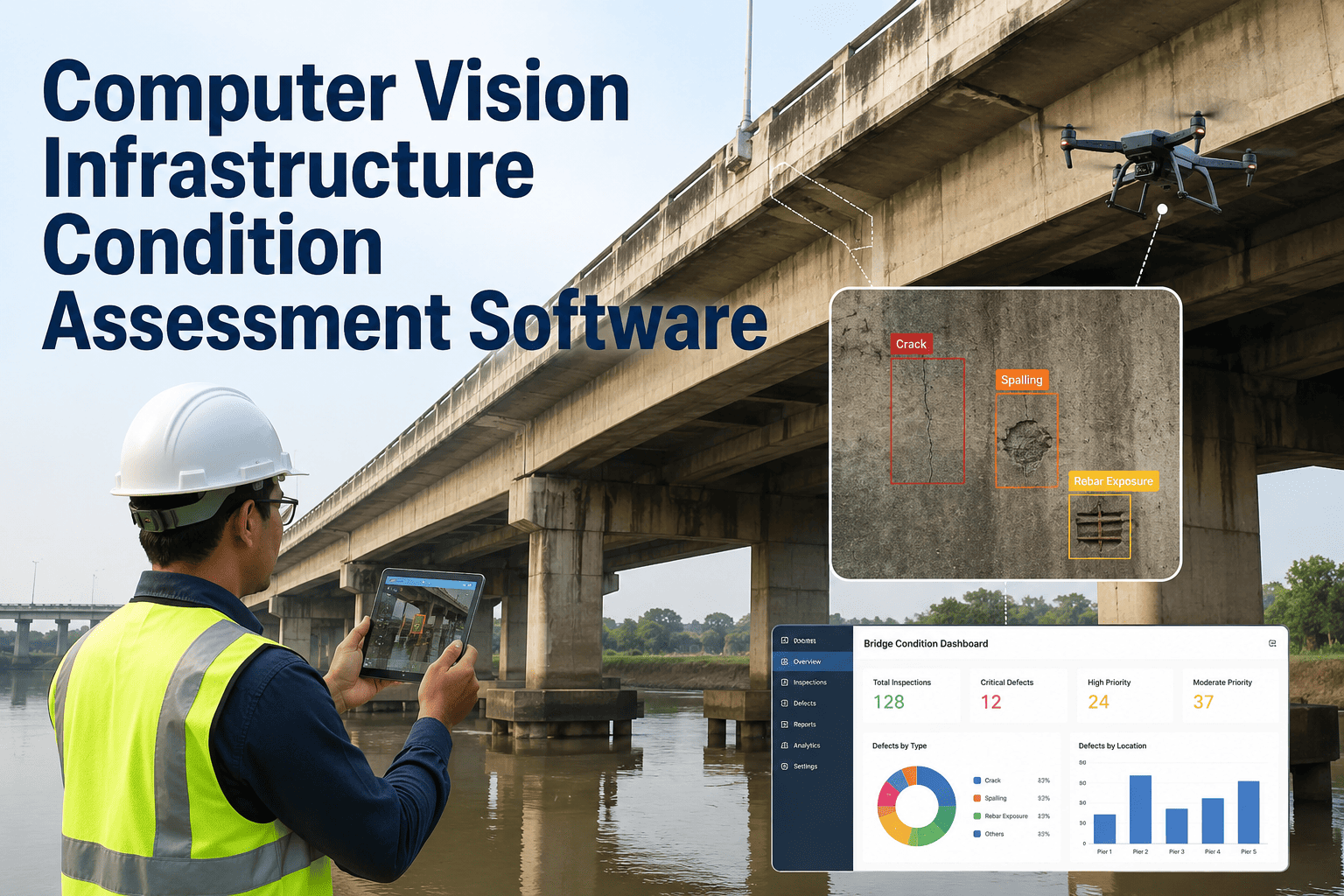
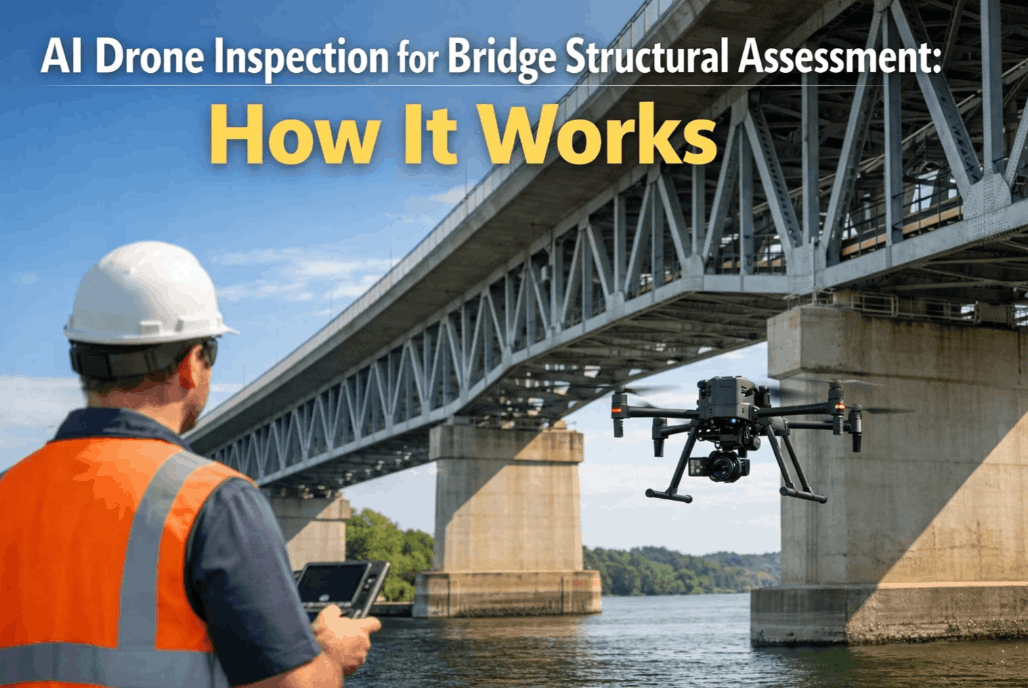
Autonomous flight paths capture high-resolution imagery of deck surfaces, girder connections, bearing assemblies, expansion joints, and abutments. Computer vision models detect and classify cracks by width, measure spalling area, identify corrosion staining, and assess joint condition — all with geotagged precision mapped to the bridge's digital twin.
Bridge inspection time: 8+ hours manual to under 2 hours with iFactory AI drone inspection. No lane closures. No under-bridge units. No scaffolding.
R
Road Surface and Pavement Condition Assessment
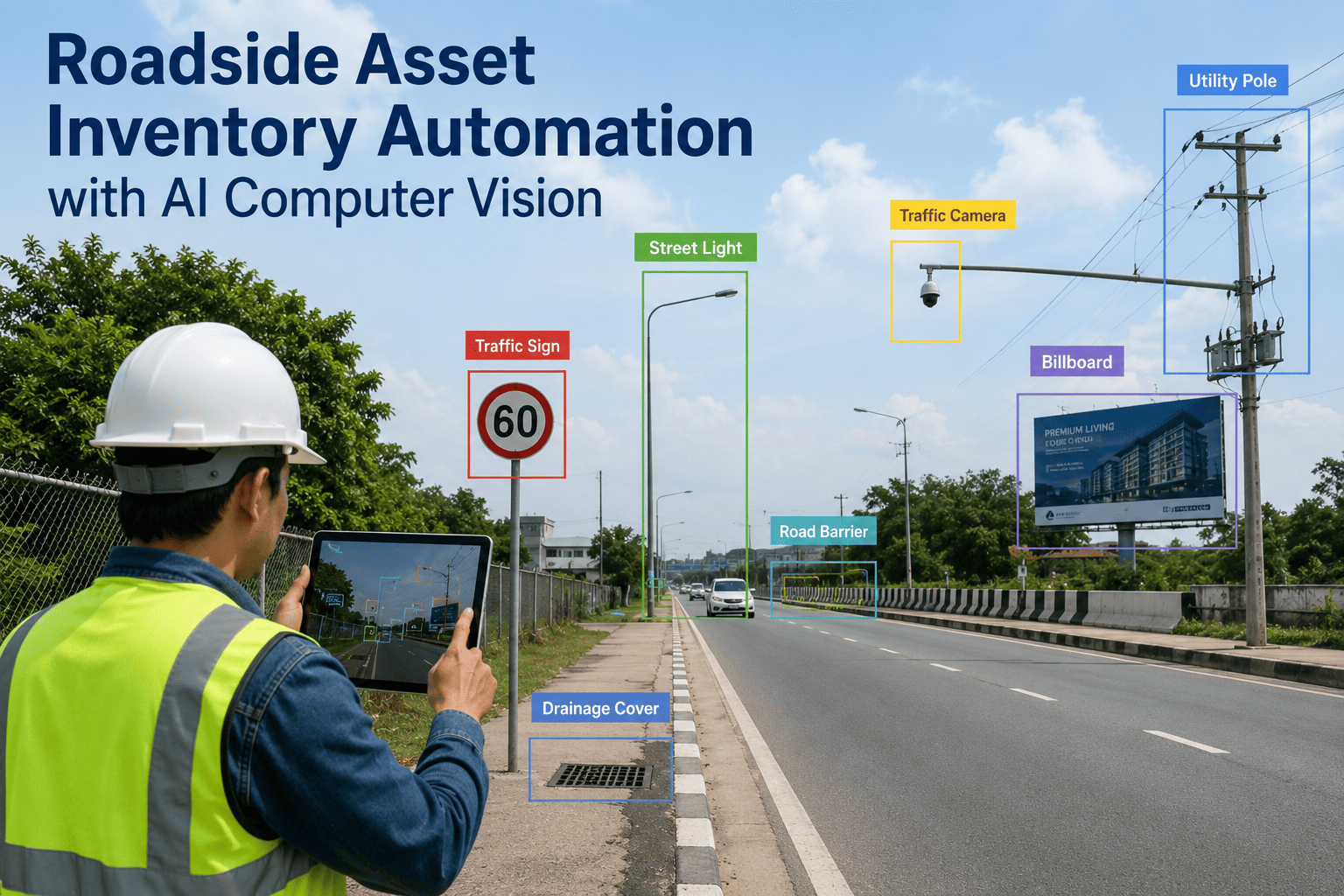
Corridor-level drone surveys capture pavement surface data at 1cm resolution across entire road networks. AI models identify and classify potholes, alligator cracking, longitudinal and transverse cracking, rutting, and shoulder deterioration. Defect data is mapped to geospatial coordinates and scored by severity for maintenance prioritisation.
Road network survey: 20 miles per day with drone vs. 3 miles per day with manual survey crew. Cost per lane-mile reduced by up to 60%.
B
Building Envelope and Facade Inspection
Vertical asset inspection using collision-tolerant drones or close-range UAV flight paths captures facade conditions at every elevation. Computer vision identifies cladding defects, sealant failure, window seal degradation, moisture intrusion signs, and structural cracking. Results are mapped to building elevation plans with severity ratings per zone.
Building facade inspection: 15-20 story structure in 4 hours with drone vs. 3-5 days with scaffolding or swing-stage access. Zero worker height-safety risk.
Manual Inspection vs. AI Drone Vision Inspection — Real-World Time and Cost Comparison
Metric
Traditional Manual Inspection
iFactory AI Drone Vision Inspection
Single Bridge Deck Inspection
6-8 hours on-site with 4-person crew. Lane closures required. Under-bridge unit needed for underside access. Scaffolding for pier and bearing inspection.
1.5-2 hours on-site with 2-person crew. Zero lane closures. Full deck, underside, girder, bearing, and joint coverage via autonomous flight paths.
10-Mile Road Corridor Survey
2-3 days with 3-person survey crew. Vehicle-mounted or walking survey. Traffic control required. Manual defect logging with photographs.
2-3 hours flight time. Single operator. 1cm resolution pavement imagery. AI defect classification and severity scoring. Geotagged output.
20-Story Building Facade Assessment
3-5 days with swing-stage scaffolding setup and removal. 4-6 person crew. Height-safety protocols. Limited to areas accessible by staging.
3-4 hours flight time. 2-person ground crew. 100% facade coverage. AI detection of cladding defects, sealant failure, cracking. Zero height exposure.
Annual Inspection Programme 50 Bridges
400-500 field hours annually. 12-15 weeks total programme duration. Report delivery 4-8 weeks after last inspection. Cost: $15,000-25,000 per bridge.
100-120 field hours annually. 4-6 weeks total programme duration. Digital results available within 48 hours of each flight. Cost: $4,000-7,000 per bridge.
The AI Drone Inspection Workflow — From Flight Plan to Maintenance Decision in Five Integrated Steps
The difference between a drone that captures video and an AI inspection platform that drives maintenance decisions is the workflow that connects flight data to action. iFactory's platform structures the entire inspection lifecycle into five repeatable steps — from pre-flight planning through to work order generation — ensuring that every flight produces structured, decision-ready data rather than raw footage that requires manual interpretation.
01
Flight Planning
Asset-specific flight paths configured for bridge geometry, road corridor alignment, or building elevation. Altitude, overlap, and resolution parameters set per asset class for consistent data capture across every inspection cycle.
02
Autonomous Capture
Executes pre-programmed flight paths with RTK GPS precision. High-resolution RGB, thermal, and multispectral capture. Real-time telemetry and image quality verification during flight.
03
AI Defect Detection
Computer vision models process imagery within 24 hours of flight. Crack detection, spalling measurement, corrosion classification, and pavement defect scoring. All defects geotagged and severity-rated.
04
Digital Asset Model
All inspection data integrated into a per-asset digital model. Time-series comparison against previous inspection cycles. Defect progression tracking. Automated condition score calculation.
05
Workflow Integration
Defect data feeds directly into maintenance workflow. Automated work order generation for critical findings. Export-ready compliance reports. Integration with existing CMMS and asset management platforms.
The Inspection KPI Framework — Measuring What Matters Across Operations, Engineering, and Leadership
AI drone inspection generates significantly more data than manual methods — but data without a decision framework is noise. iFactory's analytics dashboard structures inspection outputs into three decision layers, ensuring that every level of the infrastructure organisation sees the metrics relevant to its role and responsibility.
Layer 01
Field Operations
Critical defect count per asset — number of severe or critical findings requiring immediate maintenance intervention
Inspection coverage completeness — percentage of asset surface area captured and analysed per flight cycle
Flight-to-report turnaround time — hours from field deployment to available defect data in the dashboard
Layer 02
Engineering
Defect progression rate — rate of crack growth, spalling expansion, or corrosion spread between inspection cycles per asset
Condition index trend — asset-level condition score trajectory over the last 3, 6, and 12 months with forecast projection
False positive rate — percentage of AI-detected defects that are not confirmed during validation inspection
Layer 03
Executive Leadership
Inspection cost per asset — total programme cost divided by number of assets inspected. Month-over-month trend to measure efficiency gains
Backlog reduction rate — percentage reduction in overdue inspections since AI drone programme deployment
Maintenance intervention ROI — cost of repairs triggered by early AI detection vs. estimated cost if defects had progressed to critical stage
"
We manage over 200 bridges across three counties. Before deploying iFactory's AI drone inspection platform, we were getting through roughly 35-40 bridge inspections per year with a crew of four structural engineers and an under-bridge unit that required lane closures and traffic control on every deployment. The inspection backlog was growing by 15-20 bridges annually. In our first year with iFactory, we completed 95 inspections — more than double our historical rate — with a two-person team and zero lane closures. The computer vision defect detection caught a bearing joint deterioration on a 35-year-old bridge that our manual inspection cycle would not have reached for another 14 months. The cost of that repair was $12,000. The cost of a failure would have been in the millions. The platform did not just save us time. It changed what we thought was possible with our existing team.
— Director of Infrastructure Maintenance, County Transportation Agency — 20 Years Bridge and Roadway Asset Management
Conclusion
The infrastructure inspection model that relies on manual visual assessment, scaffolding, lane closures, and weeks-later PDF reports cannot meet the demands of aging assets, growing inspection backlogs, and increasing regulatory scrutiny. More than 46,000 structurally deficient bridges, trillions in deferred road maintenance, and a shrinking pool of qualified structural engineers make the transition to AI-powered drone and vision inspection a strategic imperative rather than a technology upgrade. The organisations that deploy AI-driven inspection programmes now will be the ones with reliable condition data across their entire asset portfolio, maintenance teams working from current defect information rather than outdated reports, and capital plans grounded in measured deterioration rates rather than subjective condition ratings.
iFactory's AI drone and vision inspection platform gives infrastructure operators a complete deployment-ready system — from autonomous flight planning and computer vision defect detection to a unified analytics dashboard that serves field teams, engineers, and executives with the metrics relevant to their decisions. With the drone inspection market projected to reach $36.9 billion by 2030 and inspection time reductions of 70% documented across bridge, road, and building deployments, the question for infrastructure leaders is no longer whether to adopt AI-powered inspection — it is how quickly the transition can begin. Book a Demo to see how iFactory's platform maps to your infrastructure asset portfolio, or talk to an expert about configuring a pilot programme for your highest-priority asset class.
Frequently Asked Questions
iFactory's flight planning module supports multi-angle inspection paths specific to bridge geometry. For bridge deck surveys, the flight path captures the deck surface from a top-down perspective. For girder, bearing, joint, and abutment inspection, the flight path includes underdeck passes using upward-angled camera orientation and side passes for vertical elements. The platform supports both autonomous pre-programmed flight paths and manual waypoint adjustment for complex structures. All captured imagery is georeferenced and mapped to the bridge's digital twin, ensuring that every structural element is documented in the correct spatial context regardless of the camera angle used during capture. Talk to an expert to discuss how the flight planning module adapts to your specific bridge geometry and inspection requirements.
Yes. iFactory's inspection outputs are designed to comply with NBIS (National Bridge Inspection Standards), AASHTO condition rating protocols, and ASTM standard defect classification frameworks. The platform generates condition reports that include defect location mapping, severity classification, and comparison against previous inspection cycles — all formatted for direct submission as inspection documentation. The digital twin model maintains a complete audit trail of every defect, including the original capture imagery, AI classification confidence scores, and any engineer review annotations. For jurisdictions that require periodic physical verification of AI-detected defects, the platform generates targeted re-inspection task lists directing engineers to specific defect locations for validation. Book a Demo to review sample compliance reports generated for bridge, road, and building inspection categories.
Weather contingency is built into iFactory's inspection workflow. The flight planning system integrates with real-time weather data services and automatically reschedules flights when wind speed, precipitation, or visibility conditions fall outside configured thresholds. Because drone inspection reduces per-asset field time by 70% compared to manual methods, the shorter per-structure field window creates significant schedule flexibility — a bridge inspection that required 8 hours of good weather with manual methods requires only 1.5-2 hours with drone capture. This makes it substantially easier to find weather windows even in challenging seasons. For assets requiring immediate post-storm assessment, iFactory's platform supports rapid deployment within available weather windows, with the same autonomous flight path and AI analysis workflow regardless of deployment cadence. Talk to an expert to discuss how weather planning integrates into your annual inspection programme schedule.
Yes. iFactory's computer vision model library includes defect classifiers trained on material-specific infrastructure datasets. For concrete structures, the models detect and classify cracks by width (hairline, medium, wide), spalling, delamination, efflorescence, and surface deterioration. For steel structures, the models identify corrosion by severity class, coating failure, connection degradation, and section loss indicators. For asphalt pavement, the models classify potholes, alligator cracking, longitudinal and transverse cracking, rutting, and raveling. For building cladding, the models detect panel displacement, sealant failure, moisture staining, and impact damage. Each defect classifier is optimised for the visual characteristics of the specific material and degradation mode, with confidence scoring that enables engineers to prioritise validation effort on lower-confidence detections. Book a Demo to see the AI defect detection model library applied to your infrastructure asset type and material category.
46,000 Bridges Need Inspection. 615,000 More Require Regular Monitoring. Manual Methods Cannot Keep Pace. iFactory Makes AI Drone Inspection the New Standard.
iFactory gives infrastructure operators a complete AI drone vision inspection platform — autonomous flight, computer vision defect detection, and a unified analytics dashboard that transforms aerial data into maintenance decisions for bridges, roads, and buildings.