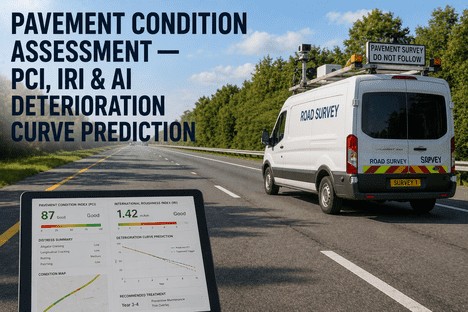
Pavement Condition Assessment — PCI, IRI & AI Deterioration Curve Prediction
By Grace on June 19, 2026
Every asset manager responsible for a road network faces the same structural dilemma: the pavement condition data used to justify maintenance budgets, schedule rehabilitation projects, and defend funding requests was collected months or years ago, processed through manual distress identification workflows, and summarised into a single PCI number that conceals more than it reveals about what is actually happening on each road segment. The consequence is a maintenance programme that applies treatments based on when the last survey was conducted rather than when the next failure is likely to occur — resurfacing segments that could have been preserved with a lighter intervention six months earlier, while segments deteriorating faster than the survey cycle can detect cross into reconstruction territory unnecessarily. The gap between the condition the PCI reports and the condition the road actually exhibits grows wider with every freeze-thaw cycle, every load-restricted detour route, and every budget cycle that defers preventive treatment to the following fiscal year. AI-powered deterioration curve prediction eliminates this gap by making the condition assessment a continuous function of time, traffic, climate, and distress progression — not a snapshot that expires the moment the survey vehicle returns to the depot.
PCI Analysis · IRI Tracking · AI Deterioration Curves · Treatment Optimisation
Asset Managers Who Reduce Pavement Reconstruction Costs by 30% or More Have One Thing in Common: They Predict Deterioration Instead of Reacting to PCI Surveys.
iFactory's AI pavement condition platform gives asset managers continuous PCI and IRI analysis with deterioration curve prediction for every road segment — with automated distress detection from survey imagery, treatment timing optimisation, and audit-ready condition records built in from day one.
Percentage of major US roads in poor or mediocre condition according to ASCE's 2025 Infrastructure Report Card — representing a USD 684 billion funding gap over the next decade
95%
Crack detection accuracy achieved by AI-powered pavement condition assessment systems using deep learning and image analysis — reducing manual survey time by up to 90%
30-50%
Reconstruction cost reduction when AI deterioration curve prediction enables preventive treatment at the optimal timing window — before distress progresses beyond preservation eligibility
USD 1,400
Average annual cost per driver in extra vehicle repairs, fuel consumption, and lost time caused by poor pavement conditions — costs that deteriorate with the road surface
The Asset Manager's Core Problem: Why Pavement Condition Surveys Cannot Keep Pace With Deterioration
A pavement condition survey is conducted in March. The asset manager receives the PCI report in May. By July, the freeze-thaw cycle that ended in April has already opened new cracks that were not present during the survey window. By September, a segment rated 72 — satisfactory, with a recommended preservation window of 18 to 24 months — has deteriorated to 58 under unseasonably heavy truck traffic from a construction detour. The maintenance programme, built on the May PCI report, schedules a slurry seal for the following spring. By the time the crew arrives, the segment is at 44 and requires a structural overlay at four times the cost. This is not a survey quality problem. It is a structural limitation of discrete condition snapshots that cannot interpolate deterioration between measurement points. AI deterioration curve prediction solves this by treating condition as a continuous trajectory that updates with every new data point, every traffic change, and every climate event — not as a fixed number that holds until the next survey.
The Six Failure Modes of Discrete Pavement Condition Assessment — and How AI Deterioration Curves Eliminate Each One
01
The PCI Snapshot Expires Before the Treatment Window Opens
A PCI rating captured during a survey window represents the pavement condition at that specific moment — not the condition six months later when the maintenance budget is approved and the contractor is mobilised. Pavements rated in the fair-to-satisfactory range (PCI 55 to 75) can lose 3 to 8 points per year depending on traffic loading, climate severity, and structural adequacy. The asset manager who schedules a preservation treatment based on a PCI of 70 may find the segment at PCI 58 by treatment date — outside the preservation eligibility window and requiring a structural intervention at two to four times the cost.
AI fix: Deterioration curve projects PCI forward continuously → asset manager sees the forecasted PCI at treatment date, not the survey PCI.
02
Manual Distress Identification Introduces Subjectivity and Delay
Traditional PCI assessment requires trained raters to identify and classify up to 19 distress types — alligator cracking, block cracking, rutting, raveling, patching, potholes, longitudinal and transverse cracking, and more — by severity and extent. Two raters surveying the same segment may return different distress densities because crack severity classification is inherently subjective. The data processing step that converts field notes to PCI scores adds weeks of lag. By the time the PCI reaches the asset manager's planning system, the distress data that produced it has already changed. Research published in Sensors and the Journal of Transportation Engineering demonstrates that AI-based crack detection achieves 95% accuracy and crack width estimation at 90% accuracy — eliminating the subjectivity and compressing the assessment cycle from weeks to hours.
AI fix: Survey imagery processed automatically → distress types, severity, and extent classified consistently within hours of collection.
03
Traffic and Climate Shifts Invalidate Historical Deterioration Rates
The deterioration curve that held true for a road segment over the previous five years may change abruptly when a construction detour diverts heavy truck traffic onto a route designed for passenger vehicles, or when a winter with above-freezing freeze-thaw cycles accelerates crack propagation across the network. Historical deterioration models that rely on age alone cannot absorb these shifts. A segment projected to reach PCI 60 in year eight may reach it in year five under increased loading. The asset manager who does not see this acceleration until the next survey cycle has already lost the preservation window for that segment. AI models that ingest traffic counts, climate data, and axle loading alongside condition data adjust the deterioration curve continuously, flagging segments whose trajectory has steepened before the PCI confirms the acceleration.
AI fix: Traffic and climate data streamed continuously → deterioration curve steepness recalibrated for each segment in response to loading and weather changes.
04
IRI Is Measured but Not Integrated Into the Treatment Decision
Many agencies collect International Roughness Index data alongside PCI but analyse them in separate workflows — PCI for structural condition, IRI for ride quality. The asset manager who treats only by PCI may miss segments where roughness is accelerating faster than structural distress, indicating a functional failure mode that affects user cost and safety before structural failure occurs. Conversely, a segment with acceptable IRI but rapidly declining PCI may be losing structural capacity invisibly. The separation of these two condition dimensions means the treatment decision is based on an incomplete picture of the pavement's actual state. AI models that fuse PCI, IRI, rutting, and cracking data into a single multi-dimensional condition vector give the asset manager the complete deterioration profile for every segment at every decision point.
AI fix: PCI, IRI, rutting, and cracking fused into unified condition vector → treatment recommendation based on all dimensions simultaneously.
05
Treatment Timing Is Based on Calendar Windows, Not Condition Trajectories
Pavement management systems that use banded PCI ranges to recommend treatments — preserve at PCI 70-85, rehabilitate at PCI 50-70, reconstruct below PCI 50 — assign a treatment category based on the current PCI without considering whether the segment is deteriorating faster or slower than the average curve. Two segments at PCI 65 may have entirely different optimal treatment timings: one that has been at 65 for three years and is deteriorating slowly has a wide preservation window, while one that dropped from 78 to 65 in 18 months under heavy loading has already passed through the preservation-eligible zone and may require a more intensive intervention. AI deterioration curve prediction shows the asset manager not just the current PCI but the slope of the curve — enabling treatment timing that matches the segment's actual deterioration velocity, not the calendar date of the last survey.
AI fix: Deterioration velocity calculated for every segment → treatment timing optimised to the curve trajectory, not the PCI band.
06
Budget Justification Lacks the Forward-Looking Evidence That Decision-Makers Require
When the asset manager requests increased maintenance funding, the evidence package typically consists of current PCI distributions, a backlog of deferred treatments, and a simple age-based deterioration assumption. Decision-makers evaluating this request against competing budget priorities cannot see the consequence of deferral beyond a single curve. The asset manager who can show the projected PCI distribution in three years under the requested budget versus the current budget, the number of segments that will cross the reconstruction threshold under each scenario, and the total cost difference between preserving now and reconstructing later has an evidence package that shifts the conversation from expense to investment. AI deterioration curve prediction produces these projections automatically from the same data the asset manager already collects.
AI fix: Budget scenario projections generated automatically → asset manager presents forward-looking condition outcomes, not backward-looking PCI summaries.
When the PCI Report Arrives Months After the Survey, the Preservation Window Has Already Started Closing. AI Deterioration Curves Keep It Open.
iFactory builds the continuous condition trajectory into every pavement analysis — so asset managers see where each segment is heading, not just where it was when the survey vehicle passed, and intervene at the moment that maximises treatment effectiveness and minimises lifecycle cost.
The AI Pavement Intelligence Architecture for Asset Managers
The iFactory AI pavement condition platform operates as a three-layer intelligence system — continuous condition assessment at the segment level, deterioration curve prediction and treatment optimisation at the network level, and budget scenario modelling and stakeholder reporting at the programme level. Each layer serves a distinct asset management function, and all three run continuously without requiring the asset manager to rebuild models between survey cycles.
Layer 01
Continuous Condition Assessment
Automated PCI, IRI, and distress analysis from survey imagery and sensor data
The condition assessment layer ingests pavement survey imagery — from dedicated inspection vehicles, mobile phone-mounted cameras, or drone surveys — and processes each frame through a deep learning model trained on over 19 distress types classified by severity and extent per ASTM D5340 and D6433 standards. Crack detection, rutting measurement, raveling classification, and patching assessment are performed automatically, producing a distress density report for every surveyed segment within hours of data collection. IRI data from profilometers is fused with the distress data to produce a multi-dimensional condition vector for each segment — combining the structural condition signal from PCI with the functional condition signal from IRI. The asset manager sees a continuous condition record that updates with every new survey pass, not a single PCI number that conceals the distress composition behind it.
AI distress classification
PCI-IRI multi-dimensional fusion
Automated ASTM standard compliance
Layer 02
Deterioration Curve Prediction and Treatment Optimisation
Forecast PCI and IRI trajectories for every segment and optimise treatment timing
The prediction layer uses ensemble machine learning models — random forest, gradient boosting, and neural network architectures demonstrated in peer-reviewed research to achieve R-squared values above 0.91 for PCI forecasting — trained on historical condition data, traffic loading, climate variables, pavement structure, and treatment history. For every segment in the network, the model produces a projected deterioration curve showing PCI and IRI trajectories over the next 5, 10, and 20 years under current conditions. When a segment's deterioration velocity changes — because traffic loading increased, a severe winter accelerated cracking, or a treatment shifted the curve upward — the model recalibrates the projection for that segment and adjacent segments on the same route. The treatment optimisation engine then matches each segment's projected trajectory to the optimal intervention: crack seal at PCI 80-85, slurry seal at PCI 75-80, thin overlay at PCI 65-75, structural overlay at PCI 50-65, or reconstruction below PCI 50. The asset manager sees each segment's recommended treatment window with the projected cost saving of treating at the optimal versus the deferred timing.
Multi-model ensemble prediction
Treatment timing optimisation
Cost projection by deferral scenario
Layer 03
Budget Scenario Modelling and Stakeholder Reporting
Network-level projections, funding gap analysis, and automated evidence reports
The reporting layer aggregates segment-level deterioration projections into network-level scenarios that answer the questions elected officials and funding bodies actually ask. Under the current budget allocation, what will the network-wide PCI distribution look like in three, five, and ten years? How many lane-miles will cross the reconstruction threshold each year under the funded versus the optimised budget scenario? What is the total cost difference between preserving segments at the optimal treatment window versus deferring to reactive reconstruction? Every projection is generated from the same deterioration model and condition data the asset manager uses for operational decisions — not from a separate planning model that requires manual calibration. The scenario reports are exportable in a format suitable for budget presentations, capital planning documents, and stakeholder communications without manual data compilation. The condition history record — showing every PCI and IRI measurement linked to the survey event, distress composition, and treatment applied — provides the audit trail that demonstrates the asset management programme is data-driven and defensible.
Multi-year condition projections
Funding gap analysis by scenario
Audit-ready condition history
What the AI Pavement Intelligence Dashboard Shows the Asset Manager
The asset manager's view of the AI pavement intelligence platform is not a data management interface — it is a strategic decision system for network-level pavement stewardship. The dashboard is designed around the questions that asset managers must answer continuously: What is the current condition of my network and where is it heading? Which segments need intervention now and which can wait? What is the cost of deferring treatment on each segment? And when the budget request is submitted, is the evidence package complete and defensible?
Asset View 01
Network PCI Distribution With Deterioration Trajectory Overlay
The entire road network displayed as a PCI distribution histogram with each segment's deterioration trajectory overlaid. Segments are colour-coded by condition band — good, satisfactory, fair, poor, very poor, serious — and the projected movement of segments between bands over the next 12, 24, and 60 months is shown as an animated trajectory. The asset manager sees not just how many lane-miles are in each condition band today, but how many will transition to a worse band by the next budget cycle if current deterioration rates hold — and which segments are accelerating fastest.
Asset manager action: Review segments projected to cross the preservation-to-reconstruction threshold within 12 months. Prioritise treatment scheduling for those with steepest deterioration velocity.
Asset View 02
Segment-Level Deterioration Curve With Treatment Window
Every road segment displays its historical condition data points, the AI-fitted deterioration curve projecting PCI and IRI forward 20 years, and the optimal treatment window shaded on the curve. The current PCI, the projected PCI at the start of the next budget cycle, and the recommended treatment with its cost estimate are shown in a single view. The asset manager can compare two segments side by side to evaluate which has the more urgent intervention need — even if their current PCI values are identical — by comparing their curve slopes.
Asset manager action: Compare curve slopes for segments at similar PCI. Treat the segment with the steeper downward trajectory first.
Asset View 03
Treatment Optimisation Queue — Ranked by Urgency and Cost Impact
The entire network's treatment needs are ranked by a composite score that considers current PCI, deterioration velocity, traffic loading, functional classification, and the cost escalation of deferring treatment to the next intervention category. A segment at PCI 72 that is deteriorating at 6 points per year under heavy truck traffic on a primary arterial ranks higher than a segment at PCI 65 that is deteriorating at 2 points per year on a local residential street — because the cost of missing the preservation window on the first segment is four times higher. The asset manager sees a ready-to-execute treatment queue that maximises the preservation impact of every dollar in the maintenance budget.
Asset manager action: Execute treatments from the top of the queue each budget cycle. Queue recalibrates automatically when segments are treated or condition data updates.
Asset View 04
Budget Scenario Comparison — Funded vs. Optimised vs. Deferred
Three budget scenarios are modelled simultaneously: the funded scenario based on the current maintenance budget allocation, the optimised scenario showing the condition outcome if the optimal treatment timing is funded for every segment, and the deferred scenario showing the outcome if no additional funding is allocated. Each scenario projects the network PCI distribution, the lane-miles crossing the reconstruction threshold, and the total cost of treatment over the planning horizon. The asset manager uses this view to answer the one question every decision-maker asks: what do we get for the additional funding we are asked to approve? The difference between the funded and deferred scenarios is the cost of inaction. The difference between the funded and optimised scenarios is the gap that a budget increase would close.
Asset manager action: Present the funded versus optimised scenario comparison to budget decision-makers. The gap quantifies the funding request in condition outcomes, not abstract need.
Asset View 05
Distress Composition Drill-Down for Any Segment
For any segment in the network, the asset manager can drill into the distress composition that produced the PCI score — alligator cracking density by severity, rut depth measurements, longitudinal and transverse crack linear feet, patching area, raveling extent, and pothole count. Each distress type is linked to the survey imagery that the AI analysed, so the asset manager can visually confirm the automated classification. This drill-down capability transforms the PCI from a single number that the asset manager must trust into a transparent condition report whose components are verifiable and actionable. A segment whose PCI is driven primarily by alligator cracking has a different treatment recommendation than one whose PCI is driven primarily by rutting, even if the PCI values are identical.
Asset manager action: Review distress composition for segments in the treatment queue. Verify AI classification against source imagery before committing to treatment type.
Asset View 06
Treatment Effectiveness Tracking — Before and After Curve Comparison
Every treatment applied to a segment is recorded with the pre-treatment PCI and IRI, the treatment type and cost, and the projected deterioration curve before treatment. After treatment, the post-treatment condition data points are plotted against the projected curve, and the actual deterioration velocity after treatment is compared to the projected velocity without treatment. A treatment that increases PCI from 62 to 88 but whose post-treatment deterioration curve is steeper than the model projected for that treatment type and traffic loading triggers an investigation flag. The asset manager can evaluate which treatment types and contractors deliver the expected performance outcome and which segments may require a different intervention approach than the standard treatment recommendation. This closes the loop between treatment decision and treatment outcome — the feedback cycle that most pavement management programmes lack.
Asset manager action: Review treatment effectiveness quarterly. Flag treatments whose post-application deterioration curve exceeds the projected trajectory.
"
Our pavement management programme was running on a three-year survey cycle with age-based deterioration assumptions that had not been recalibrated since 2018. We were treating segments based on when the PCI report said they needed it, which meant we were consistently one to two years late for the segments deteriorating fastest. The AI deterioration curves changed our entire approach. Within 90 days of loading our historical condition data, the model identified 43 segments that were deteriorating at more than twice the network average rate — segments our age-based model had classified as steady. We adjusted our treatment schedule to prioritise those segments. In the first year, we prevented nine segments from crossing the reconstruction threshold. The preservation cost was USD 1.2 million. The reconstruction cost we avoided was USD 4.7 million. That is the kind of evidence that keeps the maintenance budget funded.
— Asset Manager, County Road Network — 1,850 Lane-Miles, USD 18 Million Annual Maintenance Budget
Conclusion
Pavement condition assessment is not a data collection problem — it is a timing and trajectory problem. When the PCI report arrives months after the survey, when deterioration is measured in discrete snapshots that cannot detect acceleration between measurement points, and when treatment decisions are based on condition bands rather than curve slopes, the asset management programme is structurally unable to intervene at the moment that maximises treatment effectiveness and minimises lifecycle cost. AI-powered deterioration curve prediction addresses all three dimensions simultaneously: continuous condition assessment that compresses the survey-to-decision cycle from weeks to hours, trajectory-based deterioration monitoring that detects acceleration before the PCI confirms it, and treatment timing optimisation that matches the intervention to the segment's actual deterioration velocity, not the calendar date of the last survey.
The research evidence from 2024 through 2026 is clear. AI-based pavement condition assessment systems achieve 95% crack detection accuracy and 90% crack width estimation accuracy. Machine learning models for PCI prediction achieve R-squared values above 0.91, significantly outperforming traditional regression-based deterioration models. The documented cost avoidance from AI-optimised treatment timing ranges from 30 to 50% of reconstruction costs — savings that compound when applied across a network of hundreds or thousands of lane-miles. The asset managers achieving the upper end of that range are the ones who deployed continuous condition assessment early, configured segment-level deterioration curves with traffic and climate sensitivity, and used the budget scenario modelling to convert maintenance funding requests from expense narratives into investment evidence packages.
iFactory's AI pavement condition platform is designed for asset managers who need to extend pavement life, optimise treatment timing, and defend maintenance budgets with forward-looking evidence — not just report what the last survey revealed. Book a Demo to see the AI deterioration curve platform configured for your road network and treatment programme, or talk to an expert about a free condition assessment review and deterioration modelling pilot for your pavement network.
Frequently Asked Questions
The platform initialises using historical PCI and IRI data from at least two survey cycles — the minimum data required to establish a deterioration trend for each segment. If available, traffic loading data (AADT, truck percentage), climate zone information, pavement structure (surface type, layer thickness, base type), and treatment history improve model accuracy from the first deployment. Survey imagery from the most recent inspection cycle can be loaded to train the AI distress classification model, allowing the platform to begin producing automated distress analysis alongside the deterioration curves. The platform integrates with existing survey methods — manual PCI surveys, automated van-based collection, drone surveys, and mobile phone-mounted camera systems — without requiring the asset manager to change their data collection protocol. Survey data in standard formats (ASTM D6433, AASHTO PP 68-14, or agency-specific distress manuals) is mapped to the AI classification model during implementation. Standard integration timeline is two to four weeks from data delivery to producing deterioration curves for the full network. Talk to an expert to confirm your data readiness and receive a project-specific implementation schedule.
The ensemble machine learning model uses a technique called transfer learning and segment family grouping to generate deterioration curves for data-sparse segments. Segments are grouped by family — same pavement structure, traffic loading range, climate zone, and functional classification — and the model learns the characteristic deterioration curve shape for each family from segments with richer data histories. A segment with only one survey data point inherits the family deterioration curve as its baseline projection, which is then refined as additional data points from future surveys are ingested. Research published in the Journal of Transportation Engineering demonstrates that this few-shot learning approach achieves prediction accuracy within 8% of models trained on full data histories, making it suitable for networks where survey data coverage is incomplete or inconsistent. As the segment accumulates survey history over successive cycles, the model transitions from family-based to segment-specific curve prediction. The asset manager sees a confidence indicator on every deterioration curve reflecting the data density behind the projection. Book a Demo to see how the platform handles data-sparse segments in your network.
Yes. The platform maintains separate deterioration models for PCI, IRI, rutting depth, and cracking density — each with its own projection curve and confidence interval — while also computing a composite condition vector that fuses all four dimensions. When the signals conflict — a segment with stable PCI but rapidly increasing IRI, or low rutting but accelerating alligator cracking — the platform flags the divergence and presents the asset manager with the contributing distress analysis explaining why the composite vector differs from the PCI-only view. The treatment recommendation engine uses the composite vector to determine the appropriate intervention: a segment with acceptable PCI but high IRI may receive a functional treatment (mill and fill) rather than a structural treatment (overlay), even though the PCI alone would not trigger intervention. This multi-dimensional approach prevents the asset manager from making treatment decisions based on PCI alone while IRI or rutting reveals a different deterioration story. Talk to an expert about configuring multi-index condition fusion for your pavement management standards.
The budget scenario model applies the segment-level deterioration curves across the entire network under three funding assumptions: the current maintenance budget, an optimised budget that funds all treatments at the optimal timing window, and a deferred budget that defers all non-critical treatments. For each scenario, the model projects the PCI distribution, lane-miles crossing treatment thresholds, and total expenditure over a configurable planning horizon — typically 5, 10, or 20 years. The accuracy of the projections depends on the quality and density of the historical condition data feeding the deterioration model. Validation studies across multiple agency networks show that AI deterioration models achieve mean absolute prediction errors of 3 to 5 PCI points for 5-year projections and 5 to 8 PCI points for 10-year projections — compared to 8 to 15 PCI points for traditional age-based regression models. The model's accuracy improves over time as additional survey data is ingested and the deterioration curves are refined for individual segments. The asset manager can compare the model's historical predictions against actual condition outcomes for previous budget cycles to demonstrate projection accuracy to decision-makers. Book a Demo to see validation data from comparable network deployments.
Every treatment applied to a segment is recorded with the pre-treatment condition data, treatment type, unit cost, contractor, and application date. The platform then tracks the post-treatment PCI and IRI trajectory and compares it to the projected deterioration curve that the model generated before treatment. A segment whose post-treatment deterioration curve is steeper than the model's projection for that treatment type under the segment's traffic loading and climate exposure generates an automatic treatment effectiveness flag. The asset manager receives a notification with the segment details, the treatment record, and the variance between the projected and actual deterioration velocity. The flagged treatment can be investigated to determine whether the cause was application quality, material performance, traffic loading beyond the treatment's design range, or a condition assessment error. Over time, the treatment effectiveness data accumulates to inform future treatment selection — if a specific treatment type consistently underperforms on segments with certain traffic loading or climate characteristics, the model adjusts its treatment recommendation algorithm to favour alternative interventions for those segment profiles. This closes the feedback loop between treatment application and treatment performance that most pavement management systems lack. Talk to an expert about configuring treatment effectiveness tracking for your treatment types and performance criteria.
Every PCI Number Has a Trajectory Behind It. AI Deterioration Curves Show You Where Each One Is Heading. Get a Free Condition Assessment Review.
iFactory's AI pavement condition platform for road asset managers — continuous PCI and IRI assessment with deterioration curve prediction for every segment, treatment timing optimisation that maximises preservation impact, budget scenario modelling that converts maintenance requests into investment evidence, and treatment effectiveness tracking that closes the loop between decision and outcome.