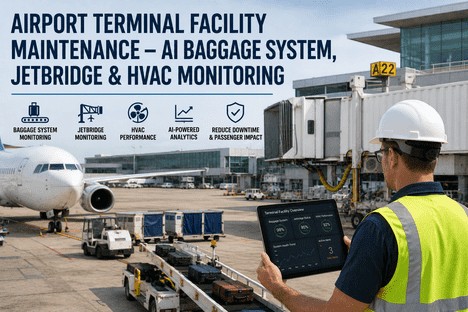
A baggage carousel bearing at a major European hub exceeded its vibration threshold for the nineteenth consecutive cycle last Tuesday morning. The building management system logged the event. The SCADA system recorded it. Neither system created a work order. Neither system alerted a maintenance technician. At 07:52, the bearing seized. The carousel stopped. Baggage for three departing flights backed up into the sorting area. Two flights pushed back with twenty-seven bags still in the terminal. The airline paid EUR 34,000 in mishandled baggage compensation for a single morning — for a failure that every connected system saw coming and no connected system acted to prevent. This is not a technology gap. It is a coordination gap. And it repeats every day, across baggage systems, jetbridges, HVAC units, and escalators, in airports that have invested millions in sensors and software that do not talk to each other. iFactory's AI-driven terminal monitoring platform was built to close exactly this gap — connecting the sensor data you already own to the maintenance actions your passengers depend on.
Your Terminal's Sensors Are Already Watching. iFactory Makes Sure Someone Acts on What They See.
One platform connecting your existing BMS, baggage SCADA, jetbridge PLCs, and HVAC BAS into a single predictive maintenance environment — no new hardware, no rip-and-replace, no 18-month deployment timelines. Real alerts. Real work orders. Real results.
of airport facilities experience costly unplanned equipment failures each year — most preceded by detectable sensor anomalies that no system acted on
$5B
Annual cost of baggage mishandling to the airline industry — 33 million bags mishandled in 2024 with 66 percent resolved within 48 hours
95%
reduction in baggage handling incidents at a North American hub after deploying AI-predictive monitoring across conveyor and sorter drive systems
$10.6B
Predictive maintenance market size in 2025, projected to reach $47.8B by 2029 — airports adopting AI-driven terminal monitoring are capturing the efficiency lead
The Real Problem With Airport Terminal Maintenance Is Not the Equipment — It Is the Disconnection Between the Systems That Monitor It
The operational challenges of managing baggage handling systems, passenger boarding bridges, and terminal HVAC across a modern airport are well understood. What is less discussed is the specific management failure mode they produce — and why it persists even in terminals that have invested heavily in building management systems, SCADA platforms, and IoT sensor networks at the individual system level.
How Disconnected Terminal Maintenance Operations Fail — and What the Pattern Looks Like
The Data Silo Problem
Baggage SCADA, jetbridge PLCs, and HVAC BAS generate alerts on three separate screens with three different severity scales.
When each terminal system runs its own monitoring platform with its own alarm thresholds and its own maintenance workflow, cross-system failure patterns remain invisible until a passenger-facing disruption occurs. A baggage conveyor bearing vibration anomaly logged at 03:00, a jetbridge hydraulic pressure drift at 05:00, and an HVAC zone temperature deviation at 06:00 are three unrelated events in three different systems — until a facility manager connects them manually during the morning review, by which time a departure delay is already in progress. The result: terminal directors make infrastructure decisions based on yesterday's data from three different sources, formatted differently, with no consistent severity classification across systems.
Reactive Decision Lag + Siloed Data
The Alarm Fatigue Crisis
A typical mid-size terminal HVAC system generates 12,000 alarm events per month. Most are noise. The critical ones get buried.
Without an intelligent prioritization layer, building automation systems produce thousands of data points and fault codes daily that nobody acts on systematically. A chiller compressor efficiency drop of 18 percent appears as one alarm among hundreds. A VAV box drifting 15 percent open generates the same alert priority as a failing AHU bearing. Maintenance teams become conditioned to ignore alarms because the majority are informational — and the few that signal developing critical failures are indistinguishable from the noise. This is the alarm fatigue pattern that leads to the expensive reactive repair: the data existed, the alert fired, but nobody could tell which alert mattered.
Alert Overload + Missed Critical Signals
The Contractor Coordination Gap
Three different maintenance contractors manage three different terminal systems. None of them see the cumulative passenger impact.
Most airport terminals operate baggage handling maintenance under one contract, jetbridge maintenance under a separate agreement, and HVAC maintenance through a third provider — each with its own CMMS, its own KPIs, and its own reporting cadence. The baggage contractor is measured on belt availability. The jetbridge contractor is measured on gate uptime. The HVAC contractor is measured on zone temperature compliance. None of them are measured on passenger experience. When a delay occurs because a baggage belt failure interacts with a gate reassignment caused by a jetbridge issue during a morning when a terminal zone was four degrees above setpoint, no single contractor owns the outcome. The cumulative passenger impact is invisible to every contract.
Fragmented Accountability + No Passenger KPI
The Reactive Maintenance Premium
Emergency repairs cost five to ten times more than planned maintenance — and airports absorb this premium daily across dozens of asset categories.
A planned bearing replacement on a baggage drive motor costs USD 2,800 in parts and labor during a scheduled night shift. The same bearing failing during the departure wave costs USD 28,000 in emergency technician callout, premium parts delivery, overtime labor, and the hidden cost of delayed baggage processing that cascades across connecting flights. When sensor data exists but is not connected to a predictive maintenance workflow, every terminal pays the reactive premium repeatedly across baggage conveyors, jetbridge hydraulics, HVAC chillers, and escalator drives — costs that accumulate silently in each contractor's maintenance budget with no cross-system attribution or root-cause analysis.
Managing Each Terminal System Separately Is Not Terminal Management. It Is Multiple Single-System Problems. iFactory Manages the Terminal.
A single platform view of every terminal system's asset health, predictive alerts, work order status, and maintenance history — updated in real time, without manual extraction, without format reconciliation, without the cross-system data calls that delay every maintenance decision.
What iFactory's Terminal Monitoring Platform Actually Does
iFactory is not a reporting layer bolted on top of your existing BAS, SCADA, and CMMS systems. It is a unified terminal intelligence platform where every baggage conveyor, every jetbridge hydraulic system, and every HVAC zone is monitored, analysed, and maintained in a single data environment — with role-based access that gives terminal directors the cross-system view they need and gives maintenance teams the asset-level tools that match their daily workflow.
Capability 01
AI Baggage Handling System Monitoring — Predict Conveyor and Sorter Failures Before They Disrupt Departures
BHS Predictive Intelligence
iFactory continuously monitors vibration, temperature, current draw, and cycle time data from every drive motor, gearbox, belt splice, sorter, and carousel bearing in your baggage handling system — ingesting data through your existing SCADA infrastructure or directly from IoT sensors installed at critical nodes. The AI models learn the normal operating envelope for each individual asset and detect developing anomalies that precede failures by days or weeks. When a drive motor bearing begins generating signature vibration patterns that match historical failure data, iFactory generates a predictive alert with remaining useful life, assigns a priority level based on the asset's operational criticality, and creates a work order in your CMMS with the specific bearing part number and estimated replacement labor hours. The repair is scheduled for the next night-time maintenance window — not in response to a 7:52 AM seizure that stops a carousel during the departure wave.
Real-time drive motor and bearing health monitoring
Predictive failure alerts with remaining useful life
Automatic work order with part and labor estimation
iFactory connects to your jetbridge PLC controllers and IoT sensor networks to monitor hydraulic cylinder pressure, drive motor current, elevation control position, rotunda bearing vibration, canopy seal extension force, and auto-leveling sensor accuracy — every subsystem that can fail and strand an aircraft at the gate. The platform learns each bridge's individual operating signature during a 60-to-90-day baseline period, then detects deviations that indicate seal wear, hydraulic fluid degradation, gearbox bearing fatigue, or control system drift. Alerts are generated with 14-to-30-day advance notice for developing mechanical issues and 72-to-96-hour notice for control system anomalies — enough time to schedule the repair during a low-traffic period, kit the correct replacement seals and hydraulic fluid, and assign a technician with the right certification level. Early adopter airports using iFactory's jetbridge monitoring report 99.6 percent boarding bridge availability and a 78 percent reduction in gate-related departure delays.
Multi-subsystem PBB health monitoring
14-to-30-day predictive alert lead time
99.6% gate availability achieved at deployed airports
Capability 03
HVAC AI Fault Detection and Energy Optimisation — Stop Terminal Hot Spots Before Passengers Complain
BAS Intelligence Layer
iFactory integrates directly with your existing Building Automation System through BACnet, Modbus, and OPC UA protocols — ingesting temperature, humidity, pressure, and energy consumption data from every AHU, VAV box, chiller, and pump in your terminal. The AI layer filters the thousands of daily BAS alarms into a prioritised queue, distinguishing between informational events, efficiency drift, and developing mechanical failures. When a chiller compressor's efficiency drops below its learned baseline threshold, iFactory generates a predictive alert with estimated energy cost impact and recommended maintenance window — not buried among 200 other alarms but surfaced as a prioritised work item. When a terminal zone begins deviating from its setpoint due to a drifting VAV damper, the system identifies the specific damper, estimates the comfort impact, and schedules corrective action during off-peak hours. Airports using iFactory for HVAC monitoring report 12 to 31 percent reduction in terminal energy consumption and an average 78 percent reduction in unplanned HVAC downtime events.
BAS integration via BACnet, Modbus, OPC UA
AI-prioritised alarm queue with energy impact analysis
12 to 31% measured energy consumption reduction
Capability 04
Unified Terminal Dashboard and Cross-System Analytics — Every Asset's Health in One Real-Time View
Terminal-Wide Visibility
The unified terminal dashboard in iFactory aggregates asset health data from every connected system — baggage handling, jetbridge, HVAC, escalators, and airfield equipment — in a single real-time view without requiring manual exports, format standardisation, or cross-system reporting calls. Terminal directors see predictive alert counts by system category, asset health scores colour-coded by severity, open work order status across all contracts, and energy consumption trends by terminal zone — all in a single configurable view. Any metric can be filtered by system type, concourse, asset category, or time period, so the comparison between baggage system reliability in Terminal A versus Terminal B is a single click, not a three-hour data compilation exercise. When a jetbridge hydraulic system crosses its predictive threshold while a baggage drive motor is trending toward an alert in the same concourse, the dashboard surfaces the cross-system correlation — and the unified response workflow begins without a phone call between two contractors.
Real-time cross-system asset health aggregation
Colour-coded severity with predictive alert counts
Cross-system correlation and unified response workflow
Measured Impact Across Deployed Airport Terminals
78%
reduction in gate-related departure delays within six months of PBB condition-based monitoring deployment
$3M–$6M
annual savings per mid-to-large hub airport in avoided delays, emergency repairs, compensation, and energy waste
8–12
weeks from initial sensor integration to first predictive alert — ROI measurable within the first quarter of operation
99.6% boarding bridge availability at deployed airports
31% reduction in terminal HVAC energy consumption
90% reduction in manual BHS inspection hours
We were managing three concourses with separate BAS platforms, separate maintenance contractors, and no unified view of asset health. Our baggage system had 480 sensors generating data every 15 seconds. Our jetbridges had PLC fault logs going back five years. Our HVAC system was producing 12,000 alarms per month. None of it was connected to our maintenance workflow. iFactory ingested all three data streams within four weeks and started generating predictive alerts in the second month. The first alert it raised — a baggage drive motor bearing with 37 days of remaining useful life — would have failed during Thanksgiving week. We repaired it on a Wednesday night shift. That single intervention paid for the first year of the platform. The unified dashboard is now our morning operations briefing tool. We do not start the day without it.
— Director of Terminal Operations — Major U.S. Hub Airport — 22 Years Airport Facility Management
Monitoring Three Different Terminal Asset Types — Why Baggage, Jetbridge, and HVAC Require Different Analytics Approaches in the Same Platform
One of the underappreciated challenges of terminal-wide monitoring is that baggage conveyors, passenger boarding bridges, and HVAC systems do not just require different sensor types — they require fundamentally different analytics frameworks. A baggage drive motor operating thousands of cycles per day generates high-frequency vibration data that demands real-time trend analysis. A jetbridge hydraulic cylinder operating dozens of cycles per day has different failure modes, different sensor requirements, and different lead-time-to-failure patterns. An HVAC chiller operating continuously against ambient temperature loads requires efficiency-trend-based analytics rather than cycle-count-based prediction. Managing all three in the same monitoring environment requires a platform that can handle asset-type-specific logic without forcing a lowest-common-denominator data model on all terminal systems.
How iFactory Handles Terminal Asset-Type Analytics Differences Within a Single Unified Monitoring Platform
Asset Type
Analytics Priority
How iFactory Configures This Asset Category
Baggage Handling System
High-frequency vibration monitoring, drive motor temperature trends, belt splice current draw analysis, sorter cycle time deviation detection
Continuous vibration spectrum analysis with 30-to-60-day bearing failure prediction, automatic work order with part-specific replacement kits, integrated SCADA data ingestion
Passenger Boarding Bridge
Hydraulic cylinder position drift, drive motor current signature, rotunda bearing vibration, canopy seal extension force, auto-leveler accuracy
Multi-subsystem health baseline with 14-to-30-day predictive alert horizon, condition-based refurbishment forecasting, cross-gate availability optimisation
Terminal HVAC System
Chiller compressor efficiency trending, AHU bearing vibration, VAV damper position drift, zone temperature deviation analysis, energy consumption anomaly detection
BAS alarm prioritisation with AI noise filtering, energy efficiency analytics with 12 to 31 percent measured savings, automated FDD with work order generation
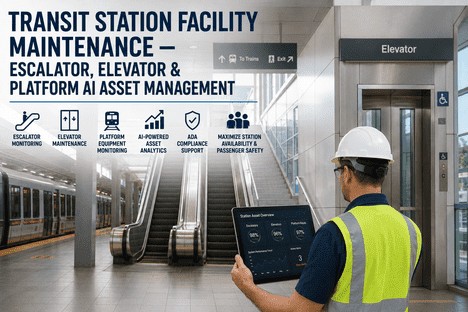
Escalator and Elevator
Drive chain vibration, motor temperature, brake pad wear, handrail tension monitoring, passenger-facing failure consequence analysis
Conclusion: The Terminal Infrastructure Intelligence Gap Is Closing
The sensors are already installed. The data is already flowing. The failure patterns are already visible in vibration spectra, current signatures, and temperature trends that your existing BMS, baggage SCADA, jetbridge PLCs, and HVAC BAS are recording every second. What has been missing is the intelligence layer that connects detection to action — that takes a bearing temperature anomaly detected by a baggage conveyor sensor and converts it into a parts-reserved, technician-assigned, off-peak-scheduled repair with post-work verification, while simultaneously checking whether a related jetbridge or HVAC issue in the same concourse requires coordinated scheduling.
iFactory provides that layer. It connects your baggage handling system, passenger boarding bridges, terminal HVAC, and vertical transport equipment into a single predictive maintenance environment — without new hardware, without ripping out your existing BAS and SCADA infrastructure, and without the 12-to-18-month deployment timelines that have made unified terminal intelligence unaffordable for most airport operators. The terminal intelligence gap costs your facility in delayed departures, energy waste, emergency repair premiums, and passenger experience degradation that accumulates invisibly across every disconnected system. Book a Demo to see iFactory's unified terminal monitoring platform mapped to your specific concourse configuration, asset mix, and existing sensor infrastructure. Or talk to an expert to begin your terminal's 8-to-12-week deployment sequence and get your first cross-system predictive alert live within sixty days.
Frequently Asked Questions
No. iFactory connects to your existing building management system, baggage SCADA, jetbridge PLC controllers, and HVAC BAS through standard industrial protocols — BACnet, Modbus, OPC UA, MQTT, and REST APIs. If your terminal already has IoT sensors or condition monitoring infrastructure, iFactory ingests that data directly. For terminals with limited sensor coverage, iFactory can recommend targeted sensor deployment during scheduled maintenance windows, but a full sensor retrofit is never required. The platform is designed to extract maximum value from the sensor infrastructure you have already invested in. Book a Demo to review your current sensor infrastructure and identify the quickest path to predictive coverage across your terminal systems.
Data ingestion and baseline establishment typically takes 60 to 90 days from initial connection. During this period, iFactory learns the normal operating envelope for each monitored asset — vibration patterns, temperature ranges, current draw profiles, pressure ranges, and cycle time distributions specific to each individual piece of equipment. The first high-confidence predictive alerts are typically generated within 8 to 12 weeks of deployment. Early adopters have consistently reported identifying 3 to 6 developing failures within the first 60 days that would have caused unplanned operational disruptions without the platform. Talk to an Expert to discuss your terminal's deployment timeline based on current data infrastructure and asset types.
Yes. iFactory integrates with all major CMMS platforms through REST APIs and webhook connectors. When the AI detects an anomaly, it automatically creates a work order in your existing system — with asset identification, predicted failure mode, recommended repair procedure, estimated labor hours, required spare parts with specific part numbers, and priority level based on operational criticality. No duplicate data entry. No platform switching for your technicians. The same integration path supports post-repair verification, where sensor data confirming the fix is logged back to the work order record, closing the intelligence loop and ensuring every repair produces measurable results. Book a Demo to see the CMMS integration workflow configured for your specific platform.
iFactory supports both on-premise deployment — running entirely within your operational technology network with zero cloud egress — and hybrid architectures for multi-terminal or multi-airport groups requiring centralised oversight. The on-premise deployment model ensures that all sensor data ingestion, AI model inference, and work order generation remains within your OT network boundary, meeting the strict cybersecurity requirements that airport critical infrastructure demands under frameworks such as TSA SDL, ISO 27001, and NIST 800-82. Cloud connectivity, where configured, is outbound-only and limited to aggregated, non-identifiable performance metrics for cross-terminal benchmarking and platform improvement. Talk to an Expert to review your airport's cybersecurity and data residency requirements and determine the optimal deployment architecture.
Your Terminal's Sensors Are Already Collecting the Data Every Second. iFactory Is the Intelligence That Finally Connects It into Coordinated Action.
AI-powered predictive monitoring for baggage handling systems, passenger boarding bridges, terminal HVAC, and vertical transport — connected through a single intelligence platform that turns your existing sensor infrastructure into a unified maintenance operations center. No hardware. No rip-and-replace. No more systems that detect failures without acting on them.