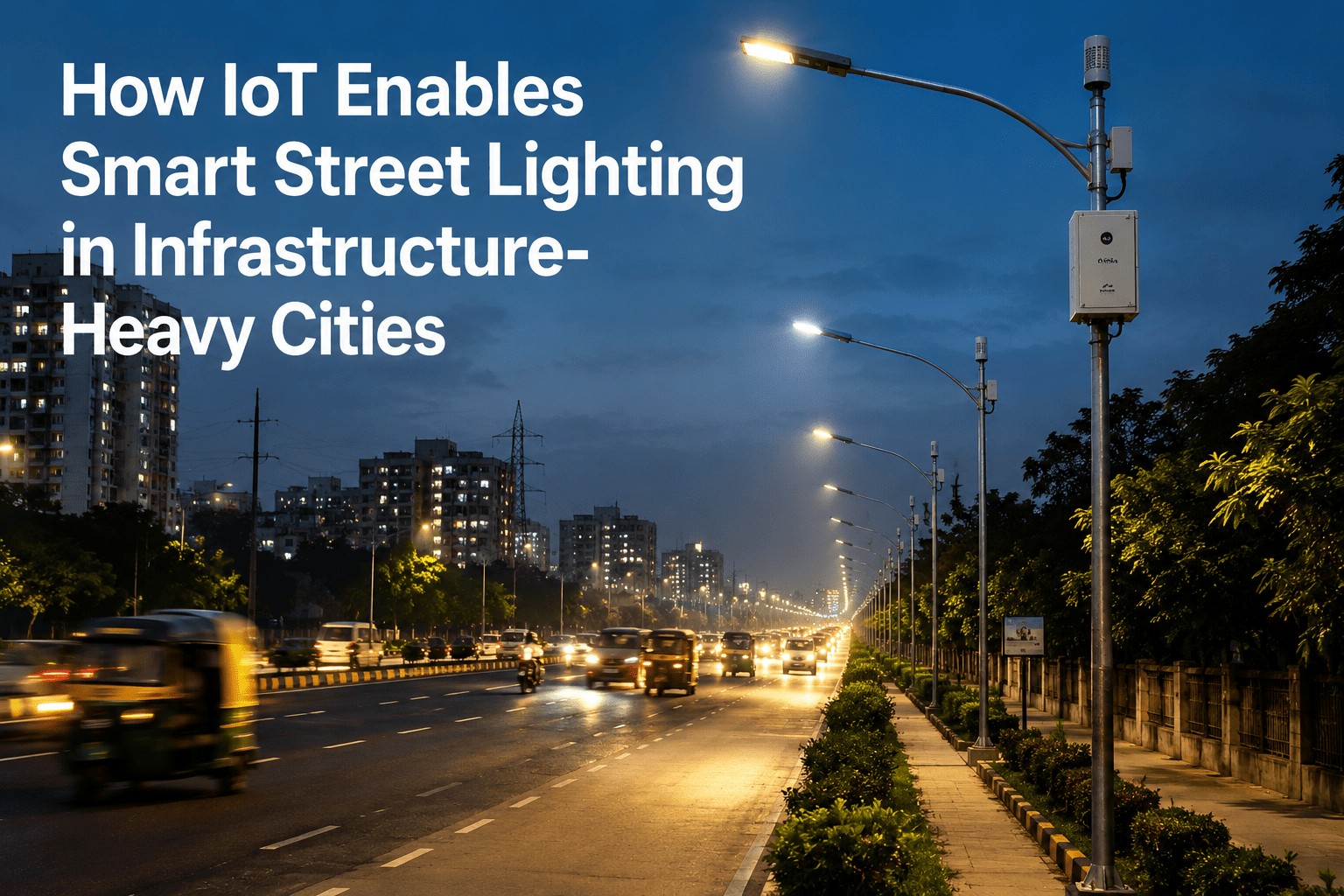
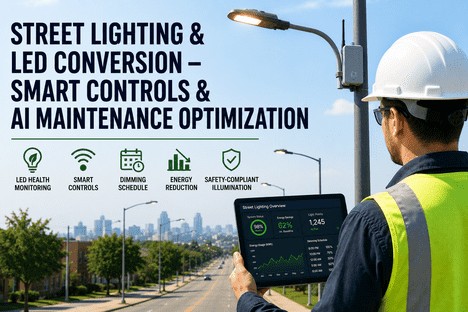
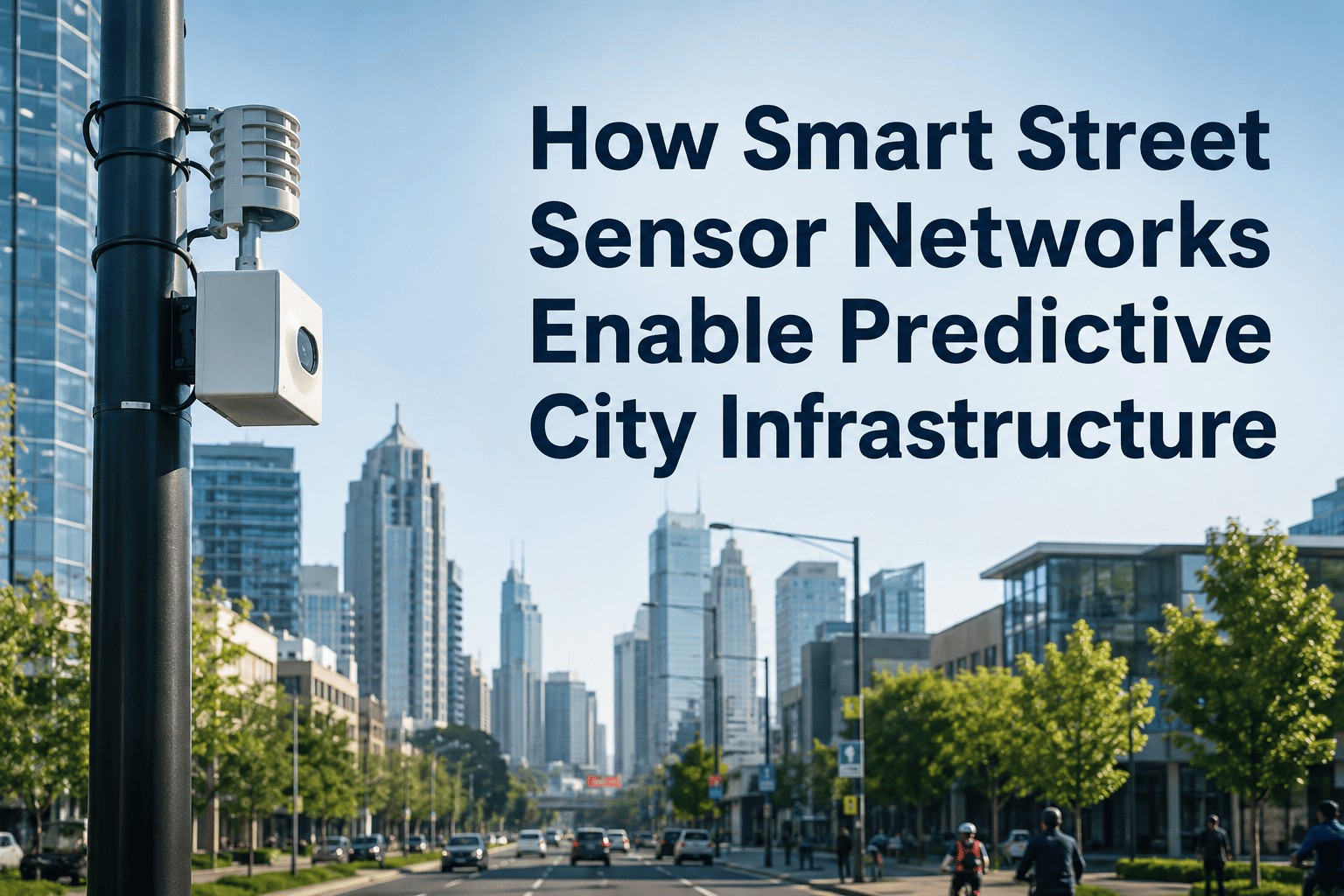
Street lighting consumes roughly 40% of a city's total electricity bill — and in most cities, a significant portion of that energy is being wasted right now: lights blazing at full power on empty roads at 3 AM, burned-out fixtures nobody's flagged, and maintenance crews dispatched reactively after failures rather than proactively before them. IoT-enabled smart street lighting doesn't just reduce that waste. It transforms a passive utility expense into a managed, monitored, continuously optimized infrastructure asset — one that pays for itself within 12 to 18 months and keeps getting smarter.
50–70%
energy reduction vs. conventional street lighting
32.9M
smart streetlights deployed globally by end of 2024
40%
maintenance cost reduction with AI predictive diagnostics
12–18mo
typical payback period for IoT lighting deployments
The Problem with "Set It and Forget It" Street Lighting
Most municipal street lighting still operates on fixed schedules — on at dusk, off at dawn, same brightness regardless of whether there are 500 cars or zero on the road. This approach was designed around the constraints of the 1970s. Sensors were expensive. Analytics were manual. Remote control was science fiction.
None of those constraints exist anymore. Yet cities are still burning the same energy at 2 AM on a Tuesday as they are during Friday rush hour. And when a fixture fails — stuck "on" in daylight (a fault that alone costs $120–$180 per fixture annually), or simply dark at night — it sits unreported until a citizen complaint or a maintenance van happens to pass by.
Where Traditional Street Lighting Leaks Money
Full Brightness, No Traffic
~35% wasted energy
Lights run at 100% from dusk to dawn with no adaptive dimming
Dayburner Failures
$120–$180/fixture/yr
Faulty fixtures that stay on through daylight — undetected until someone notices
Reactive Maintenance
50–70% unnecessary truck rolls
Crew dispatched after failure, not before — maximizing labor cost and downtime
Manual Audits
No real-time visibility
Asset health unknown until a physical inspection — which happens quarterly at best
What IoT Actually Does to a Street Lighting Network
IoT-enabled street lighting isn't just LED bulbs with a timer upgrade. It's a networked intelligence layer placed over every fixture — each pole becomes a data-reporting, remotely controllable, condition-aware node in a city-wide infrastructure grid.
The IoT Smart Lighting Loop
1
Sense
Motion sensors, ambient light sensors, and power monitors on every fixture collect data continuously — traffic presence, ambient lux, energy draw, voltage anomalies.
2
Transmit
LoRaWAN, NB-IoT, or cellular protocols carry fixture-level data to a central management platform — low-power, long-range, with no disruption to existing grid infrastructure.
3
Analyze
AI models process fixture data against baselines — flagging drift, predicting lamp-end-of-life, detecting stuck-on failures, and scoring each asset's health in real time.
4
Act
Signals dim automatically when streets are empty, brighten when motion is detected, and trigger planned maintenance work orders — days or weeks before a failure would otherwise occur.
Cities That Did It — And What They Measured
The outcomes from real deployments are consistent enough that smart street lighting is no longer an experiment — it's a proven ROI category for any city managing more than a few thousand fixtures.
Los Angeles, USA
215,000+ fixtures converted
63%
energy cost reduction after switching to smart LED with IoT controls
One of the largest municipal smart lighting deployments in the world. The city added remote dimming, fault detection, and adaptive controls across the network — delivering one of the most documented ROI cases in smart city infrastructure.
Milton Keynes, UK
Telensa smart lighting network
60%+
annual energy savings, plus full elimination of dayburner failures
The council used IoT to solve both the energy problem and a persistent operational headache: fixtures that failed to turn off at sunrise. Remote diagnostics caught every instance automatically — no manual patrols required.
Wolverhampton, UK
City-wide LED conversion
350K kWh
saved in a single year, cutting costs by over £100,000
Wolverhampton's deployment demonstrated that mid-sized cities — not just megacities — achieve transformative results. The combination of LED efficiency and IoT-controlled dimming delivered measurable payback within 14 months.
India (SLNP Program)
13M+ lights converted by mid-2024
13M+
conventional lights replaced under shared-savings contracts with zero upfront capital
India's Street Lighting National Programme showed that even budget-constrained municipalities can deploy at scale using ESCO shared-savings models — vendors install and maintain the system while cities pay back through reduced electricity bills.
AI-POWERED INFRASTRUCTURE MONITORING
Managing a Lighting Network Across Multiple Sites?
iFactory's AI platform brings predictive asset health monitoring to street lighting infrastructure — catching fixture failures, energy anomalies, and maintenance needs before they become costs.
The Predictive Maintenance Layer: Why Energy Savings Are Just Half the Story
Most conversations about smart street lighting stop at energy efficiency. That's understandable — a 60% reduction in electricity costs is a compelling headline. But the operational savings from predictive maintenance on lighting infrastructure are catching up fast.
A conventional city with 20,000 streetlights replaces lamps reactively — scheduling crews only after failures are reported. Each reactive call-out involves a truck, two-person crew, travel time, and often a temporary traffic management setup. At scale, that's a maintenance budget dominated by labor overhead for problems that were entirely predictable.
| Maintenance Scenario |
Reactive (Traditional) |
IoT + AI Predictive |
Annual Saving (10K fixtures) |
| Lamp end-of-life replacement |
Replaced after dark → citizen complaint |
Flagged 3–4 weeks early, batched route planned |
$40,000–$90,000 |
| Dayburner fault (lights on at sunrise) |
$120–$180/fixture/year, undetected |
Caught within hours, auto work order generated |
$15,000–$35,000 |
| Driver/controller failure |
Dark pole → emergency dispatch |
Power anomaly detected before full failure |
$20,000–$50,000 |
| Unplanned truck rolls |
2–3 separate visits per fault event |
50–70% reduction via batched planned routes |
$30,000–$70,000 |
How a City Deploys Smart Street Lighting Without Replacing Everything
The most common objection from infrastructure managers: "Our existing poles and wiring aren't going anywhere." The good news is that IoT smart lighting is designed to layer onto existing infrastructure — it's additive, not replacement-first.
Phase 1
Audit & Baseline (Weeks 1–4)
Deploy temporary IoT sensors on a sample of existing fixtures to measure real consumption patterns, failure rates, and peak usage times. This creates the data foundation that determines actual savings potential — and prioritizes which zones to upgrade first.
No permanent installation required
Phase 2
Pilot Zone (Months 2–6)
Retrofit 50–200 fixtures in a representative zone — busy intersections, residential streets, or a full district. Attach IoT controllers to existing luminaires (where LED-compatible) or install new LED heads with embedded sensors. Measure energy, fault rates, and maintenance costs against the baseline.
ROI calculation with live data
Phase 3
City-Wide Rollout (Months 6–24)
Scale using the pilot's validated ROI model. Financing options include ESCO shared-savings (vendor pays upfront, city repays from energy savings), green bonds, or EPA/federal infrastructure grants. The AI platform learns from accumulated fixture data — detection accuracy improves as the network grows.
ESCO / green bond financing available
Phase 4
Continuous Optimization (Ongoing)
AI models refine dimming schedules seasonally, detect emerging degradation patterns fleet-wide, and automatically generate batched maintenance work orders — so your team is always repairing what's about to fail, never what already has.
System improves with every repair cycle
SEE THE ROI FOR YOUR INFRASTRUCTURE
Get a Custom Asset Health Assessment for Your Lighting Network
Our infrastructure specialists will map your highest-cost failure points and show you exactly where AI predictive monitoring delivers the fastest payback — no cost, no commitment.
Frequently Asked Questions
How much energy can IoT smart street lighting actually save?
Real-world deployments consistently show 50–70% energy reduction compared to conventional fixed-schedule lighting. Los Angeles achieved 63% after converting 215,000+ fixtures. The savings come from two sources: LED efficiency (replacing HPS or metal halide lamps) and adaptive dimming (reducing output to 30–50% when sensors detect no traffic or pedestrians present).
Can IoT controllers be added to existing streetlight poles, or does everything need to be replaced?
In most cases, existing poles and wiring can be retained. IoT luminaire controllers — often called "nodes" — attach to the existing fixture head and add remote monitoring, dimming control, and fault reporting without infrastructure replacement. For cities with aging HPS or metal halide fixtures, a lamp head replacement (swapping to LED with an embedded controller) is common — but it's a retrofit, not a full infrastructure overhaul.
What communication protocols does IoT street lighting use, and do they require new network infrastructure?
The three most common protocols are LoRaWAN (long-range, very low power, ideal for city-wide mesh networks), NB-IoT (cellular-based, leverages existing mobile infrastructure), and PLC (powerline communication, uses the existing electrical grid as the data network). Most cities don't need to build new communication infrastructure — LoRaWAN and PLC in particular layer onto what already exists. Cellular (NB-IoT/LTE-M) relies on public mobile coverage, which is available across virtually all urban areas.
What does predictive maintenance actually detect in a street lighting network?
AI-driven monitoring watches for voltage anomalies (sign of a failing driver or power supply), power factor degradation, unusual current draw patterns, lamp flicker signatures, and thermal variance — all of which precede a visible failure by days to weeks. The system also catches dayburner faults (lights remaining on past sunrise) in real time rather than waiting for a complaint. Each detected issue generates a work order with fixture ID, fault type, and a planned repair window — so crews go out with parts in hand, not to investigate.
How do smaller cities or municipalities with limited budgets finance a smart street lighting upgrade?
Three financing models dominate: ESCO (Energy Service Company) shared-savings contracts, where the vendor handles all capital costs and recoups investment from energy savings over a 5–10 year term; green bonds issued against projected carbon and energy savings; and federal infrastructure grants through programs like EPA's WIFIA or IIJA municipal infrastructure funds. India's SLNP program converted 13 million streetlights with zero upfront municipal expenditure using the shared-savings model — demonstrating it works at any scale.
How quickly do IoT smart lighting deployments pay back their investment?
The typical payback window is 12 to 18 months for well-designed deployments. Energy savings alone often justify the investment; predictive maintenance savings (fewer truck rolls, reduced emergency repairs, extended lamp life) accelerate the payback further. For a city with 10,000 fixtures, documented annual operational savings from energy and maintenance combined routinely reach $100,000–$250,000, depending on current tariff rates and existing maintenance practices.
STOP MAINTAINING IN THE DARK
See iFactory AI Infrastructure Monitoring in Action
Whether you manage street lighting, water infrastructure, or industrial assets — the same AI health monitoring engine applies. Live demo, your asset types, real failure scenarios. No slides. No commitment.