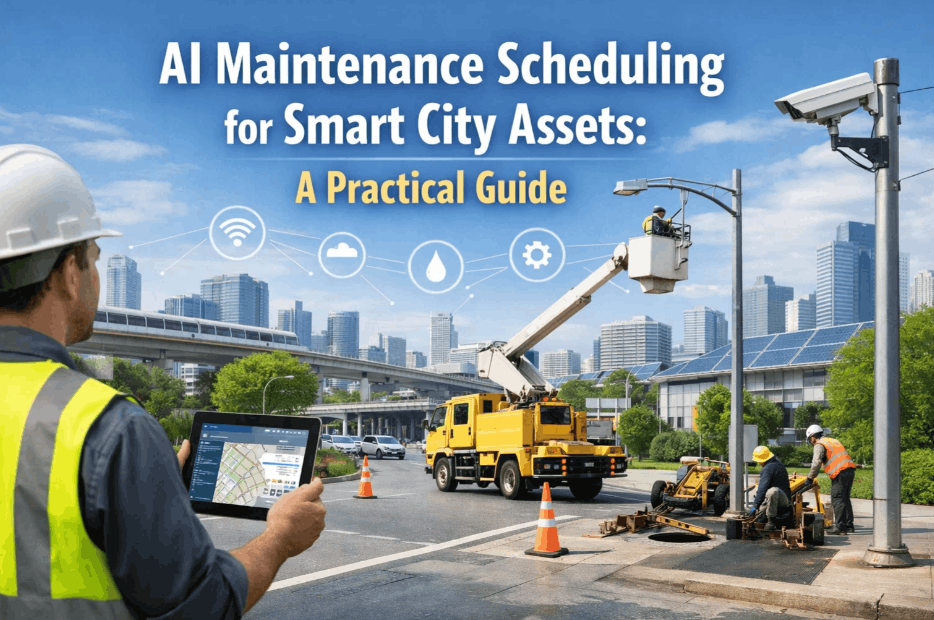
Most city infrastructure managers discover a problem only after it has already broken. A road sags, a bridge sensor finally trips, a water main bursts during morning commute. But a growing number of cities are flipping that equation entirely — moving from reactive repairs to smart street sensor networks that enable predictive city infrastructure management before failures ever happen. This is not a distant vision. It is happening now, at scale, in cities like Singapore, Berlin, and San Francisco — and the data behind it is compelling.
45–60%
reduction in total maintenance costs with IoT predictive systems
70–85%
fewer emergency repairs after sensor network deployment
40%
electricity savings from AI-driven street lighting (Berlin, 2024)
30–90 days
advance warning before failures with continuous IoT monitoring
Why Cities Are Abandoning Scheduled Maintenance
Fixed maintenance schedules were designed for a world without real-time data. Inspect a bridge every six months. Repave roads by zone rotation. Replace streetlights in batches. It seemed rational — until you compare the cost of this approach against what sensor-driven intelligence now makes possible.
Cities operating on reactive or scheduled-only maintenance cycles face a compounding problem: they spend heavily on inspections that find nothing wrong, while the actual failures they care about — the ones that cost $500K to repair and close roads for weeks — happen between those inspection windows. The gap between "last checked" and "actually broke" is where municipal budgets bleed.
Traditional Approach
- Fixed inspection schedules regardless of actual asset condition
- Reactive repairs after failures — expensive, disruptive
- No early warning until something visibly breaks
- Resource allocation based on schedule, not data
- Emergency repair costs 4–8× planned maintenance
Sensor-Driven Predictive
- Continuous real-time monitoring of every critical asset
- AI flags anomalies 30–90 days before failure
- Maintenance scheduled when assets actually need it
- Crew dispatch prioritized by risk, not calendar
- 45–60% lower total maintenance costs documented
What a Smart Street Sensor Network Actually Looks Like
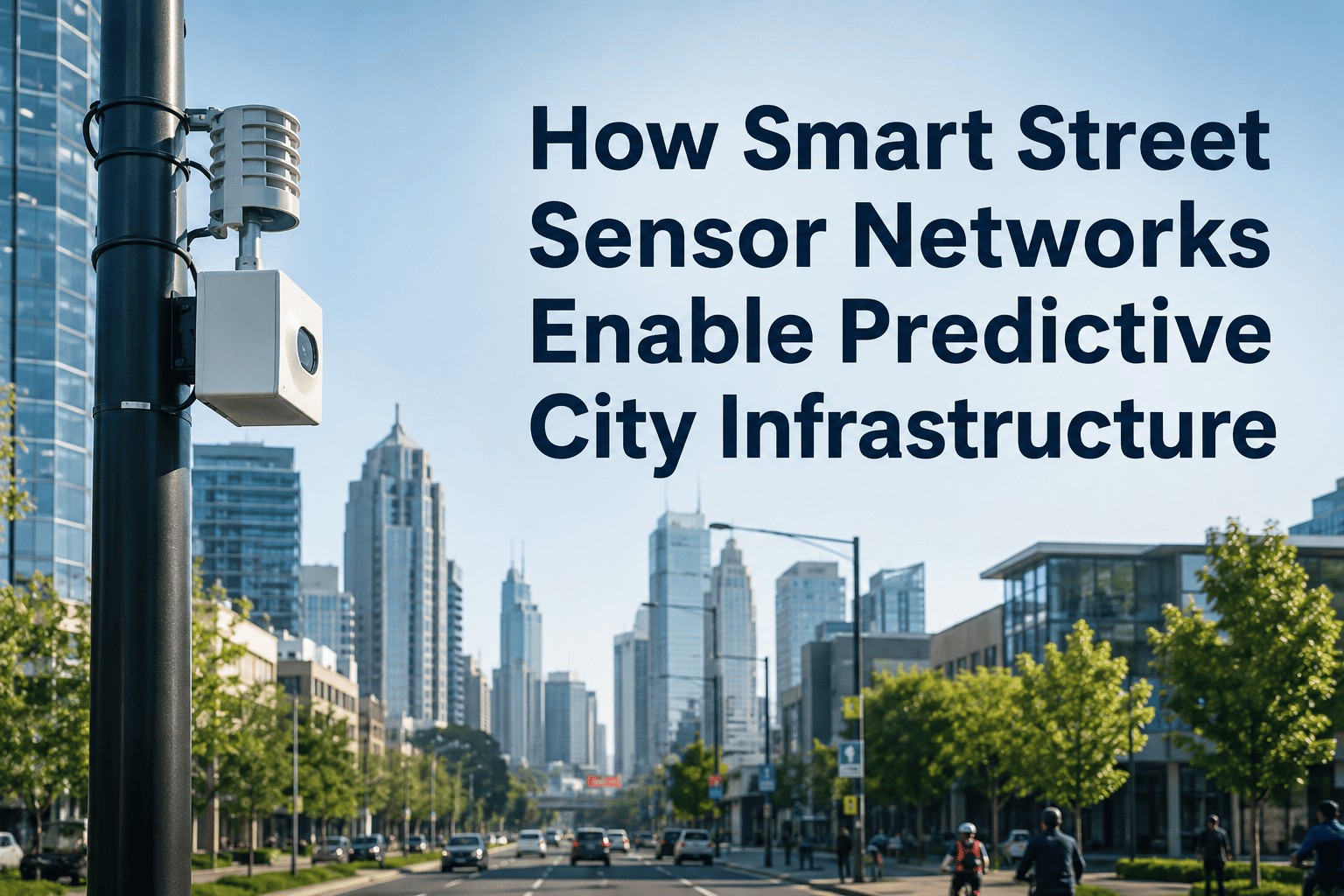
The term "sensor network" sounds abstract. In practice, it is a layered physical and digital system — sensors embedded in roads, bridges, lighting poles, pipes, and public assets, transmitting continuous data to an AI platform that turns raw signals into maintenance decisions. Here is how each layer works.
S1
Structural vibration sensors
Mounted on bridges, elevated roadways, and retaining walls. Detect micro-vibrations and harmonic patterns that signal fatigue stress before it becomes visible cracking. Accuracy: 95–98% for predicting structural degradation windows.
Best for: Bridges, overpasses, tunnels
S2
Pressure & flow sensors
Embedded in water mains and distribution networks. Track pressure drops and flow anomalies that indicate micro-leaks or pre-burst conditions. IoT pressure monitoring prevents 80–90% of main breaks when deployed at key nodes.
Best for: Water mains, drainage, fire hydrant lines
S3
Road surface sensors
Piezoelectric and moisture sensors embedded in pavement layers. Track load stress, temperature cycling, and subgrade saturation — the three primary drivers of pothole formation. Flag deteriorating zones before they become safety hazards.
Best for: Arterial roads, intersections, bridge decks
S4
Environmental & air quality sensors
Monitor PM2.5, NOx, CO2, temperature, and humidity at street level. Feed data into city heat island models and pollution event detection. Portland's network used these to automatically reroute traffic during an extreme heat event in 2024.
Best for: Dense urban corridors, near schools, high-traffic zones
S5
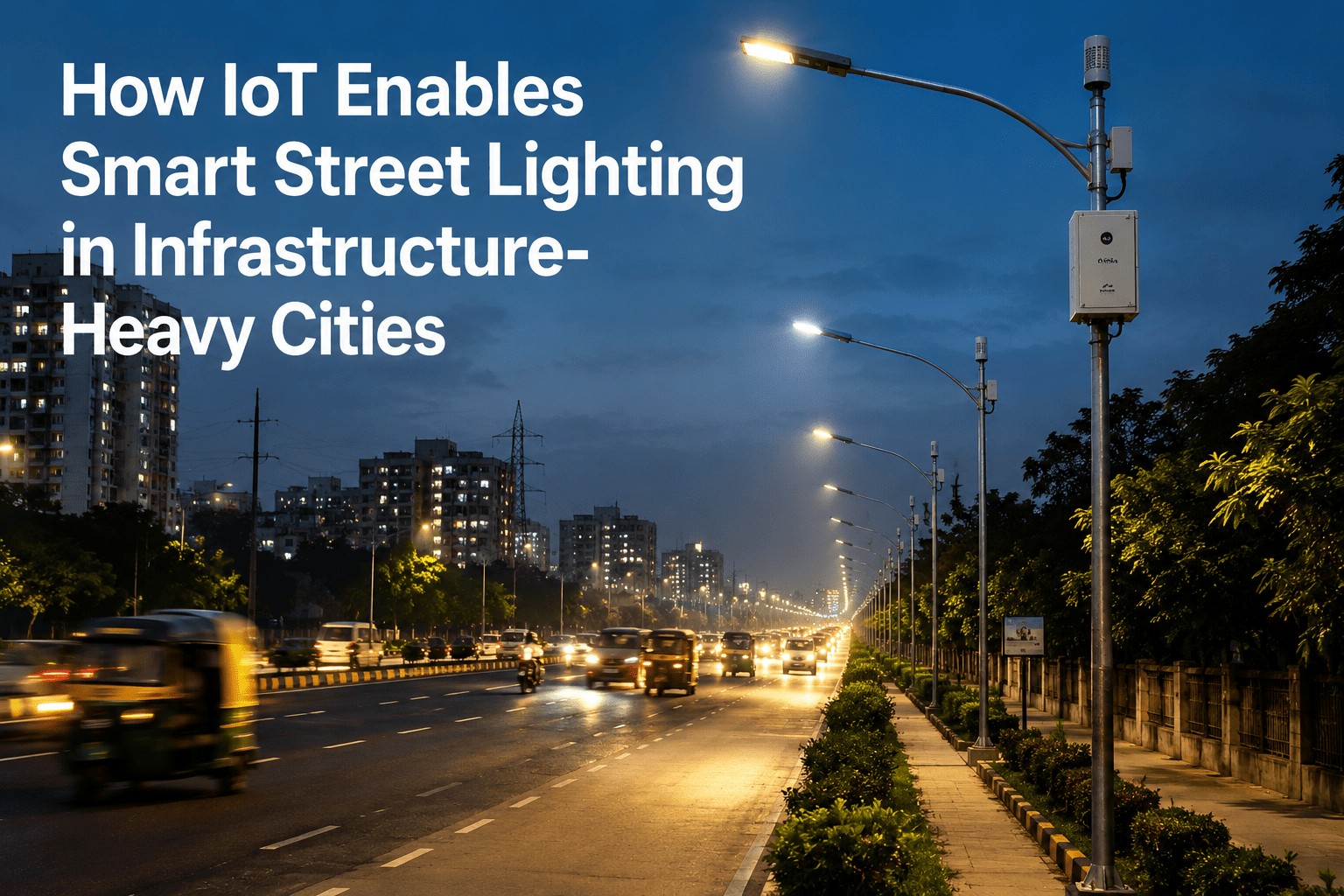
Smart lighting sensors
Embedded photocells and current monitors in street poles detect fault conditions, daylight levels, and energy draw. AI-driven control adjusts output by time-of-day and pedestrian presence. Berlin achieved 40% energy savings with this approach in 2024.
Best for: Street lighting networks, tunnels, parking structures
S6
Acoustic emission sensors
Detect high-frequency sound pulses emitted by materials under stress — cracking concrete, grinding bearings, water escaping under pressure. Often the earliest possible signal of impending failure, detectable weeks before visual or vibration indicators.
Best for: Pipelines, bridges, heavy machinery in infrastructure
INTELLIGENT INFRASTRUCTURE MONITORING
See How iFactory Connects Your City's Sensor Network to AI
iFactory's AI asset monitoring platform integrates with your existing sensors and infrastructure systems — delivering predictive alerts, automated work orders, and real-time asset health dashboards.
From Raw Sensor Signal to Maintenance Decision: The Data Flow
Collecting sensor data is only the first step. The real value — and the real complexity — is in how that data becomes an actionable maintenance decision in the hands of a city operations team. The pipeline below shows how a modern AI infrastructure platform turns a sensor reading into a dispatched work order.
01
Continuous sensing at the asset
Sensors transmit data over LoRaWAN, NB-IoT, or 5G networks every 1–15 minutes depending on criticality. Low-power hardware runs 5–8 years on a single battery — making city-scale deployment viable without ongoing infrastructure cost.
02
Edge filtering and anomaly pre-detection
Edge gateways run lightweight anomaly detection locally — filtering noise and flagging high-priority signals before cloud transmission. This reduces bandwidth load by 60–80% and enables sub-second local alerts for critical events.
03
AI baseline modeling and pattern matching
Cloud-based machine learning models compare live sensor readings against historical baselines built from months of operational data. Models account for weather, seasonal load variation, event patterns, and traffic cycles specific to each asset location.
04
Failure probability scoring
Each asset receives a continuously updated failure probability score. When that score crosses a configurable threshold, the system generates a predictive alert — ranked by urgency, asset criticality, and estimated time-to-failure window.
05
Automated work order generation
The platform auto-generates a work order — including asset ID, GPS location, fault type, recommended repair procedure, parts list, and scheduling window — and pushes it directly to your CMMS (Maximo, SAP PM, Fiix, or others). Zero manual triage required.
Real Cities, Real Outcomes
The case for smart sensor networks is not theoretical. Multiple major cities have deployed these systems and documented the results. The pattern is consistent: wherever dense sensor coverage meets AI analytics, maintenance costs fall, service quality rises, and emergency incidents drop sharply.
San Francisco, USA
30,000+ IoT sensors
Transit on-time performance improved from 72% to 94% since 2022 after AI-optimized scheduling and predictive maintenance. Infrastructure alerts now reach operators before failures reach citizens.
Berlin, Germany
40% energy reduction
AI-driven street lighting deployment in 2024 achieved a 40% reduction in electricity use across test districts through real-time sensor control and AI load optimization — without reducing lighting quality.
Singapore
Network-wide predictive alerts
Smart Nation initiative integrated IoT infrastructure alerts and AI-powered transit management across the entire urban network, delivering real-time asset health and predictive transit management citywide as of April 2025.
Pittsburgh, USA
40% fewer wait times
Surtrac AI traffic management system, fed by real-time street sensors, cut intersection wait times by 40% and reduced vehicle emissions. The system adapts dynamically to actual flow, not fixed signal cycles.
STOP REACTING. START PREDICTING.
Get a Custom Infrastructure Assessment for Your City
Our smart city specialists will map your highest-risk assets and show exactly where sensor networks deliver the fastest ROI — no cost, no commitment required.
The ROI Breakdown: Where the Savings Come From
For a city managing 500–2,000 monitored assets, the financial case for smart sensor infrastructure follows a predictable pattern. Savings come from four distinct categories, each compounding over time as AI models become more accurate.
Emergency repair avoidance
$180K–$500K / yr
Planned vs reactive maintenance shift
$120K–$280K / yr
Energy optimization (lighting, HVAC)
$60K–$180K / yr
Labor efficiency & crew optimization
$40K–$110K / yr
Combined annual savings for a mid-sized city managing 500–2,000 assets typically exceed $400,000 — with full ROI on platform and hardware investment within 12–18 months.
Frequently Asked Questions
What types of infrastructure assets benefit most from street sensor networks?
The assets with the highest failure cost and the longest repair cycles deliver the best ROI from sensor monitoring: bridges, elevated roadways, water mains, and street lighting networks. These assets also tend to have clear, measurable physical signals — vibration, pressure, current draw — that sensors can reliably track. Cities typically start with their highest-criticality assets and expand coverage once the ROI is documented.
How long does it take for AI predictive models to become accurate?
Most platforms require 30–60 days of operational data to build reliable baselines for each asset. Initial anomaly detection begins immediately, but failure-probability scoring improves significantly over the first 90 days as the AI learns seasonal and load patterns specific to each location. By month six, prediction accuracy for most asset types improves 20–35% over the initial baseline.
Can smart sensor networks integrate with our existing CMMS and GIS systems?
Yes — modern AI infrastructure platforms like iFactory connect via standard APIs, OPC-UA, and Modbus to existing CMMS, GIS, and fleet management systems without requiring infrastructure replacement. Work orders, alerts, and asset health data push directly into tools like Maximo, SAP PM, Fiix, and UpKeep. Integration typically takes 30–60 days and requires minimal IT involvement.
Is sensor network deployment only viable for large cities?
No. Per-sensor hardware costs have fallen to $200–$500 for most sensor types, and cloud AI platforms scale efficiently to networks with fewer than 200 monitored assets. Mid-sized cities and district-level pilots often see faster payback because their baseline maintenance inefficiency is proportionally higher. The economic logic — prevent expensive failures, reduce emergency repair frequency — applies at any scale.
How does predictive infrastructure maintenance help cities meet sustainability goals?
Fewer emergency repairs mean fewer heavy equipment deployments and less material waste. AI-optimized street lighting delivers documented 40%+ energy reductions. Predictive water main maintenance prevents the massive energy and water loss from undetected leaks. Smart traffic management reduces idle vehicle emissions. These make sensor-driven infrastructure management one of the most documentable decarbonization pathways available to city operations teams — and increasingly eligible for green bond and sustainability grant funding.
YOUR CITY'S INFRASTRUCTURE CAN'T WAIT
See iFactory's Predictive Infrastructure Platform Live
Our smart city team will walk you through a live demo using your asset profile and city zones — no generic slides, no obligation. See exactly how AI monitoring transforms reactive maintenance into predictive city management.