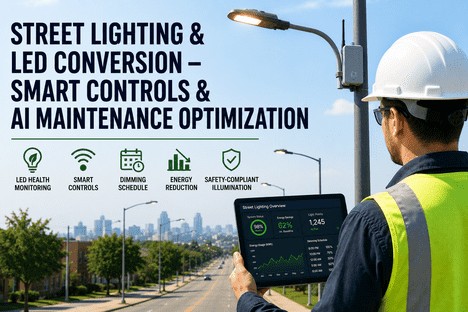
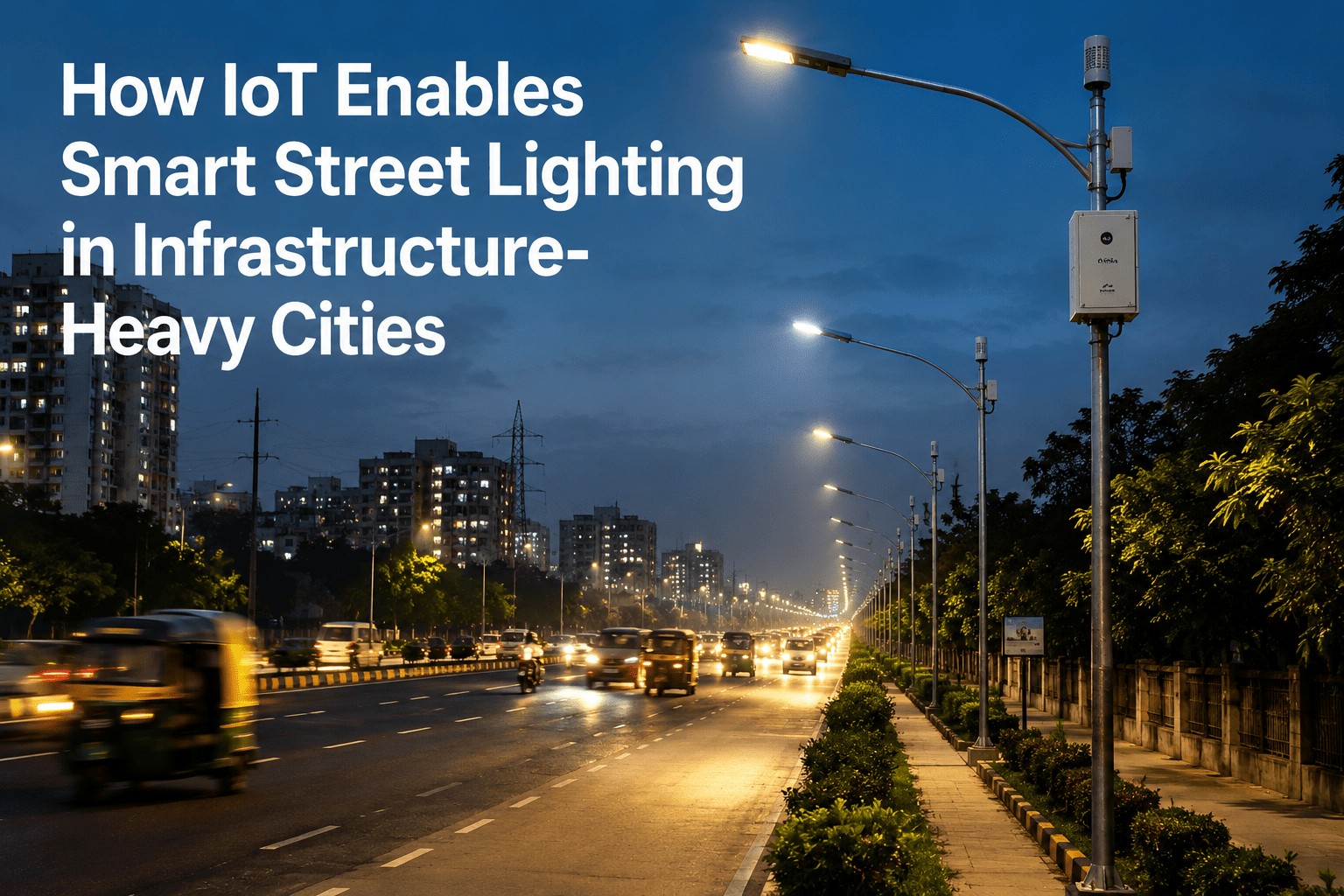
Street lighting is one of the largest single line items in any municipal electricity budget — typically accounting for 30 to 40 percent of a city's total energy spend. With over 300 million street lights installed globally and most still running high-pressure sodium or metal halide technology at less than 40 percent energy efficiency, the opportunity for transformation is immense. Yet the majority of LED conversion projects capture only half of the available savings. They replace the lamp but not the logic. The luminaire becomes efficient, but the operating schedule remains static — full power at 2 AM on a residential street where nobody is driving, full brightness on a Tuesday morning when daylight already provides adequate illumination. For the Maintenance Manager responsible for a city's lighting infrastructure, the question has shifted from whether to convert to LED to how to layer smart controls and AI-driven maintenance analytics on top of the LED foundation to capture the full 50 to 80 percent energy reduction that modern systems deliver. This guide covers the complete sequence — from luminaire specification through smart control architecture to predictive maintenance — with the operational KPIs that connect lighting performance to budget outcomes.
LED Conversion · Smart Controls · AI Maintenance · Energy Optimization · Municipal Infrastructure
Replacing the Lamp Captures 50 Percent. Adding Intelligence Captures the Other 50. iFactory Manages Both.
iFactory's street lighting management platform gives maintenance managers end-to-end control — LED asset lifecycle tracking, smart dimming schedule optimization, fault detection with automated dispatch, and energy consumption analytics that connect every luminaire to the city's energy reduction targets.
The Lighting Transformation Is Happening in Two Phases — and Most Cities Stop After Phase One
The global installed base of individually controlled smart street lights reached 32.9 million units in 2024 and is projected to grow at 20.9 percent annually to 85 million by 2029. The smart lighting market overall is projected to reach USD 88.4 billion by 2034. These numbers reflect a fundamental shift in how cities think about lighting infrastructure — not as a fixed operational cost but as a managed network asset with variable performance characteristics. The Maintenance Manager who understands the two-phase structure of this transformation is the one who delivers the full savings potential.
Phase 1 — Luminaire Replacement
50-75%
Energy reduction vs HPS
Replacing 150W-400W high-pressure sodium fixtures with 60W-150B LED luminaires delivering equivalent or better illumination. Payback typically 4-8 years on energy savings alone. LED lifespan of 50,000-100,000 hours eliminates 3-5 relamping cycles compared to HPS.
What phase 1 alone misses: Static operation. Lights run at 100% output regardless of traffic, time, or ambient light. No fault visibility until a citizen reports a dark pole. No energy consumption data per luminaire.
Phase 2 — Smart Controls + AI Maintenance
70-80%
Total energy reduction achievable
Layering adaptive dimming schedules, motion-triggered brightness, constant light output technology, and AI-driven predictive maintenance on top of the LED foundation. Smart controls alone add 20-30% savings beyond baseline LED conversion.
What phase 2 delivers: Dynamic operation per luminaire. Real-time fault detection and automated dispatch. Per-fixture energy monitoring. Predictive maintenance that reduces truck rolls by 40-60%. Compliance reporting for energy reduction mandates.
32.9M
Smart street light controls installed globally in 2024 — growing to 85 million by 2029
20.9%
Annual growth rate of individually controlled smart street lighting adoption worldwide
30%
Average operational cost reduction reported by cities deploying IoT-enabled smart street lighting
$88B
Projected global smart lighting market by 2034 — driven by energy mandates and AI integration
The Three Technologies — How LED, Smart Controls, and AI Maintenance Work Together
Each technology layer in a modern street lighting system serves a distinct function. Understanding how they interact — and where the maintenance manager's operational responsibilities sit within each layer — is the foundation of an effective deployment strategy.
Layer 1
LED Luminaire Technology
Modern LED street lights achieve 160-210 lumens per watt — more than double the efficacy of fluorescent and four times that of HPS. Precision secondary optics direct light exactly where needed, reducing pole count requirements by 15-20% through wider spacing. Constant light output technology starts at lower power and gradually increases over the luminaire's life, saving 8-12% in energy during the first five years alone.
Maintenance manager priority: Asset registry with luminaire specifications, installation date, warranty status, and lumen depreciation tracking per fixture.
Layer 2
Smart Control Architecture
Networked lighting controllers connected via RF mesh, cellular, or PLC enable per-luminaire dimming scheduling, real-time status monitoring, and fault detection. Scheduled dimming to 30-50% during low-traffic hours. Motion sensors provide on-demand brightness. Adaptive grouping creates follow-me lighting sequences. The control layer is what transforms a static asset into a responsive network.
Maintenance manager priority: Communication network reliability, dimming schedule compliance, and integration with central management system.
Layer 3
AI Predictive Maintenance
Machine learning models analyze luminaire performance data — power consumption trends, driver voltage stability, communication health, and historical failure patterns — to predict failures before they cause outages. LED drivers fail before the LEDs themselves. AI detects the early warning signs: current drift, thermal elevation, intermittent communication. Predictive maintenance reduces emergency truck rolls by 40-60% and extends effective luminaire life.
Maintenance manager priority: Predictive alert configuration, automated work order generation, and data-driven replacement cycle planning.
Predictive Maintenance · Smart Dimming · Energy Analytics · Asset Lifecycle Management
A Dark Pole Should Never Be the First Indication of a Fault. iFactory Detects the Failure Before the Light Goes Out.
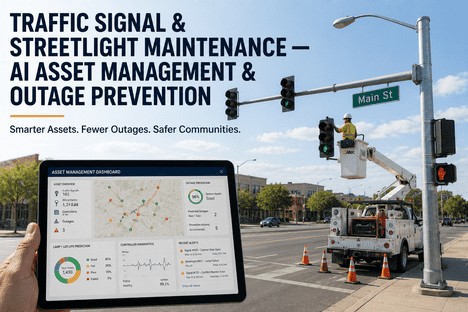
AI-driven predictive maintenance on the iFactory platform monitors every luminaire's power signature, driver health, and communication status — generating work orders from anomaly detection rather than citizen complaints.
The Five Failure Modes That AI Maintenance Catches Before the Crew Rolls
In a traditional street lighting operation, faults are discovered through citizen reports, nighttime patrols, or scheduled inspections — all reactive methods that mean a luminaire may be non-functional for days or weeks before it is detected. AI-driven analytics changes this by identifying the early indicators of each failure mode, allowing the maintenance team to intervene before the outage occurs.
01
LED Driver Degradation
The driver is the most common failure point in LED luminaires. AI detects current drift, output voltage instability, and thermal elevation days or weeks before complete driver failure. Replacing a driver is a fraction of the cost of an emergency pole replacement.
02
Communication Network Dropout
A luminaire that stops reporting to the central management system may still be functioning but is invisible to the control layer. AI identifies intermittent communication patterns that indicate RF module degradation, antenna misalignment, or mesh network routing issues before complete loss of visibility.
03
Surge and Power Event Damage
Lightning strikes, switching transients, and neutral faults cause cumulative damage to LED drivers and control electronics. AI correlates power quality events with subsequent luminaire performance degradation, identifying which assets are at elevated risk of near-term failure after a surge event.
04
Lumen Depreciation Anomaly
All LEDs lose brightness over time, but accelerated depreciation indicates a thermal management problem — failed heatsink contact, degraded thermal compound, or ambient temperature exceedance. AI flags luminaires whose light output is dropping faster than the expected depreciation curve.
05
Dimming Schedule Deviation
A luminaire that fails to execute its dimming schedule — staying at 100% when it should be at 40% — wastes energy and may indicate a controller firmware issue. AI monitors actual vs. commanded output levels and flags deviations that increase energy consumption or violate compliance requirements.
Combined impact of AI predictive maintenance
40-60% reduction in emergency truck rolls
Fewer emergency dispatches means lower labor cost, reduced vehicle fuel and maintenance expense, and longer intervals between scheduled replacement cycles.
The Maintenance Manager's KPI Framework — Connecting Lighting Performance to Budget Outcomes
Street lighting maintenance is measured by two categories of metrics: operational performance (how well the lights function) and financial performance (how efficiently the budget is spent). The Maintenance Manager who tracks both categories in a single dashboard drives better outcomes than the manager who tracks only one — because every operational decision has a cost consequence and every budget decision has an operational impact.
Luminaire availability rate — percentage of fixtures operating at correct output level at any time
Mean time between failures by luminaire type, driver model, and installation zone
Fault detection to dispatch time — how quickly the system identifies and escalates anomalies
Mean time to repair — from work order creation to luminaire restoration
Dimming schedule compliance — percentage of luminaires executing programmed dimming correctly
Energy cost per luminaire per month — per-fixture consumption with variance analysis against baseline
Maintenance cost per luminaire per year — labor, parts, and vehicle cost normalized per fixture
Emergency vs. planned maintenance ratio — target shift toward 80%+ planned interventions
Energy reduction trend — monthly percentage savings vs. pre-conversion baseline
ROI tracker — cumulative savings vs. conversion and smart control deployment costs
The Savings That Showed Up in the Dashboard, Not the Patrol
A mid-sized city deployed LED conversion across 18,000 luminaires in 2023, achieving a 62 percent energy reduction from the lamp replacement alone. In 2024, they layered smart controls and AI maintenance analytics on the same asset base. Within six months, the adaptive dimming schedule added another 22 percent energy reduction — bringing total savings to 71 percent. The AI predictive maintenance module detected fourteen driver degradation events in the first quarter alone, all of which were replaced during scheduled daytime maintenance shifts rather than emergency night callouts. The Maintenance Manager reported that the city's emergency truck rolls dropped by 53 percent year over year, and the combined energy and maintenance savings reduced the projected payback period from 6.2 years to 3.8 years. The infrastructure investment did not change. What changed was the intelligence layer managing it.
Conclusion
Street lighting is the most visible and one of the most costly infrastructure assets a city operates. With the global smart lighting market projected to reach USD 88.4 billion by 2034 and the installed base of smart street light controls growing at over 20 percent annually, the transition from static lighting to intelligent, AI-managed networks is accelerating. The Maintenance Managers who lead this transition will deliver 70-80 percent energy reductions, cut emergency maintenance costs by half, and extend the effective life of their luminaire assets — all while improving the quality and consistency of the illumination their communities depend on.
iFactory's street lighting management platform gives maintenance managers the complete toolset — from luminaire asset registry and lifecycle tracking through smart dimming schedule management to AI-driven predictive maintenance and energy analytics. Book a Demo to see how the platform maps to your city's lighting infrastructure, or Talk to an Expert to discuss your street lighting transformation strategy and projected savings.
Frequently Asked Questions
Your Street Lights Are Your City's Largest Energy Load. Make Every Watt Count.
iFactory's street lighting platform — asset lifecycle management, adaptive smart controls, AI predictive maintenance, and energy analytics — gives maintenance managers the toolset to reduce lighting energy by 70-80% and cut emergency maintenance costs in half.