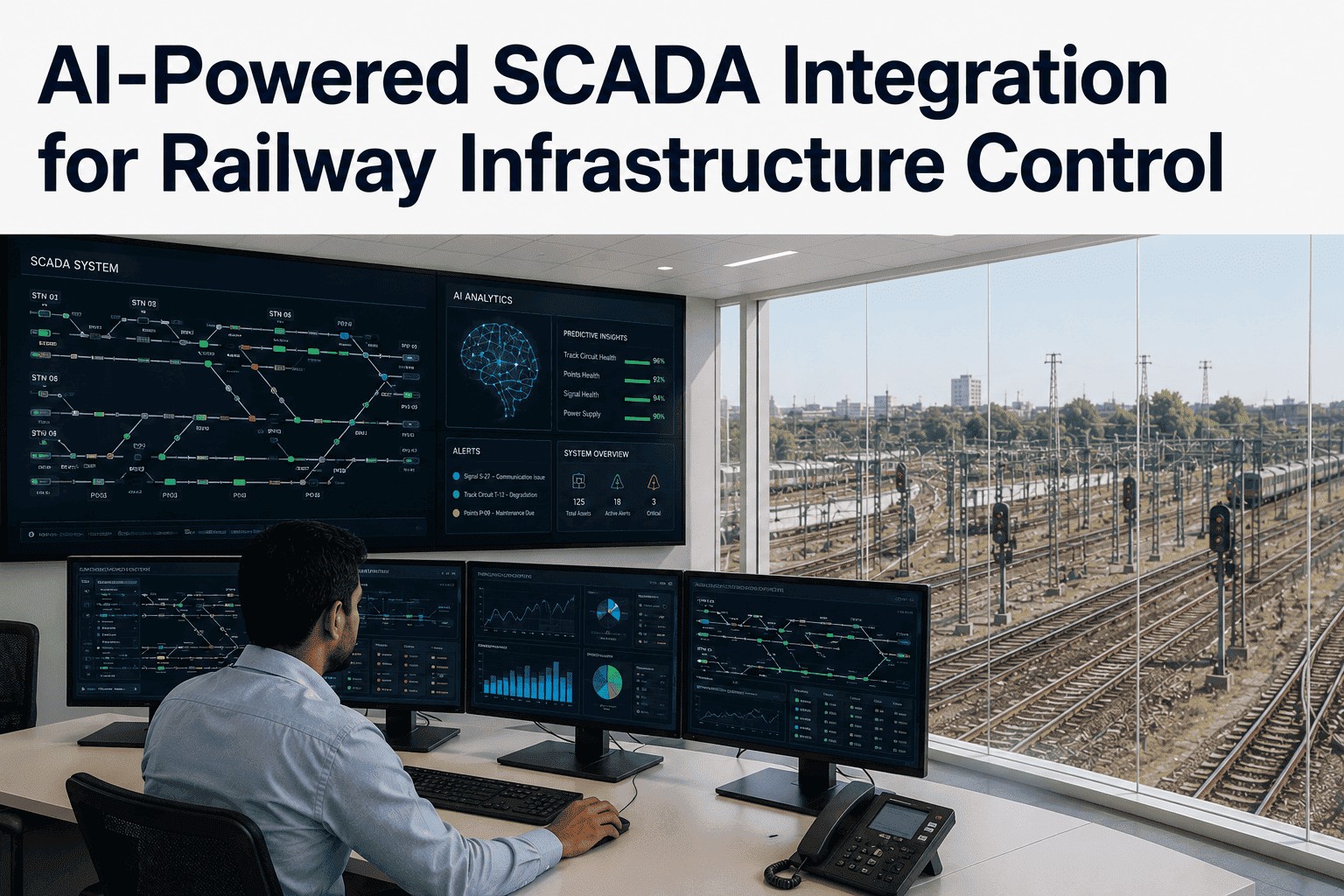
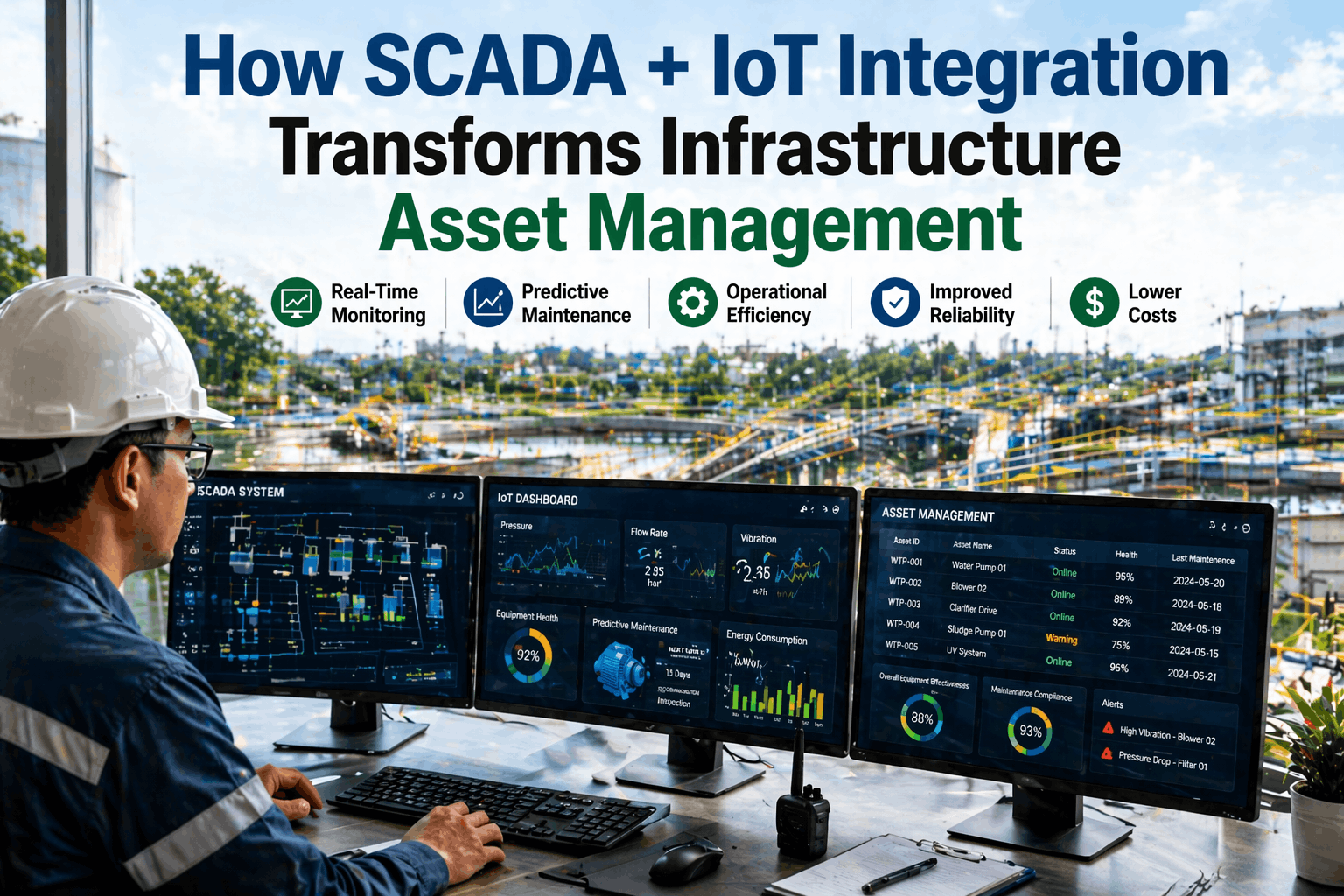
Most railway SCADA systems were built to control. They open and close relays, monitor track circuits, command interlockings, and log states. What they were never designed to do is learn. A signal that trips at 02:14 on a Tuesday looks identical to one that tripped at 02:14 every Tuesday for the past six weeks — to the SCADA system. To an AI model trained on that same data, it looks like a component three weeks from failure. The difference between those two readings is the entire value proposition of AI-SCADA integration: turning the control layer your network already runs on into an intelligent, predictive operations platform — without replacing a single RTU or rewriting a line of ladder logic.
OPC-UA · Modbus · DNP3 · Edge AI · Predictive Maintenance · SCADA Analytics
Your SCADA System Is Already Collecting the Data That Could Prevent Your Next Failure. AI Reads It.
iFactory connects AI analytics to your existing SCADA layer via standard industrial protocols — adding predictive intelligence to the infrastructure control system you already operate, without rip-and-replace.
99%
Fault prediction accuracy achieved by ML frameworks on live railway SCADA data streams
30–45%
Reduction in unplanned downtime when AI predictive maintenance runs over SCADA infrastructure data
<1ms
Fault classification latency in AI-integrated SCADA deployments using edge-resident GRU networks
$5.7B
Railway AI market value by 2029, growing at 18.1% CAGR driven by SCADA and maintenance integration
Why Legacy SCADA Systems Are Sitting on a Gold Mine of Unread Intelligence
Railway SCADA systems generate continuous telemetry — current draws, response times, contact states, voltage levels, temperature readings — from every RTU on the network, every second of every day. This data is logged. It is timestamped. It is stored in historians. And in the vast majority of networks, it is used for exactly one thing: triggering the alarm when a threshold is breached.
The breach is the failure. The data that predicted it — the motor current trending upward over six weeks, the contact response time drifting 40 milliseconds per month, the voltage variance increasing in a specific temperature band — was in the historian the whole time, waiting to be read by a model capable of recognising what it meant.
SCADA Alone — What It Sees
Point machine motor current: 4.8A. Status: within threshold. No action required.
Track circuit occupancy detected. State change logged. No anomaly flagged.
Signal relay response time: 312ms. Within operational range. No alert.
Three weeks later — point machine failure at 02:14. Emergency callout. Line blocked 4 hours.
AI + SCADA — What It Reads
Point machine motor current: 4.8A — but trending up 0.15A per week for six weeks. Pattern matches pre-failure signature in 847 historical incidents. Health score: 41/100.
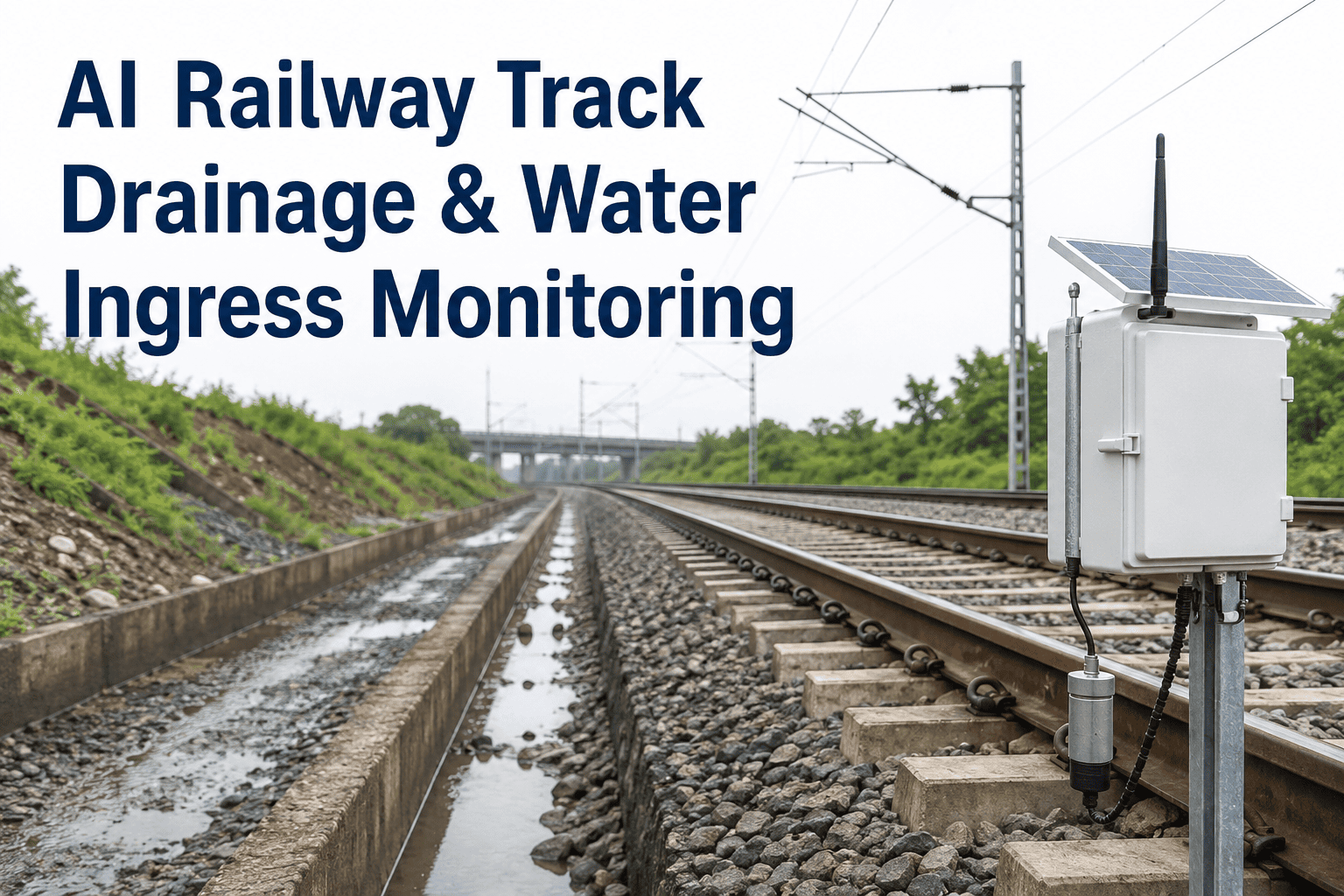
Track circuit occupancy variance 12% above seasonal baseline. Correlated with ballast moisture ingress profile from prior month.
Signal relay response drifting +8ms per week. Predicted to breach threshold in 19 days. Maintenance window auto-scheduled.
Point machine replaced during planned possession. No service disruption. Failure prevented.
The Integration Architecture: How AI Connects to a Live Railway SCADA System
Integrating AI analytics with a live railway SCADA system is an architectural problem, not a replacement exercise. The control layer stays in place. The AI layer adds above it — reading the same data streams, working on the same historian, communicating via the same industrial protocols already running on your network. The three-layer architecture used in modern deployments separates concerns cleanly: edge sensing, cloud or on-premise compute, and AI decision output.
Layer 01
Edge Sensing & Protocol Bridge
RTUs · PLCs · Sensors → Protocol Gateway
SCADA field devices — RTUs, PLCs, track circuit controllers, interlocking processors — speak legacy industrial protocols: Modbus RTU over RS-485 serial, DNP3 over WAN links, or IEC 60870-5-104 over TCP. The AI integration layer begins at a protocol gateway that reads these data streams natively and normalises them into a common data model. OPC-UA has become the standard bridge protocol for this step: it wraps legacy protocol data in a secure, interoperable envelope that AI platforms, cloud data pipelines, and historian systems can all consume without bespoke connectors.
Modbus RTU/TCP
Legacy serial & Ethernet PLCs
DNP3
Wayside RTUs over WAN
IEC 60870-5
Telecontrol over TCP/IP
OPC-UA
Modern IT/OT bridge layer
Layer 02
Data Fusion & AI Compute
Historian · Feature Engineering · ML Models
Normalised SCADA telemetry flows into the AI compute layer — either cloud-resident or on-premise — where it is contextualised with historical performance records, maintenance logs, weather exposure data, and asset age profiles. ML models — LSTM networks for temporal fault patterns, GRU networks for real-time classification, and ensemble methods for anomaly scoring — run continuously against live data streams. The AI engine does not replace the SCADA historian; it reads from it and adds a predictive intelligence layer on top of data that was previously only used reactively. A Transformer-Encoder-based temporal fusion model is now the architecture of choice for multi-source railway SCADA signal fusion, enabling the system to learn cross-asset correlations invisible to single-sensor rules.
Temporal modelling
LSTM · GRU recurrent networks for sequence learning on SCADA time series
Anomaly detection
Statistical process control + ML ensemble for threshold-independent fault detection
Multi-source fusion
Transformer-Encoder architecture fusing SCADA, IoT, environmental, and maintenance data
Layer 03
Intelligent Interaction & Output
Health Scores · Alerts · Work Orders · Digital Twins
The AI engine's outputs are actionable, not informational. Each monitored asset receives a continuously updated health score. Predictive alerts are issued with an estimated failure horizon and a recommended maintenance action — not just a threshold alarm. When a decision is made, it is dispatched back to the CMMS as a pre-filled work order, and confirmed via digital twin strategy validation before execution. The control feedback loop — perception, fusion, prediction, execution — runs continuously. Controllers and maintenance planners see a prioritised asset health dashboard, not a raw alarm log. The SCADA system continues to handle control; AI handles the interpretation of what the control data means for future reliability.
OPC-UA Integration · Asset Health Scoring · SCADA Analytics
iFactory Reads Your SCADA Historian. Your Team Reads the Results.
Connect iFactory's AI platform to your existing SCADA layer via OPC-UA, Modbus, or DNP3 — no rip-and-replace, no new RTUs, no rewriting your control logic.
What AI Monitors Inside a Railway SCADA System
Every subsystem connected to SCADA generates a different category of predictive signal. The table below maps the primary SCADA-connected railway assets to the ML technique that best extracts predictive intelligence from their data, and the failure mode that technique is designed to anticipate.
Asset
SCADA signal
AI model type
Failure predicted
Point Machines
Motor current, stroke time, operating voltage
LSTM trend detection + anomaly scoring
Mechanical seizure, motor burnout, obstruction
Track Circuits
Shunt resistance, feed current, occupancy state
GRU temporal classifier + variance analysis
False clear, shunt failure, equipment degradation
Signal Relays
Response time, contact resistance, power draw
Regression + SVM on feature drift over time
Contact weld, slow response, intermittent fault
Traction Power
Voltage, load current, harmonic distortion
LSTM + physics-informed sample generator
Switchgear failure, substation overload, arc fault
Catenary / OHL
Sag measurements, thermal imaging, tension
AdaBoost ensemble + weather correlation model
Wire break, stagger fault, weather-driven failure
Level Crossings
Barrier motor state, detection loop, timing
Threshold-adaptive ML + event pattern matching
Barrier stuck, detection failure, timing drift
The Protocol Reality: Integrating AI With What's Already in the Field
Railway SCADA networks are not homogeneous. A single control centre typically manages assets running four or five different communication protocols — some installed in the 1990s, some commissioned last year. A successful AI integration must bridge all of them without disrupting the control functions those protocols carry.
Modbus RTU / TCP
The legacy foundation
Still the most widely deployed protocol in railway field devices due to its simplicity and age. Master-slave polling architecture means AI integration gateways must be configured to passively read Modbus traffic without interfering with existing master-slave poll cycles. No built-in security or authentication — network segmentation is essential before any AI data pipeline is opened.
Integration approach: passive Modbus TCP tap → OPC-UA normalisation gateway
DNP3
The wayside workhorse
Designed specifically for SCADA telemetry over unreliable WAN links — the dominant protocol for wayside RTUs on railway infrastructure. DNP3's event-driven reporting model means AI gateways receive change-of-state data rather than needing to poll — reducing latency for condition monitoring. Supports timestamping at source, which is critical for accurate temporal ML model training on distributed rail assets.
Integration approach: DNP3 outstation mirroring → data lake ingestion with original timestamps preserved
OPC-UA
The AI integration standard
The de facto standard for modern IT/OT integration and the recommended bridge layer for AI-SCADA connectivity. OPC-UA provides built-in security (TLS, certificate-based authentication), a semantic data model that carries meaning alongside values, and direct support for cloud connectivity. Most new railway SCADA deployments specify OPC-UA as the AI data extraction interface — and protocol converters are widely available to wrap legacy Modbus and DNP3 devices in OPC-UA endpoints.
Integration approach: OPC-UA server → direct REST API or MQTT feed to AI platform
With AI, you're now able to build models to make predictions. Through developments like parallel processing chips and the rise of internet connectivity post Covid-19, we now have this unprecedented access to data in high volumes. For the rail sector, that means you're able to process these huge datasets much more quickly — and what that enables is a fundamentally different relationship between condition data and maintenance decision-making.
— Ian Dean, Principal Engineer, Track Data AI & ML, Network Rail Technical Authority (2026)
What Changes Operationally When AI Is Running Over SCADA
The operational impact of AI-SCADA integration is not incremental. It changes the fundamental information model that maintenance and control teams work from. Four shifts happen consistently across deployments.
From alarm response to failure prevention
SCADA alarms tell you something has already failed or is about to breach a static threshold. AI health scores tell you something is trending toward failure — days or weeks before the threshold is reached. The maintenance team's job shifts from responding to events to scheduling interventions that prevent them. Published results from rail metro operations show fault prediction accuracy above 98%, with the system maintaining optimal balance between detection rate and false alarm rate at scale.
From isolated alarms to cross-asset intelligence
A SCADA alarm on a track circuit and a SCADA alarm on the adjacent point machine look unrelated in an alarm log. An AI model trained on their joint history recognises that these two assets failing in sequence is a known pattern on this corridor under this weather profile — and flags both together as a correlated risk cluster, not two independent events. Graph attention networks and multi-asset fusion models make this cross-asset reasoning possible at network scale.
From fixed cycles to condition-based maintenance
Time-based maintenance replaces components whether they need it or not — or not soon enough when they do. AI condition scoring uses actual SCADA performance data to schedule maintenance when the asset's health trajectory indicates it is needed, not when the calendar says it is due. This shift from preventive to predictive maintenance consistently produces 20–30% reductions in maintenance costs and 15–20% extensions in asset lifespan.
From reactive reporting to explainable decisions
Modern AI-SCADA integrations include explainability layers — SHAP and LIME attributions that tell the maintenance engineer not just that an asset has a health score of 38, but which SCADA signals drove that score and what change in those signals would move it. Controllers and maintenance teams act on AI outputs more reliably when they can see the reasoning, not just the conclusion.
20–30%
Reduction in maintenance costs
Condition-based scheduling replaces calendar-driven replacement cycles across SCADA-connected assets.
93%+
Fault classification accuracy in real-time
GRU-based networks deployed on FPGA hardware classify 30 fault scenarios with sub-millisecond latency on live SCADA data.
20%+
Extension in asset operational lifespan
Preventing unnecessary wear through condition-based intervention rather than fixed cycle replacement or reactive repair.
What Makes a Railway Network AI-Ready for SCADA Integration
Not every network can deploy AI-SCADA integration at the same pace. Three prerequisites determine how quickly a deployment can move from protocol connection to operational predictive intelligence.
Sensor Infrastructure
IoT-capable field devices or RTUs with accessible data ports are the foundation. Networks that still rely entirely on hardwired relay logic with no digital telemetry need a sensor modernisation programme before AI analytics can be added. Networks with existing DNP3 or Modbus RTU telemetry can begin integration immediately.
Minimum: digital telemetry from key assets accessible via any industrial protocol
Data History
Supervised ML models train on labelled historical SCADA data — timestamped readings paired with known fault events. Networks with at least 12 months of historian data covering a reasonable incident history can begin model training. Shorter histories are workable with transfer learning from similar network types. Unsupervised anomaly detection models require no labelled history at all.
Minimum: 12+ months of SCADA historian data with asset event logs
Network Segmentation
AI integration means opening a data path from the OT network (SCADA) to an IT or cloud layer — which creates a security boundary that must be managed. IEC 62443 compliance, OT-aware firewalls, and unidirectional data diodes for safety-critical control paths are the recommended security architecture. The AI layer reads from SCADA; it never writes to control functions.
Minimum: IT/OT network segmentation with monitored data extraction path
Conclusion
AI-SCADA integration is not a technology project in the conventional sense. The data already exists. The sensors are already deployed. The historian is already logging. What AI adds is a reading capability — the ability to look at six weeks of motor current data and see a failure trajectory that no static threshold rule would ever catch. The integration architecture — OPC-UA bridging legacy protocols, a three-layer edge-compute-output model, and a security boundary that keeps AI read-only from the control layer — is well-established and deployable on existing railway infrastructure without operational disruption.
iFactory provides the AI analytics layer that sits above your existing SCADA system — connecting to your historian via standard industrial protocols, scoring every monitored asset continuously, and translating SCADA telemetry into the predictive maintenance intelligence your team can act on before the failure happens. Book a Demo to walk through how iFactory integrates with your specific SCADA environment, or Get In Touch to see your first asset health scores.
Frequently Asked Questions
Your SCADA historian already contains the data that predicts your next failure. Does your maintenance team have a system that reads it?
iFactory integrates with your existing SCADA layer via OPC-UA, Modbus, or DNP3 — adding AI health scoring and predictive maintenance intelligence without changing a line of control logic or a single RTU configuration.