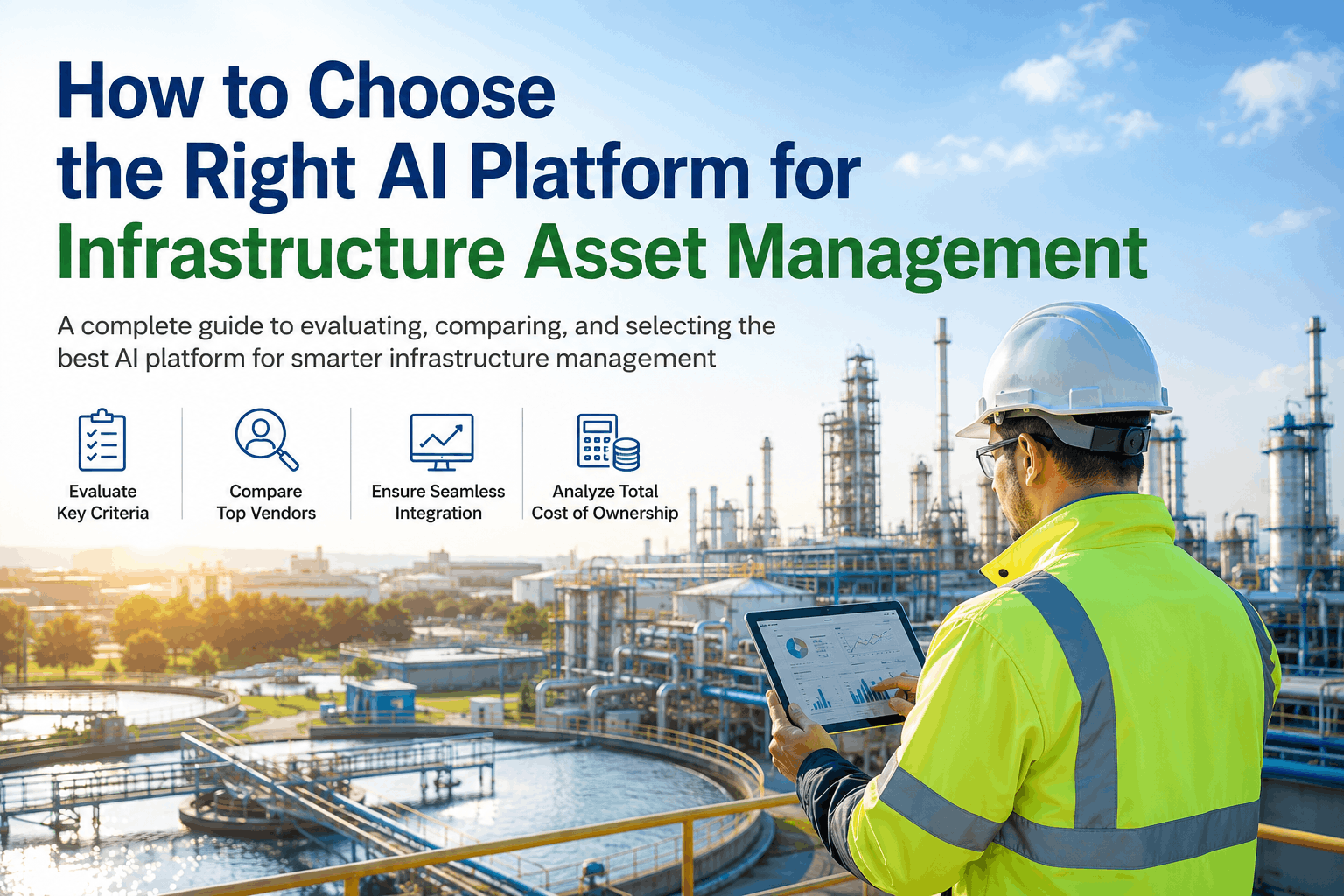
Choosing the right AI platform for infrastructure asset management is no longer a standard procurement exercise — it is a foundational decision that will dictate the operational resilience and financial stability of your organization for the next decade. In an era where critical infrastructure assets are facing unprecedented loads and climate-driven stress, the gap between general-purpose business intelligence and asset-aware industrial AI has become a primary driver of performance divergence. Many organizations make the mistake of selecting general cloud-AI platforms that require months of custom data labeling and pipeline building, only to find that these systems lack the "Physics of Failure" signatures required for high-vibration or high-heat environments. Organizations that book a demo with iFactory are discovering that true ROI comes from selecting a platform that is "Industrial from Day 1," offering pre-trained models for critical components like HAGC pumps, gearboxes, and conveyors that can be deployed onto legacy SCADA data in weeks rather than years. By selecting a platform that unifies real-time telemetry with autonomous decision logic, you bridge the gap between "Digital Hindsight" and "Autonomous Foresight," ensuring that every unit of data collected is a unit of data that informs an immediate maintenance action.
Select an AI Platform Built for Industrial Reality
iFactory's Mobile AI-driven platform eliminates the "Model Building Gap" by providing asset-aware diagnostics and real-time autonomous intelligence — purpose-built for the high-criticality infrastructure sector. Shift from a reactive "Search-and-Find" model to a proactive "Command-and-Control" tower in less than 30 days.
Why Infrastructure AI Demands Asset-Awareness Over Generic Machine Learning
The primary challenge in infrastructure asset management is that a failure mode in a rolling mill HPU is fundamentally different from a failure mode in a municipal water pump. Generic machine learning platforms treat all time-series data as equal, often missing the high-frequency transients and harmonic signatures that signal pre-failure fatigue. When choosing a platform, the first criteria must be its ability to interpret the "Physics of the Asset." If a vendor requires your reliability engineers to manually label thousands of hours of data before an alarm can be generated, you are not buying an AI platform — you are buying a data science project. iFactory solves this through our "Digital Library" of pre-trained failure modes, allowing the AI to identify issues like micro-cavitation or solenoid drift immediately upon connection to your SCADA tags.
Furthermore, the platform must be "Hardware Agnostic" yet "Physics Intimate." Integrated steel mills and utility hubs are filled with a "Brownfield" mix of 20-year-old PLCs and 1-year-old IoT sensors. Selecting an AI platform that locks you into a specific sensor ecosystem is a strategic dead-end. iFactory's modular architecture integrates with any industrial protocol (Modbus, OPC-UA, MQTT), unifying your legacy assets into a single reliability control tower. Reliability leads exploring this shift often begin by choosing to schedule a strategy session to map their SCADA landscape against our model library.
Technical Selection Matrix: Generic BI vs. iFactory Industrial AI
A multi-parameter comparison designed to assist procurement and reliability directors in evaluating AI infrastructure readiness.
| Selection Parameter | General Cloud BI / Generic ML | iFactory Asset-Aware AI | Strategic Impact |
|---|---|---|---|
| Implementation Velocity | 6-12 Months (Custom development) | 2-4 Weeks (Pre-trained deployment) | Cash-flow positive ROI in Q1 |
| Data Sampling Rate | Minute-level (Data smoothing) | 100Hz Real-time (Transient capture) | Identifies micro-failure shocks |
| Model Training Needs | Manual labeling by your staff | Physics-aware digital twins provided | Reduces reliability engineer load |
| Cybersecurity Model | Cloud-only (Internet dependent) | Edge-Centric Hybrid (Air-gapped ready) | 100% On-site data sovereignty |
| Technician Adoption | Read-only browser dashboards | Native Mobile App with Biometrics | 3.5x higher frontline engagement |
| Legacy Compatibility | Requires hardware upgrades | Protocol-agnostic IoT gateways | Brownfield asset inclusion at scale |
| Compliance Audit | Manual report reconciliation | Automated immutable digital logs | 100% ISO 55001 readiness |
| Control Capability | Visualization only (Reporting) | Autonomous setpoint optimization | Direct reduction in energy intensity |
Operational Sovereignty: The Edge vs. Cloud Debate
In high-stakes infrastructure, a platform that relies entirely on a cloud connection for its decision logic is a single-point-of-failure. If the internet goes down, your predictive maintenance and autonomous setpoint loops should not stop. High-maturity organizations demand "Operational Sovereignty," where AI models are trained in the cloud but executed locally at the "Edge." This ensure zero-latency for millisecond-scale adjustments and 100% safety during network outages. iFactory's hybrid architecture allows your mill's digital nervous system to remain active 24/7, providing the reliability required for zero-fail environments. Maintenance teams looking to harden their OT network security often book a demo to review our air-gapped gateway specifications.
Security & Privacy
Local processing ensures that sensitive production data and proprietary chemistry setpoints never leave your facility's firewall, meeting the highest IEC 62443 standards.
Latency-Free Action
Autonomous responses occur at the machine level in milliseconds. This is critical for preventing cobbles in rolling mills or cavitation in municipal water pumps.
Bandwidth Optimization
By analyzing 100Hz data at the edge, iFactory only transmits high-level insights and health scores to the cloud, reducing your site's data infrastructure costs by up to 80%.
The "Total Cost of Ownership" (TCO) Trap in AI Procurement
Many organizations are lured by the low initial license fees of generic cloud AI vendors, only to realize that the "Implementation Cost" (hiring data scientists, building custom integrations, and labeling data) is 5x the initial software price. A true infrastructure AI platform should be evaluated on its "Total Cost to Insight." If the system takes 12 months to provide its first predictive alert, you have not only lost the software fees but also the revenue from a year's worth of preventable outages. iFactory is designed as a "Low-Friction" solution, utilizing pre-configured data bridges that connect directly to your plant historian, drastically lowering the professional services burden. Organizations looking to build a data-backed business case often choose to book a demo to view our site-specific ROI models.
Level 1: Evaluation (Days 1-7)
Audit of SCADA tag density and data quality. iFactory's 'Data Readiness Scan' identifies which assets are ready for immediate predictive monitoring.
Level 2: Connectivity (Days 8-14)
Deployment of secure IoT gateways. Legacy signals are normalized and ingested into the unified iFactory data layer without production downtime.
Level 3: Intelligence (Days 15-21)
Pre-trained AI models are activated. The system begins establish 'Steady-State' baselines and identifying anomalies across the asset fleet.
Level 4: Execution (Days 22-30)
Frontline technicians transition to mobile AI workflows. Autonomous work orders and AR-guided repairs become the new operational standard.
"We spent two years trying to build our own AI model for our rolling mill HAGC system using a major cloud provider. We had data scientists but lacked 'Asset Context.' We switched to iFactory and were live with predictive alerts in four weeks. The difference was the 'Asset Library' — they already knew exactly how our pumps should sound. It's the only logical choice for high-stakes infrastructure."
Selecting an AI Asset Platform — Frequently Asked Questions
What is the most common mistake organizations make when choosing an AI platform?
The most frequent error is selecting a general-purpose BI tool that lacks industrial physics awareness. General AI requires extensive data labeling and custom engineering, which leads to high failure rates and 'pilot purgatory.' True industrial AI should come with pre-trained models for your specific asset types.
How does iFactory handle data security for mission-critical infrastructure?
iFactory utilizes an 'Edge-Centric Hybrid' security model. This ensures that sensitive production data is processed locally within your firewall. Only encrypted metadata or high-level health scores are synced to the mobile app, ensuring 100% compliance with cybersecurity standards like IEC 62443.
Do we need to hire a team of Data Scientists to reach Stage 4 maturity?
No. iFactory is designed as an 'Operator-First' platform. We automate the data science layer, providing intuitive 'Traffic Light' health scoring that your existing maintenance technicians can act on without needing a degree in ML. This democratizes intelligence across the whole workforce.
Can the platform integrate with legacy 20-year-old PLC systems?
Yes. High maturity requires unifying the whole mill, not just the newest lines. iFactory's IoT gateways support legacy protocols like Modbus and Profibus, digitizing those signals for the AI engine without requiring you to replace expensive PLC hardware.
What is the difference between visualization and autonomous control?
Visualization (Traditional BI) only tells you something is wrong. Autonomous control (iFactory) identifies the deviation and micro-adjusts setpoints or triggers work-orders to fix it. We move you from being a 'Passive Observer' to an 'Active Governor' of your infrastructure.
How does the platform assist with ISO 55001 and ESG compliance?
iFactory automates the evidence-capture required for these standards. Every health score, maintenance action, and energy intensity metric is logged in an immutable digital audit trail, reducing manual audit prep time by up to 91% and ensuring 100% report accuracy.
What is the expected ROI for a Stage 3 Predictive deployment?
Most steel plants and utilities achieve full ROI in 6-9 months. This is driven by preventing just one major unplanned outage and reducing maintenance labor costs by 22% through automated scheduling and better parts staging.
Does iFactory support multi-site benchmarking for enterprise groups?
Yes. A matured enterprise control tower allows you to compare 'Asset Health Indexes' across multiple facilities. This identifies best-performing maintenance disciplines in one site and allows you to transfer them systematically to others in your network.
Choose the AI Platform Built to Command Mill Reliability
iFactory's Mobile AI-driven App delivers integrated asset modules, real-time physics-aware analytics, and autonomous setpoint governance — built for infrastructure leaders ready to win.