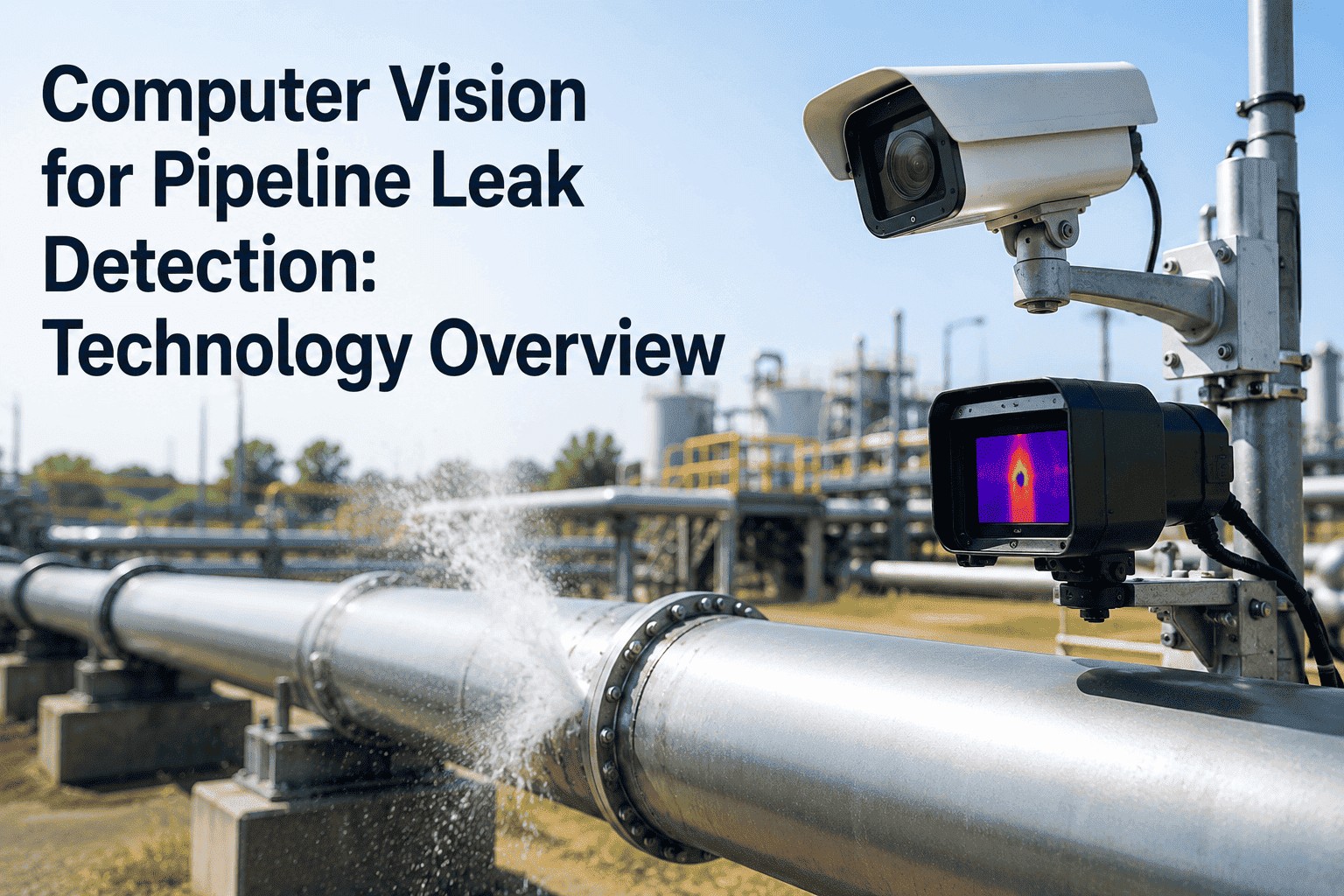
A pipeline leak is rarely a single event — it is the visible end of a slow chain that began with corrosion, third-party damage, or equipment failure months or years earlier. For decades, the operator's primary defence has been the SCADA control room: pressure, flow, and temperature sensors that compare expected versus actual values across thousands of kilometres of pipe. SCADA catches the large, fast leaks well — but it routinely misses small chronic seepages, slow weeping at construction joints, and product losses below 1% of throughput. Computer vision is closing that gap. By fusing RGB cameras, thermal infrared imagers, optical gas-imaging cameras, and deep-learning models on drones, fixed pole-mounted units, and helicopter-borne survey systems, modern pipeline operators are detecting thermal anomalies as small as 0.01–1 °C above the surrounding soil, hydrocarbon plumes invisible to the human eye, and surface staining that signals a hidden seep. Published research consistently demonstrates classification accuracy above 90% on supervised thermal-leak datasets, with false-alarm rates that have dropped below 5% in mature deployments. Operators that schedule a demo are finding they can lift small-leak detection by 4–8× compared to SCADA-only baselines while keeping false-alarm rates within operator tolerance. This article walks through how CV-powered pipeline leak detection actually works in production — the sensor stack, the deep-learning architectures, the realistic accuracy benchmarks, and how it fuses with existing SCADA without replacing it.
See the Leak in Infrared — Before It Becomes Visible to the Eye.
iFactory fuses RGB, thermal IR, optical gas imaging, and SCADA telemetry into one pipeline integrity dashboard — purpose-built for midstream operators, water utilities, and chemical transmission networks.
1. Why Pipelines Leak — and Why SCADA Alone Cannot See Everything
Pipeline networks transport oil, gas, water, and chemicals across distances where a single corroded joint can leak undetected for weeks. The dominant root causes are well documented: corrosion at construction joints and low points, equipment failure of valves and gaskets, third-party damage from excavator strikes and drilling rigs, and natural forces including ground movement and flooding. Each cause produces a different visual and thermal signature — and that variety is precisely what defeats single-channel monitoring approaches.
The Supervisory Control And Data Acquisition (SCADA) system is the operator's default defence, tracking pressure, flow rates, temperature, and valve positions across the network. SCADA is excellent at catching large, fast leaks that produce measurable hydraulic deviation at the control room. It is structurally blind, however, to small chronic seepages below 1% of throughput, slow weeping at joints, and fugitive gas emissions that never disturb the hydraulic envelope. Computer vision was built to catch exactly what SCADA cannot — and to cross-validate every visual anomaly against the control-room data before raising a field alert.
2. The Four-Channel Sensor Stack Behind Modern Pipeline CV
No single camera catches every leak. Production pipeline CV systems fuse four data streams — each contributing a different physical signature, each cross-validating the others.
| Channel | What It Captures | Strongest On | Typical Limitation |
|---|---|---|---|
| RGB Visible | Surface staining, sheen on water, vegetation stress | Post-leak visible signatures | Requires daylight or active illumination |
| Thermal IR (LWIR/MWIR) | 0.01–1 °C contrast over buried pipes | Buried-pipe seepages, day or night | Degrades in heavy rain, fog, humidity |
| Optical Gas Imaging | Methane / hydrocarbon plumes via MWIR | Fugitive emissions, gas trunklines | Sensitivity drops in strong wind |
| SCADA Telemetry | Pressure, flow, temperature, valve state | Large, fast leaks (>1% throughput) | Misses small chronic seepages |
| Fused Decision Layer | Combined multi-modal confidence score | All leak classes at once | Requires balanced multi-modal training |
3. The Deep Learning Models That Run on the Imagery
Five model families dominate production pipeline CV. They are rarely deployed in isolation — most operators run an ensemble, with each model tuned to a specific image type and decision boundary. U-Net and DeepLabv3+ handle pixel-precise segmentation of thermal anomalies and hydrocarbon sheen for environmental-volume reporting. YOLOv8 runs real-time single-stage detection on live drone and helicopter video, triggering operator alerts in seconds. ResNet and EfficientNet classifiers separate genuine leaks from solar warm spots, animal hot signatures, and vehicle exhaust — the distractors that defeat naïve threshold-based systems.
The two architectures that have moved the field furthest, however, are temporal models and sensor-fusion networks. 3D CNN and LSTM sequence models look across consecutive frames or successive overflight passes: a real leak persists, a transient artefact does not. This is the single best defence against false positives. Sensor-fusion networks then combine RGB, thermal, optical gas imaging, and SCADA inputs into one weighted decision — each modality cross-validating the others, with the combined system catching leaks that any single channel would miss. Operators that book a demonstration see the full ensemble running on their own corridor imagery.
4. From Pixel to Field Crew — The Six-Stage Production Pipeline
Modern pipeline CV is a fully automated chain. The pipeline integrity engineer enters only at the alarm-verification and field-crew-dispatch step — every prior stage runs autonomously, with severity scoring tuned to operator-defined risk tolerance.
5. Four Ways Pipeline CV Is Actually Deployed in the Field
Coverage frequency, geography, and risk profile determine which deployment mode operators choose — and most run two or three in combination for full network protection. Beyond-visual-line-of-sight (BVLOS) drones inspect corridors weekly to monthly at low marginal cost. Manned helicopters and fixed-wing aircraft with sensor pods cover hundreds of kilometres per shift, preferred for cross-country trunklines. Fixed pole-mounted cameras at pump stations, valve manifolds, and river crossings deliver 24/7 continuous monitoring of the highest-criticality assets. Methane-tuned satellites and high-altitude balloons add a low-resolution but globally consistent screening layer that catches major events anywhere on the network.
The operational reality is that no single deployment mode is sufficient. A drone fleet provides weekly granularity across primary corridors. Fixed cameras provide always-on coverage where consequences are catastrophic. Satellite provides a continuous outer ring nobody else can match. CV's strength is that all four modes feed the same fused model — so an alert flagged by satellite triggers a tasked drone overflight, which in turn triggers an operator field response with full visual and SCADA evidence already attached. Pipeline teams that want to benchmark their current detection gap typically schedule a strategy session against published CV detection benchmarks for their pipe class and corridor type.
6. Real Accuracy & False-Alarm Benchmarks — Reading the Numbers Honestly
Published pipeline CV studies and operator field data consistently report the following ranges. The honest reading: false-alarm rate matters far more than raw accuracy — an over-flagging system creates alarm fatigue and gets ignored within months.
| Detection Task | Architecture | Detection Accuracy | False-Alarm Rate |
|---|---|---|---|
| Thermal hotspot leak detection | ResNet-50 + transfer learning | 91–96% | 3–6% |
| Optical gas imaging plume detection | YOLOv8 + temporal smoothing | 88–94% | 4–8% |
| Surface staining / sheen segmentation | U-Net / DeepLabv3+ (mIoU) | 0.80–0.88 | 5–10% |
| Multi-modal fused detection | Sensor fusion network | 94–98% | 1–3% |
| Edge real-time drone inference | MobileNet QAT / YOLOv8n (F1) | 0.82–0.91 | 4–9% |
7. Five Realities Pipeline Teams Hit on Day One
Computer Vision Pipeline Leak Detection — Frequently Asked Questions
Tap any question to reveal the answer.
How does computer vision actually detect a pipeline leak?+
Can CV replace our SCADA-based leak detection system?+
What false-alarm rate should we realistically expect?+
Will CV work at night, in rain, or in dusty desert conditions?+
Can CV detect leaks on buried pipelines, or only above-ground sections?+
How does iFactory's pipeline CV platform integrate with our existing operations?+
Catch the Leak in the Soil, Not in the Newspaper.
iFactory orchestrates RGB, thermal infrared, optical gas imaging, and SCADA telemetry into a single pipeline integrity intelligence layer — giving control room operators and integrity engineers the earliest possible view of every developing leak.